

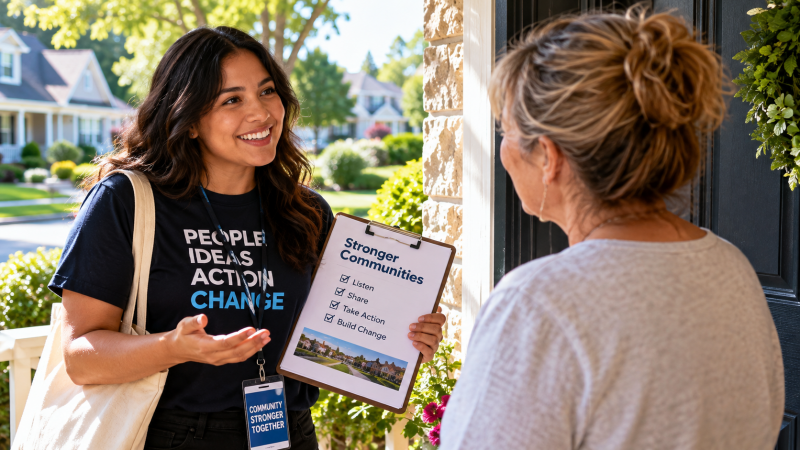
There is a moment in almost every canvassing campaign when somebody asks the question:
“Okay, but what exactly are we supposed to say when somebody opens the door?”
It sounds like a simple question.
It isn’t.
You can have great canvassing software. You can build beautiful turf. You can identify exactly the right households. You can recruit an army of volunteers, print literature, train your field team, and send hundreds of people into neighborhoods.
But eventually, all of that infrastructure comes down to one very human moment:
Knock. Knock.
The door opens.
Now what?
That conversation may last 30 seconds. It might last three minutes. Occasionally, it might turn into a 10-minute conversation somebody remembers months later.
And this is where a lot of organizations make a huge mistake.
They write a door-knocking script like they are writing a commercial.
The canvasser introduces the organization, delivers three talking points, explains why the issue is important, asks for support, hands over a piece of literature, and moves to the next house.
Technically, the canvasser followed the script.
But was there actually a conversation?
That distinction matters.
Decades of political science research have demonstrated something grassroots organizers have understood intuitively for a very long time: personal contact can matter.
One of the foundational randomized field experiments in modern voter mobilization involved roughly 30,000 registered voters in New Haven, Connecticut. Researchers Alan Gerber and Donald Green compared personal canvassing, direct mail, and telephone outreach. Personal canvassing produced a substantial increase in turnout, while direct mail produced a smaller effect and telephone calls in that experiment produced none. (ISPS)
An earlier analysis of that experiment estimated that personal canvassing increased turnout by roughly six percentage points among those assigned to receive the treatment under the study’s methodology. (PubMed)
That does not mean knocking on doors magically changes everybody’s mind.
Far from it.
But it tells us something important about grassroots communication.
There is still enormous value in one human being standing in front of another human being and having an actual conversation.
The trick is designing your script so that a conversation can happen.
First, Stop Thinking of It as a Script
This is probably the most important thing I can tell anyone building a canvassing program:
Your script should not really be a script.
At least not in the traditional sense.
It should be a conversation framework.
There is a difference.
A traditional script says:
Say this. Then say this. Then say this.
A conversation framework says:
Accomplish this. Learn this. Discuss this. Then make the appropriate ask.
That gives the canvasser structure without turning them into a robot.
Think about the last time somebody called you and obviously started reading from a script.
You knew immediately.
Their cadence changed. Their personality disappeared. They stopped reacting naturally to what you were saying because they were waiting for their next line.
Door knocking can suffer from exactly the same problem.
The person standing on the porch does not want to feel like Door Number 37 on somebody’s afternoon list.
They want to be treated like a person.
So I generally think about an effective door conversation as having several basic jobs:
- Earn permission to have the conversation.
- Establish why you are there.
- Discover what matters to the person.
- Connect the conversation to your message.
- Give them an opportunity to respond.
- Make a clear, appropriate ask.
- Record what happened.
The precise words can change.
The objectives shouldn’t.
You Have to Win the First Ten Seconds
Put yourself on the other side of the door.
You’re making dinner.
The dog is barking.
Your kid needs something.
You’re watching television.
You’re working.
Suddenly someone knocks.
You didn’t invite them.
That is the environment your canvasser is walking into.
The opening therefore needs to answer a few questions extremely quickly:
Who are you?
Why are you standing on my porch?
Is this going to take forever?
A strong introduction is usually simple:
“Hi, I’m Sarah. I’m a volunteer with [organization], and we’re talking with people in the neighborhood today about [issue]. I was hoping I could ask you a quick question.”
That’s it.
You do not need the organization’s founding history.
You do not need four policy points.
You definitely don’t need a 90-second monologue.
You need enough information for the person to understand the interaction and decide whether they want to participate.
That small word—ask—is incredibly important.
You’re opening a conversation rather than announcing the beginning of a presentation.
The First Real Question Should Get Them Talking
This is where many scripts go wrong.
They introduce the canvasser and immediately launch into persuasion.
Instead, try learning something first.
If you’re organizing around housing:
“What’s been your biggest concern about housing around here?”
If you’re working on a transportation issue:
“How do you think traffic has changed around here over the last few years?”
If you’re organizing around education:
“When you think about schools in this community, what do you think needs the most attention?”
Notice what those questions have in common.
They’re open-ended.
Compare that with:
“Do you support our plan to improve local schools?”
That question gives me almost nothing.
Yes.
No.
Maybe.
Done.
A good opening question creates room for someone to explain why they think what they think.
That information can be extraordinarily valuable.
Research has explored whether tailoring appeals to people’s expressed moral values can influence persuasion. A preregistered field experiment involving 1,034 voters, for example, examined canvassers listening for voters’ moral values and adapting subsequent appeals accordingly. (RCNi Company Limited)
The larger lesson for field organizers is straightforward:
Don’t assume you already know why someone cares about an issue. Ask them.
Your Script Needs Branches
This is one of the biggest differences between a beginner canvassing script and a professional one.
Beginner scripts are linear.
A → B → C → D.
Real conversations aren’t.
Suppose your organization is advocating for a local policy and you ask:
“What’s your biggest concern about growth in our community?”
Person A says:
“Traffic.”
Person B says:
“Property taxes.”
Person C says:
“I think the growth is great.”
Person D says:
“I honestly haven’t thought about it.”
Those are four completely different conversations.
Why would your canvasser give all four people exactly the same response?
They shouldn’t.
Instead, build a decision tree.
The canvasser should know what to do when somebody is supportive, undecided, skeptical, opposed, uninformed, rushed, or simply uninterested.
You don’t necessarily need seven separate scripts.
You need several conversational paths.
For example:
Supportive → reinforce → ask for action
Unsure → ask questions → provide relevant information → check again
Skeptical → understand objection → address relevant point → check again
Opposed → understand perspective if they’re willing → thank them → move on
Busy → give concise reason for visit → offer information → exit
That creates consistency without forcing every human interaction into the same box.
Ask “Why?” More Than You Think You Should
One of the most valuable follow-up questions in grassroots organizing is also one of the simplest:
“What makes you feel that way?”
Not sarcastically.
Not as a challenge.
With genuine curiosity.
Someone tells you they support your issue.
Great.
Why?
Someone says they’re undecided.
Why?
Someone disagrees with you.
Why?
Their answer tells you far more than the original response.
Suppose somebody says:
“I don’t support that proposal.”
A poorly trained canvasser immediately starts rebutting them.
A better-trained canvasser might say:
“That’s fair. What’s your biggest concern with it?”
Now you actually know what conversation you’re having.
Maybe they misunderstood the proposal.
Maybe they understand it perfectly and disagree with it.
Maybe their concern has nothing to do with the talking point your organization assumed mattered.
You cannot meaningfully respond to an objection you haven’t identified.
Listening Matters—But Don’t Turn It Into a Myth
There is an important nuance here.
Listening is valuable.
People generally appreciate being treated respectfully, and good listening can improve the quality of the interaction.
But organizers should be careful about making exaggerated claims that simply listening to somebody automatically makes persuasion happen.
A 2025 Proceedings of the National Academy of Sciences field experiment tested this directly. Researchers studied nearly 1,500 approximately 10-minute conversations concerning immigration policy. High-quality, nonjudgmental listening improved participants’ perceptions of the persuader and reduced defensiveness, but it did not independently increase the persuasive effect of the message in that experiment. A persuasive narrative, however, did produce durable attitude changes. (DOI)
That’s fascinating.
And it gives us a much more sophisticated lesson than “just listen.”
Listen because you are talking to another human being and because understanding the conversation makes you a better communicator. But eventually you still need something meaningful to say.
Listening isn’t the message.
It helps you understand which conversation you’re actually having.
Build the Message Around One Central Idea
Another mistake I see constantly is trying to cram the entire organization’s platform into one doorstep conversation.
Don’t.
Your canvasser does not need seven talking points.
They need one clear central idea.
If somebody remembers only one thing after closing the door, what should it be?
Start there.
Then build two or three supporting points underneath it.
Not ten.
Think of it like a tree.
Your central message is the trunk.
Your supporting arguments are the major branches.
Facts, examples, stories, and answers to common objections are smaller branches that canvassers can use when appropriate.
The canvasser doesn’t need to climb every branch during every conversation.
They simply need to know where everything is.
Facts Matter. So Does the Way You Explain Them.
You absolutely should give canvassers accurate information.
If you’re talking about a tax proposal, know the numbers.
If you’re discussing housing, understand the relevant housing data.
If you’re talking about criminal justice, know what the policy actually changes.
If you’re discussing education, understand the existing system.
But a doorstep is not a legislative committee hearing.
Dumping statistics on somebody is rarely a substitute for explaining why those statistics matter.
Instead of:
“Forty-three percent of X experienced Y between 2019 and 2025.”
Try:
“That’s why we’re hearing from so many families who say they’re struggling with this. The data show the problem has grown substantially, and that’s what this proposal is trying to address.”
Then, if the person wants the details, your canvasser should have them.
Lead with meaning. Support it with evidence.
Stories Can Give the Facts a Human Shape
There is serious research behind narrative persuasion.
A well-known 2016 Science field experiment found that an approximately 10-minute door-to-door conversation encouraging perspective-taking produced reductions in prejudice that persisted for at least three months in the study. (PubMed)
More recent research has continued examining narrative-based interpersonal persuasion. In the 2025 PNAS experiment I mentioned earlier, sharing a persuasive narrative produced durable changes in attitudes even though adding high-quality listening did not independently strengthen that effect. (DOI)
That doesn’t mean every campaign should invent an emotional story.
Please don’t.
Authenticity matters.
But if your issue affects real people, explain what that looks like in real life.
A number becomes much easier to understand when people can see the human reality behind it.
The strongest combination is often:
Person → problem → evidence → solution.
Here is someone experiencing the problem.
Here is what happened.
Here is evidence showing this isn’t isolated.
Here is what we’re proposing to do about it.
That is far easier to follow than a wall of statistics.
Never Make Your Canvasser Argue
This deserves its own section.
The objective of canvassing is not to win arguments on people’s porches.
If someone strongly disagrees with you, your canvasser does not receive bonus points for standing there another 12 minutes proving them wrong.
In fact, that can destroy your field efficiency.
Imagine a canvasser has 80 doors assigned.
They spend 15 minutes arguing at three houses.
They have now burned 45 minutes that could have produced dozens of additional knocks.
Give volunteers explicit permission to leave.
Something as simple as:
“I appreciate you taking a minute to talk with me. Have a great afternoon.”
Done.
Next door.
Respectful disagreement is not failure.
Sometimes the data point itself is valuable.
You learned where that household stands.
Record it and keep moving.
Build Objection Handling Into the Script
Before launching your canvass, sit down with your team and ask:
What are the five most common reasons somebody might disagree with us?
Then develop short, accurate responses.
Not debate-club answers.
Not paragraphs.
Responses.
A useful structure is:
Acknowledge → clarify → respond → check
For example:
“I understand why that would concern you. Is your biggest concern the cost or how the program would actually operate?”
Now you have clarified the objection.
Answer that specific concern.
Then ask:
“Does that address some of what you were worried about?”
Notice what you didn’t do.
You didn’t unload every argument your organization possesses.
You answered the person’s actual question.
Every Script Needs an Ask
This is where grassroots organizing separates itself from simple awareness.
Awareness is nice.
Action builds movements.
Every conversation should have a potential next step appropriate to the campaign.
That might be signing up for updates, attending a public meeting, volunteering, displaying a sign, contacting an elected official, joining an organization, attending an event, signing a petition, making a plan to vote in a nonpartisan turnout campaign, or taking some other lawful civic action.
The important thing is specificity.
“Get involved” is vague.
“Would you like me to send you the information for Thursday’s community meeting?” is actionable.
Your script should contain an ask ladder.
Someone who strongly supports the cause may be willing to volunteer.
Someone moderately supportive may join the email list.
Someone who is merely curious may take literature.
Not everyone needs the same ask.
The Closing Should Feel Like a Closing
Do not ruin a good conversation by awkwardly lingering on someone’s porch.
Once you’ve accomplished the objective, close.
“Thanks for taking a couple minutes to talk with me. I really appreciate it. Have a great evening.”
Simple.
Human.
Done.
Then step away from the door before entering your data.
That last part sounds trivial until you’ve managed canvassers.
Don’t stand directly outside someone’s house staring at your phone for two minutes.
Walk toward the sidewalk.
Then update the record.
The Data After the Conversation Matters Almost as Much as the Conversation
A professional canvassing script should correspond directly with your canvassing database.
If your script asks:
“What issue matters most to you?”
Your software should probably contain an issue-interest field.
If you’re measuring support, create consistent support categories.
If you’re recruiting volunteers, record the volunteer commitment.
If someone wants a yard sign, record it.
If they request additional information, record it.
If they moved, record it.
If the address is inaccessible, record it.
If nobody answered, record the correct disposition.
Your field program becomes exponentially more useful when today’s conversations improve tomorrow’s targeting.
This is why I tell people that door knocking is not simply communications.
It is communications plus organizing plus data collection.
Every meaningful conversation teaches the organization something.
Train the Script—Then Take the Script Away
This sounds contradictory.
It isn’t.
New canvassers should practice the actual language.
Role-play it.
Again.
Again.
Again.
Have somebody play the enthusiastic supporter.
Then the skeptic.
Then the person who won’t stop talking.
Then the person who knows more about the issue than the canvasser.
Then the person who says:
“I’ve got 30 seconds. What do you want?”
That’s training.
Eventually, though, your canvasser should understand the structure well enough that they don’t need to stare at their phone and read.
The goal is not memorization.
The goal is mastery.
They should understand the message well enough to explain it naturally.
That is when the script starts becoming a conversation.
Test Your Script in the Field
And here’s the part organizations sometimes hate hearing:
Your first script probably isn’t your best script.
That’s okay.
Run it.
Collect data.
Talk to canvassers.
What questions keep coming up?
Where are conversations dying?
Which opening question gets people talking?
Which explanation confuses people?
What objection didn’t you anticipate?
Where are volunteers stumbling?
What language are residents themselves using to describe the issue?
Then revise.
You can even formally test variations when the campaign has sufficient scale and appropriate experimental design.
Script A might use one opening.
Script B might use another.
Measure meaningful outcomes rather than whichever version your staff happens to like.
That distinction is important because political persuasion research repeatedly demonstrates that intuition about messaging is not always reliable.
The field should inform the script.
The script should inform the data.
And the data should improve the next round of field.
That feedback loop is where a canvassing operation starts becoming genuinely sophisticated.
What the Framework Actually Looks Like
Strip everything down and a strong door-knocking framework can be surprisingly simple:
INTRODUCTION
Who are you?
Why are you there?
OPENING QUESTION
What does this person think?
FOLLOW-UP
Why do they think it?
CONNECTION
Which part of your message actually relates to their concern?
MESSAGE
What is the central idea you want them to understand?
EVIDENCE OR STORY
What credible fact, example, or experience helps explain it?
CHECK
What do they think now?
ASK
What appropriate action are they willing to take?
CLOSE
Thank them.
DATA
Record what happened.
That’s your script.
Everything else is training.
The Best Script Sounds Nothing Like a Script
This is the irony of great canvassing.
The more work you put into developing the script, the less scripted the conversation should eventually feel.
Your volunteers should know the facts.
They should know the message.
They should know the common objections.
They should know the questions.
They should know the different conversational branches.
They should know the asks.
And then they should walk up to the door and talk like themselves.
Because ultimately, that is what makes door-to-door organizing different from almost every other form of modern communication.
An advertisement talks at people.
An email talks to thousands of people simultaneously.
A social media post gets filtered through an algorithm.
But a doorstep conversation?
That’s one person standing in front of another person.
And research going back decades gives us good reason to take that interaction seriously. Personal canvassing has demonstrated measurable effects in randomized voter-mobilization experiments, while subsequent field research has continued finding circumstances in which direct interpersonal contact and candidate canvassing can influence political behavior. (ISPS)
The lesson isn’t that every knock changes a mind.
It won’t.
The lesson is that people still matter.
And if you’re trying to grow an organization, educate a community, recruit volunteers, mobilize supporters, advocate for an issue, or build a genuine grassroots movement, never forget what you’re really building.
It isn’t a script.
It isn’t a voter file.
It isn’t a piece of literature.
It isn’t even the canvassing app.
You’re building conversations.
One neighborhood.
One street.
One porch.
And one person at a time.
Add comment
Comments