

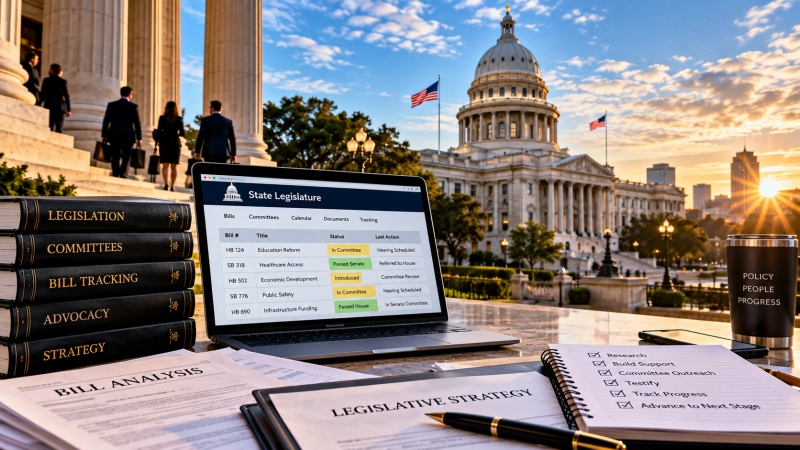
Most people have a very different picture of lobbying than what lobbying actually looks like.
Say the word lobbyist, and people tend to imagine expensive suits, steak dinners, campaign checks, and somebody whispering into a politician’s ear behind a closed door.
The reality—especially at the state level—is usually a lot less dramatic and a whole lot more complicated.
A good state lobbyist spends an enormous amount of time reading legislation, watching committee calendars, researching lawmakers, talking with legislative staff, counting votes, negotiating amendments, building coalitions, preparing testimony, answering questions, monitoring substitute bills, and trying to figure out where a piece of legislation is going next.
And sometimes the biggest victory is making sure a bill never goes anywhere at all.
I have spent years working around state legislatures, issue advocacy, grassroots organizing, coalitions, and public policy. One of the biggest lessons I learned is that legislative advocacy becomes considerably less mysterious once you understand the process.
So forget the Hollywood version.
Consider this a crash course in how state lobbying actually works.
First: What Exactly Is Lobbying?
At its simplest, lobbying is an attempt to influence government action.
At the legislative level, that could mean trying to:
- pass a bill,
- defeat a bill,
- amend a bill,
- secure or remove an appropriation,
- influence a resolution,
- change language in legislation,
- persuade a committee to hear—or not hear—a bill,
- or influence another legislative action or nonaction.
The exact legal definition matters because lobbying laws are different in every state.
The National Conference of State Legislatures notes that states define both “lobbying” and “lobbyist” differently. Those definitions determine who must register and what disclosure, reporting, ethics, and other requirements apply. Professional lobbyists must register before lobbying in every U.S. legislature, although the details differ considerably from state to state. (NCSL)
That brings us to Rule Number One.
Before You Lobby Anybody, Know the Rules
Do not assume the rules from one state apply in another.
Registration requirements, fees, reporting deadlines, gift restrictions, disclosure requirements, definitions, exemptions, and enforcement mechanisms vary.
Some states require information about the clients—or “principals”—a lobbyist represents. Some require employers or principals themselves to file certain information. Registration fees can range from nothing to hundreds of dollars. (NCSL)
Activity and expenditure reporting requirements also vary substantially across states. (NCSL)
Gift laws are another minefield. Most, if not all, states restrict gifts legislators can accept, but definitions, dollar thresholds, exemptions, reporting requirements, and prohibitions vary considerably. (NCSL)
Florida provides a useful example of how detailed these systems can become. State law separately addresses legislative lobbying and executive-branch lobbying, and lobbying firms can have quarterly compensation-reporting obligations. (Online Sunshine)
This isn’t paperwork you deal with after you start lobbying.
It is paperwork you understand before you start lobbying.
And when there is any doubt about whether your activity triggers registration or reporting requirements, consult the appropriate state authority or qualified legal counsel.
Compliance is part of lobbying.
The Legislative Session Actually Starts Before the Legislative Session
Here is one of the first mistakes inexperienced advocates make:
They wait until session begins.
By then, you may already be behind.
State legislative calendars vary dramatically. NCSL’s 2026 calendar, for example, shows states convening and adjourning on very different schedules. (NCSL)
Good legislative work therefore starts during the interim.
This is when you should be researching the issue, building relationships, identifying potential sponsors, talking with stakeholders, developing coalitions, collecting data, finding opposition, studying existing law, and figuring out exactly what problem you are trying to solve.
That last part matters.
Do not start with a bill. Start with a problem.
If your opening position is, “We need to pass this exact language,” you have already limited your options.
Instead ask:
What is happening?
Why is it happening?
Who is affected?
What does current law say?
What would fix it?
What are the unintended consequences?
Who would administer the change?
How much would it cost?
Who is likely to oppose it?
Can their concerns be addressed without destroying the purpose of the proposal?
Those questions are how you turn an idea into something capable of surviving a legislature.
Step One: Map the Battlefield
Before legislation gets moving, build yourself a legislative map.
You need to understand the people and institutions that can affect your issue.
Start with leadership.
Who is the Senate president?
Who is the House speaker?
Who are the majority and minority leaders?
Then identify the committees with jurisdiction over your issue.
If you are working on criminal justice, for example, you may encounter judiciary, criminal justice, appropriations, finance, public safety, or similar committees depending on the state.
Then go deeper.
Who chairs those committees?
Who is vice chair?
Who sits on them?
Who are the relevant legislative staff members?
Which legislators have worked on this issue before?
Which agencies will be affected?
Which organizations already have positions?
Who represents the constituencies most affected?
You are essentially building a stakeholder map.
And do not reduce lawmakers to party labels.
Two legislators from the same party can view the same issue completely differently because of their districts, professional backgrounds, committee assignments, personal experiences, constituent concerns, or policy priorities.
Lobby the legislator sitting in front of you—not the stereotype you created before walking into the room.
Step Two: Find the Right Sponsor
A great bill with the wrong sponsor can struggle.
A good sponsor does more than put their name on legislation.
They understand the issue.
They are willing to defend it.
They can explain it.
They will work with stakeholders.
They will negotiate when appropriate.
And ideally, they have enough credibility with their colleagues to move the legislation forward.
Depending on the state and strategy, you may also need a sponsor or companion measure in the other chamber.
This is where relationships matter.
But relationships should never mean dishonesty or transactional politics.
Your credibility is one of the most valuable things you possess in a Capitol.
Protect it.
Step Three: Draft the Legislation
An idea eventually has to become legislative language.
That means translating:
“We should fix this problem.”
into:
“Here are the exact words we want inserted into, removed from, or added to state law.”
That is a completely different exercise.
Legislative drafting offices and counsel play important roles here, and procedures vary by state.
Every word matters.
Definitions matter.
Effective dates matter.
Cross-references matter.
Enforcement provisions matter.
Agency authority matters.
Funding matters.
One poorly written definition can completely change how a law operates.
This is also where you should begin pressure-testing your proposal.
Ask people who disagree with you to look at it.
Seriously.
If somebody can identify a legitimate flaw before the bill is filed, they have just done you a favor.
Fixing a problem before introduction is usually much easier than fixing it after opponents discover it during a committee hearing.
Step Four: The Bill Is Filed
Now your idea officially becomes legislation.
It receives a bill number and begins moving through the formal process.
The exact mechanics vary, but most states follow a recognizable structure: introduction, committee referral, committee consideration, floor consideration in the originating chamber, consideration in the second chamber, reconciliation of differences if necessary, and eventually action by the governor. Nebraska is the major state-level exception because it has a unicameral legislature rather than separate House and Senate chambers. (NCSL)
This is when bill tracking becomes absolutely critical.
Bill Tracking Is the Nervous System of Your Operation
You should never have to ask:
“Wait…what happened to our bill?”
Build a tracker.
At minimum, I want to know:
Bill number | Sponsor | Companion | Current committee | Next committee | Hearing date | Amendments | Vote | Current status | Position | Next action
But a serious tracking operation goes further.
Track amendments.
Track committee substitutes.
Track fiscal analyses.
Track staff analyses.
Track agendas.
Track vote histories.
Track companion bills.
Track similar legislation.
Track opposing legislation.
Track appropriations connected to the issue.
Track relevant agency recommendations.
Track deadlines.
And most importantly, track changes in the actual bill text.
Never assume the bill you supported three weeks ago is the bill sitting in front of you today.
Bills evolve.
NCSL notes that relatively few bills are enacted in exactly the form in which they were introduced. Committees frequently recommend amendments as legislation moves through the process. (NCSL)
Read the latest version.
Every time.
Step Five: Committee Is Where the Real Work Happens
People naturally pay attention to final floor votes.
Lobbyists pay enormous attention to committees.
There is a reason.
Committees are where legislators dig into legislation, hear testimony, ask questions, debate policy, recommend amendments, and decide whether a measure should advance.
NCSL describes committees as the principal vehicles for legislative scrutiny, debate, and modification. They are also a major formal access point for citizens and interest groups. (NCSL)
Florida’s legislative guidance similarly describes the committee as the “heart of the legislative process” because smaller groups can perform detailed fact-finding and study that would be difficult for the entire chamber to conduct. (Online Sunshine)
So if your bill is headed to committee, your job begins well before the hearing.
Count the votes.
Who is supportive?
Who is opposed?
Who is undecided?
Who has questions?
Who hasn’t been contacted?
Who has a concern you can legitimately address?
That gives you something like:
YES — 5
LEAN YES — 2
UNDECIDED — 3
LEAN NO — 1
NO — 4
Now you know where to spend your time.
Do not waste three hours convincing somebody who already agrees with you.
And do not spend six meetings trying to flip somebody who has made it absolutely clear they will never support the proposal.
Work the movable middle.
Step Six: Prepare for the Hearing
Committee testimony should not be a lecture.
Legislators often have enormous agendas and limited time.
Get to the point.
Explain:
The problem.
The evidence.
The proposed solution.
Why this bill addresses it.
What you want the committee to do.
Whenever possible, bring people directly affected by the issue.
Data is important.
Human experience gives that data context.
The strongest presentations often combine both.
Instead of saying:
“This policy hurts small businesses.”
show how many businesses are affected, explain the economic consequences, and then let an actual business owner explain what the policy means for their operation.
That is considerably more useful than slogans.
Florida’s Senate, for example, explicitly encourages people to communicate before legislative action occurs, be concise and specific about a bill’s impact, suggest a course of action, and participate through testimony at public hearings. (Florida Senate)
Step Seven: Amendments Are Not Automatically Defeats
New advocates sometimes treat every amendment like betrayal.
That is a mistake.
Legislating is negotiation.
An amendment might strengthen your bill.
It might clarify ambiguous language.
It might remove unintended consequences.
It might address legitimate opposition.
It might make the proposal politically viable.
Or, yes, it might gut the entire bill.
Your job is to know the difference.
Ask one simple question:
Does this amendment preserve the core purpose of the legislation?
If yes, you may have room to negotiate.
If no, you need to decide whether the amended bill is still worth supporting.
Never become so emotionally attached to “passing something” that you forget why you started the effort.
Step Eight: Get Out of the Capitol
This is where lobbying and grassroots organizing should meet.
You can make a great argument inside a legislative office.
But lawmakers also need to hear from the people they represent.
That means building a genuine grassroots component around your legislative strategy.
Identify constituents.
Educate supporters.
Give them accurate information.
Make it easy for them to contact legislators.
Organize testimony.
Write letters to the editor.
Hold community meetings.
Bring stakeholders together.
Use digital tools to turn online attention into real-world participation.
And make the ask specific.
“Support criminal justice reform” is vague.
“Please support HB 123 when it comes before the Judiciary Committee Tuesday” is actionable.
That difference matters.
Step Nine: The Bill Reaches the Floor
Surviving committee does not mean the job is finished.
Depending on the legislature, measures may still have to navigate rules committees, calendars, leadership decisions, multiple readings, floor amendments, debate, and final passage.
NCSL’s general model includes committee consideration followed by consideration of the full chamber, with second and third readings commonly playing important roles before final passage. (NCSL)
This is when your vote count expands beyond the committee.
Now you may need to account for the entire chamber.
And floor amendments can change things quickly.
Keep reading.
Keep counting.
Keep communicating.
Step Ten: Congratulations. You Get to Do It Again.
Your bill passed the House!
Great.
Now it has to survive the Senate.
Or vice versa.
The second chamber generally puts the legislation through its own process—referral, committees, debate, amendments, and votes. (Florida Senate)
This is where companion bills become important.
Sometimes the chambers are moving substantially identical measures.
Sometimes one version begins moving faster.
Sometimes the language diverges.
Sometimes one bill stalls while the other becomes the vehicle.
Do not become emotionally attached to a bill number.
Be attached to the policy outcome.
Step Eleven: Watch for the Conference Process
Suppose the House passes one version and the Senate passes another.
Somebody has to reconcile the differences.
Depending on the state and circumstances, one chamber may concur with the other’s changes, reject them, or the dispute may move into a conference process.
Conference committees generally consist of legislators from both chambers working to resolve differences in legislative language. (NCSL)
Late-session negotiations can move very quickly.
Which brings us to another important lesson.
The Last Days of Session Are Different
Everything accelerates.
Bills start moving.
Language gets amended.
Negotiations intensify.
Schedules change.
Proposals get attached to other legislation where procedural rules allow.
Appropriations are negotiated.
Conference reports appear.
Something that looked dead can suddenly move.
Something that looked inevitable can suddenly collapse.
Your monitoring operation needs to tighten considerably.
During slower periods, checking a bill once a day may be enough.
During the final stretch, you may need to watch developments almost continuously.
This is not the time to disappear.
Step Twelve: Passage Is Not the Same as Becoming Law
Both chambers finally pass identical language.
You won.
Well…
Almost.
The legislation generally still goes to the governor.
Depending on the state’s constitution and laws, a governor may sign legislation, veto it, or allow it to become law without a signature under specified circumstances. Legislatures may also have mechanisms for overriding vetoes. (NCSL)
Florida offers a concrete example: its Constitution generally gives the governor seven consecutive days after presentation to act while the Legislature remains in session, with 15 days under specified adjournment circumstances. A Florida veto can be overridden by a two-thirds vote of each chamber. (Online Sunshine)
Other states have different rules.
Which means your lobbying strategy may not end when the Legislature adjourns.
You may now need an executive strategy.
Step Thirteen: Implementation Matters
The governor signs the bill.
Now can we celebrate?
Absolutely.
But the work still isn’t necessarily finished.
A law can require agencies to develop rules, procedures, forms, guidance, regulations, grant programs, enforcement systems, or other implementation mechanisms.
An effective advocate follows the implementation.
What is the effective date?
Which agency is responsible?
Does rulemaking follow?
Was funding appropriated?
Are regulations consistent with legislative intent?
Are affected communities aware of the change?
Is the policy producing the intended result?
Passing a law that nobody implements effectively is not much of a victory.
The Biggest Lobbying Do’s
Know your legislation better than anyone in the room.
You should know the bill number, sponsor, committee assignments, current language, amendments, fiscal impact, opposition arguments, and legislative history.
Tell the truth.
If you do not know the answer, say:
“I don’t know, but I’ll find out.”
Then find out.
That answer is infinitely better than bluffing.
Respect legislative staff.
Staff members are not obstacles between you and legislators.
They are often extraordinarily knowledgeable about policy and procedure and can be essential to understanding what is happening.
Treat them accordingly.
Bring solutions, not just complaints.
Anyone can explain why something is terrible.
The valuable person explains what can realistically be done about it.
Listen to opponents.
You do not have to agree with them.
But you should understand their strongest argument.
If you cannot explain the opposition’s position fairly, you probably do not understand the issue well enough yet.
Be concise.
A 15-minute meeting does not require a 14-minute monologue.
Have a one-minute explanation.
Have a five-minute explanation.
Have the full technical explanation ready when someone wants it.
And the Biggest Don’ts
Don’t threaten legislators.
“I’ll make sure you lose your election” is rarely the brilliant lobbying strategy people imagine it to be.
Don’t lie about your support.
Do not manufacture coalitions.
Do not pretend organizations support legislation when they do not.
Do not exaggerate vote counts.
Don’t surprise your sponsor.
If opposition emerges, tell them.
If an amendment is coming, tell them.
If your coalition is changing position, tell them.
Nobody likes learning what is happening with their own legislation from somebody else.
Don’t burn bridges over one vote.
Today’s opponent may be tomorrow’s ally.
I have worked with people I strongly disagreed with on one issue and then stood beside them on another.
That is normal.
Don’t confuse social media with lobbying.
A viral post can create pressure.
It cannot substitute for knowing who chairs the committee your bill is sitting in Tuesday morning.
Don’t ignore procedure.
Procedure determines opportunity.
You can have 70 percent public support for an idea and still lose because the bill never gets a hearing.
The Secret Nobody Likes Hearing
Successful lobbying is rarely about giving the greatest speech.
It is about preparation.
Relationships.
Credibility.
Timing.
Research.
Organization.
Follow-up.
Vote counting.
Coalition building.
Grassroots pressure.
Negotiation.
And understanding the legislative process well enough to know where your leverage actually exists.
A legislature is not one giant vote.
It is a series of decision points.
The sponsor.
The committee chair.
The committee.
The next committee.
Leadership.
The floor.
The other chamber.
Another committee.
Another floor.
Potentially conference negotiations.
Then the governor.
Then implementation.
Your strategy should change at each stage.
Build Yourself a Legislative War Room
You do not need a giant lobbying firm to operate professionally.
A spreadsheet can go surprisingly far.
Create tabs for:
Bills
Bill number, title, sponsor, companion, committees, status, position and next action.
Legislators
District, party, committees, staff contacts, issue interests, meeting history and position.
Vote Counts
Yes, lean yes, undecided, lean no and no.
Stakeholders
Organizations, businesses, advocates, agencies and opposition groups.
Amendments
Date, sponsor, description, impact and your position.
Meetings
Who attended, what was discussed, commitments made and follow-up required.
Grassroots
District, constituent contacts, calls, emails, testimony and volunteer activity.
Then assign ownership.
Every action should answer:
Who is doing what by when?
That one sentence will save you an incredible amount of confusion.
What Professional Lobbying Really Looks Like
The best lobbyists are not necessarily the loudest people walking around a Capitol.
Often they are the people who know where a bill is, what changed overnight, who has concerns, which amendment is coming, where the votes currently stand, what the opposition’s strongest argument is, and what needs to happen next.
They become useful.
That is the word I keep coming back to.
Useful.
Useful to clients.
Useful to coalitions.
Useful to lawmakers.
Useful to staff.
Useful to the people affected by the legislation.
You can disagree with somebody politically and still give them accurate information.
You can advocate aggressively without becoming dishonest.
You can fight hard for legislation without treating everyone on the other side as an enemy.
And you can compromise on details without abandoning your principles.
That balance is where effective legislative advocacy lives.
The Entire Session in One Page
If you want the simplest possible version, here it is:
Before Session: Research → define the problem → map stakeholders → build coalitions → identify sponsors → develop legislation → understand compliance requirements.
Bill Filed: Read the actual language → identify committees → establish tracking → build your initial vote count.
Committee Stage: Meet members → answer objections → mobilize stakeholders → prepare testimony → monitor amendments → count votes.
First Chamber: Survive committees → monitor calendars → work the floor → track amendments → secure passage.
Second Chamber: Repeat the process → monitor companion legislation → reconcile differences.
End of Session: Watch amendments and conference negotiations → monitor final votes → verify the final language.
Governor: Make the case for signature or other desired action → monitor constitutional deadlines and veto procedures.
After Passage: Track the effective date → agency implementation → rulemaking → funding → results.
Then start preparing for the next session.
Because government does not stop when everyone leaves the Capitol.
Neither should good advocacy.
Final Thought
Lobbying gets treated like some mysterious profession available only to people with expensive offices three blocks from the Capitol.
It shouldn’t be.
At its core, legislative advocacy is organized civic participation.
Learn the rules.
Understand the process.
Know your issue.
Build relationships.
Bring evidence.
Organize people.
Tell the truth.
Know your votes.
Follow the bill.
And keep showing up.
Because once you understand how a legislature actually works, something interesting happens.
Government stops looking like an impenetrable machine.
You start seeing the individual gears.
And once you can see the gears, you can understand where ordinary citizens, businesses, nonprofits, advocates, and organized communities can participate in the process.
That is ultimately the part of lobbying I wish more people understood.
You don’t need to know everything about the legislative process before you get involved.
But if you want to become effective at changing public policy, learning how that process actually works is a pretty good place to start.
Add comment
Comments