

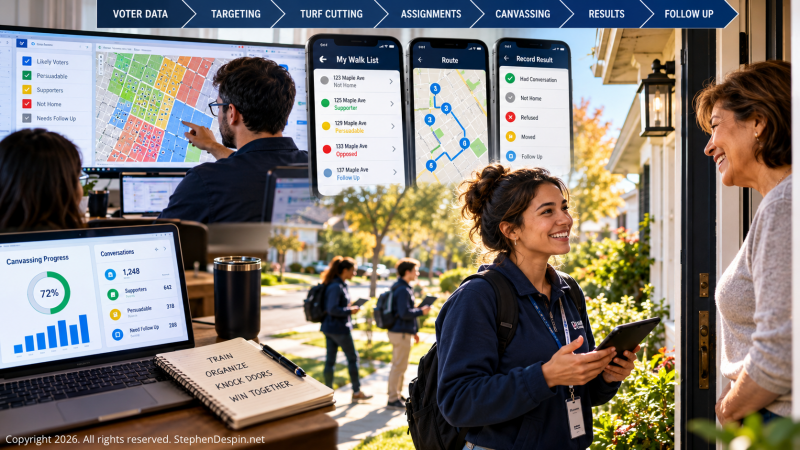
If you have ever had someone knock on your door during election season, the interaction probably seemed pretty simple.
A volunteer or organizer walks up your driveway.
They knock.
They ask if you have a minute.
Maybe they mention a candidate, an issue, an upcoming election, or simply remind you to vote.
You talk for a couple of minutes. They tap something into their phone. They thank you for your time and head to the next house.
Simple, right?
Not exactly.
What you witnessed may have lasted three minutes, but there can be an enormous amount of work happening behind that three-minute conversation.
Long before somebody knocked on your door, a campaign or organization had to build or acquire a voter universe, decide which voters it wanted to contact, load or synchronize that information with canvassing software, organize thousands of voters geographically, divide neighborhoods into manageable pieces, assign those pieces to canvassers, develop the questions being asked, train people to use the system, monitor what was happening in the field, and figure out what to do with all the information coming back.
That little tap on a smartphone after the conversation?
That is where the whole operation starts coming full circle.
And having spent years around grassroots organizing and field operations, I think this is one of the most misunderstood parts of political campaigns.
People see the door knocking.
They rarely see the machine behind the door knocking.
So let’s open the hood.
First, Understand What a Canvassing Campaign Actually Is
A canvassing campaign is essentially a large-scale human contact operation supported by data.
Strip away the campaign terminology and think about it like this:
You have a very large database of people.
You don’t have enough time, money, staff, or volunteers to personally speak with every person in that database.
So you have to determine whom you need to contact, where those people live, what information you need from those conversations, and how you are going to efficiently get people to those doors.
Then you need a way to record what happened.
That is the basic architecture.
The technology has changed dramatically over the years, but the underlying concept really hasn’t.
Campaigns once relied heavily on printed voter lists, clipboards, highlighters, handwritten notes, paper maps, and somebody sitting in an office entering all that information afterward.
Paper walk lists still exist, and some platforms still support them. But modern canvassing platforms can move much of that process onto a smartphone or tablet. For example, Ecanvasser’s current documentation describes a backend where administrators can import contacts, filter databases, create lists, cut geographic turf, assign users and teams, configure surveys and talking points, monitor field activity, and export results. (Ecanvasser Support)
Different platforms call things different names.
The architecture, however, tends to look something like this:
Data → Targeting → Lists → Turf → Assignment → Canvassing → Results → Database → Follow-up
That’s the entire system in one line.
Now let’s unpack it.
Step One: Everything Starts With Data
Before you can knock on voters’ doors, you need to know where the voters are.
That generally begins with voter-registration data.
There is an important misconception here.
There is no single federal master voter-registration database containing every voter in America. States maintain voter-registration systems, and laws governing access to those records vary considerably from state to state. The National Conference of State Legislatures notes that states differ in who can obtain voter lists, which fields are available, which information remains confidential, and what permissible uses apply. (NCSL)
That means the exact information available to a campaign depends partly on where the campaign is operating.
Voter-registration records may contain information such as a voter’s name, registered address, precinct or district information, party registration where applicable, and voting history.
That last one deserves a giant clarification.
Voting history does not tell a campaign whom you voted for.
The secret ballot is still secret.
A voter file may indicate that someone participated in a particular election, depending on the jurisdiction and data available. It does not reveal which candidate that person selected.
That distinction matters.
Commercial political-data companies can then combine or enhance voter-file information with other legally available data and analytical products.
For example, TargetSmart says its VoterBase product contains hundreds of fields, voting-history information, geographic election results, predictive models, and other information used for segmentation and outreach. Its current voter-file product describes more than 265 million individual records across its broader database. (TargetSmart)
L2 similarly markets a national voter database alongside consumer and other datasets. (L2 Data)
These are examples, not endorsements, and different campaigns use very different vendors and technology stacks.
The important point is this:
The canvassing application sitting on someone’s phone is only the visible end of a much larger data system.
Step Two: Build the Voter Universe
Imagine you are running a campaign in a district containing 100,000 registered voters.
You probably aren’t going to knock 100,000 doors tomorrow.
Instead, campaigns create what people in politics often call a universe.
A universe is simply a defined group of records meeting whatever criteria have been selected for a particular program.
Think of your full voter database as a gigantic bucket.
A universe is a smaller bucket created from it.
For example, a campaign might create separate universes for a research program, voter-registration effort, volunteer recruitment effort, issue survey, persuasion program, or get-out-the-vote operation.
The criteria can change depending on the purpose of the campaign and the data legally available.
The critical concept is that targeting happens before turf cutting.
You generally aren’t starting by randomly circling neighborhoods on Google Maps and telling volunteers to knock every door inside the circle.
You’re deciding which records belong in the particular outreach program.
Then geography helps organize those records efficiently.
This is where database filters become incredibly powerful.
A modern voter database may contain hundreds of fields. Campaign staff can use permitted data fields to segment the database into whatever universe the program requires.
That selected universe becomes the foundation of the field operation.
Step Three: Clean the Data
This isn’t the exciting part.
It is also one of the most important parts.
Bad data creates bad field programs.
People move.
Addresses change.
Apartment numbers can be missing.
Records become outdated.
Names can be formatted strangely.
Multiple voters can live at the same address.
A voter can register somewhere else.
Someone can appear in your database at an address where they haven’t lived for years.
Even sophisticated commercial systems acknowledge this limitation. TargetSmart’s documentation, for example, notes that there can be differences between maintained commercial voter databases and official state records and recommends official election authorities as the final authority for an individual’s registration status. (TargetSmart Documentation)
That’s important because political databases aren’t magical.
They are databases.
And databases are only as useful as the underlying information.
Before field deployment, campaigns therefore need to think about things like address formatting, duplicate records, geographic information, missing information, synchronization, and recent updates.
This matters enormously once you start building turf.
A messy database sitting behind a beautiful canvassing app is still a messy database.
Step Four: Geocoding Turns Addresses Into a Map
Now things start getting interesting.
The database knows that Jane Smith lives at 123 Main Street.
But your canvassing system needs to understand where 123 Main Street actually is geographically.
That’s where geocoding comes in.
In simplified terms, geocoding translates an address into a geographic location that mapping software can understand.
Once enough records are geocoded, thousands of rows in a spreadsheet suddenly become points on a map.
Instead of seeing:
Jane Smith — 123 Main Street
John Doe — 129 Main Street
Maria Johnson — 134 Main Street
you start seeing houses, streets, neighborhoods, blocks, and clusters.
Now the campaign can begin thinking geographically.
This is where database management turns into field management.
Step Five: Now We Cut Turf
Welcome to one of my favorite pieces of campaign jargon:
cutting turf.
Despite how dramatic it sounds, nobody is actually cutting anybody’s lawn.
A turf is simply a geographically defined chunk of the larger canvassing universe.
Imagine looking at a map containing 5,000 doors.
Sending a volunteer into that map with the instruction “go knock some doors” would be chaos.
So an organizer divides the map into manageable sections.
That’s cutting turf.
Modern canvassing platforms can allow administrators to draw boundaries directly onto a map. Ecanvasser, for example, currently supports polygon and free-draw turf tools, with the resulting geographic selection reflecting both the area drawn and any database filters that have already been applied. (Ecanvasser Support)
That last part is crucial.
Suppose there are 400 registered voters physically located inside the area you just drew.
But only 175 of those records are members of the universe you’re currently contacting.
Your turf may contain only those 175 targeted records.
The geographic boundary tells the system where.
The database filter tells it who.
That distinction is basically the heart of digital turf cutting.
What Makes Good Turf?
Here’s where software stops being a substitute for human judgment.
You can draw a beautiful polygon on a map that makes absolutely no sense to walk.
A field organizer has to think like the person who will actually be standing on the sidewalk.
Is there a highway splitting the turf?
A canal?
A gated community?
An apartment complex?
A huge parking lot?
A subdivision with only one entrance?
A road without sidewalks?
Are the targeted houses concentrated on three streets or scattered across two square miles?
Can someone reasonably walk from one end to the other?
Two turfs containing the same number of voters can require dramatically different amounts of time.
Fifty doors in a dense neighborhood might be fairly compact.
Fifty rural addresses could involve substantial driving.
Fifty apartment units might exist inside one building.
This is why good turf cutting is partly data science and partly local knowledge.
The goal isn’t to make pretty shapes.
The goal is to minimize wasted movement while making the assignment manageable for the canvasser.
Some platforms now add automated route optimization on top of this process. Ecanvasser, for example, documents walking and driving route planning that can reorder selected stops to reduce travel time. (Ecanvasser Support)
That is a major technological improvement over handing someone a paper map and saying, “Good luck.”
Step Six: Turf Becomes a Walk List
Once the geography has been selected, those voters need to become an actual assignment.
Historically, that often meant a printed walk list.
Picture several sheets of paper containing addresses and voter names arranged roughly in walking order.
A canvasser would walk the neighborhood, mark responses on the sheet, return it to headquarters, and somebody would eventually enter the results into the database.
Yes.
Someone actually had to do that.
And if you have ever done campaign data entry from handwritten canvass sheets, you already know exactly how much fun that could be.
Modern canvassing software largely eliminates that extra step when used correctly.
The turf can instead become a digital list assigned directly to a user or team.
Ecanvasser still supports printable walk-list exports, but its current system also allows lists and territories to be assigned digitally to users. (Ecanvasser Support)
So the field director can essentially say:
“This section belongs to Team A.”
“This one goes to Team B.”
“Stephen gets Turf 17.”
And the assignment appears in the canvasser’s application.
Step Seven: The Campaign Builds the Conversation
Now we have another major piece of the backend.
What exactly is the canvasser supposed to do when someone answers?
A well-designed field program shouldn’t rely on 50 volunteers independently inventing 50 different conversations.
The campaign establishes the purpose of the contact and the information that needs to come back.
Depending on the program, the application might display talking points, questions, surveys, response options, or prompts.
Current canvassing systems can be configured with custom fields, surveys, talking points, interaction statuses, ratings, and other structured inputs. Ecanvasser specifically recommends defining campaign objectives first and then configuring the fields and interaction outcomes needed to measure them. (Ecanvasser Support)
This is another area where simplicity matters.
The temptation is to ask everything.
Don’t.
Every additional question makes the interaction longer and the data more complicated.
The best field conversations still need to sound like conversations.
Nobody wants someone standing on their porch staring at a phone and conducting what feels like a 37-question government survey.
Technology should support the human interaction.
It shouldn’t replace it.
Step Eight: The Canvasser Opens the App
Now we’ve finally reached the part the volunteer sees.
They log in.
Open their assignment.
Select their turf.
And suddenly the complicated backend becomes remarkably simple.
Depending on the platform, the canvasser may see a map containing the doors in the assignment, a list of households, an optimized route, voter names at an address, and the campaign’s questions or talking points.
The application becomes the bridge between campaign headquarters and someone’s front porch.
Let’s imagine the canvasser approaches 123 Main Street.
The application might show that there are two targeted voters associated with that household.
The canvasser knocks.
Nobody answers.
They record the appropriate outcome.
Next door.
Someone answers.
The canvasser records that an interaction occurred and enters whatever responses the campaign has configured.
Next door.
The voter has moved.
Record it.
Next door.
The person doesn’t want to participate.
Record the appropriate outcome.
Next door.
Conversation.
Record it.
The field operation is essentially creating a structured dataset one human interaction at a time.
Step Nine: Dispositions Are Incredibly Important
This is another piece outsiders rarely think about.
A failed conversation is still data.
Let’s say a canvasser knocks 100 doors.
Only 25 people answer.
It would be a huge mistake to simply ignore the other 75.
The campaign needs to know what happened.
Was nobody home?
Was the address inaccessible?
Did the person move?
Was the house vacant?
Did someone refuse?
Was there a language barrier?
Did the canvasser skip the address?
Was there an incorrect address?
The exact terminology varies between systems and campaigns, but these are generally called statuses, outcomes, results, or dispositions.
And they’re enormously valuable.
Why?
Because “not home” and “refused to speak” are not the same thing.
One potentially tells the campaign:
Try again later.
The other may tell it:
Another attempt may not be productive.
CampaignSidekick made this point in explaining its mobile system: even something as simple as recording “not home” can allow a campaign to identify those addresses for another attempt later. (Campaign Sidekick)
That’s why data discipline matters.
If canvassers don’t record outcomes accurately, the campaign loses intelligence.
Step Ten: The Data Travels Back to Headquarters
This is the part that makes modern digital canvassing so powerful.
The person at the door sees someone tap a button.
Campaign headquarters sees a changing database.
Depending on the platform and connectivity, field activity can synchronize back into the campaign’s system, where staff can examine attempts, completed interactions, survey responses, team activity, geographic progress, and other metrics.
Ecanvasser’s current documentation describes dashboards for interaction information and user performance, along with field tracking that can show organizer activity while teams are working. (Ecanvasser Support)
Now imagine this happening across an entire campaign.
One canvasser records 80 attempts.
Another records 95.
Another records 60.
Another records 110.
Multiply that by 20 people.
Then 50.
Then several days.
The database starts changing very quickly.
And this is where canvassing stops being merely “door knocking.”
It becomes a feedback system.
Step Eleven: The Field Director Watches the Numbers
A good field director doesn’t simply ask:
“How many doors did we knock?”
That’s only the beginning.
The backend can help answer much more useful operational questions.
How many attempts were made?
How many actual conversations occurred?
Which turfs have been completed?
Which turfs remain unfinished?
Where are there large numbers of no-contacts?
How many contacts generated the particular outcome the program was designed to measure?
Which assignments are moving slowly?
Where are canvassers spending their time?
Are some areas producing unusual data?
Are people actually recording results?
These metrics help campaign managers distinguish activity from results.
Someone can spend four hours “canvassing” and accomplish very little.
Another person can spend the same four hours working a well-designed, dense turf with accurate data and generate a substantial number of useful interactions.
Counting volunteer hours alone doesn’t tell you that.
Neither does counting doors alone.
Step Twelve: Yesterday’s Results Can Build Tomorrow’s Lists
This is where the cycle becomes really powerful.
Remember our original universe?
The campaign can now update its understanding based on the field results.
Suppose 10,000 voters were assigned for contact.
Some answered.
Some didn’t.
Some had incorrect addresses.
Some requested follow-up.
Some completed the campaign’s survey.
Some had already taken whatever action the campaign was encouraging.
Now the campaign can create new lists based on those outcomes.
That could mean another attempt at households where nobody answered, a follow-up program for people who requested additional information, removing bad addresses from future assignments, or creating a separate universe for another phase of the campaign.
In other words:
Canvassing isn’t just sending information outward.
It is collecting information inward.
That is the part people miss.
Step Thirteen: Election Season Changes the Database Again
As voting begins, campaigns can sometimes obtain updated information indicating that a voter has already participated, depending on the jurisdiction and type of voting.
Again, this does not tell the campaign how the person voted.
It indicates participation.
Commercial voter-data providers build products specifically around this process. TargetSmart, for example, says it collects early and absentee voting information as it becomes available so organizations can create exclusion audiences for get-out-the-vote programs. (TargetSmart)
Operationally, that can matter enormously.
If someone has already voted, continuing to spend limited canvassing resources reminding that person to vote may not make sense.
So that voter can potentially disappear from a future contact universe while the campaign reallocates resources elsewhere.
The list changes.
New turf gets cut.
New assignments go out.
More doors get knocked.
More data comes back.
And the cycle continues.
What the Entire System Looks Like
If you’re still with me, congratulations.
You now understand more about field organizing than quite a few people who talk about campaigns online.
Here’s the whole operation from beginning to end:
1. Acquire or maintain voter data.
2. Clean, update, standardize, and geocode the records.
3. Define the universe for the specific field program.
4. Apply the appropriate database filters.
5. Display those targeted records geographically.
6. Divide them into manageable turf.
7. Turn turf into lists or assignments.
8. Assign those lists to organizers or volunteers.
9. Configure the script, survey, talking points, and interaction outcomes.
10. Send canvassers into the field.
11. Record the result of every attempted contact.
12. Synchronize those results back into the campaign database.
13. Monitor progress and data quality.
14. Build follow-up universes from the results.
15. Cut new turf.
16. Repeat.
That’s the machine.
The person knocking on the door is simply the point where that entire system finally meets another human being.
Why Campaigns Still Knock Doors in a Digital World
At this point someone inevitably asks the obvious question.
We have social media.
We have email.
We have texting.
We have digital advertising.
We have connected television.
We have incredibly sophisticated databases.
Why are campaigns still sending human beings walking through neighborhoods knocking on doors?
Because human contact can matter.
One of the classic randomized field experiments in political science, conducted by Alan Gerber and Donald Green and published in the American Political Science Review, involved roughly 30,000 registered voters in New Haven during the 1998 election. The researchers compared nonpartisan get-out-the-vote contact through personal canvassing, direct mail, and telephone calls. Their experiment found a substantial turnout effect from personal canvassing, a smaller effect from direct mail, and no detectable effect from the telephone calls used in that experiment. (Cambridge University Press)
That doesn’t mean every knock magically changes someone’s behavior.
It certainly doesn’t mean every campaign, message, voter population, or election will produce identical results.
It means something much simpler.
Face-to-face political contact has been important enough that campaigns have spent decades figuring out how to make it more organized, measurable, and scalable.
The technology didn’t eliminate canvassing.
The technology made canvassing smarter.
And This Is Why Bad Field Data Can Destroy a Good Operation
Here’s something else that deserves more attention.
Fancy software does not create a good campaign.
You can buy sophisticated voter data.
You can purchase expensive canvassing software.
You can build beautiful dashboards.
You can generate predictive scores.
You can optimize routes.
You can create elaborate reports.
And you can still run an absolutely terrible field program.
If your organizers cut terrible turf, your volunteers waste time.
If your database is outdated, they knock bad addresses.
If your universe is poorly defined, you’re contacting the wrong records for the purpose of the program.
If your survey is confusing, you collect unreliable answers.
If your volunteers aren’t trained, they enter inconsistent data.
If nobody records no-contacts, you don’t know which doors need another attempt.
If your staff doesn’t monitor the incoming data, mistakes can continue for days.
Technology amplifies good operations.
It also amplifies bad ones.
The software isn’t the strategy.
It’s infrastructure.
There’s Also a Serious Privacy and Security Responsibility
This deserves its own section because campaigns can be dealing with substantial amounts of personal information.
Voter-file laws vary dramatically by state. Some jurisdictions restrict who may obtain voter information, what fields may be released, how those records may be used, or whether certain protected voters’ information can appear at all. NCSL’s 50-state review documents significant differences in these rules and notes special confidentiality protections for certain voters, including participants in address-confidentiality programs. (NCSL)
Campaigns and organizations therefore shouldn’t treat voter data like a random marketing spreadsheet.
Know the applicable rules.
Limit access appropriately.
Use permission levels.
Remove access when staff or volunteers leave.
Protect administrative accounts.
Be careful with exports.
And secure the systems holding the information.
The federal Cybersecurity and Infrastructure Security Agency specifically recommends multifactor authentication for campaign electronic accounts and services, along with strong passwords and other cybersecurity practices. (CISA)
A campaign’s responsibility to organize effectively doesn’t erase its responsibility to handle information responsibly.
The Most Important Part of the System Still Isn’t the Software
Here’s what I love about field organizing.
After everything I just explained—databases, models, maps, polygons, geocoding, dashboards, route optimization, voter histories, targeting, mobile applications and analytics—the most important part of the entire operation can still come down to two people standing on a front porch having a conversation.
That’s it.
The technology gets the organizer to the right door.
The data helps the campaign understand why that door is part of the program.
The turf makes getting there efficient.
The application tells the canvasser what information the campaign needs.
The database records what happened afterward.
But the software doesn’t knock.
It doesn’t smile.
It doesn’t listen to someone explain what’s happening in their neighborhood.
It doesn’t answer an unexpected question.
It doesn’t build a relationship.
A person does.
That’s something worth remembering as political campaigns become increasingly obsessed with artificial intelligence, predictive analytics, automation, digital advertising, and increasingly sophisticated targeting technology.
All of those tools can be useful.
But grassroots organizing is fundamentally about people.
Technology works best when it helps people organize people.
So the Next Time Someone Knocks on Your Door…
Take a second and think about what probably happened before they got there.
Somewhere, a database contained a voter record.
That record became part of a universe.
That universe was filtered.
Those records appeared on a map.
Someone divided that map into turf.
The turf became an assignment.
The assignment was sent to someone’s phone.
That person walked down your street.
They found your address.
They knocked on your door.
You answered.
And whatever happened next became another tiny piece of information flowing back through the system.
One conversation.
One household.
One record.
Now multiply that by hundreds of volunteers, thousands of conversations, tens of thousands of doors, and weeks or months of organizing.
That’s a canvassing campaign.
From the outside, it looks like people walking around neighborhoods carrying literature.
Behind the scenes, it is logistics, geography, data management, technology, training, analytics, and an enormous amount of human coordination working together.
And when it’s done well, the technology almost disappears.
The voter doesn’t see the database.
They don’t see the turf.
They don’t see the dashboard.
They don’t see the targeting or the nightly reports.
They just see another person standing at their door asking:
“Hi, do you have a minute to talk?”
Everything before that moment is the backend.
Everything after that moment becomes data.
And the conversation in the middle?
That’s the part the entire system was built to make possible.
Add comment
Comments