There is a difference between supporting a politician and surrendering your principles to one.
That distinction matters.
I have known plenty of elected officials over the years whom I respect personally, have worked alongside professionally, or agree with on the overwhelming majority of issues. None of that means I am obligated to pretend disagreements do not exist.
Politics becomes dangerous when principles become subordinate to personalities.
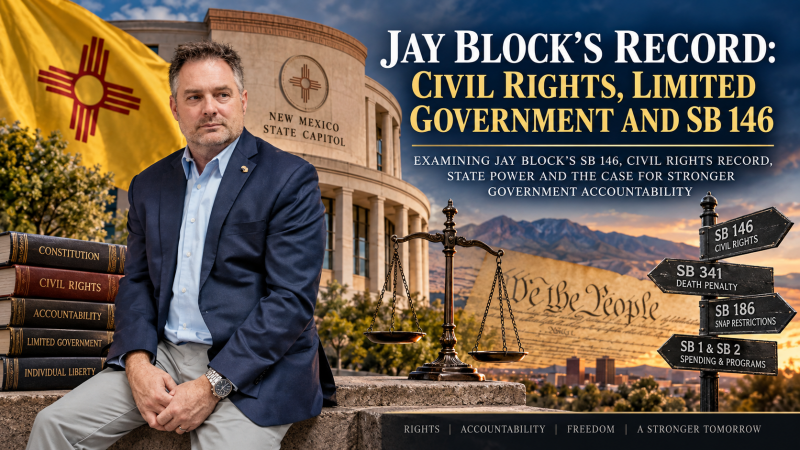
So when I started digging deeper into the legislative record of New Mexico State Senator Jay C. Block, I wasn’t looking for an excuse to attack him. There are significant portions of Block’s record that fit comfortably within a limited-government philosophy: tax relief, Second Amendment protections, regulatory restraint, government oversight and other traditionally conservative priorities.
But there are also several places where his legislative record raises legitimate questions when viewed through a philosophy centered on individual liberty, constitutional accountability, subsidiarity, fiscal restraint and the inherent dignity of the human person.
One bill deserves particular attention.
Senate Bill 146.
If you care about civil liberties, government accountability or qualified immunity, this is not some obscure procedural bill that can be brushed aside.
It goes directly to the question at the heart of constitutional government:
What happens when government violates your rights?
And that is a question I take very seriously.
SB 146: The Most Significant Disagreement
In 2026, Democratic Sen. George Muñoz and Republican Sen. Jay Block introduced Senate Bill 146, titled “Civil Rights Act Claim Changes.”
The bipartisan sponsorship is important because this shouldn’t be reduced to the usual Republican-versus-Democrat narrative.
The actual policy deserves scrutiny.
SB 146 proposed substantial amendments to the New Mexico Civil Rights Act, including changes to liability standards, damages, filing deadlines and notice requirements. The legislation ultimately died without receiving a recorded floor vote. (New Mexico Legislature)
To understand why this matters, you have to understand what happened five years earlier.
What New Mexico Did in 2021
In 2021, New Mexico enacted the New Mexico Civil Rights Act through House Bill 4.
The legislation established a state cause of action allowing people to seek relief when government actors violate rights protected by the New Mexico Constitution.
Most importantly, the legislation explicitly addressed qualified immunity.
The law states that government entities and people acting under government authority cannot invoke qualified immunity as a defense against claims brought under the New Mexico Civil Rights Act. (New Mexico Legislature)
That wasn’t accidental.
It was one of the central purposes of the legislation.
Qualified immunity has traditionally operated primarily in federal civil-rights litigation. Over decades of federal jurisprudence, courts developed a doctrine under which government officials can frequently escape personal civil liability unless the constitutional right they violated was “clearly established” under existing precedent.
New Mexico took a different route.
Rather than waiting for Washington or the federal courts, the state created its own mechanism for enforcing rights guaranteed by its own constitution.
That is federalism in action.
And from a limited-government perspective, there is a straightforward philosophical argument behind it:
If government possesses extraordinary power over citizens, citizens need meaningful mechanisms for holding government accountable when that power is abused.
Rights without remedies can become little more than promises on paper.
What SB 146 Would Have Changed
SB 146 did not simply make a technical adjustment to that system.
It proposed several significant changes.
Among them, the bill would have altered the liability language governing claims, prevented recovery under both the New Mexico Civil Rights Act and Tort Claims Act for claims arising from the same occurrence, reduced maximum recovery limits, shortened the statute of limitations, imposed broader notice requirements, restricted interest and prohibited exemplary or punitive damages. (New Mexico Legislature)
Those provisions deserve individual consideration because they affect different parts of the accountability process.
Start with the filing deadline.
The original Civil Rights Act established a three-year statute of limitations for bringing claims. SB 146 proposed reducing that period to two years. (New Mexico Legislature)
That means citizens alleging constitutional violations would have less time to recognize what happened, obtain counsel, investigate the circumstances and initiate litigation.
The bill also proposed additional notice requirements.
These kinds of procedural requirements can serve legitimate governmental purposes. Governments need reasonable notice of claims, records must be preserved, witnesses need to be identified and public entities need some ability to estimate potential liabilities.
But there is another side.
Every procedural barrier between a citizen and a constitutional remedy creates the possibility that an otherwise legitimate claim never gets heard on its merits.
That tension deserves attention.
The question isn’t simply whether government should be protected from frivolous lawsuits.
Of course frivolous litigation is a legitimate concern.
The harder question is how to discourage abusive litigation without making legitimate constitutional claims unnecessarily difficult to pursue.
The Qualified-Immunity Question
This is where SB 146 becomes especially interesting.
The New Mexico Civil Rights Act explicitly says qualified immunity is unavailable as a defense.
SB 146 proposed language allowing a defense based upon an “objectively good faith belief” concerning the legality of government conduct.
That would not necessarily have recreated federal qualified immunity word for word.
That distinction matters.
It would therefore be inaccurate to say SB 146 simply copied federal qualified immunity back into New Mexico law.
But the practical and philosophical question remains substantial: how much protection should government receive when its actions result in the deprivation of constitutional rights?
The original 2021 framework deliberately tilted the answer toward accountability.
SB 146 would have moved the balance toward additional protection for public bodies and government actors.
For someone approaching government from a skepticism-of-power perspective, that deserves serious scrutiny.
Because government is not an ordinary defendant.
Government can arrest you.
Government can search you.
Government can seize property.
Government can incarcerate you.
Government can regulate your business.
Government can use armed officers to enforce its decisions.
Government possesses powers that no private organization possesses.
That extraordinary authority is precisely why constitutional restraints exist in the first place.
The philosophical question therefore shouldn’t be whether government officials deserve reasonable protection while performing difficult jobs. They obviously need room to make lawful discretionary decisions without facing endless personal litigation.
The question is where that protection ends when constitutional rights begin.
The Damages Question
The 2021 Civil Rights Act included a $2 million liability limit per claim, inclusive of costs and reasonable attorney fees. (New Mexico Legislature)
SB 146 proposed replacing that structure with substantially different limits.
Supporters of lower caps can make a legitimate fiscal argument.
Civil-rights settlements ultimately affect government budgets. Large judgments can affect counties, municipalities and taxpayers. Governments therefore have a responsibility to manage public resources carefully.
That concern shouldn’t be dismissed.
But neither should the other side of the equation.
A damages cap doesn’t change the severity of an injury.
Imagine two people suffering radically different consequences from unconstitutional government actions. One suffers a relatively minor deprivation. Another loses years of freedom, suffers catastrophic physical injuries or experiences permanent consequences.
A statutory cap treats liability according to a legislatively determined ceiling rather than the full extent of damages established in court.
That creates a genuine tension between fiscal predictability for government and complete compensation for citizens whose constitutional rights were violated.
A limited-government analysis should acknowledge both.
One alternative policymakers can consider is addressing the causes of expensive civil-rights litigation rather than concentrating primarily on limiting recoveries after violations occur.
Better training.
Better supervision.
Transparent disciplinary systems.
Body-camera requirements where appropriate.
Independent investigation of serious misconduct.
Early intervention for employees with repeated complaints.
Improved settlement procedures.
Liability insurance structures that create incentives for better risk management.
The objective in such models isn’t simply to make government lawsuits cheaper.
It is to make constitutional violations less frequent.
That is a fundamentally different approach.
SB 341: Capital Punishment and the Limits of State Power
Another significant philosophical disagreement appears in Senate Bill 341.
Block was the sole sponsor of the 2025 legislation, which proposed restoring the death penalty for specified crimes.
The legislation covered certain deaths of children and law-enforcement officers and established procedures for imposing capital punishment. It required unanimous juries for death sentences and provided automatic appeal to the New Mexico Supreme Court. The legislation died without receiving a recorded floor vote. (New Mexico Legislature)
There is no difficulty understanding the emotional appeal behind legislation like this.
Crimes against children are horrifying.
Murdering a police officer is horrifying.
Society has every legitimate reason to punish violent offenders severely and protect innocent people from dangerous criminals.
The question is whether execution by the state is necessary to accomplish those objectives.
For people who approach government with deep skepticism toward irreversible state power, capital punishment creates an unusual problem.
Government makes mistakes.
Prosecutors make mistakes.
Police make mistakes.
Witnesses make mistakes.
Juries make mistakes.
Forensic evidence can be misunderstood.
People can lie.
Evidence can emerge years later.
Most governmental mistakes can at least theoretically be corrected.
An execution cannot.
There is also a distinct Catholic dimension to this question.
The current Catechism teaches that the death penalty is inadmissible because it attacks the inviolability and dignity of the person. The Church’s reasoning explicitly recognizes society’s obligation to protect innocent people while concluding that modern detention systems allow that protection without permanently eliminating an offender’s possibility of redemption. (Vatican)
That teaching remains current under Pope Leo XIV. In April 2026, Leo reiterated that human dignity is not lost after the commission of serious crimes and expressed support for abolition of capital punishment. (Vatican)
That doesn’t mean serious criminals should escape serious consequences.
Quite the opposite.
Catholic teaching recognizes the authority of the state to impose punishment proportionate to an offense, protect society and maintain public order. It also recognizes rehabilitation as one purpose of punishment. (USCCB)
The policy alternative to execution is therefore not leniency.
Life imprisonment without parole for the most dangerous offenders can permanently incapacitate someone while avoiding an irreversible exercise of government power.
A government can release someone wrongfully imprisoned.
It can compensate someone wrongfully convicted.
It cannot resurrect someone it wrongfully executed.
That distinction matters.
SB 186: When Government Starts Regulating the Grocery Cart
Then there is Senate Bill 186 from the 2026 session.
Sens. Pat Woods, Rex Wilson and Jay Block sponsored legislation prohibiting Supplemental Nutrition Assistance Program benefits from being used to purchase candy or sweetened beverages.
The legislation defined sweetened beverages broadly enough to include drinks containing at least five grams of added sugar or any amount of artificial sweetener, with exceptions for certain milk products, milk substitutes and beverages containing at least 50 percent fruit or vegetable juice. (New Mexico Legislature)
The bill died without receiving a recorded vote. (New Mexico Legislature)
This issue is more philosophically complicated than either side sometimes acknowledges.
SNAP isn’t private money.
It is taxpayer-funded assistance.
That gives taxpayers and lawmakers a legitimate interest in determining what public benefits are intended to accomplish.
The argument for restrictions is straightforward: if taxpayers are financing nutrition assistance, government can reasonably insist that the money be used for nutrition.
There is logic to that argument.
But there is also a limited-government objection.
Once government begins deciding which legal grocery-store products adults may purchase, lawmakers inevitably have to decide where those restrictions stop.
Candy?
Diet soda?
Energy drinks?
Potato chips?
Sweetened cereal?
Frozen desserts?
Processed meat?
Foods containing certain additives?
The government has now moved from providing assistance to designing an approved shopping cart.
There is another approach policymakers can examine: incentives rather than prohibitions.
Programs can encourage purchases of fruits, vegetables and healthier foods by increasing their purchasing value without necessarily banning other legal products.
Nutrition education can be paired with benefits.
States can experiment with voluntary incentive structures.
Local organizations, charities, churches and food banks can complement government assistance.
That reflects a broader principle of subsidiarity: problems should generally be addressed at the most immediate and competent level rather than automatically shifting decisions upward into increasingly centralized bureaucracies.
Whether restrictions or incentives produce better nutritional outcomes is ultimately an empirical question.
But philosophically, there is a meaningful difference between saying:
“You cannot buy that.”
and saying:
“We’ll make healthier alternatives easier to afford.”
SB 1: A Billion-Dollar Proposal That Became Something Smaller
Fiscal policy presents another area requiring nuance.
Block was among the sponsors of Senate Bill 1 in 2025, which created the Behavioral Health Trust Fund and Behavioral Health Program Fund.
The introduced version proposed transferring $1 billion from New Mexico’s general fund into the new trust fund. (New Mexico Legislature)
The legislation ultimately enacted was substantially different: legislative materials describing the final legislation identify a $100 million General Fund transfer rather than the introduced $1 billion proposal. (New Mexico Legislature)
That distinction is critical.
It would be misleading to say Block simply voted to spend $1 billion through the final legislation.
But his sponsorship of the introduced version still makes the original proposal relevant when examining his fiscal philosophy.
Behavioral health is unquestionably a serious public-policy issue.
Mental illness and substance abuse affect families, law enforcement, emergency rooms, courts, jails and communities.
The question is not whether those problems exist.
The question is what government should do about them.
The legislation created permanent institutional structures through a nonreverting trust fund and a behavioral-health program fund administered by the Health Care Authority. The law contemplated spending on treatment, prevention, infrastructure, technology, workforce support, matching funds and regional behavioral-health plans. (New Mexico Legislature)
Supporters can reasonably argue that a trust-fund model creates predictable long-term funding rather than forcing programs to compete for appropriations every year.
Fiscal conservatives can reasonably ask different questions.
What outcomes are taxpayers purchasing?
What measurable benchmarks determine success?
What happens when programs fail?
Can money be redirected?
Are private and nonprofit providers competing for funding?
Are programs independently audited?
Does permanent funding reduce legislative accountability?
Those questions matter because government programs have an institutional tendency to survive long after the circumstances that created them.
A limited-government alternative need not mean abandoning people struggling with mental illness or addiction.
Policymakers can instead emphasize measurable outcomes, competitive contracting, sunset provisions, independent audits, local administration and periodic legislative reauthorization.
The debate should be about institutional design, not whether vulnerable people deserve help.
SB 2 and the Expansion of Public Programs
Block also joined a bipartisan coalition sponsoring SB 2 in 2025, dealing with public-health and safety initiatives.
The legislation included appropriations across behavioral health, courts and related programs. The introduced bill alone appropriated $1.7 million for regional planning, statewide resource mapping, monitoring, quality assurance and related activities through the Administrative Office of the Courts. (New Mexico Legislature)
The Senate eventually passed a committee substitute 37–4, but the legislation died later in the process. (New Mexico Legislature)
Again, sponsorship doesn’t automatically tell us whether a proposal was fiscally irresponsible.
Government legitimately performs certain public-safety functions.
The more useful questions involve scope, accountability and measurable results.
Does the program solve a clearly defined problem?
Is government uniquely positioned to solve it?
Can the program be evaluated objectively?
Is there a sunset date?
What happens when it doesn’t work?
Those questions are more useful than reflexively assuming every government expenditure is bad—or assuming every program with a compassionate objective is good.
The Common Thread: How Much Power Should Government Have?
When you put these bills next to each other, an interesting theme emerges.
SB 146 deals with government’s accountability when constitutional rights are violated.
SB 341 deals with government’s ultimate authority over life and death.
SB 186 deals with government’s ability to dictate how public-assistance recipients spend benefits.
SB 1 and SB 2 deal with government’s role in financing and administering behavioral-health systems.
They aren’t the same issue.
But they all raise variations of the same fundamental question:
Where should the authority of government end?
That is the question that matters more to me than whether the politician sponsoring the legislation has an R or a D next to his name.
Limited government cannot simply mean limiting government when the other political party controls it.
Civil liberties cannot matter only when our political opponents violate them.
Fiscal restraint cannot disappear when spending happens to serve a cause we personally like.
Human dignity cannot depend upon whether the person receiving it is sympathetic.
Constitutional government becomes meaningful precisely when principles are applied consistently.
Accountability Is Not Anti-Police
SB 146 also touches something conservatives should be willing to discuss openly.
Supporting law enforcement and supporting government accountability are not mutually exclusive.
Good police officers have an interest in removing bad officers.
Good government employees have an interest in removing corrupt employees.
Good institutions become stronger when misconduct has consequences.
Accountability should not be understood as hostility toward law enforcement.
It is hostility toward abuse of authority.
Those are very different things.
Police officers perform difficult, dangerous and indispensable work. They make split-second decisions most citizens will never face.
Reasonable legal protections should recognize that reality.
But a badge cannot become immunity from constitutional accountability.
Neither should a government title.
The American constitutional tradition rests on the opposite premise:
Government itself is bound by law.
That concept goes all the way back through centuries of Anglo-American legal development—the idea that rulers are not above the law and that government authority is legitimate only within defined limits.
The question surrounding qualified immunity therefore isn’t whether police officers are good or bad.
The question is whether citizens have a meaningful remedy when government crosses constitutional boundaries.
That is the conversation SB 146 deserves.
There Is Plenty in Block’s Record That Points the Other Direction
Fair analysis requires acknowledging something else.
These bills do not constitute Jay Block’s entire record.
Far from it.
His legislative history also contains proposals involving tax relief, government oversight, Second Amendment protections and regulatory restraint. In 2026, for example, he sponsored legislation repealing New Mexico’s Special Zoning District Act. (New Mexico Legislature)
That is why cherry-picking four bills and declaring that they completely define an elected official would be intellectually lazy.
Politicians aren’t ideological spreadsheets.
Legislative records are complicated.
Coalitions change.
Bills contain compromises.
Sponsors sometimes support legislation because they agree with 80 percent of it while disliking 20 percent.
Committee substitutes can dramatically change bills.
Votes can reflect procedural strategy.
Context matters.
But context shouldn’t become an excuse for avoiding substantive disagreement either.
SB 146 was sponsored.
SB 341 was sponsored.
SB 186 was sponsored.
SB 1 was sponsored.
Those are facts.
They deserve examination on their merits.
Principles Matter Most When Your Own Side Violates Them
One of the biggest problems in modern politics is that too many people have replaced principles with teams.
When Democrats expand government, Republicans scream about government overreach.
When Republicans expand government for something their voters like, suddenly government power becomes acceptable.
Democrats do the same thing in reverse.
That isn’t philosophy.
That’s tribalism.
A coherent philosophy should survive a change in administration.
If you oppose government surveillance under one president, you should oppose it under another.
If you oppose executive overreach when Democrats control the White House, you should oppose it when Republicans do.
If you believe citizens deserve remedies when government violates their constitutional rights, that principle shouldn’t change because the official involved happens to wear the same partisan jersey you do.
Consistency is the entire point.
And that brings me back to SB 146.
Of all the legislation examined here, this is the proposal that raises the deepest constitutional question.
The New Mexico Civil Rights Act created a mechanism allowing ordinary citizens to hold government accountable under their state constitution.
SB 146 proposed narrowing several parts of that mechanism.
There are legitimate arguments surrounding litigation costs, municipal liability and frivolous claims.
Those concerns deserve serious consideration.
But the response to those problems doesn’t necessarily have to begin by making constitutional claims harder for citizens to pursue.
Another approach begins on the government side of the equation.
Reduce misconduct.
Improve training.
Increase transparency.
Strengthen supervision.
Identify problem employees earlier.
Create better disciplinary procedures.
Require meaningful risk-management systems.
Protect whistleblowers.
Improve independent review.
Make settlements transparent.
Collect better data.
Then measure whether constitutional violations and taxpayer-funded settlements decline.
That framework changes the question from:
How do we protect government from lawsuits?
to:
How do we reduce the government misconduct that produces legitimate lawsuits in the first place?
Those are very different conversations.
Liberty Requires Consistency
I don’t expect any elected official to agree with me on everything.
Frankly, I would be suspicious of anyone who suddenly did.
Healthy politics requires disagreement.
But disagreement becomes productive only when we stop treating it as personal betrayal.
Jay Block has supported policies that advocates of limited government, gun rights, tax restraint and regulatory reform may find consistent with their priorities.
He has also sponsored legislation that raises serious questions from civil-libertarian, limited-government and Catholic human-dignity perspectives.
Both things can be true simultaneously.
The purpose of examining a legislative record shouldn’t be to determine whether someone belongs on the “good team” or the “bad team.”
It should be to understand what government is actually doing.
Read the bills.
Read the amendments.
Read the fiscal analyses.
Follow the money.
Understand the legal consequences.
Then decide whether the policy matches your principles.
Because ultimately, politicians work for citizens.
Citizens don’t work for politicians.
And constitutional rights aren’t favors government gives us when convenient.
They are limitations on government itself.
That is exactly why SB 146 deserves considerably more public attention than it received.
New Mexico made a consequential decision in 2021 when it created a state civil-rights remedy and explicitly rejected qualified immunity within that framework. (New Mexico Legislature)
Five years later, SB 146 proposed moving portions of that framework in another direction. (New Mexico Legislature)
Whether New Mexico should do that is a debate citizens deserve to have with the actual statutory language in front of them.
Not partisan talking points.
Not slogans.
Not personalities.
The text.
The consequences.
And the principles behind them.
That is how self-government is supposed to work.
Add comment
Comments