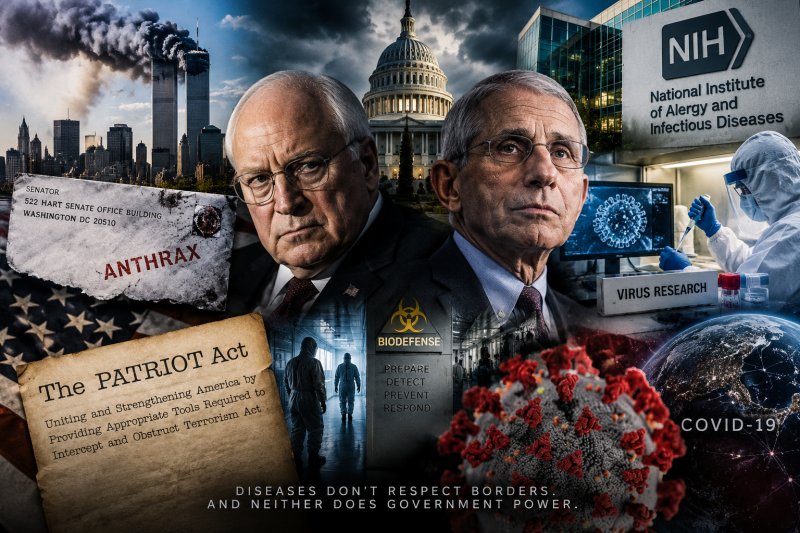
There are moments in American history when fear changes government almost overnight.
September 11, 2001, was unquestionably one of them.
Most Americans know what happened next in the conventional national-security story. Congress passed the USA PATRIOT Act. Washington dramatically expanded surveillance and intelligence authorities. Two major wars followed. Airport security changed. Federal agencies accumulated powers that would have been politically difficult to imagine only months earlier.
But another transformation was happening at almost exactly the same time, largely outside the public spotlight.
America was building a new biodefense establishment.
The catalyst was not merely September 11.
It was anthrax.
Beginning only days after the terrorist attacks, letters containing Bacillus anthracis spores were mailed through the United States postal system. Twenty-two people developed anthrax infections and five died. Congressional offices were evacuated. Postal facilities were contaminated. Americans suddenly confronted something that had previously seemed more at home in a Cold War thriller: biological terrorism.
Washington responded with billions of dollars.
Some of that money went toward vaccines, medicines, detection systems and emergency preparedness.
But something considerably larger happened as well.
The federal government dramatically expanded biological-threat research. The National Institutes of Health became a major component of the national biodefense apparatus. The National Institute of Allergy and Infectious Diseases—NIAID—vastly expanded its biodefense portfolio. New high-containment laboratories were constructed. Universities were recruited into biodefense research. Research involving dangerous pathogens expanded.
And the man directing NIAID was Dr. Anthony Fauci.
That history matters.
Not because it proves some grand conspiracy connecting Dick Cheney to COVID-19. It doesn’t.
Not because the historical record establishes that Fauci created the pandemic. It doesn’t establish that either.
It matters because the institutions at the center of some of the most contentious debates of the COVID era did not suddenly appear in 2020.
Much of the American biodefense system that existed when COVID arrived was built in the aftermath of 9/11 and the anthrax attacks.
And Dick Cheney was involved in the story before either event occurred.
Cheney’s Role Actually Began Before 9/11
This is one of the most interesting parts of the history because the timeline frequently gets oversimplified.
On May 8, 2001—four months before September 11—President George W. Bush announced that he had asked Vice President Dick Cheney to oversee development of a coordinated national effort dealing with the consequences of chemical, biological, radiological and nuclear weapons.
Bush’s announcement specifically contemplated coordination among the Departments of Defense, Health and Human Services, Justice and Energy, along with the Environmental Protection Agency and other federal agencies.
That isn’t speculation reconstructed twenty-five years later.
It’s sitting in the archived White House record.
Bush said he had asked Cheney to oversee the development of the coordinated national effort. (George W. Bush White House Archives)
That distinction matters.
Cheney didn’t become involved in biodefense because anthrax suddenly landed in congressional mailboxes. The Bush administration had already identified weapons-of-mass-destruction preparedness as an important national-security issue and placed the vice president in a major coordinating position.
Then September 11 happened.
Then anthrax happened.
And Washington’s sense of urgency exploded.
Anthrax Changed the Equation
The anthrax attacks exposed something government planners already feared: America was poorly prepared for a serious biological attack.
Vaccines were limited.
Detection capabilities were inadequate.
Emergency-response systems were fragmented.
The biomedical tools necessary to respond to an unfamiliar biological attack were nowhere near what national-security planners wanted.
The Bush White House acknowledged exactly that.
Its February 2002 biodefense plan said the anthrax attacks had revealed major deficiencies in America’s medical tools for combating bioterrorism.
The administration’s answer was extraordinary.
For fiscal year 2003, Bush proposed approximately $2.4 billion specifically for biological-defense research and development.
Of that amount, $1.75 billion was designated for NIH.
More than $600 million was designated for the Department of Defense. (George W. Bush White House Archives)
Stop there for a second.
When most people hear “biodefense,” they probably imagine the Pentagon.
Yet the Bush administration was putting a tremendous portion of its new biomedical biodefense investment into the National Institutes of Health.
That decision would have lasting consequences for American science.
Enter NIAID—and Anthony Fauci
NIH isn’t one organization doing one kind of research. It contains numerous institutes and centers.
For infectious diseases, one of the most important was NIAID.
And NIAID’s director was Anthony Fauci, who had held that position since 1984.
Following the anthrax attacks, NIAID’s mission expanded dramatically.
GAO later described NIAID as the principal NIH institute responsible for research involving pathogens that could potentially be used in bioterrorism and emerging infectious diseases.
In February 2002, NIAID produced its Strategic Plan for Biodefense Research.
The plan called for research aimed at developing vaccines, diagnostics and therapeutics—and for additional biocontainment laboratories capable of conducting that work safely. (GAO)
This wasn’t simply an emergency order for millions of doses of antibiotics.
It was an expansion of the scientific infrastructure itself.
NIAID planned basic research involving microorganisms with potential bioterrorism applications.
It planned translational research.
It planned new diagnostics.
New vaccines.
New therapeutics.
Regional research centers.
Repositories.
And high-containment laboratories.
NIH’s June 2002 advisory committee minutes described plans for approximately 25 NIAID initiatives involving basic research on microorganisms and the development of countermeasures. The plans included BSL-3 and BSL-4 laboratory capacity. (ACD)
This is where the scale becomes difficult to ignore.
From $53 Million to $1.6 Billion
Government programs have a habit of becoming abstract when we discuss them only in bureaucratic language.
So consider the numbers.
According to a 2004 HHS fact sheet, NIH biodefense research funding increased from approximately:
$53 million in FY2001
to
$1.6 billion in FY2004.
That’s roughly a thirtyfold increase in three fiscal years.
The Bush administration itself called it the largest single increase in resources for any initiative in NIH history.
By 2004, NIH had developed more than 50 biodefense initiatives and invested more than $800 million in 11 extramural laboratories, three intramural laboratories and related security infrastructure. (George W. Bush White House Archives)
That wasn’t an incremental adjustment.
Washington was constructing an ecosystem.
The Biocontainment Boom
Researching extremely dangerous pathogens requires specialized facilities.
Biosafety Level 3 laboratories handle agents capable of causing serious or potentially lethal disease, particularly through inhalation.
BSL-4 laboratories represent the highest containment level and are designed for especially dangerous or exotic agents.
After the anthrax attacks, NIAID concluded that America needed considerably more high-containment capacity.
It established programs for National Biocontainment Laboratories and Regional Biocontainment Laboratories. (GAO)
The federal solicitation for these facilities explicitly described research involving Category A, B and C priority pathogens.
The Regional Biocontainment Laboratory program contemplated state-of-the-art BSL-3 laboratories, while the national system included still higher containment capabilities. (Grants.gov)
Universities and research institutions became part of a growing national biodefense network.
And NIAID’s own institutional history records what happened plainly.
In 2003, NIAID says it established an “intellectual and physical infrastructure” for biodefense through National and Regional Biocontainment Laboratories and Regional Centers of Excellence for Biodefense and Emerging Infectious Diseases. (National Institutes of Health)
That phrase—intellectual and physical infrastructure—may be one of the most important descriptions in this entire history.
Because infrastructure lasts.
Administrations leave.
Presidents leave.
Vice presidents leave.
Agency directors eventually leave.
Infrastructure remains.
Why Would Anyone Want This Research?
Before going further, it’s important to understand the strongest argument supporting what Washington was doing.
Imagine intelligence officials believe an adversary might engineer a pathogen to evade an existing vaccine.
How do you prepare?
Scientists may need to understand which biological changes could allow that to happen.
Imagine terrorists might make a microorganism more virulent.
Researchers want to understand the mechanisms controlling virulence.
Imagine a pathogen could evolve or be modified so existing medicines no longer work.
Scientists want therapeutics capable of defeating those variants.
Those are legitimate defensive questions.
That’s why simply describing all dangerous-pathogen research as “bioweapons research” isn’t accurate.
But there is an unavoidable problem.
The same scientific knowledge that tells you how to stop a pathogen can sometimes tell somebody else how to make a more dangerous one.
That’s called the dual-use problem.
And Washington understood it remarkably early.
Scientists Were Warning About Dual-Use Research in 2004
In 2004, the National Academies published Biotechnology Research in an Age of Terrorism, commonly associated with the Fink Committee.
The committee wasn’t composed of internet conspiracy theorists.
It consisted of serious scientific experts wrestling with a serious problem.
They identified categories of experiments that warranted additional scrutiny because the research could potentially be misused.
Among the concerns were experiments that could make infectious agents more lethal or undermine vaccines. (National Academies)
Think about what that means.
Twenty years before many Americans heard phrases like “gain of function,” experts were already debating essentially the same dilemma:
When does research intended to protect us create additional risk?
That’s the question at the center of this story.
And Richard Ebright was asking versions of it almost from the beginning.
Richard Ebright’s Warning
Rutgers molecular biologist Richard Ebright has become one of the country’s most prominent critics of high-risk pathogen research.
Whatever one thinks about his conclusions regarding COVID-era controversies, one historical fact is particularly important:
His criticism did not begin with COVID.
Ebright was raising concerns about the enormous post-anthrax expansion of biodefense research in the early 2000s.
That gives today’s debate a very different context.
The disagreement isn’t simply Fauci versus critics who emerged after 2020.
There was a genuine scientific-policy dispute developing while the biodefense infrastructure itself was being constructed.
One side essentially argued:
We need to understand dangerous pathogens to defend against them.
The other warned:
Creating a much larger network of laboratories, researchers and experiments involving dangerous pathogens introduces additional opportunities for accidents, misuse and unintended consequences.
Those aren’t mutually exclusive observations.
Both can be true.
Research can produce valuable vaccines and treatments while simultaneously creating risks requiring extraordinary oversight.
That’s exactly why oversight matters.
Project BioShield Makes the System Permanent
Then came another major development.
Project BioShield.
President Bush announced the initiative in 2003, and Congress enacted the Project BioShield Act in 2004.
Its purpose was straightforward: traditional pharmaceutical markets didn’t necessarily provide companies enough incentive to spend enormous amounts developing products against diseases or biological weapons that might never create a conventional commercial market.
Government would create one.
The federal government could guarantee purchases of countermeasures.
NIH would receive additional flexibility.
Research could move faster.
Promising treatments could be made available during emergencies.
The administration described BioShield as a mechanism for accelerating NIH research and development while allowing government to purchase needed countermeasures. (George W. Bush White House Archives)
Again, there were perfectly understandable reasons for doing this.
But another piece of the permanent biodefense state was falling into place.
Research funding.
Laboratories.
Government procurement.
Industry partnerships.
Academic partnerships.
National-security involvement.
Emergency authorities.
All increasingly connected.
Where Cheney Fits—and Where the Evidence Gets Murkier
This is where we need to separate documented history from a more controversial interpretation of that history.
Ebright has argued that Cheney played a central role in shifting certain biodefense research toward civilian agencies such as NIH/NIAID.
The stronger version of that argument goes further: that research was moved away from the Department of Defense because military biological research faced Biological Weapons Convention compliance scrutiny that civilian biomedical research could navigate differently.
That is a consequential allegation.
But it should not currently be presented as established fact.
The public record clearly establishes several pieces surrounding it.
Cheney was assigned a major biodefense/WMD preparedness role before 9/11.
The Bush administration subsequently directed enormous resources into civilian biodefense.
NIH/NIAID became a major center of that research.
NIAID massively expanded dangerous-pathogen research infrastructure.
The administration integrated public health, biomedical research and national security much more closely.
Those facts are documented.
What the available public evidence does not conclusively establish is a simple paper trail saying:
“Cheney moved this research to Fauci so it could evade Pentagon treaty oversight.”
That’s an interpretation requiring additional documentary evidence.
And intellectual honesty requires saying so.
A suspicious-looking institutional history isn’t proof of every allegation made about it.
If we’re going to demand transparency from government, we should demand precision from ourselves too.
The Next Chapter: Gain-of-Function Research
Fast-forward a decade.
The scientific debate became even more contentious.
Experiments involving highly pathogenic avian influenza raised concerns about whether scientists should deliberately alter pathogens in ways that might increase traits such as transmissibility or pathogenicity.
Eventually the federal government itself became concerned enough to intervene.
In October 2014, the government announced a funding pause covering certain gain-of-function research involving influenza, MERS and SARS viruses when experiments were reasonably anticipated to enhance pathogenicity or respiratory transmissibility in mammals.
NIH implemented the pause while the government reconsidered the risk-benefit framework. (Grants.gov)
Read that again.
The United States government itself concluded that certain experiments presented enough potential danger to warrant temporarily stopping new federal funding while officials reconsidered how those risks should be evaluated.
That doesn’t mean all gain-of-function research was inherently reckless.
It means the risk was real enough that the government recognized it.
Then Came Coronavirus Research
Following outbreaks of SARS in 2003 and MERS beginning in 2012, coronavirus research became increasingly important.
NIAID supported research intended to understand viruses circulating in animals and evaluate their potential to spill over into humans.
One NIAID grant became extraordinarily controversial after COVID: EcoHealth Alliance’s Understanding the Risk of Bat Coronavirus Emergence.
Part of the work involved the Wuhan Institute of Virology in China.
Here again, precision matters.
NIH has maintained that it did not approve research under that grant that met the applicable federal definition of gain-of-function research expected to increase coronavirus transmissibility or lethality in humans. (Stage Test Domain 3)
Critics disputed how the research should be categorized.
But something considerably less ambiguous eventually emerged from a federal watchdog.
The HHS Office of Inspector General examined NIH’s oversight of EcoHealth Alliance.
Its findings were not reassuring.
The audit covered three NIH awards totaling approximately $8 million and $1.8 million in subawards to eight organizations, including the Wuhan Institute of Virology.
The inspector general concluded that NIH did not effectively monitor the awards and that deficiencies limited the government’s ability to understand the research, identify problems and take corrective action.
The watchdog specifically concluded that NIH missed opportunities to monitor the research more effectively. (HHS Inspector General)
That finding deserves attention regardless of anyone’s theory about COVID’s origin.
Because oversight failures involving potentially consequential biological research are a problem whether or not that research caused a pandemic.
Did This Research Cause COVID?
Here is where this discussion frequently falls apart.
We still cannot responsibly say that the Bush biodefense program, NIAID, Fauci, EcoHealth Alliance or the Wuhan Institute of Virology caused COVID-19.
The origin of SARS-CoV-2 remains unresolved.
U.S. intelligence agencies have disagreed.
The 2024 unclassified intelligence assessment said that all agencies considered both natural exposure and a laboratory-associated incident plausible. At that time, the National Intelligence Council and four agencies favored natural exposure, while the FBI and Department of Energy favored a laboratory-associated incident. (ODNI)
The World Health Organization’s independent SAGO assessment published in 2025 concluded that the weight of available evidence favors zoonotic spillover, while also emphasizing that crucial information remains unavailable and that a laboratory-related incident cannot be conclusively excluded.
WHO therefore says the investigation remains unfinished. (World Health Organization)
That uncertainty is uncomfortable.
But uncertainty isn’t permission to replace missing evidence with certainty.
If tomorrow credible evidence conclusively establishes a natural spillover, follow the evidence.
If credible evidence establishes a laboratory accident, follow the evidence.
Government accountability should never depend on our preferred answer winning.
But COVID’s Unresolved Origin Doesn’t Erase the Larger Story
This is where I think the conversation becomes much more important.
You don’t have to prove a laboratory origin for COVID to question whether America’s biodefense research system has been adequately supervised.
The HHS inspector general has already documented shortcomings in NIH oversight of EcoHealth.
The federal government itself paused certain gain-of-function research in 2014 because of concerns about risk.
The National Academies had warned about dual-use biological research in 2004.
And the post-anthrax expansion created far more facilities and far more research involving dangerous pathogens.
Those are legitimate policy questions independent of COVID’s origin.
How much dangerous-pathogen research should government fund?
What experiments create unacceptable risks?
Who gets to decide?
How transparent should those decisions be?
Should taxpayers fund research overseas when American agencies cannot guarantee access to laboratory records?
What happens when grant recipients fail to provide required information?
Should national-security considerations ever override ordinary scientific transparency?
And who watches the institutions doing the watching?
Those aren’t anti-science questions.
They’re governance questions.
The PATRIOT Act Parallel
This is where the broader post-9/11 history comes together.
After September 11, Americans were frightened.
Government promised protection.
Congress responded rapidly.
The USA PATRIOT Act became law on October 26, 2001.
Supporters argued that law enforcement and intelligence agencies needed modernized authorities to investigate terrorism, improve information sharing and follow sophisticated networks across jurisdictions. The Justice Department later credited the law with eliminating barriers between intelligence and law enforcement and providing investigators additional tools. (Department of Justice)
Civil-liberties advocates saw another side of it.
They argued that expanded surveillance authorities, secretive national-security processes and broader investigative powers threatened privacy, due process and constitutional protections.
That debate continued for years—and subsequent disclosures about American surveillance ensured it never really disappeared.
The important lesson isn’t that every post-9/11 government action was unnecessary.
America had just suffered the deadliest terrorist attack in its history.
Government had a legitimate responsibility to protect people.
The lesson is that emergencies create political conditions in which extraordinary government powers can expand extraordinarily quickly.
And once government builds institutions around those powers, rolling them back becomes considerably harder.
Two Expansions Happened at Once
Look at the post-9/11 period from thirty thousand feet.
On one side:
expanded surveillance,
expanded intelligence sharing,
expanded national-security authorities,
expanded secrecy,
expanded executive power.
On the other:
expanded biodefense spending,
expanded dangerous-pathogen research,
expanded high-containment laboratories,
expanded federal-academic research partnerships,
expanded emergency medical authorities,
expanded government pharmaceutical procurement.
These histories are normally discussed separately.
They shouldn’t be.
They grew from the same political environment.
Fear.
Urgency.
A genuine threat.
A demand that government make certain nothing like this happened again.
And an understandable willingness among Americans to give Washington enormous resources and authority to accomplish that mission.
Fauci Didn’t Create This System by Himself
That point deserves emphasis because history becomes distorted when everything is reduced to one personality.
Anthony Fauci did not appropriate billions of dollars to NIAID.
Congress did.
Fauci didn’t appoint Dick Cheney.
George W. Bush did.
Fauci didn’t enact Project BioShield.
Congress and Bush did.
Fauci didn’t single-handedly create America’s national biodefense strategy.
Multiple administrations, departments, scientists, legislators, intelligence officials, universities and private companies participated.
But Fauci occupied an extraordinarily important position inside the system.
NIAID became one of the primary institutions through which civilian biodefense research flowed.
He directed NIAID from 1984 until 2022.
That meant the same individual who helped lead an institution through the enormous post-anthrax biodefense expansion was still leading it when COVID arrived nearly two decades later.
That institutional continuity matters more than personality.
The Government Eventually Acknowledged the Risk Again
There is another development worth noting.
In 2025, NIH announced implementation steps suspending or terminating federal support for research meeting the government’s new definition of dangerous gain-of-function research under circumstances specified by a presidential executive order.
The notice required award recipients to review ongoing research and identify projects potentially meeting the definition. (Grants.gov)
Whatever political arguments surround that policy, its existence demonstrates something important:
The fundamental tension identified two decades earlier never disappeared.
Scientific knowledge can protect humanity.
Scientific knowledge can also create risks.
Government therefore faces an extraordinarily difficult responsibility when taxpayer dollars finance experiments involving pathogens with pandemic potential.
That responsibility demands transparency, oversight and humility.
What the Bush Administration Actually Left Behind
So did George W. Bush and Dick Cheney “lay the groundwork for COVID”?
If that sentence means they created SARS-CoV-2 or caused the pandemic, the available evidence doesn’t establish it.
That’s too large a leap.
But if we’re talking about institutional groundwork, there is a much stronger and considerably more interesting argument.
The Bush administration helped construct the modern American biodefense establishment that existed when COVID arrived.
It dramatically expanded NIH biodefense funding.
It helped transform NIAID’s biodefense portfolio.
It accelerated construction of high-containment laboratories.
It integrated biomedical research more deeply into national-security planning.
It created incentives for pharmaceutical countermeasure development.
It expanded government partnerships with universities and private laboratories.
It institutionalized a national strategy for anticipating biological threats.
And it did all of that during essentially the same historical moment in which Washington was dramatically expanding surveillance and national-security authority through measures such as the PATRIOT Act.
That is history.
What we make of that history is a separate question.
The Lesson We Should Have Learned After 9/11
Government has legitimate responsibilities.
Protecting Americans from terrorism is one of them.
Preparing for pandemics is another.
Developing vaccines, medicines and diagnostics is enormously valuable.
Research into infectious disease has saved millions of lives.
None of that requires pretending government institutions are incapable of making mistakes.
Quite the opposite.
The more consequential the government power, the more serious the oversight should be.
The more dangerous the research, the greater the transparency should be.
The more catastrophic the potential failure, the less acceptable bureaucratic complacency becomes.
And whenever officials say extraordinary authority is necessary because we’re facing an extraordinary emergency, citizens should be willing to ask two questions simultaneously:
Is this necessary right now?
And:
What prevents this emergency power from becoming permanent?
Those questions should have been asked more aggressively about surveillance after September 11.
They should have been asked more aggressively about the emerging biodefense establishment after the anthrax attacks.
And they remain worth asking today.
The Real Connection Between Anthrax and COVID
The strongest connection between 2001 and 2020 isn’t a secret memo proving Dick Cheney created the pandemic.
We don’t have that evidence.
The connection is institutional.
The anthrax attacks helped convince Washington that biological threats represented a national-security danger requiring massive federal investment.
The Bush administration responded by directing unprecedented resources toward biodefense.
NIH became central to that effort.
NIAID expanded enormously.
Anthony Fauci directed NIAID.
New research networks and biocontainment facilities followed.
Scientists warned that some forms of biological research presented dual-use risks.
Years later, the federal government temporarily paused certain gain-of-function research because those risks had become impossible to ignore.
NIAID subsequently funded coronavirus research through EcoHealth Alliance that included work at the Wuhan Institute of Virology.
Federal auditors later found meaningful deficiencies in oversight of those grants.
Then a novel coronavirus emerged in Wuhan and produced the worst global pandemic in generations.
Whether those final two events are causally connected remains unresolved.
That distinction matters enormously.
But so does everything that came before them.
Liberty Requires Memory
There is a habit in Washington that Americans should recognize by now.
A crisis happens.
Government expands.
The crisis eventually fades.
The expansion remains.
September 11 gave America the PATRIOT Act and a vastly enlarged national-security apparatus.
The anthrax attacks accelerated another transformation—one involving laboratories, infectious-disease research, pharmaceutical countermeasures, emergency preparedness and billions in federal biodefense spending.
Some of those programs undoubtedly strengthened America’s ability to confront biological threats.
Some produced valuable scientific knowledge.
But the history also presents difficult questions about oversight, dual-use research, laboratory safety, institutional accountability and the wisdom of allowing emergency programs to evolve into permanent bureaucratic structures without sustained public scrutiny.
COVID should make those questions more urgent, not less.
We don’t need conspiracy theories to scrutinize government.
The documented record is serious enough.
And we don’t need to decide the origin of SARS-CoV-2 before demanding better oversight of research capable of creating catastrophic consequences.
The constitutional principle involved here is older than Fauci, Cheney, Bush, NIAID or the PATRIOT Act:
Power deserves scrutiny precisely because human beings wield it.
That applies when government wants to read our communications in the name of national security.
It applies when government wants emergency authority during a pandemic.
And it applies when government funds experiments involving pathogens capable of threatening millions of people.
The Bush administration’s post-9/11 legacy therefore deserves to be understood in its entirety.
It wasn’t merely wars overseas and surveillance at home.
Washington simultaneously constructed a vastly larger biodefense infrastructure whose institutions, laboratories, funding mechanisms and research debates survived long after the anthrax envelopes disappeared from the headlines.
That system did not, on the evidence presently available, establish that the Bush administration caused COVID-19.
But it unquestionably helped create the American biodefense architecture that confronted COVID-19—and the system through which some of the controversial pre-pandemic coronavirus research was funded and overseen.
Those are different claims.
Keeping them separate doesn’t weaken the case for accountability.
It strengthens it.
Because when we’re talking about constitutional liberty, public money, national security and biological research capable of enormous consequences, we shouldn’t need exaggeration.
The facts give us more than enough to ask hard questions.
Add comment
Comments