There is a strange thing that happens in American politics whenever a major foreign-policy announcement is made.
Within minutes, everybody seems to know exactly what happened.
One side declares it the greatest diplomatic victory since the Louisiana Purchase. The other side insists absolutely nothing happened and the whole thing was a publicity stunt.
Then there is reality.
And reality is usually considerably more complicated.
That is exactly where we find ourselves with President Donald Trump’s newly announced agreement involving Greenland.
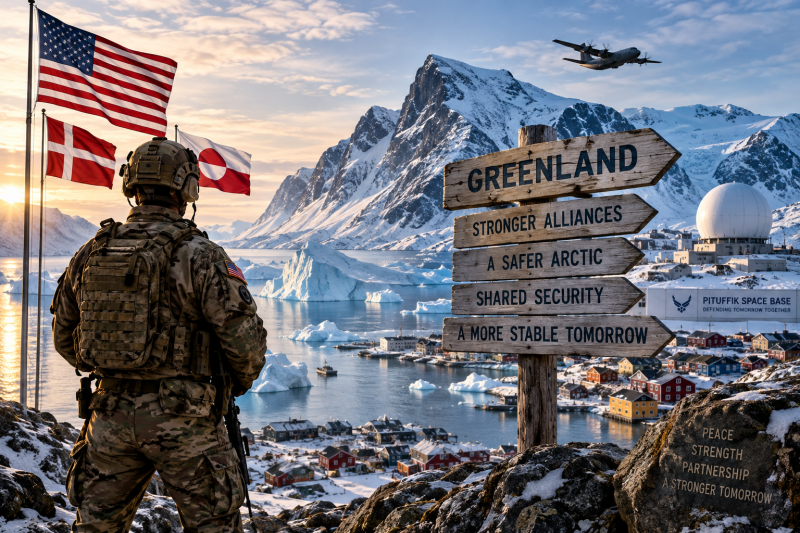
After months of Trump insisting that the United States needed Greenland for national security—and repeatedly raising the possibility of acquiring the enormous Arctic territory—the United States, Denmark and Greenland have apparently reached an agreement designed to dramatically strengthen America’s security position there.
Trump described it in characteristically sweeping terms.
According to the president, the agreement gives the United States “permanent control” over Greenland’s security and other American strategic needs.
That sounds enormous.
Read the headlines alone and you could easily walk away believing the United States essentially obtained Greenland without technically purchasing it.
But that isn’t what happened.
At the same time, dismissing the agreement as meaningless would be equally inaccurate.
The emerging deal appears to contain several potentially significant provisions involving American military access, NATO responsibility for Arctic security, restrictions on hostile foreign investment and guarantees intended to prevent countries such as Russia or China from establishing strategic footholds in Greenland.
Those are legitimate national-security interests.
There is just one enormous piece of historical context missing from much of the conversation:
The United States already possessed extraordinarily broad military rights in Greenland.
And we have possessed them for roughly three-quarters of a century.
Understanding that history completely changes how this new agreement should be understood.
First, America Did Not Acquire Greenland
We should begin with the easiest misconception to clear up.
Greenland has not become American territory.
Denmark did not sell Greenland.
The United States did not receive sovereignty over Greenland.
Greenlanders did not surrender their right to determine their own political future.
Whatever political language surrounds the agreement, those basic facts remain.
The agreement announced by Trump leaves Greenland within the Kingdom of Denmark while explicitly recognizing Danish sovereignty, Greenland’s territorial status and the Greenlandic people’s right to self-determination.
Danish Prime Minister Mette Frederiksen has emphasized precisely that point, while Greenlandic Prime Minister Jens-Frederik Nielsen has said the emerging agreement recognizes Greenland’s interests.
That matters because Trump’s language has sometimes sounded considerably broader.
He said the agreement gives America “permanent control over security, and all other needs, in Greenland.”
That is Trump’s description of the agreement—not evidence that the United States now possesses political sovereignty over Greenland.
Reuters reported on September 21 that Denmark describes the emerging framework somewhat differently. Danish Foreign Minister Lars Løkke Rasmussen said responsibility for Arctic security would increasingly be handled through NATO rather than simply by Denmark and the United States. (Reuters)
Those two descriptions are not necessarily contradictory.
A country can grant another country extensive military rights without surrendering sovereignty.
America has military bases throughout the world. Those installations do not become sovereign American territory simply because American forces operate there.
Greenland is actually a particularly good example because that distinction has existed there since 1951.
The Agreement America Already Had
To understand what Trump accomplished, we have to go backward before going forward.
During World War II, Greenland became strategically important to the defense of North America and the North Atlantic.
That importance only increased with the beginning of the Cold War.
In 1951, the United States and Denmark entered into the Defense of Greenland Agreement.
And this was not some narrow arrangement allowing a few American soldiers to visit occasionally.
It established extraordinarily broad American military access.
The agreement provided the legal framework allowing the United States to establish and operate defense facilities in Greenland, station personnel there and move American military forces through Greenland.
American military aircraft received access for operations involving Greenland, while American forces obtained extensive authority necessary to operate and protect defense installations.
The United States eventually maintained a substantial Cold War presence there.
At its height, America operated numerous installations across Greenland and stationed thousands of personnel on the island.
Today that footprint is considerably smaller.
The most important remaining American installation is Pituffik Space Base, formerly known as Thule Air Base.
Pituffik isn’t some ceremonial outpost.
It performs missions critical to North American security, including missile warning, missile defense support and space surveillance. AP notes that the base traces directly to the defense framework created by the 1951 treaty. (AP News)
That brings us to an important question.
If America already had military access to Greenland, what exactly were we missing?
Geography Explains Why Greenland Matters
Before answering that, it is worth understanding why Washington cares so much about an island with only around 56,000 residents.
Look at Greenland on a typical flat world map and its strategic importance can be easy to misunderstand.
Look at the Arctic from above the North Pole and everything changes.
Greenland sits between North America, Europe and the Arctic approaches toward Russia.
That makes it enormously valuable for monitoring aircraft, missiles, satellites and maritime activity moving through the northern hemisphere.
During the Cold War, that geography made Greenland an important component of the early-warning system protecting North America from Soviet attack.
Today the technology has changed.
The geography hasn’t.
Russia remains a major Arctic military power.
China has also sought a greater economic and strategic role in the Arctic.
Meanwhile, melting Arctic ice has increased international interest in shipping routes, mineral resources, energy development and infrastructure across the region.
Greenland therefore sits at the intersection of several major American interests: continental defense, missile detection, space operations, Arctic navigation and strategic competition.
Trump was hardly wrong to argue that Greenland matters enormously to American national security.
Where the debate becomes more complicated is whether owning Greenland was necessary to protect those interests.
The historical record strongly suggests it wasn’t.
America Already Had Access
This is perhaps the most important fact in the entire discussion.
The United States did not need to annex Greenland to put additional military forces there.
Denmark had already demonstrated willingness to discuss expanded American military cooperation.
AP reported that Danish officials repeatedly made clear that they were prepared to work with Washington to expand America’s military presence and strengthen American commercial interests in Greenland. (AP News)
That distinction matters enormously.
Imagine renting a warehouse under an agreement that already allows you to expand your operation, install equipment and increase staffing.
Then imagine announcing that you need to purchase the entire industrial park because you require more warehouse space.
Those are two entirely different problems.
For decades, America had already possessed a framework for expanding its military footprint in Greenland.
That doesn’t mean the old agreement answered every modern strategic challenge.
It clearly didn’t.
But it does mean we should be careful about describing rights America already possessed as entirely new concessions.
So What Does Trump’s Agreement Actually Add?
This is where Trump’s accomplishment becomes more interesting.
The emerging agreement appears to do something broader than merely reaffirm American basing rights.
According to AP, a State Department official said the agreement would prohibit any non-NATO country from establishing a base in Greenland, restrict adversarial investment and guarantee that China and Russia cannot establish bases there. (AP News)
Reuters similarly reports that Trump says American adversaries will not be allowed military bases or certain sensitive investments without American approval. (Reuters)
If those provisions appear in the final agreement as described, they matter.
The original Greenland defense framework was principally about what America could do.
This emerging agreement appears partly concerned with what America’s strategic competitors cannot do.
That is a meaningful distinction.
Modern geopolitical influence does not begin when somebody plants a flag and builds a military base.
It can begin with infrastructure.
Ports.
Telecommunications.
Mining operations.
Airports.
Energy projects.
Data infrastructure.
Transportation networks.
Control over strategically important infrastructure can create economic leverage and, under certain circumstances, security vulnerabilities.
A modern Arctic security agreement that specifically addresses those concerns would therefore represent something genuinely different from a treaty negotiated during the early Cold War.
The China and Russia Question
This deserves careful treatment because political rhetoric can easily outrun the evidence.
Trump has repeatedly emphasized the danger of Russian and Chinese activity around Greenland.
The broader strategic concern is legitimate: both Russia and China have significant Arctic ambitions.
But that does not mean every claim about their immediate presence around Greenland is automatically accurate.
AP noted that Trump has made claims about Russian and Chinese forces around Greenland that were unsupported by the available evidence. (AP News)
Those are two separate questions.
Is Chinese or Russian strategic penetration of Greenland something Washington should take seriously?
Absolutely, as a national-security question worthy of scrutiny.
Does that mean Russian and Chinese military forces were already preparing to seize Greenland?
There is not public evidence establishing that.
A serious foreign policy should be capable of recognizing emerging threats without exaggerating them.
If the new agreement establishes clear rules preventing hostile powers from acquiring strategically sensitive infrastructure or establishing military facilities, that could strengthen Western security without pretending an invasion fleet was sitting offshore.
NATO May Be One of the Biggest Parts of the Story
There is another development receiving considerably less attention.
Denmark appears to be pushing Greenland’s security increasingly into the broader NATO framework.
Rasmussen told Danish media that Arctic security under the agreement would not simply remain a Danish-American responsibility.
“To a large extent,” he said, NATO would look after the Arctic.
NATO itself welcomed the emerging agreement as something that could advance security, stability and cooperation in the region. (Reuters)
That may ultimately prove important.
The Arctic is not merely an American concern.
Nor is Greenland’s security solely Denmark’s responsibility in strategic terms.
Denmark and the United States are NATO allies.
So are Canada, Norway, Iceland and numerous other countries whose security interests intersect across the North Atlantic and Arctic.
A stronger NATO Arctic posture distributes responsibility among allies instead of requiring America to treat every strategic problem as something Washington must solve alone.
That is especially important for Americans who believe national defense is one of the legitimate and necessary functions of government but who also believe alliances should involve actual burden-sharing.
Denmark itself has acknowledged underinvesting in Greenland’s defense for decades and has committed to increasing its presence. (Reuters)
Getting allies to assume greater responsibility for their own neighborhood is a materially different outcome from simply expanding America’s obligations.
Trump Created Pressure—and Pressure Produced Movement
There is also a broader diplomatic question.
Would this agreement exist without Trump’s aggressive campaign over Greenland?
Possibly.
Would it have become this urgent?
That is much harder to say.
Trump undeniably forced Greenland onto the international agenda.
Denmark increased its focus on Arctic defense.
NATO became more directly engaged.
Greenland’s strategic importance became the subject of sustained international attention.
Negotiations ultimately produced an emerging agreement addressing American security concerns.
Those are observable developments.
But evaluating the method requires acknowledging another observable consequence.
Trump’s refusal at times to rule out military force against territory belonging to a NATO ally caused a serious diplomatic dispute.
AP reports that the rhetoric rattled NATO allies and damaged perceptions of the United States among Europeans, according to foreign-policy specialists interviewed by the outlet. (AP News)
Both things can be true.
Pressure can produce negotiations.
Pressure can also impose diplomatic costs.
Foreign policy becomes distorted when we insist every development must be either an absolute triumph or an absolute disaster.
Countries have interests.
Negotiations involve leverage.
Actions produce benefits and costs.
Adults should be capable of examining all three.
What Trump Didn’t Get
This is equally important.
Trump did not acquire Greenland.
Greenland remains under Danish sovereignty.
Its people retain their right to self-determination.
The emerging agreement reportedly requires parliamentary action in Denmark and Greenland before it can take effect. (AP News)
And Denmark’s government explicitly says the agreement recognizes the sovereignty and territorial integrity of the Kingdom of Denmark.
So anyone describing this as America essentially annexing Greenland is getting ahead of the evidence.
Trump may describe the agreement as providing “permanent control” over security.
That phrase deserves attention.
But until the actual legal text is publicly available, we should distinguish carefully between political descriptions and enforceable treaty provisions.
The Most Important Document Is the One We Haven’t Seen Yet
This brings us to the frustrating part.
As of September 21, the complete agreement has not been publicly released.
Reuters reports that significant details remain undisclosed, including whether the agreement formally modifies the 1951 defense framework governing America’s military presence. (Reuters)
That means anybody claiming to know precisely how much authority Washington gained is working with incomplete information.
The final document needs to answer several important questions.
What does “permanent” legally mean?
Exactly what military facilities can America construct?
Does Washington possess unilateral authority to expand them?
How are sensitive investments defined?
Who determines whether an investment threatens national security?
Does America actually possess veto authority, or does Denmark and Greenland retain the final legal decision?
What happens if Greenland eventually becomes independent?
How does the agreement interact with the 1951 treaty and its later modifications?
Those aren’t technical footnotes.
They determine whether this represents a fundamental restructuring of Greenland’s security architecture or a modernization of an already extensive relationship.
Until we have those answers, intellectual honesty requires some restraint.
The Bigger Lesson: Separate Security From Ownership
Perhaps the most interesting lesson from this entire episode has little to do with Trump personally.
National security does not necessarily require territorial ownership.
America needs secure access to Greenland.
America needs reliable missile-warning capabilities.
America needs Arctic surveillance.
America has legitimate reasons to prevent hostile military powers from controlling strategically important infrastructure near North America.
None of those things inherently requires the American flag flying over Nuuk.
There is an important principle buried inside that distinction.
A strong country should be capable of defending its legitimate interests without assuming it must politically control every place important to those interests.
Alliances, treaties and voluntary cooperation exist precisely because sovereign countries frequently share security interests.
Greenlanders are not pieces on somebody else’s geopolitical chessboard.
They are people with communities, families, institutions and the right to determine their own future.
Security arrangements should respect that reality.
And according to Denmark and Greenland, the emerging agreement does.
So What Actually Changed?
Strip away the partisan celebration and partisan outrage and the picture becomes considerably clearer.
America already possessed broad military access to Greenland.
America already operated a strategically vital installation there.
America already had a legal framework allowing significant defense cooperation.
Denmark was already willing to discuss increasing the American military presence.
Those facts substantially weaken any suggestion that the United States suddenly obtained access to territory from which it had previously been excluded.
But Trump’s agreement appears to add something meaningful.
It reportedly modernizes the relationship around today’s strategic environment.
It establishes stronger barriers against hostile foreign military activity.
It addresses sensitive adversarial investment.
It reinforces long-term American access.
It encourages a larger American military footprint.
And it appears to place greater responsibility for Arctic security on NATO and Denmark rather than exclusively on Washington.
That is more than nothing.
It is also considerably less than acquiring Greenland.
And perhaps that is exactly why this story is so instructive.
Facts Don’t Need a Team Jersey
Our political culture increasingly demands instant conclusions.
Was Trump victorious?
Was Trump defeated?
Did Denmark win?
Did America lose?
Those questions turn complicated international relations into professional wrestling.
A better question is much simpler:
What actually happened?
America appears to have secured stronger and potentially more durable guarantees protecting its strategic interests in Greenland.
That is significant.
America also already possessed extensive military rights there.
That is significant too.
Trump’s pressure accelerated attention toward Arctic security.
His rhetoric also strained relations with an allied country whose cooperation America needed.
Both facts belong in the story.
Greenland remains Greenland.
Denmark retains sovereignty.
Greenlanders retain self-determination.
America retains—and apparently strengthens—its ability to defend North America from one of the most strategically important locations on Earth.
Russia and China appear likely to face stronger barriers against establishing strategic footholds there.
And NATO appears poised to assume greater responsibility for Arctic security.
That is the story as the available evidence currently supports it.
When the final agreement becomes public, we should read it.
Not Trump’s summary.
Not Denmark’s press release.
Not somebody’s viral post on X.
The agreement itself.
Then put it beside the 1951 agreement and its subsequent modifications and ask the question that should have been asked from the beginning:
What authority did the United States actually gain that it did not already possess?
That answer will ultimately determine the historical significance of Trump’s Greenland deal.
Until then, there is nothing wrong with recognizing an American strategic accomplishment where one exists while refusing to turn diplomacy into mythology.
Strong countries do not need mythology.
They need clear interests, reliable allies, credible defenses and leaders willing to distinguish what sounds impressive from what actually advances the security and liberty of the people they serve.
In Greenland, the facts suggest America strengthened an already powerful position.
Whether history regards the agreement as a fundamental transformation of Arctic security or primarily a modernization of a 75-year-old partnership will depend on the legal language we have yet to see.
For now, that distinction is not weakness or fence-sitting.
It is simply where the evidence leads.
Add comment
Comments