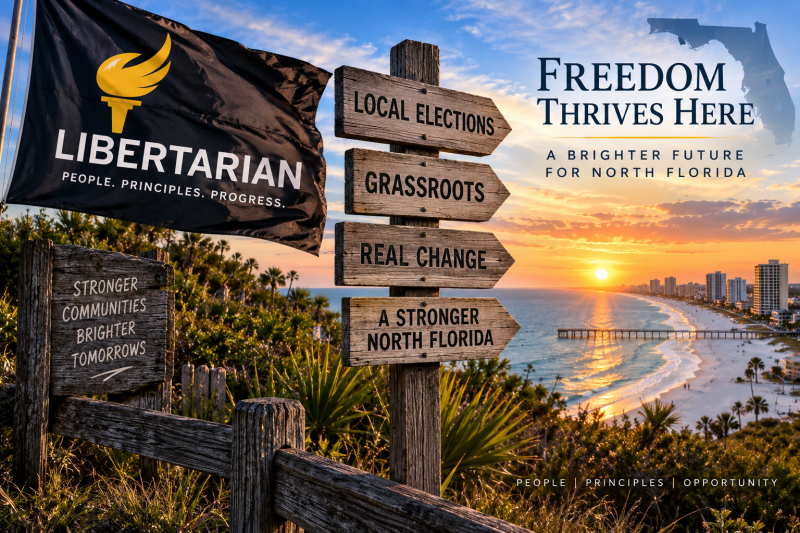
There is a tendency in American politics to look at a map, see red counties and blue counties, and assume the political story has already been written.
I think that misses something important about how political movements are actually built.
Political parties do not become relevant because somebody in Washington decides they should be relevant. They become relevant because people organize. Someone holds the first meeting. Someone builds the first volunteer list. Someone knocks the first hundred doors. Someone recruits the first credible candidate for city commission. Someone creates the first county organization that actually functions like an organization rather than a Facebook page.
Eventually, enough of those small things can become something much bigger.
That makes North Florida—and particularly the Florida Panhandle—an interesting case study for the Libertarian Party of Florida.
Not because there is evidence that some massive Libertarian electoral wave is about to sweep across Northwest Florida. There isn’t. Republicans currently possess an enormous registration advantage throughout much of the region, and pretending otherwise would accomplish nothing.
The interesting question is different:
What happens when a minor political party stops measuring success exclusively by statewide elections and starts building political infrastructure from the ground up?
That question matters considerably more than another debate about whether a third-party presidential candidate can suddenly break through nationally.
Because grassroots politics starts locally.
And right now, the numbers suggest both an obstacle and an opening.
Americans Are Tired of the Two-Party System—But That Isn’t Enough
Start with the national environment.
Gallup reported in January 2026 that a record 45% of American adults identified politically as independents during 2025, compared with just 27% identifying as Republicans and 27% as Democrats.
That is extraordinary.
Independents have generally been the largest political identification group in Gallup polling for years, but the 45% figure represented a new high. Importantly, many independents still lean toward one of the two major parties, so this cannot simply be translated into a hypothetical 45% constituency for third parties.
Still, it tells us something important about Americans’ relationship with the traditional party structure. (Gallup.com)
Pew Research Center found something similarly revealing in 2026.
As of its April survey, 58% of Americans viewed the Republican Party unfavorably and 59% viewed the Democratic Party unfavorably. Even more interestingly, 26% held unfavorable opinions of both parties, up from 21% in 2020. (Pew Research Center)
That frustration goes deeper than simple approval ratings.
In another Pew study, 56% of Americans said the Republican Party did not represent the interests of people like them well, while 58% said the same thing about the Democratic Party. A full quarter said neither major party represented their interests even somewhat well. Among independents and people identifying with other parties, that figure reached 39%. (Pew Research Center)
Those numbers do not prove that voters are waiting for the Libertarian Party.
They demonstrate something more limited, but still politically significant: there is a sizable constituency whose relationship with the two-party system is weak, dissatisfied or transactional.
And dissatisfaction creates an opening only when somebody builds an organization capable of entering it.
Florida Has Its Own Version of This Story
Florida’s voter-registration numbers make the picture even more interesting.
As of August 31, 2026, Florida had 13,580,124 active registered voters. Republicans numbered 5,649,410 and Democrats 4,098,139.
But another 3,326,661 Floridians were registered with no party affiliation, while 505,914 were registered with minor parties. (Florida Department of State)
Again, those voters should not be treated as a ready-made Libertarian electorate. NPA voters range across the ideological spectrum, and minor-party registrants include numerous different political parties.
But more than 3.8 million active Florida voters are outside the Republican and Democratic registration columns.
That is not politically meaningless.
The harder question is whether any minor party possesses the organization necessary to communicate consistently with even a small portion of those voters.
That is where North Florida becomes interesting.
Look at Bay County
Consider Bay County.
According to the Florida Division of Elections’ August 31 registration report, Bay County had 127,484 active registered voters.
Republicans accounted for 74,890.
Democrats accounted for 23,698.
Another 23,467 voters had no party affiliation, while 5,429 were registered with minor parties. (Florida Department of State)
Nobody looking seriously at those numbers should pretend Bay County is on the verge of becoming a three-way partisan battleground.
It isn’t.
But there are roughly as many NPA voters in Bay County as registered Democrats.
That makes the county an interesting laboratory for something much more modest and achievable: building a durable minor-party organization capable of participating consistently in civic and electoral life.
There is a tremendous difference between saying, “We’re going to win Congress,” and saying, “We’re going to build an organization capable of recruiting volunteers, attending local government meetings, developing candidates, registering voters, knocking doors and competing in appropriate local races.”
The second is how political infrastructure is actually created.
The Biggest Opportunity May Be the Empty Map
The Libertarian Party of Florida’s own organizational map demonstrates how much work remains.
Its current county-affiliate page lists numerous counties without established affiliates, including several across North Florida and the Panhandle: Calhoun, Franklin, Gadsden, Gulf, Holmes, Jackson, Jefferson, Leon, Liberty and Madison, among others. (Libertarian Party of Florida)
That can be interpreted as weakness.
It can also be understood as organizational whitespace.
Political organizations frequently make the mistake of assuming that an empty county means there is no constituency there.
Sometimes it simply means nobody has organized it yet.
Those are two very different things.
A functioning political organization needs considerably more than a logo and social-media account. It needs identifiable leadership, recurring meetings, membership recruitment, volunteer development, voter contact, fundraising, candidate recruitment, communications, data management and relationships throughout the community.
That work isn’t glamorous.
It is also almost impossible to replace.
You cannot manufacture grassroots infrastructure six weeks before Election Day.
Start With the Smallest Winnable Battlefield
One of the recurring mistakes minor parties make is beginning with the biggest offices imaginable.
President.
Governor.
United States Senate.
Congress.
Those campaigns can provide visibility, but visibility and organization are not the same thing.
Local politics operates differently.
City commissions, municipal boards and other community offices can involve electorates small enough that personal relationships, candidate quality, door knocking and community reputation matter enormously.
That doesn’t mean those races are automatically easy for minor-party candidates. Far from it. Candidate recruitment, ballot rules, fundraising and the partisan composition of individual jurisdictions all matter.
But mathematically, organizing several thousand voters is a fundamentally different project from organizing millions.
That creates a potential organizational ladder:
Build the county organization.
Develop volunteers.
Train organizers.
Become visible in community issues.
Recruit credible candidates.
Compete where circumstances make competition realistic.
Retain the voter and volunteer infrastructure afterward.
Then repeat.
The important word there is retain.
Too many political campaigns disappear the morning after Election Day.
Thousands of names sit untouched in databases. Volunteers stop hearing from organizers. Relationships disappear. Social-media pages go dormant.
Then, eighteen months later, everybody starts from zero again.
That isn’t movement building.
A serious political organization treats Election Day as one milestone in a permanent organizing operation.
Grassroots Means More Than Social Media
This is especially important in an era when political engagement increasingly gets confused with online engagement.
Posting isn’t organizing.
Arguing isn’t organizing.
Getting 300 likes isn’t organizing.
Real grassroots organization is considerably less exciting.
It is calling someone who attended a meeting three months ago.
It is knocking on a door when it’s 92 degrees outside.
It is setting up a table at a community event.
It is remembering that a volunteer said she could help on Saturdays.
It is training someone who has never canvassed before.
It is maintaining accurate voter-contact records.
It is following up.
Then following up again.
Digital communication is enormously useful—I spent years working at the intersection of digital engagement and grassroots organizing—but digital works best when it multiplies human relationships rather than replacing them.
The strongest political organizations connect the two.
A Facebook ad becomes a signup.
A signup becomes a phone call.
A phone call becomes a meeting.
A meeting becomes a volunteer.
A volunteer becomes an organizer.
An organizer recruits five more people.
Now you have something.
North Florida Has a Particularly Interesting Political Culture
There is another reason the Panhandle deserves attention from anyone studying Libertarian organization.
The region is heavily Republican in registration, but registration tells us who voters currently associate with; it does not tell us that every voter agrees with every position taken by Republican officials.
The same principle applies in Democratic counties.
Political coalitions are coalitions precisely because their members disagree internally.
Pew’s national issue polling illustrates this fragmentation. On economic policy, for example, 38% of Americans said they agreed with Republicans and 35% with Democrats, while 26% said they agreed with neither. On the federal budget deficit, 37% said they agreed with neither major party. (Pew Research Center)
That creates space for issue-based conversations that do not begin with party labels.
Government spending.
Property rights.
Civil liberties.
Criminal-justice reform.
Occupational licensing.
Privacy.
Small-business regulation.
Government surveillance.
Local taxation.
Housing.
Land use.
Free speech.
Foreign policy.
There are voters who will agree with Libertarians on one of those issues and strongly disagree on another.
That is normal.
A functioning grassroots political organization does not require everybody to agree on everything before having a conversation.
In fact, Pew found broad public demand for something almost embarrassingly basic: Americans want elected officials to be knowledgeable, admit mistakes, treat political opponents with respect and, in substantial numbers, demonstrate a willingness to compromise. (Pew Research Center)
Maybe the public isn’t asking for louder politics.
Maybe a lot of people are asking for better politics.
The Panhandle Also Has History on Its Side
There is something fitting about experimenting with political institution-building in Northwest Florida.
The Panhandle occupies an important place in Florida’s earliest European colonial history. Pensacola Bay was the site of the 1559 Tristán de Luna settlement attempt, decades before the founding of St. Augustine, although storms and other hardships caused the Pensacola colony to fail and St. Augustine became the oldest continuously occupied European-established settlement in what is now the continental United States.
Florida’s western edge has always had a distinct identity.
It is geographically removed from Tallahassee’s political machinery and even farther culturally from the massive metropolitan centers of Central and South Florida.
That distinctiveness does not guarantee Libertarian success.
But political movements are often strongest when they develop identities connected to the places where they organize rather than importing a national message wholesale.
What matters in Panama City isn’t necessarily what matters in Miami.
What matters in Marianna isn’t necessarily what matters in Orlando.
What matters in a rural county of 10,000 people can be completely different from what motivates voters in Tampa.
Grassroots politics respects those differences.
Organization Has to Come Before Ambition
The Libertarian Party of Florida is an officially registered minor political party in Florida. (Florida Department of State)
The question isn’t whether the organization exists.
The question is what kind of organization can exist underneath that statewide structure.
Imagine a Panhandle network where functioning county organizations regularly communicate with one another.
Where volunteers receive actual training.
Where someone interested in running for city commission doesn’t have to figure everything out alone.
Where organizers maintain relationships with community groups.
Where voter-registration efforts happen throughout the year.
Where activists attend county commission and city council meetings.
Where candidates understand campaign finance, voter targeting, canvassing, digital advertising and earned media before filing paperwork.
Where one county’s strongest organizer helps develop the next county.
That is not an election prediction.
It is organizational capacity.
And capacity compounds.
Ten volunteers become twenty.
Twenty become fifty.
One county affiliate helps establish another.
One credible local candidate makes it easier to recruit the next.
One competitive campaign creates voter data, donors, volunteers and experience that survive into another cycle.
Eventually, the organization stops rebuilding itself from scratch.
That is when a political party begins behaving like an institution.
There Are Serious Obstacles
None of this should become an exercise in wishful thinking.
Florida remains dominated by two major parties, and North Florida is particularly Republican.
Ballot access alone does not create competitiveness.
Dissatisfaction with Republicans and Democrats does not automatically benefit Libertarians.
Independent voters are not synonymous with libertarian voters.
Social-media enthusiasm is not equivalent to votes.
And ideological purity cannot substitute for candidates who understand their communities.
Those realities should be acknowledged rather than explained away.
There is also a structural chicken-and-egg problem confronting almost every minor party.
People hesitate to volunteer because the party isn’t competitive.
The party isn’t competitive because it lacks volunteers.
Donors hesitate because candidates rarely win.
Candidates struggle because fundraising is weak.
Strong candidates hesitate to run because infrastructure is limited.
Infrastructure remains limited because strong candidates rarely run.
Breaking that cycle requires something less dramatic than a political revolution.
It requires persistence.
Politics Is Still About People
There is an old temptation in politics to search for the perfect message.
I don’t believe there is one.
People are complicated.
Communities are complicated.
Politics is complicated.
A working father worried about property taxes may also care deeply about criminal-justice reform. A small-business owner who wants fewer regulations may disagree with Republicans on foreign policy. A Democrat concerned about civil liberties may disagree with Libertarians about economics.
Human beings refuse to fit neatly into political databases.
That is probably healthy.
The most durable grassroots organizations understand that politics begins with listening before persuasion and relationships before transactions.
And that brings us back to the Panhandle.
Nobody can responsibly promise that North Florida is destined to become a Libertarian stronghold.
The existing numbers do not support that conclusion.
But the numbers do show millions of Floridians outside the two major parties, substantial national dissatisfaction with both Republicans and Democrats, hundreds of thousands of Floridians registered with minor parties and significant portions of North Florida where Libertarian organizational infrastructure remains undeveloped. (Florida Department of State)
That creates a legitimate political experiment worth watching.
Can a minor party build from municipalities upward rather than Washington downward?
Can county organizations cooperate regionally?
Can candidate development begin years before Election Day?
Can digital engagement feed permanent grassroots infrastructure instead of temporary outrage?
Can political organizing become community organizing again?
Those questions cannot be answered by another national poll.
They can only be answered locally.
County by county.
Neighborhood by neighborhood.
Conversation by conversation.
Door by door.
American political movements have always had to begin somewhere.
There is no law of politics saying the next interesting experiment cannot begin in the Florida Panhandle.
Add comment
Comments