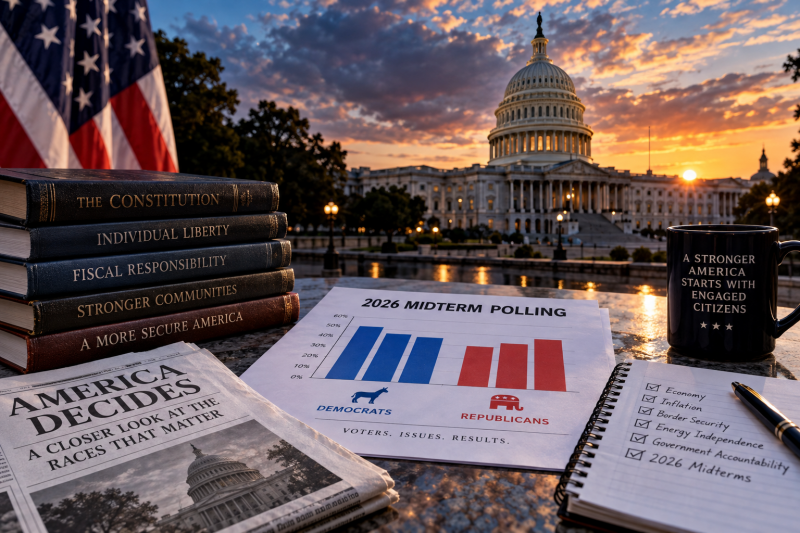
If you have been following my previous updates on the 2026 midterms, you already know that I have been watching these numbers with one rule in mind: ignore the political cheerleading and follow the data.
That matters even more now.
We are getting close enough to Election Day that polling begins telling us considerably more than it did six months ago. Candidate fields have largely solidified. Voters are paying more attention. Campaign advertising is intensifying. Early voting is approaching or already beginning in some places. And instead of trying to interpret hypothetical matchups involving candidates voters barely know, we are increasingly looking at the actual choices that will appear on November ballots.
And the latest numbers deserve attention.
Not because Republicans are guaranteed to lose Congress. They aren’t.
Not because Democrats are guaranteed some enormous wave. They aren’t.
And certainly not because a single poll released on a Friday afternoon suddenly tells us what millions of Americans will do in November.
What the accumulating evidence does tell us is that the political environment Republicans face in September 2026 is considerably more difficult than they would probably like it to be.
The warning lights aren’t coming from one pollster.
They’re showing up nationally.
They’re showing up in competitive House districts.
They’re showing up in Senate races.
And, perhaps most interestingly for those of us here in Florida, they’re beginning to show up in places Republicans have grown accustomed to treating as relatively safe territory.
That doesn’t tell us what happens in November.
But it absolutely tells us what deserves watching between now and then.
Start With the National Environment
The simplest place to begin is the generic congressional ballot.
For anyone unfamiliar with that term, the generic ballot asks voters something along the lines of: if the election for Congress were held today, would you vote for the Republican candidate or the Democratic candidate in your district?
It isn’t a perfect predictor of House seats.
Far from it.
Congressional elections happen district by district, candidate by candidate, across 435 different political environments. Geography matters. Redistricting matters. Incumbency matters. Candidate quality matters. Turnout matters.
But the generic ballot remains one of the better tools available for measuring the overall national political environment.
And lately, that environment has moved toward Democrats.
As of September 19, The Projection Desk’s weighted national polling average had Democrats at 47.2% and Republicans at 41.5%, producing a Democratic advantage of approximately 5.8 percentage points. More importantly, that margin had moved about 1.2 points toward Democrats during the preceding week. (The Projection Desk)
Individual national polls have been even more striking.
Marquette Law School’s national survey released September 16 found Democrats leading Republicans 54% to 41% among likely voters on the congressional ballot. Among registered voters, the result was 50% Democratic to 42% Republican. (Marquette Today)
That’s a substantial spread.
Other recent polling has produced smaller Democratic advantages. John Zogby Strategies reported Democrats ahead 46% to 40% among likely voters in polling conducted September 15–17. The Rainey Center reported Democrats ahead 48% to 42% among registered voters in its September 10–14 survey. (PB Polls)
The New York Times/Siena polling released this week reportedly placed Democrats eight points ahead nationally, while another recent YouGov/Economist result showed an even larger Democratic advantage among likely voters. (Nate Silver’s Bulletin)
Those surveys differ in methodology, sample composition and likely-voter modeling, which is precisely why no serious analysis should grab whichever number produces the most dramatic headline.
The important thing isn’t whether the national environment is D+6, D+8 or D+13 on a particular morning.
The important thing is the direction and consistency.
Multiple surveys are currently showing Democrats ahead nationally.
That is the story.
The Economy Remains Central
There is another reason the Marquette poll deserves attention.
It isn’t simply telling us how people say they intend to vote. It gives us some clues about why the environment looks the way it does.
Marquette found inflation and the cost of living remained voters’ top concern. The survey also found Democrats receiving higher marks than Republicans on the economy, inflation, Medicare and Social Security, and health care, while Republicans performed better on national defense, crime, immigration and border security. (Marquette Today)
That issue breakdown matters.
For years Republicans have generally wanted elections centered on inflation, economic frustration, crime and immigration.
But political issues are not permanently owned by either party.
Voters judge outcomes.
They judge their grocery bills.
They judge gasoline prices.
They judge rent.
They judge mortgage payments.
They judge whether their wages are actually keeping pace with what it costs to raise a family.
That is one of the fundamental realities politicians sometimes forget once they spend too much time inside Washington.
Most Americans do not experience government through ideological white papers.
They experience it at the kitchen table.
They experience it when the electric bill arrives.
They experience it when they fill the gas tank.
They experience it when their property insurance renews.
They experience it when they look at the price of groceries and wonder how a cart that used to cost $150 suddenly costs substantially more.
Political messaging can influence how voters interpret those experiences.
It cannot erase the experiences themselves.
The House Is Where Republicans Have the Least Room for Error
The House deserves particular attention because Republicans simply do not have much cushion.
Republicans currently hold a 219–214 majority, according to the latest congressional breakdown reported by The Wall Street Journal. (The Wall Street Journal)
Think about how narrow that is.
This isn’t a majority capable of absorbing a large political shift.
A relatively small number of flipped districts can change control of the chamber.
Cook Political Report’s September 11 House ratings showed 21 Toss Up districts, along with nine Lean Democratic districts and seven Lean Republican districts. Cook listed another 12 as Likely Democratic and 21 as Likely Republican. (Cook Political Report)
Those ratings aren’t election results. They’re professional assessments of competitiveness based on district composition, candidates, the political environment and reporting from campaigns.
But they illustrate how concentrated the battle for the House has become.
And then we got something even more useful this week: polling specifically from competitive congressional districts.
Cook Political Report’s Battleground District Project surveyed voters across some of the country’s most competitive House districts and found Democrats ahead 49% to 47% in the congressional vote. (Cook Political Report)
That two-point advantage is much smaller than some of the national generic-ballot numbers.
And that is important.
It is one reason I would caution anyone against looking at a national D+8 poll and immediately translating it into some enormous number of Democratic House pickups.
That’s not how congressional elections work.
The political geography of America matters enormously.
District boundaries matter.
Where those additional Democratic votes are located matters.
A party can pile up gigantic margins in urban districts without gaining another congressional seat.
Conversely, a relatively modest national shift concentrated in suburban and competitive districts can change dozens of races.
The battleground poll therefore gives us a useful reality check.
Democrats may currently have a sizable national advantage while the districts most likely to determine control of Congress remain considerably tighter.
Both things can be true simultaneously.
Then There Is the Senate
This is where the 2026 picture gets particularly interesting.
Republicans currently hold a 53–47 Senate advantage, counting the two independents who caucus with Democrats on the Democratic side of that division.
Democrats therefore need a net gain of four seats to control the chamber in 2027. There are 35 Senate elections this cycle, including special elections in Florida and Ohio, and 23 of the seats being contested are currently held by Republicans. (270toWin.com)
That structure gives Democrats opportunities.
It also gives them a difficult assignment.
They cannot simply play offense.
They have to defend competitive seats of their own while simultaneously flipping Republican-held seats.
And several new polls released over the past week illustrate just how fluid that battlefield has become.
Georgia
Georgia remains one of the most important defensive races for Democrats.
A recent Quantus Insights survey had Democratic Sen. Jon Ossoff at 49% and Republican Mike Collins at 45%.
Another recent Trafalgar survey had Ossoff at 49% and Collins at 43%. (RealClearPolling)
Those are snapshots, not outcomes.
But Georgia’s political transformation over the past several election cycles means neither party can afford to take the state for granted.
Republicans looking for a path to preserve or expand their Senate majority have every reason to keep Georgia high on the board.
Democrats have every reason to defend it aggressively.
North Carolina
North Carolina is almost the inverse situation: an important Republican-held opportunity for Democrats.
Recent polling has shown Democrat Roy Cooper ahead of Republican Michael Whatley.
InsiderAdvantage reported Cooper leading 48% to 43%, while a Trafalgar poll showed Cooper at 48% and Whatley at 42%. (RealClearPolling)
Again, we’re talking about individual polls.
But when multiple pollsters begin showing similar direction, the race deserves attention.
North Carolina has been tantalizingly competitive for Democrats for years while frequently remaining just beyond their reach in major statewide federal contests.
Whether that pattern holds again is one of the major questions of 2026.
Michigan
Michigan is another Democratic defense Republicans need to contest.
A recent InsiderAdvantage survey showed Democrat Abdul El-Sayed at 47% and Republican Mike Rogers at 45%. (RealClearPolling)
A two-point race is exactly what it sounds like:
Close.
Nothing more needs to be manufactured from it.
The result doesn’t establish who will win Michigan. It tells us Michigan belongs in the group of races worth watching closely.
New Hampshire
New Hampshire has produced some fascinating numbers.
Recent InsiderAdvantage polling showed Democrat Chris Pappas leading Republican Chris Sununu 48% to 40%.
An earlier Rasmussen survey had Pappas ahead 45% to 34%. (RealClearPolling)
At the same time, Cook Political Report moved the New Hampshire Senate contest into its Toss Up category on September 15, underscoring the uncertainty surrounding the race despite individual polls showing a Democratic advantage. (Cook Political Report)
That apparent tension is a useful reminder that analysts consider much more than one or two topline polls.
Candidate strength, state fundamentals, fundraising, historical voting patterns and anticipated turnout all matter.
Texas Is No Longer a Race You Can Ignore
Then we get to Texas.
A September 18 Trafalgar survey showed Democrat James Talarico at 46% and Republican Ken Paxton at 45%. (RealClearPolling)
One point.
In Texas.
That doesn’t mean Texas has suddenly become a Democratic state.
It doesn’t mean Republicans are destined to lose the seat.
It means a major Republican state has produced a Senate poll showing a statistical dead heat.
That alone makes the contest politically significant.
Texas is enormous.
Campaigning there is expensive.
Media markets are expensive.
And when a party has to spend serious money defending territory it ordinarily expects to hold, that can have downstream consequences elsewhere.
That is why competitive races matter beyond the boundaries of the states where they’re happening.
Money spent defending Texas is money that cannot simultaneously be spent somewhere else.
The same principle applies to Democrats when they are forced to defend states they hoped would be secure.
Politics is ultimately a competition involving finite resources.
Iowa Just Got More Interesting
Iowa is another Republican-held seat producing mixed polling.
The newest Trafalgar result listed by RealClearPolling has Republican Ashley Hinson at 44% and Democrat Josh Turek at 42%. (RealClearPolling)
But earlier September polling produced different results.
YouGov polling showed Turek narrowly ahead in one registered-voter sample and by four points among likely voters, while Emerson College polling from late August and early September had Hinson ahead by five. Other surveys have also shown small Republican advantages. (Hedge)
That is exactly the kind of race where averages and trends become more useful than whichever poll happens to appear newest on your social-media feed.
The surveys disagree.
That disagreement itself tells us something.
The race remains competitive enough that assumptions are dangerous.
And Then There Is Florida
This one obviously caught my attention.
Florida has moved substantially toward Republicans over the past several election cycles.
That political shift is real.
But a new St. Pete Polls survey released September 19 showed Republican Ashley Moody and Democrat Angie Nixon tied at 45% in Florida’s special U.S. Senate election. (RealClearPolling)
Now, before anybody runs wild with that number, context matters.
Other Florida polling has looked considerably better for Moody.
Quantus Insights polling conducted September 8–10 had Moody at approximately 50% and Nixon at roughly 43%.
Change Research polling conducted September 7–9 had the candidates tied at 47% each.
Earlier surveys from the University of North Florida, Stetson University and Emerson College showed Moody with larger advantages. (Election.org)
So what is the responsible conclusion?
Not that Florida has suddenly flipped.
Not that Moody is certain to win.
Not that Nixon is certain to win.
The responsible conclusion is simply that recent Florida polling is unusually divergent, with some surveys showing a substantial Republican advantage and others showing essentially an even race.
That makes Florida worth watching.
Nothing more and nothing less.
Don’t Forget Kansas
Another result that deserves mention came out of Kansas.
The September 18 RealClearPolling update listed an Emerson survey showing Democrat Christy Davis Hamilton at 45% and Republican Sen. Roger Marshall at 43%. (RealClearPolling)
Kansas is traditionally Republican territory at the federal level, although Democrats have demonstrated an ability to win statewide under certain circumstances.
One poll should never redefine an entire state’s political identity.
But competitive polling in Kansas adds to the broader pattern we’re seeing: the number of states requiring serious attention is expanding.
And that is strategically important for both parties.
Republicans Still Have Paths Through This Environment
It would be very easy to stop here and write the standard horse-race headline:
Republicans are collapsing.
That would be premature.
There are several reasons.
First, competitive-district House polling is considerably closer than the national generic ballot.
Second, Senate races are candidate-specific. A national political environment does not affect every state equally.
Third, polling error exists.
Fourth, turnout models can change.
Fifth, we’re still several weeks from Election Day.
And sixth, Democrats have problems of their own.
Reuters reported September 19 that Democratic divisions remain visible in several important states, including Maine, Texas, Michigan, New York and Florida. Some prominent Democrats have withheld endorsements or remained reluctant to campaign alongside nominees following contentious primaries. (Reuters)
That could matter.
Campaigns are not simply television commercials and polling averages.
They are organizations.
Volunteers knock doors.
Organizers recruit people.
Campaigns identify supporters.
Coalitions communicate with communities.
Field programs chase ballots.
Candidates build trust.
And parties have to convince people who agree with them to actually vote.
That last part is frequently underestimated.
The Associated Press reported September 19 that several major progressive voter-engagement organizations are dealing with significant funding shortages and staffing reductions heading into the election. America Votes, for example, reported funding below its 2022 midterm level, while other organizations have scaled back voter-registration and mobilization programs. (AP News)
That is not something a generic-ballot poll captures.
A voter telling a pollster, “I prefer Democrats,” is not the same thing as that voter filling out a ballot.
Likewise, a Republican frustrated with Washington but reluctant to answer political surveys may still show up on Election Day.
Elections are won with ballots, not polling responses.
There Is a Larger Lesson Here
This is where I think our political culture frequently gets things backward.
Too many people treat elections like football games.
Their team is winning.
Their team is losing.
The referee is corrupt.
The polls are fake.
The polls are brilliant.
Everything becomes another excuse to cheer or scream.
But elections are supposed to be something considerably more serious than that.
They are moments of accountability.
Political power is temporary.
It should be temporary.
No party owns a congressional seat.
No politician owns an office.
No movement is entitled to power simply because it won the previous election.
The voters lend power to representatives for a defined period of time and then get another opportunity to judge what those representatives did with it.
That is one of the healthiest features of our constitutional system.
And if you believe in limited government, individual liberty, fiscal responsibility, strong communities, personal dignity and government accountable to the people it serves, then you should welcome accountability even when it makes your preferred political coalition uncomfortable.
Especially then.
A political movement that cannot tolerate criticism eventually stops being a movement based on principles and becomes a movement based on personalities.
That distinction matters.
I don’t care whether a politician has an R, D, L or I beside their name.
The questions should remain the same.
Did government become more accountable?
Did families gain greater control over their own lives?
Did Washington become more fiscally responsible?
Were constitutional liberties protected?
Did government respect the dignity and autonomy of ordinary citizens?
Did elected officials exercise restraint with the enormous power entrusted to them?
Did they leave communities stronger?
Those questions are considerably more important than whether somebody wearing the right-colored jersey gets another two years in Washington.
What I’m Watching Next
The next several weeks should tell us considerably more.
I’m watching the national generic ballot, but I’m paying even closer attention to competitive House districts.
I’m watching whether Democrats maintain their current national advantage or whether the numbers begin tightening as Election Day approaches.
I’m watching Florida.
I’m watching Texas.
I’m watching North Carolina.
I’m watching Georgia.
I’m watching Michigan.
I’m watching Iowa.
I’m watching Maine, Ohio, Alaska and New Hampshire.
And I’m watching whether states such as Kansas continue producing unexpectedly competitive polling.
Most importantly, I’m looking for confirmation.
One poll is interesting.
Two polls are more interesting.
A sustained trend across several high-quality pollsters is something worth taking seriously.
That is how I’m going to continue approaching these updates.
No panic.
No partisan celebration.
No pretending we know something the data doesn’t actually tell us.
Just follow the numbers.
The Bottom Line
As of September 19, the evidence points to a difficult national political environment for Republicans.
Democrats currently lead the national generic congressional ballot across multiple recent surveys and by about 5.8 points in one weighted polling average. (The Projection Desk)
Republicans hold an extremely narrow House majority.
The competitive House districts themselves appear closer than the national numbers, which is an important distinction.
Meanwhile, the Senate map has become increasingly complicated.
Republicans are competitive in Democratic-held states such as Georgia, Michigan and New Hampshire.
Democrats are competitive in Republican-held states including North Carolina, Iowa and, according to some recent polling, Texas, Florida and Kansas.
Neither chamber’s eventual composition can be read directly from today’s polls.
But compared with earlier stages of this election cycle, the battlefield has widened.
And for Republicans, that may be the most important development of all.
When your political coalition is defending only the places everyone expected you to defend, you can concentrate your money, volunteers and attention.
When states you expected to hold comfortably begin requiring resources too, the strategic equation changes.
That is what I’m watching now.
We have reached the point in the 2026 midterms where the polling is becoming genuinely fascinating.
Not because it has already told us the ending.
It hasn’t.
But because the range of plausible outcomes represented by competitive races is broad enough that the final weeks matter enormously.
So I’ll continue doing exactly what I’ve done throughout this series.
Follow the data.
Question the narratives.
Separate polling from prediction.
Pay attention to what voters are actually saying.
And remember that regardless of which party controls Congress in January, elected officials work for us—not the other way around.
Election Day gets the final word.
Add comment
Comments