People sometimes expect departures from political organizations to come with a dramatic story.
There must have been a blowup.
Some huge disagreement.
A meeting where somebody slammed their fist on the table.
A scandal.
A betrayal.
Some grand ideological showdown where everybody picked a side and somebody dramatically walked out the door.
That isn’t what happened when I resigned from Americans for Prosperity Florida.
The truth is considerably less dramatic—and probably considerably more useful.
I didn’t leave because I suddenly hated Americans for Prosperity. I didn’t leave because I stopped believing in everything the organization worked on. And I certainly didn’t leave because of one policy fight or because I wasn’t producing results.
I left because, over time, I realized something pretty simple:
It wasn’t the right fit anymore.
And sometimes recognizing that is one of the healthiest professional decisions you can make.
I Wasn’t Just an Employee. I Believed in the Mission.
To understand why I eventually left AFP Florida, you have to understand why I joined AFP in the first place.
My relationship with the organization started in New Mexico.
Burly Cain and I had both traveled through the broader Libertarian political ecosystem in New Mexico. We met while working around Gary Johnson’s 2016 presidential campaign through our mutual friend Jason Vaillancourt.
When Burly became State Director of Americans for Prosperity-New Mexico and Jason became Grassroots Engagement Director, I started helping as a volunteer.
And I mean helping.
I wasn’t showing up occasionally for a free T-shirt and pizza.
I was traveling around New Mexico supporting the county-by-county Right-to-Work campaign. AFP-New Mexico publicly described its “New Jobs New Mexico” effort as a statewide grassroots campaign, and Sandoval County became the first county in the state to enact one of those ordinances in January 2018, sponsored by Commissioners David Heil and Jay Block. Other counties followed. (Americans for Prosperity)
I traveled around the state testifying and organizing.
If two hearings were happening simultaneously, obviously I couldn’t physically be in both places. Short of that, I wanted to be there.
Because I believed in what we were doing.
I also went through the Grassroots Leadership Academy, completing Grassroots Mobilizer, Grassroots Organizer and Grassroots Leadership certifications. More importantly, I met people through that network who genuinely cared about their communities.
That matters to this story.
There is a tendency after leaving an organization to rewrite your entire history with it—to convince yourself everything was secretly terrible from the beginning.
That’s not my experience.
I was all in.
Then Criminal Justice Reform Changed Everything
By 2019, Jason had moved on and I joined AFP-New Mexico full time as Grassroots Engagement Director.
My first All Staff gathering happened basically as I was beginning the job.
Talk about jumping into the deep end.
But something there stuck with me.
I watched AFP staff from around the country receive recognition for criminal justice reform campaigns and coalition work.
Criminal justice reform and government accountability were issues I had cared about long before AFP, so I remember talking with Burly afterward.
My thinking was straightforward.
New Mexico was politically very different from the places where a traditional center-right organization could simply assemble the usual coalition and expect results. If we wanted to make a meaningful impact, we needed to build relationships outside our ideological comfort zone.
Criminal justice reform could do that.
More importantly, it was worth doing on its own merits.
Government has enormous power over an individual’s life and liberty. When that power is exercised unjustly, there should be meaningful accountability. And when someone has served a sentence, government shouldn’t continue stacking unnecessary barriers between that person and a productive life.
So I asked a simple question:
Why weren’t we doing more of this in New Mexico?
Burly’s response, as I remember it, was essentially that organizations such as the ACLU weren’t talking to us.
My answer?
I can make that happen.
His response was basically: show me.
So I did.
Not overnight.
Not with some magical phone call.
I kept reaching out. I kept showing up. I kept trying.
Eventually, a door opened.
Our early cooperation included occupational-licensing reform affecting people with criminal records. We didn’t immediately accomplish everything we wanted.
But something more important happened.
Trust started developing.
People who weren’t “supposed” to work together discovered that they actually could.
That eventually grew into something much larger.
The Coalition Nobody Expected
By the 2021 legislative session, AFP-New Mexico was working alongside organizations including the ACLU of New Mexico, Innocence Project and other groups supporting HB 4, the New Mexico Civil Rights Act.
The coalition was real.
And it was ideologically diverse.
The ACLU publicly described AFP-New Mexico as one of its “non-traditional allies” in the effort. AFP likewise publicly identified the ACLU, Innocence Project, Institute for Justice and others as partners in the broader push for reform. (ACLU of New Mexico)
That is exactly what I had hoped we could build.
HB 4 ultimately became law in April 2021. It created a state cause of action for violations of rights protected by the New Mexico Constitution and expressly prohibited qualified immunity as a defense under the act. (American Civil Liberties Union)
AFP-New Mexico called HB 4 its priority legislation that session and reported mobilizing thousands of New Mexicans while participating in a broad coalition supporting the legislation. (Americans for Prosperity)
For me, though, the biggest lesson wasn’t about getting credit.
It was about what happens when people stop asking, “Is this person on my team?” and start asking, “Can we solve this problem together?”
That philosophy has stayed with me.
People don’t surrender their dignity because they vote differently from me.
Good ideas don’t become bad ideas because somebody from the other political tribe supports them.
And protecting individual rights should never require checking somebody’s voter-registration card first.
Then I Went to Florida
After our success in New Mexico, I accepted a promotion and moved to Americans for Prosperity Florida as Deputy Director of Grassroots Operations.
I originally expected that a substantial part of my role would involve building digital engagement integrated with traditional grassroots organizing.
That wasn’t ultimately how the job developed.
But that wasn’t the fundamental problem.
I’ve never believed digital should replace grassroots organizing anyway.
Digital is a tool.
Clicks aren’t people.
Impressions aren’t relationships.
An email list isn’t a movement.
The objective should be using digital communication to identify, educate, mobilize and empower actual human beings.
So changing responsibilities weren’t enough to make me leave.
The deeper issue was cultural and ideological fit.
New Mexico and Florida Were Different Experiences
My experience in New Mexico under Burly was much closer to my natural approach to politics.
It was coalition-oriented.
There was room for experimentation.
There was an emphasis on individual liberty, removing government barriers and occasionally working with people who disagreed with us on nine issues because we agreed on the tenth.
My experience in Florida under Skylar Zander was different.
I viewed the Florida chapter as operating in a more conventionally Republican political environment. That’s not inherently good or bad. It’s simply different.
AFP’s state structure also gives state leadership meaningful room to determine priorities and strategy. I actually respect decentralization like that. Florida shouldn’t necessarily operate like New Mexico because Florida isn’t New Mexico.
The problem was that my own philosophy increasingly didn’t align with the environment in which I was working.
And political advocacy is a difficult profession when you’re regularly being asked to advocate positions you personally don’t believe.
Eventually, that creates friction.
It did for me.
The Management Style Didn’t Fit Me Either
There was another component: management.
I want to be fair about this because I’ve had several years to look back on the experience without the emotions that naturally accompany leaving a job.
I don’t think the leadership at AFP Florida consisted of bad people.
Quite the opposite.
My experience was that they were knowledgeable, experienced and capable political professionals who understood Florida’s political ecosystem and knew how to move public policy.
Where I struggled was with the management style.
I work best when somebody gives me an objective, gives me the resources to accomplish it and then lets me build.
Give me a mountain and tell me to figure out how we’re getting over it.
That’s when I’m happiest.
My experience in Florida felt considerably more top-down and micromanaged. In my view, that approach could produce the specific results leadership wanted, but it could also contribute to burnout and turnover. That’s my assessment based on my own experience—not a claim that every employee experienced the organization the same way.
And I simply didn’t thrive under it.
Combine that with growing ideological differences and eventually the conclusion became obvious.
I could keep trying to force myself into an environment that didn’t fit me anymore.
Or I could move on.
So I Resigned
Before leaving, I pursued the possibility of moving into a national digital role that I believed would better match my strengths.
Those positions ultimately weren’t opened as I had hoped.
So I had a decision to make.
Stay somewhere I knew wasn’t working for me anymore—or resign.
I resigned.
No dramatic showdown.
No scorched-earth exit.
No grand betrayal.
No single policy issue.
Just an adult realization that the relationship between an employee and an organization had run its course.
Around this broader period, AFP itself was experiencing leadership change at the national level. Longtime president Tim Phillips departed in late 2021 after having led the organization since 2006. (The Washington Post)
From my perspective inside the network, the organization I experienced later felt different from the one I had originally joined.
Organizations change.
People change too.
I certainly did.
I Needed to Remember What I Was Fighting For
After leaving, I stepped back from politics for a while.
I was burned out.
So I redirected my attention toward things that mattered more than another legislative session, another campaign plan or another political argument.
My family.
Being a father.
My faith.
My community.
The things that made me who I was before politics consumed so much oxygen in my life.
And somewhere in that process, I rediscovered something important.
Politics was never supposed to become my identity.
It was supposed to be one way of serving people.
That’s a significant distinction.
Eventually I came back into the political arena—but through a different door.
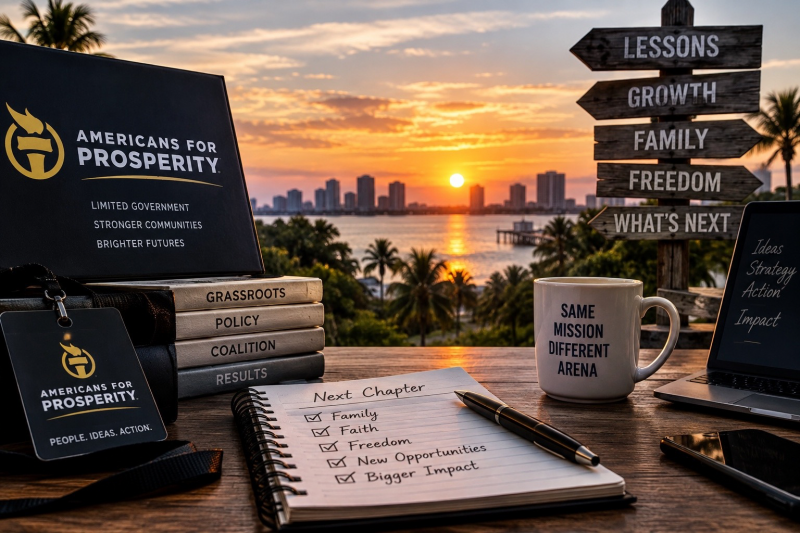
Same Mission. Different Arena.
Today, much of my political and advocacy work happens through digital strategy and communications.
I work with candidates, grassroots organizations, party affiliates, nonprofits and businesses on campaigns designed to drive actual action rather than simply inflate vanity metrics.
And I love it.
Seriously.
I enjoy this work more.
I can take everything I learned from years of grassroots organizing—the relationships, persuasion, coalition building, messaging, mobilization and understanding of what makes someone actually take action—and combine it with digital tools capable of reaching people at enormous scale.
I’m currently doing that work through Emerald Coast Media, while remaining open to opportunities to take that approach to a larger scale with the right organization.
Same basic mission.
Different arena.
And, importantly, a life that leaves considerably more room for my family.
I Don’t Regret AFP
This is probably the most important thing I can say.
I don’t hate Americans for Prosperity.
I don’t hate AFP Florida.
I don’t have some personal vendetta against its leadership.
AFP has employed and trained some extraordinary people. I’ve met passionate volunteers across state chapters who sincerely want to make their communities better.
AFP-New Mexico’s criminal-justice work remains something I’m enormously proud to have participated in. The coalition we helped build demonstrated that organizations with major ideological differences could nevertheless cooperate around constitutional rights and government accountability. Public accounts from both AFP and the ACLU document just how unusual and broad that coalition became. (Americans for Prosperity)
My time in Florida taught me lessons too—even the difficult parts.
Especially the difficult parts.
I’ve grown.
I’ve learned.
I’ve matured.
And I’ve gotten much more comfortable recognizing that disagreement doesn’t require hostility.
I can work with AFP tomorrow on something where our principles overlap.
And I can respectfully decline to work with them on something where they don’t.
That’s healthy.
That’s how politics should work more often.
We don’t need to turn every disagreement into a blood feud.
We don’t need to pretend someone is evil because we reached different conclusions.
And we certainly don’t need to remain inside organizations, political parties, careers or movements after realizing they no longer fit who we’ve become.
Sometimes a chapter simply ends.
Mine with Americans for Prosperity did.
There wasn’t a villain.
There wasn’t some grand final battle.
There were good people, meaningful accomplishments, genuine disagreements, professional friction, changing circumstances and eventually a realization that it was time for me to do something different.
So I did.
And looking back now, I’m grateful for what I learned, proud of what we accomplished and completely comfortable saying that leaving was the right decision for my own career and life.
I wish the people at AFP well.
Where we agree, I’m happy to work together.
Where we disagree, I’m happy to shake hands and go our separate ways.
Because ultimately, principles matter more than organizations.
People matter more than politics.
And sometimes moving forward doesn’t require burning the bridge behind you.
Sometimes you just cross it, appreciate where it took you, and keep walking toward whatever comes next.
Add comment
Comments