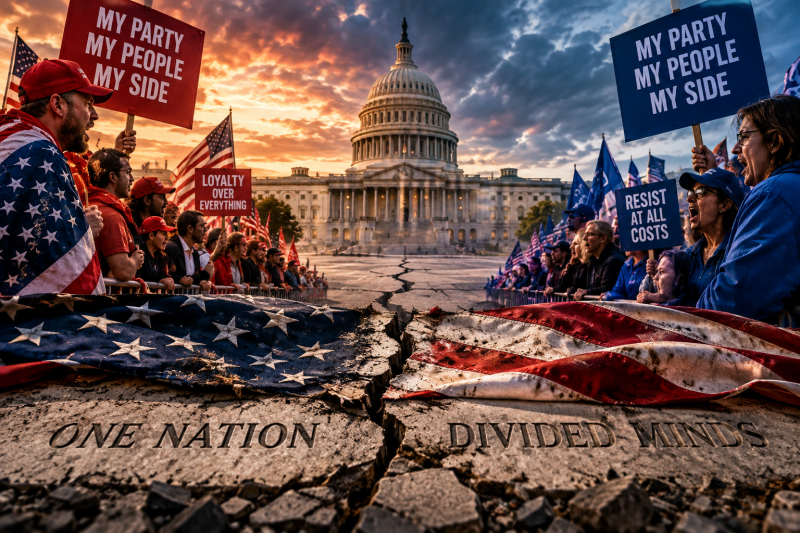
Spend enough time around American politics and you will hear plenty of warnings about dangerous “isms.”
Socialism.
Communism.
Authoritarianism.
Fascism.
And there are legitimate historical reasons Americans should understand each of them. Political philosophies matter. The concentration of government power matters. Individual liberty matters. Property rights matter. Free speech matters. Due process matters. The constitutional restraints placed upon government matter.
I am certainly not suggesting we stop having those conversations.
But I think we are overlooking another “ism” that is operating right in front of us.
Tribalism.
Unlike some theoretical argument about what America might become twenty years from now, political tribalism is already influencing how millions of Americans process information, judge politicians, interpret government actions, interact with neighbors, and even decide whether something is right or wrong.
And it is not confined to one political party.
That is precisely what makes it so dangerous.
Political tribalism transforms politics from a competition of ideas into a competition of identities. The question stops being, “Is this policy constitutional, effective, affordable, or morally defensible?”
Instead, the question becomes:
“Which team did it?”
That distinction might sound small.
It isn’t.
It changes everything.
When Politics Becomes an Identity
Political scientists usually use somewhat more precise terminology than “tribalism.” Researchers frequently discuss affective polarization—the increasing tendency of Republicans and Democrats to dislike and distrust members of the opposing party.
An extensive review of the research published in the Annual Review of Political Science describes affective polarization as something distinct from ordinary disagreements over policy. Americans increasingly view partisanship as a social identity, and negative feelings toward the opposing political group can influence behavior well beyond elections or public policy. (Annual Reviews)
Other researchers have gone further.
A group of scholars writing in Science described a phenomenon they called political sectarianism. Their framework focuses on three related forces: “othering” political opponents, developing strong aversion toward them, and moralizing political differences. The danger emerges when defeating the opposing political tribe becomes more important than debating ideas. (PubMed)
That sounds remarkably similar to what many Americans encounter every day.
We increasingly don’t simply disagree with each other.
We assign identities to each other.
Republican.
Democrat.
MAGA.
Progressive.
Liberal.
Conservative.
Socialist.
Fascist.
RINO.
Communist.
Never Trumper.
And once somebody receives the appropriate label, we frequently stop evaluating the individual argument.
The jersey becomes the argument.
The Data Show How Deep the Divide Has Become
Consider how Americans increasingly view politicians from the opposing party.
In June 2024, Pew Research Center reported that just 8% of Democrats and Democratic-leaning independents viewed Donald Trump favorably, while only 6% of Republicans and Republican-leaning independents viewed Joe Biden favorably.
Compare that with 2008.
Back then, 27% of Democrats viewed Republican presidential nominee John McCain favorably—and exactly 27% of Republicans viewed Democratic nominee Barack Obama favorably. (Pew Research Center)
Think about that change.
We certainly had partisan politics in 2008. Republicans and Democrats fought bitterly over taxes, healthcare, Iraq, abortion, spending, judicial nominations and plenty more.
But substantially larger portions of each political coalition could still look across the aisle and say, essentially:
I disagree with that person, but I don’t necessarily despise that person.
That distinction is becoming harder to maintain.
By 2025, Pew found overwhelming frustration directed across party lines. Eighty-six percent of Republicans and Republican-leaning independents said the Democratic Party made them feel frustrated. Among Democrats and Democratic-leaning independents, 89% said the Republican Party made them feel frustrated.
Anger was also widespread: 70% of Republicans expressed anger toward the Democratic Party, while 81% of Democrats expressed anger toward the Republican Party. (Pew Research Center)
Those numbers should concern anyone regardless of party.
Because eventually politics stops being a disagreement over governing philosophy.
It becomes us versus them.
The Home-Team Exception
Here is where tribalism becomes especially corrosive.
People naturally notice hypocrisy in their opponents more easily than hypocrisy within their own coalition.
Imagine two nearly identical government actions.
When Party A does it, supporters of Party B call it unconstitutional.
Four years later Party B controls the government and does essentially the same thing.
Suddenly Party B’s supporters discover seventeen reasons why this situation is completely different.
Then power changes hands again.
Everybody switches arguments.
We see variations of this with executive power, deficits, government spending, surveillance, federalism, foreign intervention, prosecutorial discretion, emergency powers and countless other issues.
The principle somehow changes depending upon who occupies the chair.
That isn’t principled government.
That is political fandom.
If something violates your principles when the other party does it, it should violate your principles when your party does it.
If executive overreach concerns you under a Democratic president, executive overreach should concern you under a Republican president.
If reckless spending bothers you when Republicans control Congress, it should bother you when Democrats control Congress.
If government surveillance threatens civil liberties when directed toward people you sympathize with, it should still threaten civil liberties when directed toward people you dislike.
If political violence is wrong when committed against someone wearing your jersey, it remains wrong when committed against somebody wearing the other jersey.
Principles that disappear when politically inconvenient aren’t really principles.
They’re preferences.
Tribalism Gives Politicians an Incredible Amount of Power
This is perhaps the most dangerous part.
Politicians benefit enormously when voters become tribal.
A principled voter asks difficult questions.
A tribal voter asks only one:
“Is our side winning?”
Those are completely different standards.
A principled voter can support a politician on Monday, oppose that politician’s legislation on Tuesday, praise another decision Wednesday and vote against the politician altogether the next election.
There is nothing inconsistent about that.
That is exactly how representative government should work.
Politicians are public servants.
They are not tribal chiefs.
They are not celebrities requiring unconditional loyalty.
They are certainly not infallible.
Yet increasingly, criticizing someone from your political coalition is treated almost like betrayal.
That creates terrible incentives.
If politicians know their supporters will defend virtually anything they do because the alternative is allowing the other team to win, accountability collapses.
Why change behavior if your voters aren’t going anywhere?
Why control spending?
Why restrain executive authority?
Why respect constitutional boundaries?
Why compromise?
Why admit mistakes?
Why remove corrupt officials?
Why challenge bad legislation originating from your own side?
If voters have been convinced that every election is an existential battle between absolute good and absolute evil, practically anything can be justified as necessary to prevent the opposing tribe from gaining power.
That is a dangerous road for any republic.
Social Media Didn’t Create Tribalism—but It Supercharged It
Human beings have always formed tribes.
Family.
Community.
Religion.
Ethnicity.
Nationality.
Sports teams.
Political movements.
There is nothing inherently wrong with belonging to a group. Human beings are social creatures, and healthy communities are essential to a functioning society.
The problem begins when group membership overrides independent judgment.
Modern communications technology can make that dramatically easier.
Every day Americans enter information environments filled with algorithms, influencers, partisan commentators, memes, clipped videos and outrage-driven headlines competing for attention.
And anger is remarkably effective at capturing attention.
The result can become a self-reinforcing cycle.
You interact with political content.
Platforms learn what interests you.
You receive more of it.
You become increasingly immersed in one interpretation of political events.
The opposing side appears increasingly incomprehensible.
Eventually you aren’t merely disagreeing with people.
You begin wondering how any decent or intelligent human being could possibly believe what they believe.
That is where disagreement becomes dehumanization.
And once politics reaches that stage, compromise stops looking like negotiation.
It looks like surrender.
There Is an Important Distinction We Should Make
We should also be careful not to exaggerate the evidence.
Americans being angry with one another does not mean the average Republican or Democrat wants political violence.
Research actually provides some reassuring evidence here.
A large study examining more than 73,000 survey interviews found fewer than 4% of Americans supported violent crimes such as assault or arson against political opponents, with similarly low numbers among Democrats and Republicans. (PRL Public)
Another peer-reviewed study found earlier surveys may have substantially overstated public support for partisan violence because ambiguous questions and inattentive respondents distorted the results. After accounting for those problems, researchers estimated substantially lower support. (PubMed Central (PMC))
Other research similarly finds overwhelming majorities of Americans reject violations of democratic norms and partisan violence. (PubMed)
That matters.
We shouldn’t portray America as being on the verge of universal political warfare when the evidence doesn’t support that conclusion.
But neither should we dismiss political tribalism.
More recent research suggests strong partisan identity can influence how people judge identical political behavior. A 2026 survey experiment found partisan bias in assessments of political violence among both Republicans and Democrats, with the effect especially pronounced among strong partisans. (OUP Academic)
The lesson isn’t that Americans are inherently violent.
It is that tribal identity can distort judgment.
And that is dangerous enough.
The Real Damage Happens Before Violence
A republic can suffer tremendous damage without widespread political violence.
Tribalism damages institutions more quietly.
It lowers standards.
It excuses hypocrisy.
It rewards outrage.
It discourages compromise.
It makes friendships across political lines harder.
It incentivizes politicians to demonize opponents.
It turns journalism into competing narratives.
It encourages people to evaluate facts according to whether those facts help or hurt their political coalition.
And perhaps most importantly, it creates different standards for different people.
That is incompatible with equal justice.
A healthy society cannot operate under the principle that wrongdoing is unforgivable when committed by our opponents but understandable when committed by our allies.
Justice requires consistency.
Liberty requires consistency.
Constitutional government requires consistency.
Either the rule applies or it doesn’t.
Americans Are Already Showing Signs of Exhaustion With the Two-Party System
There is another fascinating trend developing beneath all of this.
More Americans are distancing themselves from formal identification with either major political party.
Gallup reported in January 2026 that a record 45% of U.S. adults identified politically as independents during 2025.
Only 27% identified as Democrats.
Another 27% identified as Republicans. (Gallup.com)
That doesn’t mean 45% of Americans are politically neutral. Many independents lean toward one major party, and Pew has found that partisan leaners often behave politically much like the party toward which they lean. (Pew Research Center)
Still, the scale of independent identification tells us something important.
A massive portion of America doesn’t feel comfortable simply wearing one of the two jerseys.
Pew found in 2023 that 28% of Americans held unfavorable opinions of both major political parties—the highest level in nearly three decades of its polling at that time. Among independents and people identifying with another party, 46% viewed both major parties unfavorably. (Pew Research Center)
That is not a fringe phenomenon.
That is millions upon millions of Americans.
My Own Decision
This is where my personal political decision comes into the conversation.
I have increasingly reached the conclusion that merely complaining about the two-party system while continuing to reinforce it doesn’t make much sense for me.
So I chose another direction.
For me, that means the Libertarian Party.
That is my decision—not an instruction for anyone else.
People should evaluate political parties according to their own principles, priorities and judgment.
My reasoning is primarily structural.
If I am going to invest my time in a third party, I want one with an existing national organization and a demonstrated ability to overcome the extraordinarily complicated ballot-access requirements imposed across fifty different states.
The Libertarian Party describes itself as America’s third-largest political party and has state-level organizational infrastructure across the country. (Libertarian Party)
More concretely, its 2024 presidential ticket of Chase Oliver and Mike ter Maat qualified for the ballot in 47 states, while pursuing recognized write-in status in the remaining three. (Chase Oliver for President) The Federal Election Commission also identifies Oliver as the Libertarian Party’s 2024 presidential candidate. (FEC.gov)
That ballot-access infrastructure matters to me.
It doesn’t mean the Libertarian Party is perfect.
It isn’t.
No political party composed of human beings ever will be.
And Libertarians themselves are certainly capable of falling into exactly the tribalism I’m criticizing here.
Changing the color of the jersey while keeping the same mentality solves absolutely nothing.
The point is bigger than one political party.
The Answer Isn’t Necessarily Becoming Less Political
I don’t believe the solution is for Americans to stop caring about politics.
Quite the opposite.
We need citizens who care deeply about government because government possesses enormous power over our lives.
But we need to rediscover something more important than partisanship:
Principle.
Ask yourself what you actually believe before asking what your political party believes.
Write it down if necessary.
What should government’s proper role be?
What rights belong to every person?
When may government legitimately use force?
What constitutional limitations should constrain political power?
What level of taxation is justified?
What civil liberties should government respect?
When should America use military force?
What powers should belong to Washington, the states, local communities, families and individuals?
Then apply those principles consistently.
Especially when consistency becomes inconvenient.
That last part is the test.
Anyone can defend civil liberties for people they like.
Defend them for people you despise.
Anyone can oppose government censorship when their side is being censored.
Oppose it when the speech disgusts you.
Anyone can criticize executive power when the opposing party controls the White House.
Demand restraint when your preferred candidate controls it.
Anyone can condemn corruption across the aisle.
Demand accountability inside your own coalition.
That is how you defeat tribalism.
We Also Need More Human Contact Across Political Lines
There is encouraging research here.
A massive Science study involving more than 32,000 participants tested 25 different interventions designed to reduce partisan animosity and antidemocratic attitudes.
Some of the strongest reductions in partisan hostility came from something remarkably simple: showing people relatable, sympathetic individuals who held different political beliefs and emphasizing identities Americans shared across partisan lines.
Correcting inaccurate perceptions about opposing partisans also helped reduce certain antidemocratic attitudes. (DOI)
In other words, one antidote to political tribalism is remembering that the person on the other side of the political argument is still a person.
Your neighbor.
Your coworker.
Your cousin.
The guy coaching Little League.
The woman sitting two pews over on Sunday.
The business owner down the street.
The veteran drinking coffee at the diner.
The parent sitting beside you at the school board meeting.
We have far more identities than Republican and Democrat.
We are Americans.
We are parents, children, neighbors, workers, entrepreneurs, veterans, volunteers, parishioners, coaches, teachers and friends.
Politics should never become so powerful that it consumes all those other relationships.
Stop Treating Washington Like the Super Bowl
Politics is not sports.
There is no trophy awarded to ordinary Americans because their political team controlled Washington for four years.
Your mortgage doesn’t care which jersey won.
Your grocery bill doesn’t care.
The national debt doesn’t care.
Your constitutional rights don’t care.
Your small business doesn’t care.
Your children’s future doesn’t care.
Good policy is good policy regardless of who proposes it.
Bad policy is bad policy regardless of whose name appears beside it.
We should be capable of praising politicians we normally oppose when they get something right.
We should be equally capable of criticizing politicians we normally support when they get something wrong.
That isn’t weakness.
That isn’t disloyalty.
That is citizenship.
America Doesn’t Need Another Tribe
The ultimate answer to tribalism cannot simply be building a third tribe.
That would miss the entire point.
Whether someone chooses to remain Republican, remain Democratic, become independent, join the Libertarian Party or support another political movement is ultimately that person’s decision.
The more fundamental question is whether Americans are willing to place principle above party.
Because tribalism thrives when identity replaces judgment.
It thrives when disagreement becomes hatred.
It thrives when hypocrisy becomes acceptable because our side did it.
It thrives when politicians convince ordinary Americans that their neighbors are enemies.
And it thrives whenever winning becomes more important than being right.
Yes, Americans should understand socialism.
We should understand communism.
We should understand authoritarianism.
We should understand fascism.
History gives us ample reason to understand what happens when political power becomes concentrated, individual dignity is disregarded and governments escape meaningful restraints.
But we should also recognize the danger sitting directly in front of us.
Tribalism.
It is already here.
It is already influencing how Americans see each other.
And unlike some distant ideological threat, defeating it doesn’t require waiting for Congress, the president, the Supreme Court or the next election.
It begins with us.
Take off the jersey.
Read beyond the headline.
Question your own side.
Give your opponent the same benefit of the doubt you give your allies.
Apply the same constitutional standard regardless of who holds power.
Judge policies on their merits.
Judge politicians by their actions.
And never allow a political party to become such an important part of your identity that defending the team becomes more important than defending your principles.
Because a free society doesn’t require Americans to agree.
It requires something much harder.
It requires us to disagree without forgetting that we are still countrymen.
And if we can relearn how to do that, we may discover that America’s greatest political divide isn’t actually between left and right.
It’s between people who believe politics is a team sport—and people who still believe citizenship requires thinking for yourself.
Add comment
Comments