I believe people are allowed to change their minds.
Actually, I wish more people in politics would.
There is nothing inherently wrong with looking at new evidence, realizing you got something wrong, and saying so publicly. In an era when politicians and political personalities would rather perform intellectual gymnastics than admit they made a mistake, changing your mind can be admirable.
So when Laura Loomer says she was wrong about Ukraine, I am perfectly willing to consider that possibility.
What I am considerably less willing to do is ignore the timeline.
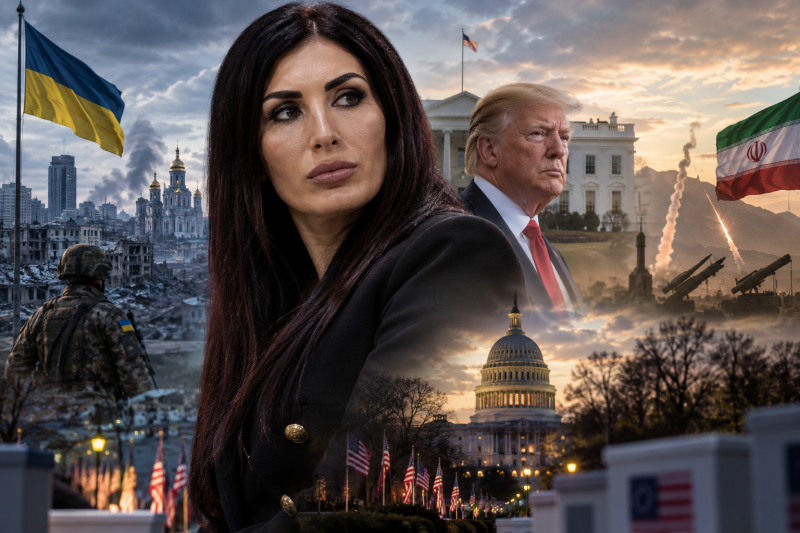
Because when you put Laura Loomer’s dramatic reversal on Ukraine alongside Donald Trump’s changing rhetoric toward Kyiv, the increasingly unpopular American war with Iran, Loomer’s battles with anti-war figures inside MAGA, an organized effort to persuade conservative influencers on Ukraine, her direct access to Trump, and a midterm environment that has become increasingly difficult for Republicans, the chronology becomes impossible to dismiss as politically irrelevant.
Does that prove there was some secret White House meeting where somebody told Loomer to change the subject from Iran to Ukraine?
No.
I found no evidence of that.
No email. No text message. No financial transaction. No recorded conversation. No credible source saying Trump instructed Loomer to become pro-Ukraine as part of an electoral strategy.
And I think intellectual honesty requires saying that clearly.
But there is another question entirely:
Is Loomer’s Ukraine transformation extraordinarily convenient for the political movement with which she has built her influence, access, audience and professional identity at precisely the moment that movement desperately needs a different foreign-policy conversation?
The public record gives us plenty to examine.
And the deeper I dug, the more interesting the timeline became.
Start on February 28, Not in Ukraine
If you want to understand Loomer’s Ukraine reversal, I don’t think the story starts in Kyiv.
I think it starts on February 28, 2026.
That was when the United States and Israel launched military action against Iran.
Loomer immediately became one of Trump’s most aggressive defenders on the issue.
That matters because Iran quickly exposed one of the deepest contradictions inside the modern America First coalition.
Trump had spent years presenting himself as the president who opposed endless wars and foreign entanglements. Yet America was suddenly involved in another Middle Eastern conflict.
Parts of Trump’s own political coalition revolted.
Tucker Carlson criticized the intervention.
Other prominent figures on the right questioned it.
Rep. Thomas Massie opposed the war.
Marjorie Taylor Greene criticized the direction of foreign policy.
And Loomer?
She went after them.
Not casually.
Aggressively.
The Washington Post reported that Loomer communicated directly with Trump about criticism coming from figures including Carlson, Megyn Kelly and Greene.
That establishes something important before Ukraine ever enters the story:
Laura Loomer was personally aware of the political fracture Iran was creating inside Trump’s coalition, and she was communicating directly with Trump about that fracture.
By early March, another theme began appearing in her commentary.
Russia.
More specifically, Russian state media.
Loomer began arguing that RT and other foreign outlets were amplifying right-wing personalities attacking Trump’s Iran policy.
That becomes enormously important later.
Because when Loomer eventually explains why she reconsidered Russia, one of her explanations is not simply that she suddenly discovered the history of Russia’s invasion of Ukraine.
She talks about watching right-wing personalities turn against Trump and then seeing Russian media amplify them.
That is a very different origin story.
The road to Loomer’s Ukraine conversion appears to run directly through the MAGA civil war over Iran.
Then Iran Becomes a Political Liability
The political environment deteriorated quickly.
A Quinnipiac University poll released March 9 found that more than half of registered voters opposed the U.S. military action against Iran. Fifty-nine percent said Trump should have received congressional approval before beginning military action, while 62 percent said the administration had failed to provide a clear explanation for it.
By June, the problem had not disappeared.
Quinnipiac’s June 24 polling found 60 percent of voters saying the military action against Iran had not been worth it.
Then came July.
On July 29, Quinnipiac found 66 percent of registered voters saying the war was not worth fighting.
Only 31 percent said it was.
Trump’s overall approval had fallen to 32 percent in that poll.
His handling of Iran was even more unpopular: 28 percent approved and 66 percent disapproved.
Those aren’t obscure numbers buried in a foreign-policy journal.
Those are politically brutal numbers heading toward a midterm election.
And the problem has only become more serious.
By September, Reuters/Ipsos found Trump’s overall approval at 35 percent and Democrats ahead 44 percent to 37 percent on the generic congressional ballot. Reuters noted that the seven-point Democratic advantage was the largest in its polling since Trump returned to office.
Generic congressional polling does not tell us who will control Congress after November. Elections are decided district by district and state by state.
But Republicans have very little room for error.
As of early September, the House stood at 218 Republicans, 214 Democrats, one independent and two vacancies.
The Senate has a Republican majority as well.
Losing either chamber would fundamentally alter Washington during the final two years of Trump’s presidency.
Legislation becomes harder.
Investigations become easier for the opposition.
Committee chairmanships can change.
Subpoena power can change hands.
The entire governing environment changes.
So nobody around Trump needs a political science degree to understand the stakes.
The Most Important Revelation: Loomer’s Shift Wasn’t Spontaneous
This is where the investigation became substantially more interesting.
Before Laura Loomer went to Ukraine, someone from her organization had already gone.
Andrew Moore, a producer working with Loomer Unleashed, traveled to Ukraine with assistance from the Ukraine Freedom Project.
That organization was founded by Steven Moore, a former Republican congressional chief of staff.
Ukraine Freedom Project is remarkably transparent about its mission. It describes itself as a U.S.-based nonprofit working to counter Russian misinformation and provide information about Ukraine to American policymakers and media.
Steven Moore has been even more explicit.
He wrote in July that his organization had been working since 2023 to get information about Ukraine to “conservatives, Republicans and Christians.”
He also confirmed:
“I have never met Laura Loomer and had nothing to do with the planning of her trip, but we took her editor, Andrew Moore, to Ukraine last month.”
Semafor separately reported that Ukraine Freedom Project helped facilitate Andrew Moore’s visit, taking him to an evangelical church damaged by Russia and embedding him with a Ukrainian drone unit.
That does not establish anything nefarious.
Advocacy organizations try to persuade journalists, lawmakers and influencers every day.
But let’s call it what it is.
There was an organized effort to change conservative opinion about Ukraine.
And Loomer’s organization was reached by that effort before Loomer publicly completed her reversal.
That isn’t speculation.
Steven Moore openly discusses the mission.
The Times of London subsequently described a broader campaign aimed at changing Trump and MAGA’s thinking about Ukraine.
Again, there is nothing inherently improper about persuasion.
But it changes the context dramatically.
This wasn’t simply Laura Loomer sitting alone one evening, reading history books and independently discovering that her worldview had been mistaken.
There was an active persuasion network operating around conservative media.
Her producer participated in it.
Then he came home.
Then Loomer’s rhetoric changed.
That deserves attention.
June 16 Is the Date I Keep Coming Back To
June 16 may be the most important date in this entire story.
Andrew Moore had returned from Ukraine.
Loomer brought him onto her program.
And Loomer said something remarkable:
“I fell for Russian propaganda.”
That sounds like the full conversion.
Except it wasn’t.
At that point, Loomer still explicitly opposed sending additional American money to Ukraine.
That distinction matters enormously.
Her position was evolving in stages.
First:
Russia-friendly and deeply skeptical of Ukraine.
Then:
Increasingly suspicious of Russia.
Then:
Reconsidering what she believed about Ukraine.
And finally:
Supporting additional assistance to Ukraine.
Those stages did not occur simultaneously.
On June 16, she was still telling her audience she didn’t favor sending more money to Ukraine.
What had changed most dramatically was her attitude toward Russia.
And once again, her explanation included the politics surrounding Trump.
Loomer described watching RT amplify people on the American right who were attacking Trump.
She also discussed Russia’s relationships with forces and governments hostile to American interests.
The connection between Iran, Trump’s domestic critics and her reconsideration of Russia was already visible.
Then the story accelerated.
Trump Moves Before Loomer Gets to Kyiv
Here is another fact that prevents this story from being reduced to a simplistic conspiracy theory.
Trump’s own Ukraine shift preceded Loomer’s trip.
On July 8, Trump met Ukrainian President Volodymyr Zelenskyy at the NATO summit in Ankara.
Trump’s rhetoric was dramatically different from what Americans had heard earlier in his presidency.
He praised Zelenskyy.
He praised aspects of Ukraine’s military performance.
And he announced that the United States would allow Ukraine to manufacture Patriot missile interceptors.
Reuters described the tone as a sharp departure from Trump’s previous criticism of Zelenskyy.
The Washington Post called it a dramatic change.
So whatever happened with Loomer, she did not single-handedly change Trump’s Ukraine policy.
The president was already moving.
That actually makes the political story more interesting.
Because instead of:
Loomer changes, therefore Trump changes
the chronology looks more like:
Trump begins changing → Loomer rapidly changes → Loomer goes to Ukraine → Ukrainian officials recognize her influence → Loomer interviews Zelenskyy → Trump publicly praises the interview.
That is a very different sequence.
Then Loomer Goes to Ukraine
Loomer arrived in Kyiv on July 19.
Her transformation accelerated almost immediately.
She experienced air-raid warnings.
She visited sites damaged by Russian attacks.
She met Ukrainian officials.
She visited the Kyiv-Pechersk Lavra after Russian drone damage to the historic religious complex.
She publicly challenged Putin’s presentation of Russia as a defender of Christianity.
She began telling her audience that many of the things she had believed about Ukraine were distorted or wrong.
Then she received access that very few American political influencers could dream of receiving.
She sat down with Zelenskyy.
The interview lasted more than 40 minutes.
And Trump noticed.
He shared material from the interview and wrote:
“Very good!!!”
Then Loomer said she called Trump.
She told the Kyiv Independent that she spoke with him after interviewing Zelenskyy and intended to brief him again after returning to Washington.
That creates a fascinating information pipeline:
American pro-Ukraine advocates → Loomer’s producer → Loomer → Ukrainian officials → Zelenskyy → Loomer → Trump.
Every link in that sequence is publicly documented.
What is not documented is any instruction flowing in the opposite direction telling Loomer what position to take.
That distinction has to remain clear.
Follow the Money—Carefully
Whenever political messaging changes this dramatically, people naturally ask who paid for what.
That question produced an interesting answer but not the smoking gun some might expect.
The Washington Post reported that Loomer said American donors helped cover security costs associated with her Ukraine trip.
She declined to identify them.
She also said she received no foreign money.
That leaves a legitimate unanswered question:
Who were those American donors?
I could not find credible public reporting identifying them.
But unidentified donors paying security expenses is not evidence that Ukraine bought Loomer’s opinion.
We should not turn an unanswered question into an accusation.
Similarly, I found no reliable evidence establishing that Trump’s campaign or Republican Party currently pays Loomer to promote particular positions.
Loomer operates Loomer Unleashed, crowdfunds her work, and runs Loomered Strategies, which she has described as providing opposition research, vetting and other due-diligence services.
Her professional world is unquestionably political.
Her influence is unquestionably tied to the Trump-era Republican ecosystem.
Her access to Trump is unquestionably valuable to her public profile.
But those facts are different from proving a direct financial quid pro quo.
Accuracy matters, especially when criticizing people we distrust.
Then Iran Suddenly Becomes an Argument for Ukraine
This may be the most revealing piece of the entire timeline.
By July 27, Loomer had moved beyond admitting she was wrong.
She was advocating that Ukraine receive access to Patriot missiles.
Remember where she stood June 16:
No additional American money for Ukraine.
Six weeks later?
Support Ukraine more substantially.
Then on July 28, Ukrainska Pravda asked Loomer directly what had changed her position.
Her answer brought us straight back to Iran.
Loomer pointed to Russia supplying Iran and cited Ukrainian claims that Russia was providing Iran intelligence useful against American forces.
She argued:
“It seems like it would just be cheaper and more efficient to support the defeat of Russia now than have a full-scale war in the future.”
Think about that progression.
Iran begins creating a massive political fracture inside MAGA.
Loomer defends Trump.
Loomer attacks Trump’s anti-war critics.
Loomer notices Russian media amplifying those critics.
Loomer becomes more suspicious of Russia.
Her producer visits Ukraine through a pro-Ukraine advocacy organization.
Loomer publicly admits falling for Russian propaganda.
Trump independently begins softening toward Zelenskyy.
Loomer travels to Ukraine.
Loomer receives extraordinary access.
Loomer speaks with Trump.
And Loomer then explicitly argues that supporting Ukraine makes sense partly because of Iran.
That doesn’t prove a distraction strategy.
But politically, the overlap is impossible to ignore.
Ukraine Gives Trump Something Iran Cannot
There is another enormous political difference between these conflicts.
Trump can blame Ukraine on Joe Biden.
He has done exactly that.
Trump has repeatedly described the Russia-Ukraine conflict as “Biden’s war.”
Whether someone agrees with that framing or not, its political utility is obvious.
Russia launched its full-scale invasion in February 2022 while Biden was president.
Trump can therefore discuss Ukraine while portraying himself as someone attempting to resolve a conflict inherited from his predecessor.
Iran is different.
The current U.S.-Iran war began February 28, 2026.
Trump owns that decision politically in a way he simply does not own Russia’s original invasion of Ukraine.
That creates an extraordinary messaging asymmetry.
Ukraine allows Trump to talk about war while emphasizing what he inherited.
Iran forces Trump to talk about a war initiated during his own presidency.
And two months before the midterms, one of those conversations is dramatically more politically comfortable than the other.
We Now Know the White House Understands the Midterm Problem
This is where the hypothesis moves beyond simply reading political tea leaves.
On September 2, Reuters reported that senior Trump aides were pushing to keep the Iran conflict from escalating before the November 3 midterm elections.
Reuters cited four people familiar with the discussions.
According to the report, White House officials could reconsider increased military action after the election.
That is significant.
It means electoral considerations surrounding Iran aren’t something outsiders invented.
According to Reuters’ reporting, they are being discussed inside the administration.
The public polling explains why.
By July, Quinnipiac found 66 percent saying the Iran war was not worth fighting.
By September, Reuters/Ipsos showed Republicans trailing nationally on the generic congressional ballot.
The Iran conflict has also produced tangible economic consequences.
Oil disruptions have contributed to higher fuel costs.
And on September 15, the Congressional Budget Office estimated that the war had already cost approximately $38 billion, with additional costs potentially running around $3 billion per month.
Eighteen American service members had died.
Whatever someone’s ideological position on Iran may be, those are real costs.
And voters notice real costs.
The Republican Majority Is Thin
This isn’t occurring in a political vacuum.
Republicans currently hold an extraordinarily narrow House majority.
The House Radio-TV Gallery listed 218 Republicans, 214 Democrats, one independent and two vacancies as of September 2.
Recent procedural votes have demonstrated just how thin the governing margin can become.
That means even relatively modest electoral movement could change who controls committees, legislation and oversight during Trump’s final two years.
Again, national generic-ballot polling does not predict individual congressional races.
It cannot tell us who will win in November.
But it absolutely tells political professionals what the national environment looks like.
And right now, Republicans have reasons to be concerned.
So What Do We Actually Know?
After following every path I could find, here is where the evidence lands.
There was an organized effort to persuade conservatives and Trump-aligned audiences to reconsider Ukraine.
Laura Loomer’s producer participated in that effort.
Loomer’s hostility toward Russia began growing amid the MAGA fracture over Trump’s Iran policy.
She specifically cited Russian amplification of Trump’s right-wing critics as something that changed her thinking.
Her producer then traveled to Ukraine.
Loomer publicly admitted she had fallen for Russian propaganda.
Trump independently began softening toward Ukraine.
Loomer traveled to Ukraine.
Unidentified American donors helped cover her security costs.
Ukrainian officials gave her extensive access.
She interviewed Zelenskyy.
Trump praised that interview.
She spoke directly with Trump afterward.
Within weeks, Loomer moved from opposing additional Ukraine funding to advocating greater military support.
And when asked why she changed her position, she explicitly invoked Russia’s relationship with Iran.
Meanwhile, the Iran war became increasingly unpopular.
Republicans’ national political environment deteriorated.
And Trump aides are now reported to be explicitly considering the midterm calendar when deciding how aggressively to prosecute the Iran conflict.
Those are facts.
What we do not know is whether those facts represent coordination or convergence.
That distinction is everything.
Maybe Laura Loomer Really Changed Her Mind
Perhaps the simplest explanation is true.
Maybe Loomer went through a genuine intellectual evolution.
Maybe she watched Russian media more critically.
Maybe Andrew Moore returned from Ukraine and challenged assumptions she had held for years.
Maybe she traveled there because she genuinely wanted to see the situation herself.
Maybe standing inside buildings damaged by Russian attacks affected her.
Maybe meeting Ukrainians affected her.
Maybe experiencing air-raid warnings affected her.
Maybe she looked at Russia’s relationship with Iran and concluded that her old geopolitical assumptions no longer made sense.
All of that is possible.
People change.
Experience changes people.
Facts change people.
And if that’s what happened, admitting publicly that she was wrong deserves more credit than pretending she never held those views.
But none of that requires us to pretend political incentives don’t exist.
Laura Loomer has built enormous influence through her proximity to Trump and her willingness to defend him against people she considers disloyal.
She has described her work in intensely Trump-centered terms.
Her consulting business operates inside the political ecosystem.
Her audience exists largely inside that ecosystem.
And she has demonstrated extraordinary access to the president himself.
Those relationships don’t prove dishonesty.
They do make political context relevant.
The Question I Cannot Get Past
The question isn’t simply whether Loomer believes what she is saying today.
She may.
The better question is:
Why did all of these incentives, relationships, foreign-policy shifts and political necessities converge when they did?
February: Iran begins.
March: MAGA fractures.
March: Loomer starts highlighting Russian amplification of Trump’s critics.
Spring: Iran becomes increasingly unpopular.
Late May and June: Loomer’s producer travels to Ukraine through an organization deliberately trying to change conservative opinion.
June 16: Loomer publicly says she fell for Russian propaganda while still opposing additional Ukraine funding.
July 8: Trump dramatically softens toward Zelenskyy.
July 19: Loomer arrives in Ukraine.
July 23: she interviews Zelenskyy.
Trump praises it.
Loomer speaks with Trump.
July 27: she advocates Patriots for Ukraine.
July 28: she explicitly cites Iran as part of her reason for supporting Ukraine.
July 29: polling shows two-thirds of registered voters saying the Iran war wasn’t worth fighting.
September: Reuters reports Trump aides want to keep Iran relatively quiet until after the midterms because of Republican electoral concerns.
September: Republicans trail nationally in Reuters/Ipsos congressional preference polling.
That is one remarkable sequence of events.
Maybe every piece of it developed organically.
Maybe Loomer simply changed her mind at precisely the moment Trump was changing his.
Maybe Ukraine’s interests, Loomer’s interests and Trump’s political interests simply converged.
Possible.
But political journalism shouldn’t require us to choose between declaring a conspiracy and pretending coincidences aren’t worth examining.
There is a responsible middle ground.
Follow the chronology.
Follow the relationships.
Follow the money where the money can actually be documented.
Separate evidence from inference.
And keep asking questions.
Because skepticism isn’t cynicism.
It’s citizenship.
I don’t need to prove that Laura Loomer received instructions from Donald Trump to find this story politically fascinating.
I don’t need to claim Ukraine secretly purchased her support.
I don’t need an elaborate conspiracy theory at all.
The documented story is interesting enough.
A highly influential Trump ally who had spent years attacking Ukraine began reconsidering Russia amid a bitter MAGA fight over Trump’s increasingly unpopular Iran war. Her producer was then brought to Ukraine through an organized conservative-persuasion effort. Trump began changing his own Ukraine posture. Loomer followed with an extraordinary reversal, traveled to Ukraine with security expenses partly covered by unidentified American donors, met Zelenskyy, communicated directly with Trump, and eventually used Iran itself as an argument for why Americans should support Ukraine.
All of this happened while Iran was becoming an increasingly serious political problem for Trump and Republicans heading into an election that will determine who controls Congress during the final two years of his presidency.
That does not prove coordination.
It does establish political convenience.
And until the remaining unanswered questions—particularly the identities and interests of the American donors who helped fund Loomer’s security and the full extent of communications surrounding her trip—are answered publicly, the timeline deserves scrutiny rather than dismissal.
People are allowed to change their minds.
Laura Loomer is allowed to change hers.
But voters are allowed to look at when, how, and around whom that change happened.
And then make up their own minds about what it means.
Add comment
Comments