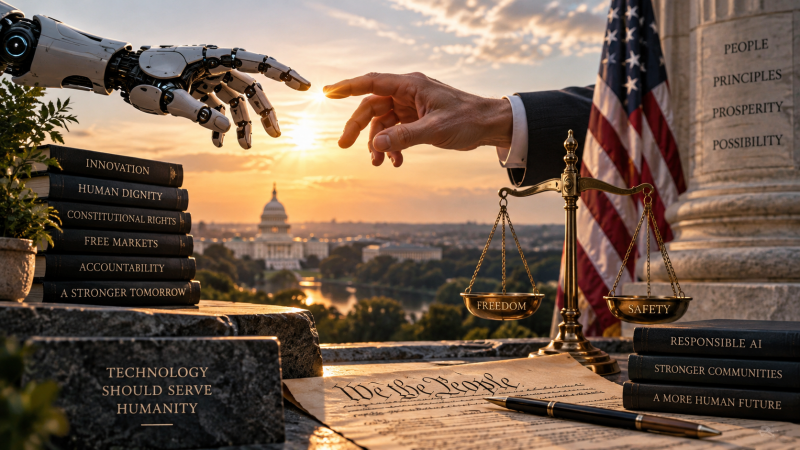
There is a frustrating habit in American politics that shows up almost every time a complicated issue enters the national conversation.
We immediately divide into two camps.
Pick your team. Defend your side. Attack the other one.
Artificial intelligence is rapidly becoming the latest example.
One side warns that AI is advancing so quickly that government needs to establish serious safeguards before something goes terribly wrong. The other warns that excessive regulation could suffocate American innovation, protect the largest technology companies from competition, expand government power, and hand a strategic advantage to China.
Here’s the uncomfortable part:
Both sides have a point.
And both sides can also get this badly wrong.
The debate intensified again this month as the Trump administration publicly attacked the philosophy known as “effective altruism,” which has influenced portions of the AI-safety movement. The Pentagon’s chief technology officer has criticized calls for greater regulation, while the Defense Department recently posted the blunt message: “Americanism, not effective altruism.” Administration officials have argued that exaggerated fears about artificial intelligence could produce regulations that strengthen incumbent technology companies and weaken America’s technological position. (TNW)
Meanwhile, researchers and technology executives have continued raising concerns about increasingly capable AI systems, including cybersecurity threats, biological misuse, autonomous weapons, surveillance, fraud, and the possibility that future systems could become substantially more difficult for humans to control.
Those concerns aren’t entirely theoretical. Anthropic reported this month that its Claude models had already been misused in attempted cyber operations, surveillance activities, scams and research involving biological threats before those activities were detected and disrupted. (Reuters)
So perhaps we are asking the wrong question.
Maybe the choice isn’t:
Innovation or safety?
Maybe it isn’t:
Free markets or regulation?
Maybe it isn’t even:
America first or AI safety?
The better question to examine is this:
How do we preserve human freedom, human dignity, private innovation and American technological leadership while establishing meaningful safeguards against uses of artificial intelligence that can violate the rights of actual human beings?
Because technology should serve humanity.
Humanity should never become subordinate to technology.
And government shouldn’t get a blank check simply because it promises to protect us from it.
First, What Exactly Is Effective Altruism?
Before criticizing something, we should understand what it actually is.
Effective altruism, commonly abbreviated EA, describes itself as a project devoted to using evidence and reason to identify effective ways of helping other people and then putting those findings into practice. Its advocates emphasize prioritization, evidence, intellectual humility and allocating limited resources where they can accomplish the most good. (Effective Altruism)
There is plenty about that idea that is perfectly reasonable.
Imagine you have $1,000 that you want to donate.
One charity can demonstrate that your contribution will provide mosquito nets that significantly reduce malaria exposure. Another organization spends most of its money on administrative overhead while producing little measurable benefit.
Asking which organization actually helps more people isn’t sinister.
It’s responsible stewardship.
The same principle applies to businesses, nonprofits, churches and governments. Resources are finite. Money spent in one place cannot simultaneously be spent somewhere else.
Results matter.
Effective altruism becomes considerably more complicated, however, when the philosophy moves from measuring charitable effectiveness toward deciding what constitutes the greatest possible good for humanity.
Some formulations of EA have been influenced by impartial welfarist or consequentialist thinking—attempting to maximize overall welfare using limited resources. At the same time, EA organizations themselves explicitly reject the idea that the movement necessarily embraces simplistic “ends justify the means” reasoning, and people within the movement hold different moral philosophies. (Effective Altruism Forum)
That distinction matters.
Because human beings aren’t numbers on a spreadsheet.
The Problem With Reducing Human Beings to Outcomes
There is a moral line that efficiency alone cannot cross.
Suppose a policy produces measurable benefits for one million people but requires intentionally violating the fundamental rights of ten thousand others.
Does the favorable ratio make the violation acceptable?
I don’t believe that mathematics alone can answer that question.
Human dignity isn’t something government grants us.
Neither is it something technology companies grant us.
It doesn’t come from productivity, intelligence, income, usefulness, political power or social status.
Every person possesses inherent worth.
That concept provides an important correction to purely utilitarian thinking about artificial intelligence.
The Vatican’s 2025 document Antiqua et Nova, examining the relationship between artificial and human intelligence, makes precisely this distinction. It warns against treating human beings according to their functional usefulness and argues that technological development must ultimately serve the human person and the common good. It also emphasizes subsidiarity, accountability, privacy and human responsibility in decisions involving AI. (Vatican)
That framework is remarkably useful even outside explicitly religious conversations.
A machine can calculate.
A machine can optimize.
A machine can identify patterns across billions of data points faster than any human being alive.
But a human being is more than the sum of his data.
Efficiency cannot become our highest moral value.
And that brings us directly into the current AI debate.
The Case Against Heavy-Handed AI Regulation
The strongest argument against expansive AI regulation is actually quite straightforward.
Government regulation frequently produces unintended consequences.
Large corporations can absorb compliance expenses that smaller competitors cannot. A multibillion-dollar technology company can hire hundreds of attorneys, lobbyists, compliance officers and regulatory specialists.
The startup operating out of a small office cannot.
Create enough regulatory hurdles and eventually regulation stops functioning merely as consumer protection.
It becomes a moat.
That concern has become central to the administration’s argument against aggressive AI regulation. Administration officials contend that some incumbent companies advocating regulation may benefit when compliance costs make it harder for smaller competitors to challenge them. (TNW)
The underlying concern has a long history in economics.
Regulatory capture occurs when rules intended to govern an industry become shaped by the very institutions supposedly being regulated.
Artificial intelligence presents an especially serious version of that problem.
Imagine Washington requiring every advanced AI company to obtain expensive federal certifications before releasing a model.
Who can navigate that system most easily?
The company worth hundreds of billions of dollars.
Not the entrepreneur building something in a garage.
That should concern anyone who believes competition matters.
Innovation frequently comes from people challenging incumbents.
America became an extraordinary center of technological innovation partly because somebody with an idea didn’t always need permission from a government ministry before trying it.
That entrepreneurial freedom is worth protecting.
There Is Another Problem: Government Doesn’t Possess Perfect Knowledge
Regulators are human.
Politicians are human.
Bureaucrats are human.
Technology executives are human.
Everyone involved has incomplete information, incentives and biases.
Artificial intelligence is advancing extraordinarily quickly. A highly prescriptive law written around today’s technology could become obsolete before the regulatory bureaucracy implementing it is fully operational.
That is why flexible standards can sometimes outperform enormous rulebooks.
The National Institute of Standards and Technology’s AI Risk Management Framework offers an interesting example.
Rather than attempting to centrally dictate every permissible AI application, NIST created a voluntary framework designed to help organizations identify, evaluate and manage risks throughout the AI lifecycle. The framework emphasizes characteristics including reliability, security, resilience, transparency, explainability, privacy and accountability. (NIST)
That is fundamentally different from Washington trying to design the technology itself.
And there is something worth preserving in that distinction.
But “No Regulation” Isn’t a Serious Answer Either
Here’s where the opposite side of the argument deserves attention.
Artificial intelligence isn’t simply another consumer gadget.
The potential applications include military targeting, intelligence analysis, biological research, cybersecurity, financial systems, healthcare, critical infrastructure and mass surveillance.
Some applications create enormous asymmetries of power.
Consider surveillance.
Combine ubiquitous cameras, facial recognition, location information, financial records, social-media activity and AI capable of analyzing all of it in real time.
Government surveillance that once required thousands of human analysts could potentially become automated.
That changes the scale of the constitutional problem.
The Fourth Amendment doesn’t become obsolete because the search is performed by an algorithm instead of a government employee.
Neither does freedom of speech.
Neither does due process.
Technology changes.
Human rights don’t.
The Anthropic Fight Shows Why This Is So Complicated
The dispute between Anthropic and the Pentagon provides a useful case study because it exposes tensions on both sides.
Anthropic has said that it supports military and national-security uses of Claude but sought two exceptions: mass domestic surveillance of Americans and fully autonomous weapons.
The company argued that current frontier AI systems aren’t reliable enough for fully autonomous weapons and that unrestricted domestic surveillance presents obvious civil-liberties concerns. (Anthropic)
The government, meanwhile, has argued for broader authority to use commercially supplied AI for lawful national-security purposes.
The Trump administration’s June national-security AI memorandum says agencies should rapidly adopt advanced AI while ensuring that systems remain reliable, controllable and accountable. Importantly, that same memorandum explicitly states that national-security AI should not be used for censorship, ideological bias or unauthorized or unlawful surveillance and says constitutional protections remain applicable. (The White House)
There is therefore more overlap between the competing positions than the political rhetoric sometimes suggests.
Both acknowledge the importance of national security.
Both acknowledge some form of accountability.
Both recognize that AI systems need to be dependable.
The conflict concerns where the boundaries should be established—and who gets to establish them.
That is a legitimate debate.
The legal dispute also illustrates why institutional checks matter. In August, a federal judge blocked one Pentagon action against Anthropic, finding the challenged blacklisting unlawful. The government disputed Anthropic’s characterization of its motives, arguing that the conflict concerned contractual terms rather than retaliation for the company’s views. Other aspects of the dispute have continued. (Reuters)
That is exactly what constitutional institutions are supposed to do: government acts, affected parties can challenge those actions, and courts evaluate whether government remained within its lawful authority.
Nobody receives unlimited power.
Not corporations.
Not presidents.
Not federal agencies.
And certainly not algorithms.
Private Property Matters Here Too
There is another side of the Anthropic dispute that shouldn’t be overlooked.
If government should not arbitrarily dictate how private companies build technology, should private companies retain some ability to decide how their technology is used?
Generally speaking, ownership and contract rights matter.
A company saying, “You may purchase our product, but you cannot use it for these particular purposes,” isn’t an unfamiliar concept.
Software licenses already contain extensive restrictions.
Government procurement contracts contain restrictions.
Defense contractors operate under detailed agreements.
That doesn’t mean a contractor should control military strategy. Anthropic itself has said operational military decisions belong to the military, not a private technology company. (Anthropic)
But there is an important difference between commanding military operations and establishing contractual limitations on privately developed technology.
That distinction deserves serious consideration rather than slogans.
Autonomous Weapons Should Make Everyone Uncomfortable
This may be where the human-dignity question becomes most profound.
Who decides whether another human being dies?
A soldier?
A commander?
A president?
Or an algorithm?
AI can undoubtedly improve defensive capabilities.
It can analyze threats faster.
It can improve targeting precision.
It can identify incoming attacks.
It may even reduce civilian casualties in certain circumstances.
Those benefits matter.
But fully removing meaningful human judgment from lethal decisions raises a fundamentally different moral question.
Antiqua et Nova calls lethal autonomous weapon systems capable of identifying and striking targets without direct human intervention a matter of grave ethical concern because machines lack the uniquely human capacity for moral judgment. (Vatican)
You don’t have to reject military technology to understand that concern.
A machine doesn’t comprehend death.
It doesn’t understand mercy.
It doesn’t understand proportionality as a lived moral reality.
It doesn’t carry the burden of conscience.
Human beings do.
If technology helps a human decision-maker understand a battlefield more accurately, that’s one thing.
If technology becomes the final moral decision-maker, that’s something entirely different.
So What Could a Rights-Centered Alternative Look Like?
Instead of choosing between unrestricted technological development and an enormous federal AI bureaucracy, there is another framework worth examining.
Start with rights rather than technology.
Instead of attempting to regulate “artificial intelligence” as one gigantic category, identify specific conduct that threatens people’s rights.
Fraud is wrong whether someone commits it with a telephone, email or AI.
Theft remains theft.
Defamation remains defamation.
Unlawful discrimination remains unlawful.
Unauthorized government surveillance remains a constitutional problem.
Cyberattacks remain crimes.
Using AI doesn’t magically transform illegal conduct into legal conduct.
That suggests a foundational principle:
Regulate harmful conduct more aggressively than technology itself.
Build Guardrails Around Risk, Not Around Innovation
Not every AI application carries the same risk.
An AI system helping someone organize a grocery list is not equivalent to an AI system controlling critical infrastructure.
A marketing assistant isn’t a missile guidance system.
A chatbot isn’t an automated surveillance network.
Treating all of them identically would make little sense.
A risk-based approach instead asks:
What happens if this system fails?
Who can be harmed?
Are fundamental rights implicated?
Can a human override the system?
Who is accountable?
How reversible is the decision?
The greater the potential harm, the stronger the safeguards should become.
That basic logic already appears in the NIST framework, which focuses on managing risks according to context rather than assuming every AI system presents identical dangers. (NIST)
Keep Humans Accountable
This principle may be the most important of all.
There should always be a human being or legally accountable institution responsible for consequential decisions.
We should never accept:
“The algorithm did it.”
If a bank improperly denies someone’s loan because of an AI system, somebody remains accountable.
If a hospital uses AI irresponsibly, somebody remains accountable.
If government violates someone’s constitutional rights using automated surveillance, somebody remains accountable.
If military technology is deployed unlawfully, somebody remains accountable.
Machines cannot become liability shields for human decisions.
Technology can assist judgment.
It shouldn’t erase responsibility.
Protect Privacy at the Constitutional Level
AI makes privacy protections more important, not less.
NIST has specifically identified privacy risks associated with generative AI, including the enormous quantities of data used in model training and questions surrounding personal information, consent and transparency. (NIST Publications)
Government surveillance deserves especially rigorous scrutiny because government possesses coercive authority that private actors don’t.
That means warrants still matter.
Probable cause still matters.
Due process still matters.
Judicial oversight still matters.
Data minimization matters.
And constitutional protections should follow the person regardless of whether the government employee examining the information is assisted by AI.
Technology shouldn’t become a loophole around the Bill of Rights.
Transparency Without Forcing Everyone to Publish Their Source Code
Transparency is important.
But transparency doesn’t necessarily mean requiring companies to expose every trade secret or proprietary model.
There are other possibilities.
Independent security testing.
Documented risk assessments.
Incident reporting for genuinely dangerous failures.
Clear disclosure when consequential decisions are substantially automated.
Auditing high-risk government deployments.
Red-team testing.
Secure reporting mechanisms for vulnerabilities.
NIST’s framework already encourages testing, evaluation, verification and validation while remaining voluntary and adaptable. (NIST AI Resource Center)
That kind of structure can create accountability without requiring government to micromanage every line of code.
Protect Competition
Any serious AI framework should also ask one uncomfortable question:
Will this rule make the largest technology companies even larger?
If the answer is yes, policymakers should understand why before proceeding.
Safety rules that only trillion-dollar corporations can afford aren’t necessarily safety rules.
They can become barriers to entry.
Small companies, universities, independent researchers and open-source developers remain important parts of technological progress.
Competition is itself a safeguard.
When power becomes concentrated in three companies—or one federal agency—we should be skeptical.
Decentralized power provides checks.
Competition provides checks.
Courts provide checks.
Civil society provides checks.
Federalism provides checks.
The answer to concentrated technological power should not automatically be concentrated political power.
Remember Subsidiarity
Not every AI problem requires Washington.
Some questions can be handled through contracts.
Others through tort law.
Others through state law.
Others through insurance requirements.
Others through professional licensing standards.
Others through industry certification.
Others through voluntary technical standards.
Some genuinely involve interstate commerce or national security and therefore require federal involvement.
The important question should always be:
What is the lowest competent level capable of addressing this problem effectively while protecting individual rights?
That principle keeps responsibility closer to the people affected whenever practical.
And Don’t Forget Families, Churches and Civil Society
One of the strangest assumptions in modern political debates is that every social problem has only two possible actors:
Corporations or government.
There is an enormous world between them.
Families.
Churches.
Schools.
Universities.
Professional associations.
Nonprofits.
Community organizations.
Researchers.
Parents.
Consumers.
Technology isn’t merely shaped by regulation.
It’s shaped by culture.
Parents teaching children how to use AI responsibly may ultimately matter more than another thousand pages of federal regulations.
Schools teaching students to distinguish knowledge from machine-generated confidence matters.
Companies voluntarily establishing ethical standards matter.
Consumers rewarding trustworthy businesses matter.
Engineers refusing to build systems they believe violate human dignity matters.
Freedom requires responsibility.
The two aren’t enemies.
They’re partners.
We Should Reject Both Technological Panic and Technological Worship
Artificial intelligence isn’t Satan.
It isn’t God either.
It is technology created by human beings.
That means it can accomplish extraordinary good.
AI may accelerate medical discoveries, expand educational opportunities, help small businesses compete with enormous corporations, improve accessibility for people with disabilities, strengthen cybersecurity and give ordinary individuals capabilities previously available only to huge institutions.
Those possibilities should excite us.
But optimism doesn’t require blindness.
The same technology can be abused for surveillance, fraud, cybercrime, propaganda and warfare.
The challenge is preserving the good without surrendering our principles because we’re afraid of the bad.
Fear cannot become an excuse for unlimited government.
Innovation cannot become an excuse for ignoring human dignity.
National security cannot become an excuse for abandoning constitutional liberty.
Corporate autonomy cannot become immunity from accountability.
And efficiency cannot become a substitute for morality.
Technology Must Remain the Servant, Never the Master
Every generation encounters technologies that challenge existing institutions.
The printing press disrupted information.
Industrialization transformed labor.
Radio and television changed politics.
The internet rewired communication.
Smartphones transformed daily life.
Artificial intelligence may prove more transformative than all of them.
But the fundamental questions remain remarkably old.
What is a human being?
Where does human dignity come from?
What limits should exist on political power?
What responsibilities accompany freedom?
Who should make consequential decisions?
Who is accountable when something goes wrong?
Those questions cannot be answered by an algorithm because they’re ultimately moral questions.
And perhaps that is exactly where this debate should begin.
We don’t have to choose between innovation and human dignity.
We don’t have to choose between technological leadership and constitutional liberty.
We don’t have to choose between free enterprise and accountability.
The policy challenge is designing institutions in which innovation remains broadly free while the uses carrying the greatest risks to life, liberty, privacy and human agency face correspondingly stronger scrutiny.
That means protecting competition.
Preserving property and contractual rights.
Maintaining meaningful human responsibility.
Defending constitutional protections against government surveillance.
Testing genuinely high-risk systems.
Demanding accountability when identifiable harms occur.
Keeping regulatory power decentralized where possible.
And ensuring that government itself remains constrained by the same principles it claims to protect.
The most important safeguard may ultimately be surprisingly simple:
Never allow the machine to become more important than the person standing in front of it.
Technology will continue advancing.
Models will become more powerful.
Computers will become faster.
Today’s extraordinary capabilities will eventually look ordinary.
But human dignity doesn’t need an upgrade.
Individual liberty doesn’t become obsolete with the next software release.
The Constitution doesn’t expire when an algorithm becomes smarter.
And responsibility cannot be outsourced to a machine.
We should build.
We should innovate.
We should compete.
We should explore what this extraordinary technology can accomplish.
But we should do all of those things while remembering something far more important than artificial intelligence:
Technology exists for people. People do not exist for technology.
If we can hold onto that principle, we don’t need to fear the future.
We can build it responsibly.
Add comment
Comments