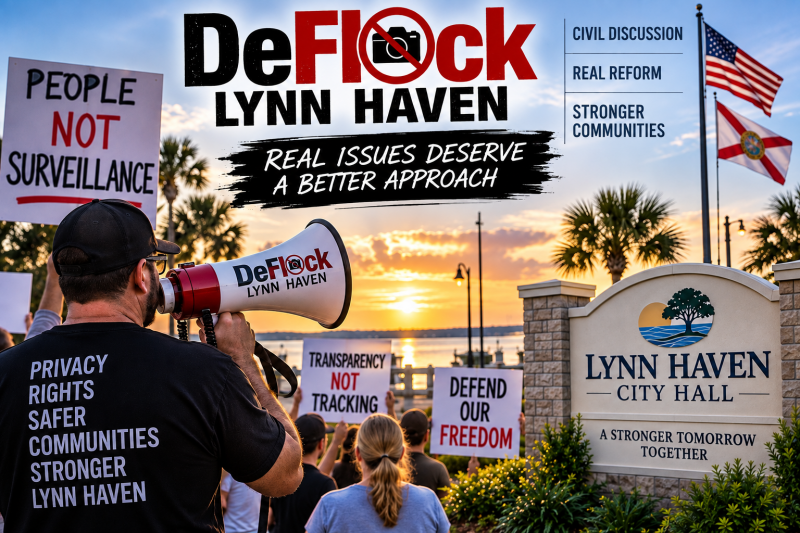
There is a reason I have paid close attention to the debate surrounding DeFlock Lynn Haven.
On the underlying issue, we have considerably more common ground than someone might assume.
I have serious concerns about Flock Safety’s automated license plate reader network. I believe government surveillance deserves intense scrutiny. I believe the Fourth Amendment matters just as much in an age of artificial intelligence, searchable databases, and interconnected cameras as it did when the greatest threat of an unreasonable search involved somebody physically entering your home.
And criminal justice reform?
That is not an abstract issue for me. It is an area where I have spent years doing the difficult, frequently frustrating work of actually trying to change public policy.
That experience is also precisely why I have concerns about the approach surrounding DeFlock Lynn Haven.
Because there is an enormous difference between protesting government and changing government.
I learned that difference firsthand.
I Don’t Come to Criminal Justice Reform as a Spectator
Before getting into DeFlock, some context matters.
I’ve spent a substantial portion of my professional life working in grassroots advocacy and public policy, including criminal justice and civil-rights reform.
In New Mexico, I was part of the effort surrounding one of the country’s most significant state-level qualified-immunity reforms.
The New Mexico Legislature passed House Bill 4, the New Mexico Civil Rights Act, in 2021. The legislation created a state cause of action for violations of rights protected by the New Mexico Constitution and expressly prohibited qualified immunity as a defense under that state-law cause of action. It passed the House 39–29, passed the Senate 26–15 and was signed by Gov. Michelle Lujan Grisham on April 7, 2021. (New Mexico Legislature)
That distinction matters. New Mexico did not abolish the federal qualified-immunity doctrine nationwide or eliminate it from federal §1983 litigation. What we accomplished was creating a state civil-rights remedy where qualified immunity could not be invoked as a defense.
That’s still an extraordinarily significant reform.
And I was part of the grassroots and coalition effort that helped get it across the finish line.
Americans for Prosperity-New Mexico made HB 4 its priority legislation and mobilized thousands of New Mexicans around it. The broader effort brought together organizations and people that normally would not be mistaken for ideological allies: AFP, the ACLU of New Mexico, Institute for Justice, the Innocence Project, criminal-justice advocates and others. Ben Cohen and Jerry Greenfield of Ben & Jerry’s joined the effort as well. (Americans for Prosperity)
I participated in that effort as AFP-New Mexico’s Grassroots Engagement Director, including public advocacy and coalition work around the legislation.
Think about that coalition for a minute.
Conservatives.
Libertarians.
Progressives.
Civil-liberties advocates.
Criminal-justice reformers.
Business-oriented organizations.
People who probably disagreed about 80 percent of everything else happening in American politics.
Yet we worked together.
Why?
Because changing policy requires something very different from screaming at people.
That’s Why DeFlock Lynn Haven Frustrates Me
This is where my disagreement with the approach surrounding DeFlock Lynn Haven begins.
The underlying concerns about Flock aren’t ridiculous.
They’re increasingly mainstream.
Florida itself recently revoked permits for license-plate-reader systems in state highway rights-of-way. The Florida Department of Transportation cited the rapid expansion of the systems along with reports of misuse, privacy concerns and surveillance concerns. (Reuters)
Lynn Haven subsequently suspended its use of Flock. The city announced that Lynn Haven Police Department user accounts associated with the system had been disabled, preventing department personnel from accessing it. Bay County Sheriff’s Office and Panama City Beach Police also moved away from the system. (AOL.com)
Nationally, Flock’s footprint is enormous. Reuters reported this month that the company operates roughly 120,000 cameras across 49 states. A Reuters/Ipsos poll conducted amid the controversy found 47% of respondents opposed having such cameras in their communities, while 38% supported them. (Reuters)
So there is a serious policy conversation sitting right in front of us.
You don’t have to manufacture outrage.
You don’t have to turn every disagreement into a personal feud.
You don’t need slander, insults or ad hominem attacks.
The facts themselves are enough to demand a conversation.
I Learned Something Important From Qualified Immunity Reform
When you’re trying to pass something as controversial as qualified-immunity reform, you quickly discover that being right in your own mind isn’t enough.
You need votes.
You need legislators.
You need coalition partners.
You need ordinary citizens.
You need people who don’t already agree with you.
And eventually, you need somebody sitting on the other side of the table to say:
“Okay. I understand your argument.”
That’s persuasion.
During the New Mexico fight, I worked with people whose political philosophies were radically different from mine. We didn’t pretend those differences didn’t exist.
We simply recognized that constitutional accountability was bigger than our partisan disagreements.
That is how reform works.
You build the broadest coalition possible around the narrow area where people agree.
You don’t spend your time searching for reasons to kick people out of the coalition.
Insults Don’t Build Coalitions
This is where activist movements can lose the plot.
There is a difference between holding elected officials accountable and treating them as enemies.
There is a difference between criticizing someone’s vote and attacking someone’s character.
There is a difference between aggressively challenging government power and creating an environment where anybody who disagrees with your tactics becomes another target.
The first can produce reform.
The second usually produces a social club for people who already agree with one another.
And that may feel good.
It may produce likes.
It may produce shares.
It may create applause at meetings.
But none of those things is the same as producing sustainable public-policy change.
If your goal is reform, ask yourself a brutally practical question:
Did what I just said make the person I need to persuade more likely to listen to me tomorrow?
If the answer is no, what exactly did you accomplish?
DeFlock’s Own Model Actually Shows the Better Path
Ironically, DeFlock’s broader public-facing project contains plenty of examples of what effective advocacy can look like.
Its Lynn Haven page maps reported cameras, tracks government agendas and encourages residents to ask who approved cameras, determine how long data is retained, investigate data sharing, file public-records requests and participate in public meetings. (DeFlock The USA)
Those are substantive tactics.
Public-records requests work.
Government transparency works.
Research works.
Mapping surveillance infrastructure can inform citizens.
Showing up at meetings works.
Drafting policy works.
Finding sympathetic elected officials works.
Building coalitions works.
Educating residents works.
Those tactics create leverage because they produce information, participation and institutional pressure.
That’s very different from turning activism into a perpetual confrontation.
Movements Have to Decide What They’re Trying to Accomplish
Occupy Wall Street offers a useful historical lesson here, although saying it literally accomplished “nothing” would be too broad.
Occupy undeniably changed America’s political vocabulary. “The 99 percent” became part of mainstream political discussion, and economic inequality received enormous attention.
What Occupy struggled to do was convert an extraordinary amount of public attention into a similarly durable institutional policy program.
That distinction matters.
A movement can dominate conversation without dominating legislation.
It can generate thousands of social-media posts without changing a single ordinance.
It can fill a meeting room without assembling enough votes to change the policy being debated.
It can become famous without becoming effective.
That is the danger for any movement built increasingly around confrontation.
Eventually, the confrontation becomes the product.
The issue becomes secondary.
There Are Signs of a Broader National Backlash Against Flock
Which makes unnecessarily abrasive tactics even more puzzling.
Critics of Flock are no longer trying to drag an obscure issue into public consciousness.
The issue has arrived.
Recent reporting shows communities around the country terminating or reconsidering Flock contracts. Privacy controversies, questions about data sharing and documented allegations of misuse have pushed ALPR systems into a national debate. (Reuters)
Florida has taken action.
Lynn Haven has suspended access.
Bay County Sheriff’s Office has stopped using the technology.
In other words, opponents of Flock have an opportunity to turn public concern into thoughtful, durable rules governing surveillance technology.
That should be the focus.
What happens with the next vendor?
What happens when artificial intelligence becomes dramatically better at identifying vehicles, people and patterns?
How long should information be retained?
Who gets access?
Should searches require documented investigative purposes?
What auditing should occur?
When should warrants be required?
What happens when an officer abuses access?
What information should citizens be able to obtain through public records?
Those are serious questions.
Those are policy questions.
And policy questions require serious people willing to sit down and work through them.
Criminal Justice Reform Requires Something More Difficult Than Anger
One lesson I carried away from the qualified-immunity fight is that meaningful reform rarely looks like social media imagines it does.
It isn’t one heroic speech.
It isn’t the perfect protest sign.
It isn’t humiliating somebody at a public meeting.
It’s phone calls.
It’s coalition meetings.
It’s research.
It’s talking points.
It’s legislative language.
It’s thousands of citizen contacts.
It’s explaining the same policy for the hundredth time.
It’s sitting beside somebody with whom you fundamentally disagree because, on this particular issue, you discovered common ground.
It is exhausting.
It is frequently boring.
And it works.
New Mexico’s Civil Rights Act became law because an unusually broad coalition turned a controversial principle into legislation capable of passing two chambers and reaching the governor’s desk. (New Mexico Legislature)
That experience fundamentally shaped how I look at advocacy.
You don’t change hearts and minds by making people hate talking to you.
You change them by being difficult to dismiss.
Know the facts better than anyone else.
Understand the opposing argument.
Treat people like human beings.
Build relationships.
Find common ground.
Be relentless without becoming obnoxious.
And when someone disagrees with you, figure out why.
Lynn Haven Deserves That Kind of Conversation
There is an opportunity here that extends far beyond Flock.
The real conversation should be about how Lynn Haven—and Bay County more broadly—handles emerging surveillance technologies in the decades ahead.
Flock may disappear tomorrow.
The technology won’t.
Artificial intelligence will improve. Cameras will become cheaper. Databases will become larger. Searching them will become faster. Different datasets will increasingly be capable of being connected.
The constitutional questions are therefore much larger than one company.
That is exactly why this issue deserves mature advocacy.
Challenge government.
Question law enforcement.
Demand transparency.
File public-records requests.
Investigate contracts.
Expose documented wrongdoing when it occurs.
Propose ordinances.
Show up at commission meetings.
Build coalitions.
And absolutely defend constitutional liberties.
But don’t confuse cruelty with courage or insults with accountability.
If the goal is lasting criminal justice and civil-liberties reform, the measure of success isn’t how angry you can make everyone in the room.
It’s whether anything is different when you leave it.
I know that because I’ve been fortunate enough to participate in one of those rare reform efforts where something was different afterward.
A bill passed.
A governor signed it.
A new civil-rights cause of action became law.
Qualified immunity could no longer be invoked as a defense under that New Mexico statute. (New Mexico Legislature)
That’s what successful advocacy looks like.
And that’s ultimately my criticism of the approach surrounding DeFlock Lynn Haven.
The concern about surveillance deserves to be taken seriously.
The question is whether the movement surrounding it will develop the discipline, coalition-building and policy focus necessary to turn legitimate public concern into durable reform—or allow confrontation itself to become the cause.
Add comment
Comments