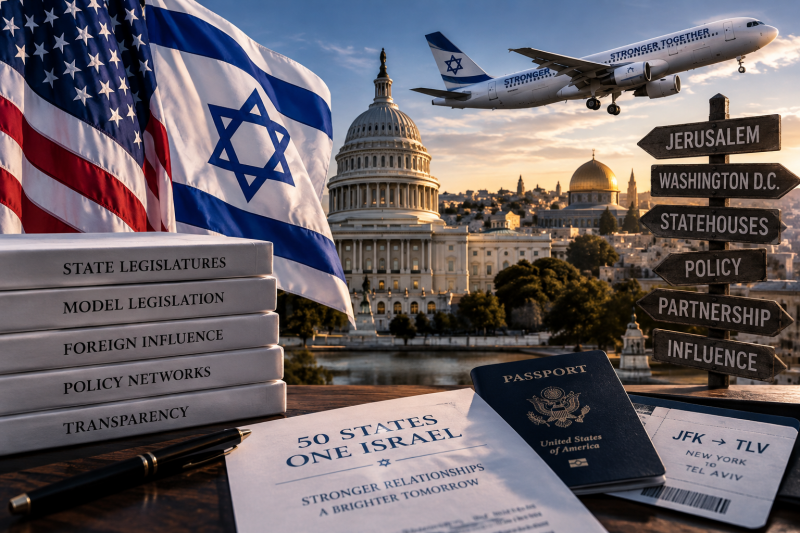
For decades, when Americans talked about Israel’s political influence in the United States, the conversation almost always began and ended in Washington.
Congress. Presidents. Foreign aid. AIPAC. Defense agreements. Campaign spending. The State Department.
That conversation is no longer big enough.
Over the past several months, I started looking into something much closer to home: a group of New Mexico legislators who traveled to Israel in September 2025 as part of an extraordinary program called “50 States, One Israel.”
What began as a fairly straightforward question about a foreign-government-funded trip led somewhere much larger.
The deeper I dug, the more apparent it became that state legislatures have become an important arena in the relationship between Israel and the United States.
That conclusion does not require a conspiracy theory. It does not require assuming that every legislator who travels to Israel has been “bought.” It does not require conflating Jewish Americans, American pro-Israel organizations, AIPAC, evangelical Christians, the Israeli government, or legislators who independently support Israel.
Those are different people and institutions, and responsible reporting has to treat them that way.
The documentary record is significant enough on its own.
Israel’s Ministry of Foreign Affairs organized a massive program bringing roughly 250 American state legislators from all 50 states to Israel. An Oregon ethics opinion concerning the trip says Israel’s consulate was covering transportation, lodging and meals for participating legislators. Ohio legislators publicly said they had been invited by Israel’s Ministry of Foreign Affairs and its consulate. During the program, lawmakers met senior Israeli officials and discussed political issues. (Oregon Legislature)
And this was not simply another congressional delegation.
These were state legislators.
That distinction matters.
Because state governments make decisions involving contracting, universities, pension funds, investment, discrimination law, definitions of antisemitism, boycotts, procurement and other issues that can intersect directly with Israel policy.
Once you understand that, “50 States, One Israel” looks less like an isolated diplomatic trip and more like something worth examining as part of a broader state-level influence strategy.
The Largest State-Legislator Delegation of Its Kind
The September 2025 gathering was remarkable simply because of its scale.
Approximately 250 American state legislators participated, representing all 50 states. Public accounts describe it as the largest delegation of elected officials ever brought to Israel. Israeli diplomatic officials were directly involved, and legislators were invited through Israel’s Ministry of Foreign Affairs and diplomatic missions. (Ohio House)
An official Oregon Government Ethics Commission opinion provides unusually useful documentation of what was being offered.
Oregon Rep. David Gomberg sought guidance before accepting the invitation. According to the commission, the trip was sponsored by Israel’s Consulate General, which would cover transit, lodging and meals. The ethics commission analyzed whether those benefits qualified for an exception under Oregon’s gift laws for sanctioned fact-finding, trade-promotion and related governmental travel. (Oregon Legislature)
That document matters because it removes ambiguity about an essential point:
This wasn’t merely an American advocacy organization paying for legislators to visit Israel.
A foreign government was directly financing travel and hospitality for American elected officials.
That does not automatically make the travel illegal or unethical. Legislators routinely participate in international educational, diplomatic and economic-development programs, and ethics rules vary significantly among states.
But legality and public-interest scrutiny are different questions.
Citizens can reasonably want to know when another government pays substantial expenses for their elected representatives.
What Israel Wanted From State Legislators
Another important question is what the gathering was designed to accomplish.
Official statements from participating legislators describe strengthening relationships between Israel and American states, discussing political issues, learning about trade opportunities, visiting communities affected by the October 7 attacks and meeting Israeli leadership. (Ohio House)
That is legitimate diplomacy.
It is also influence in the ordinary meaning of the word.
Diplomacy itself is partly about influence: governments cultivate relationships, explain their positions, encourage trade and attempt to persuade foreign officials that particular policies are beneficial.
The important issue is therefore not whether influence occurred.
It is how extensive the effort has become, how much is being spent, what policies are being discussed, and what transparency Americans should expect when foreign governments cultivate relationships with their state lawmakers.
And New Mexico provides an unusually interesting case study.
Six New Mexico Legislators Went to Israel
The New Mexico delegation included Republican legislators Jay Block, Ant Thornton, Stefani Lord, Rod Montoya and others previously identified in reporting and attendee records.
But what makes New Mexico particularly interesting is that the September trip did not occur in a vacuum.
A political and legislative infrastructure supportive of Israel was already developing inside the state.
And one of the most consequential figures in that story never needed the September trip at all.
His name is Craig Brandt.
Craig Brandt’s Israel Relationship Predates “50 States, One Israel”
Brandt, a Republican state senator from Rio Rancho, had already become publicly involved in Israel-related issues after October 7, 2023.
In February 2024, Brandt and fellow lawmakers were involved in organizing “A Day for Israel” at the New Mexico Capitol.
Source New Mexico reported that Brandt, then-Sen. David Gallegos and Rep. Rod Montoya invited the Santa Fe Jewish Center to participate. The event included prayers for Israeli hostages, an Israeli soldier appearing remotely and a recorded presentation involving an Israeli official. Reps. Stefani Lord and John Block were also present. (Source New Mexico)
The Santa Fe Jewish Center’s own event page confirms Brandt’s prominent participation. (Santa Fe Jewish Center)
That chronology is important because it prevents us from making a mistake that is easy to make when investigating political networks.
These legislators did not suddenly become interested in Israel because someone bought them plane tickets in September 2025.
Several were publicly supportive of Israel long beforehand.
Brandt’s relationship went further.
In December 2024, Brandt traveled to Israel.
And according to Brandt himself, this wasn’t simply a personal pilgrimage.
He described it as a diplomatic journey undertaken with Israel’s Consul General to the Southwest United States, writing that one purpose was to deepen relations between New Mexico and Israel. (The Roosevelt Review)
That trip becomes particularly significant because of what happened afterward.
The Friends of Israel Project
Brandt subsequently founded an organization called the Friends of Israel Project.
Its own history explicitly connects the organization’s creation with his experience in Israel.
The organization says the Israeli Consulate invited Brandt on the diplomatic trip in November 2024. After traveling in December and speaking with people there, Brandt returned home and developed what became the Friends of Israel Project. (Friends Of Israel Pr)
Its website identifies Brandt as founder and chairman.
The organization describes its purpose around connecting, advocating, understanding, supporting and educating regarding Israel and the Jewish community. (Friends Of Israel Pr)
Again, none of this is inherently improper.
Americans organize advocacy organizations around foreign-policy issues constantly.
But Brandt is not merely a private citizen.
He is a state senator.
And his Israel activity soon crossed another institutional boundary.
A Friends of Israel Caucus Inside the Legislature
Brandt also organized a Friends of Israel Caucus in the New Mexico Legislature.
The New Mexico Jewish Journal reported that the caucus had 16 legislators. Brandt intended the organization to be bipartisan, although the publication reported that only Republicans had joined at that point. (New Mexico Jewish Journal)
That means New Mexico had developed an organized Israel-focused bloc of state legislators.
The caucus was not merely ceremonial.
Reporting indicates that it had been involved with antisemitism policy and university divestment issues. (New Mexico Jewish Journal)
By February 2026, the caucus was also among the sponsors of Jewish Community Day at the Roundhouse, alongside the Santa Fe Jewish Center-Chabad and the Jewish Community Relations Coalition of New Mexico. Roughly 20 Jewish community organizations participated in the event. (New Mexico Jewish Journal)
Those community organizations should not be conflated with the Israeli government. Nor should participation by Jewish organizations be treated as evidence of foreign influence.
The relevant institutional distinction is important:
American Jewish organizations are American organizations.
Israel is a foreign government.
The question investigated here concerns documented activity by that foreign government and the political networks that subsequently intersect with it.
Then Came SB155
In 2026, Brandt introduced New Mexico SB155.
The bill concerned something seemingly simple but politically significant: what New Mexico’s government would call the territory generally referred to by the United States government and much of the international community as the West Bank.
Brandt’s legislation would instead require state agencies to use “Judea and Samaria,” “Judea” or “Samaria.”
At first glance, this might appear to be an unusual New Mexico-specific proposal.
It isn’t.
The trail leads to Arkansas.
Arkansas Was First
On March 31, 2025, Arkansas Rep. Mindy McAlindon introduced HB1929, the “Recognizing Judea and Samaria Act.”
The bill prohibited Arkansas state agencies from using “West Bank” in official government materials.
Arkansas enacted the legislation as Act 797 on April 17, 2025. (Arkansas Legislature)
Its language established the basic architecture that would later appear elsewhere:
definitions of government materials and state agencies;
a prohibition against official use of “West Bank”;
requirements concerning “Judea and Samaria” terminology;
restrictions involving state funds;
and a waiver process. (Arkansas Legislature)
Then another organization entered the story.
ALEC.
ALEC Turns It Into Model Legislation
The American Legislative Exchange Council is well known for developing model policies that state legislators can adapt for their own states.
On July 17, 2025, ALEC introduced a model “Recognizing Judea and Samaria Act.”
ALEC lists the policy as finalized on August 11, 2025. (American Legislative Exchange Council)
Read ALEC’s model beside the Arkansas legislation and the lineage is readily apparent.
ALEC’s model prohibits state agencies from using “West Bank” in official materials, defines covered agencies and government materials, restricts state funding for materials using that terminology and establishes a waiver process. (American Legislative Exchange Council)
Similar legislation subsequently surfaced in additional states, including New Mexico.
That alone demonstrates something important about modern state politics.
Policy does not necessarily originate independently inside 50 separate capitols.
Ideas move through national networks.
Model legislation gets developed, circulated, adapted and introduced.
That happens across the ideological spectrum and across many policy areas.
The question here is how the Israel-related networks intersect.
Because the intersections keep appearing.
The Arkansas Sponsor Went to “50 States, One Israel”
McAlindon, the Arkansas legislator who sponsored the original Judea and Samaria legislation, was subsequently identified among Arkansas participants in “50 States, One Israel.” (Kiwix Server)
That chronology deserves precision.
Her legislation came first.
Arkansas HB1929 was introduced in March 2025 and enacted in April. (Arkansas Legislature)
ALEC’s model came afterward, finalized in August. (American Legislative Exchange Council)
“50 States, One Israel” occurred in September.
Therefore, the Israeli trip could not have caused McAlindon to introduce HB1929.
Likewise, it would be inaccurate to claim that the September conference originated the Judea and Samaria legislation.
The model-policy pipeline already existed.
What the evidence does show is overlap among the people and institutions operating inside these networks.
Then Another Organization Appeared: SLIC
The story continued after “50 States, One Israel.”
A new organization called the State Legislator Israel Caucus, or SLIC, emerged.
Reporting by Drop Site News describes SLIC as having grown out of relationships associated with the 2025 Israel trip. Florida state Rep. Michael Gottlieb became one of its central figures. The organization has reportedly discussed helping legislators develop or share model legislation. (Drop Site News)
According to that reporting, the Israeli government also funded travel and accommodations associated with SLIC’s Washington launch.
Those claims are based on records obtained by the publication and should be understood as reported findings rather than proof that Israel controls SLIC.
SLIC describes itself as independent.
That distinction matters.
But the broader pattern is unmistakably worthy of examination:
A foreign government brings hundreds of state legislators to its country.
Relationships develop among those legislators.
A state-legislator organization focused on that foreign country subsequently emerges.
And model legislation is part of the policy ecosystem being discussed.
That is precisely the kind of political infrastructure transparency laws and investigative journalism are supposed to illuminate.
The New Mexico Question
This brings us back to Craig Brandt and SB155.
There is currently no public document I have found showing that Israel’s government told Brandt to introduce SB155.
There is no public document establishing that SLIC gave Brandt the bill.
There is no public document showing that one of the six New Mexico legislators who attended “50 States, One Israel” returned home and handed Brandt the legislation.
And there is no basis for presenting any of those possibilities as established fact.
But there is a documented national model.
There is documented Israel-related organizing inside New Mexico.
There are documented relationships among New Mexico legislators.
There is Brandt’s documented diplomatic trip to Israel.
There is his Friends of Israel Project.
There is his 16-member legislative Friends of Israel Caucus.
There is the enormous Israeli-government-sponsored state-legislator delegation.
There is the subsequent emergence of SLIC.
And there is substantially similar Judea and Samaria legislation moving through multiple states.
The unanswered question is not whether these networks exist.
They plainly do.
The unanswered question is exactly how information, draft legislation and policy priorities move between them.
Follow the Draft, Not the Theory
This is where investigations can go wrong.
Once you see a network this interconnected, it becomes tempting to draw every missing arrow yourself.
We shouldn’t.
The responsible approach is much simpler:
Follow the documents.
For SB155, that means obtaining Brandt’s original drafting request.
Who requested the language?
Was source material attached?
Was ALEC’s model attached?
Did another legislator forward it?
Was it supplied by an advocacy organization?
Did Legislative Council staff independently locate the model?
Were SLIC, Israeli diplomatic personnel, the Friends of Israel Project or other organizations involved?
Those questions are answerable.
They require records.
Until those records surface, the precise provenance of SB155 should remain an open question.
That doesn’t weaken the investigation.
It makes it stronger.
How Much Is Israel Spending?
This is another area where precision is essential.
It is tempting to take every dollar spent by an American pro-Israel organization and call it “Israeli money.”
That would be wrong.
AIPAC, for example, is an American organization. Money raised and spent by American political organizations is not automatically money supplied by the Israeli government.
The same distinction applies to American Jewish organizations, Christian Zionist organizations and individual donors.
If we’re discussing foreign-government influence, we should count foreign-government money as foreign-government money and domestic political spending as domestic political spending.
The public numbers show that Israel’s government is spending real money on American-facing activity, but different databases measure different things.
OpenSecrets’ Foreign Lobby Watch, using Foreign Agents Registration Act disclosures, reported approximately $2.3 million in Government of Israel spending for 2025 within the category it tracks. OpenSecrets warns that FARA activity includes not only attempts to influence policy or public opinion but also tourism and trade promotion. (LTNR)
That figure should therefore not be confused with Israel’s total American public-diplomacy budget.
Nor does it capture every expenditure connected with programs such as “50 States, One Israel.”
The Oregon ethics documentation establishes that Israel’s diplomatic apparatus was covering legislators’ transportation, lodging and meals. (Oregon Legislature)
But I have not located a reliable public accounting giving the complete cost of transporting, housing, feeding and programming approximately 250 legislators for “50 States, One Israel.”
That number should be disclosed.
If taxpayers in another country financed a program involving hundreds of American elected officials, Americans have a legitimate interest in knowing exactly how much was spent.
Direct Foreign Influence Is Also Becoming More Visible Through FARA
There is another layer.
Foreign Agents Registration Act records provide visibility into firms performing political or public-relations work for foreign principals.
One 2025 Department of Justice FARA filing concerning work associated with an Israeli foreign principal describes contemplated activity involving political commentary, foreign policy, public perception and shaping public discussion in the United States. (FARA eFile)
That doesn’t mean every Israeli public-diplomacy initiative is the same program.
It doesn’t.
But it demonstrates why FARA exists.
Foreign governments are permitted to communicate, advocate and lobby in the United States.
The American principle isn’t that foreign governments must remain silent.
The principle is disclosure.
Americans should know who is speaking, who is paying and whose interests are being represented.
The Constitutional Question Is Bigger Than Israel
There is a broader principle here that matters regardless of which country is involved.
Imagine replacing Israel with another foreign government.
Suppose Saudi Arabia invited roughly 250 state legislators to Riyadh and paid their transportation, hotels and meals.
Suppose China brought lawmakers from all 50 states to Beijing.
Suppose Qatar organized a nationwide network of state legislators.
Suppose the United Arab Emirates paid for hundreds of elected officials to participate in programming designed to strengthen political relationships.
Would Americans want disclosure?
Would journalists follow the money?
Would constituents want to know what policies were discussed?
I would hope the answer would be the same regardless of the flag involved.
That is exactly why this conversation should not become an argument about whether someone is “pro-Israel” or “anti-Israel.”
The governing principle should be institutional.
American elected officials represent Americans.
Foreign governments represent their own citizens and national interests.
Those interests can overlap substantially.
They can also diverge.
Transparency is how a self-governing republic manages that reality.
Israel Is Entitled to Advocate for Israel
None of this requires pretending that Israel is behaving irrationally.
Quite the opposite.
From Israel’s perspective, cultivating relationships with American state officials can be perfectly understandable statecraft.
Israel has strategic, economic, diplomatic and political interests.
It wants American officials to understand its security concerns.
It wants American investment.
It wants opposition to BDS.
It wants favorable economic relationships.
It wants American public opinion on its side.
It wants relationships with officials who may eventually hold other offices.
A government pursuing its national interests is doing what governments generally do.
The responsibility for maintaining American political independence therefore belongs primarily to American institutions.
Our ethics rules.
Our disclosure laws.
Our legislators.
Our journalists.
And ultimately our citizens.
Statehouses Deserve the Same Scrutiny as Washington
That may be the biggest lesson from this investigation.
Americans have spent decades watching Washington for foreign influence while paying far less attention to state capitals.
Yet state legislatures collectively contain thousands of elected officials.
They regulate enormous pools of public money.
They oversee public universities.
They establish procurement policies.
They regulate investments.
They enact anti-discrimination laws.
They can restrict government contracting.
They can adopt definitions and terminology carrying significant foreign-policy implications.
And many state legislators eventually become governors, members of Congress and other national political figures.
For any foreign government interested in building durable American relationships, statehouses are therefore an obvious arena for diplomacy.
“50 States, One Israel” demonstrates that Israel understands their importance.
Bringing roughly 250 state legislators from all 50 states together in Israel was not incidental outreach.
It was organized national-scale diplomacy directed specifically at subnational American elected officials. (Oregon Legislature)
Calling that diplomacy does not diminish its significance.
It clarifies it.
What We Know—and What We Don’t
After following this trail, several things are documented.
Israel’s government organized and financed major portions of travel and hospitality for hundreds of American state legislators. (Oregon Legislature)
Israel-related legislative organizing existed in New Mexico before that trip. (Source New Mexico)
Craig Brandt traveled to Israel with Israel’s Consul General to the Southwest in December 2024. (The Roosevelt Review)
Brandt subsequently founded the Friends of Israel Project and helped establish a legislative Friends of Israel Caucus. (Friends Of Israel Pr)
Arkansas enacted a “Recognizing Judea and Samaria Act” in April 2025. (Arkansas Legislature)
ALEC finalized substantially similar model legislation in August 2025. (American Legislative Exchange Council)
The Arkansas sponsor subsequently participated in “50 States, One Israel.” (Kiwix Server)
SLIC subsequently emerged as a national organization focused on Israel and state legislators, with reporting indicating an interest in sharing or developing model legislation. (Drop Site News)
Those are facts and documented reporting.
What has not been established is equally important.
We do not currently have evidence showing that Israel ordered Brandt to introduce SB155.
We do not have evidence establishing that Israel wrote SB155.
We do not have evidence proving that SLIC supplied Brandt with SB155.
We do not have evidence showing that AIPAC financed the six New Mexico legislators’ Israel trip.
And we should not pretend that American organizations supportive of Israel are interchangeable with the Israeli government.
Those distinctions are essential.
The Conversation America Should Be Having
There is enough documented evidence here that we don’t need exaggeration.
The more interesting question is structural.
How much foreign-government-funded travel should American elected officials accept?
What disclosure should accompany it?
Should every itinerary, donor, sponsor and dollar be publicly searchable?
Should foreign governments be permitted to finance large-scale programs involving hundreds of state lawmakers?
Should legislators disclose subsequent bills touching the interests of a government that recently financed their travel?
Should organizations formed from relationships cultivated through foreign-government-sponsored programs disclose those origins and subsequent foreign funding?
And should state ethics laws be strengthened where current disclosure requirements make reconstructing these relationships unnecessarily difficult?
Those questions apply far beyond Israel.
They should apply to every foreign government.
Transparency Is Not Hostility
Criticism of governmental influence should never become hostility toward a people, religion or ethnicity.
Jewish Americans are Americans.
They are not representatives of Israel unless they actually represent Israel.
American Christians who support Israel are Americans exercising their political rights.
AIPAC and other American advocacy organizations should be evaluated according to American campaign-finance and lobbying laws, not automatically characterized as foreign agents merely because their policy preferences frequently align with Israel.
And Israel itself is a sovereign country with every right to conduct diplomacy.
Those distinctions aren’t semantic technicalities.
They’re necessary to conduct this conversation responsibly.
But responsibility cuts both ways.
Avoiding conspiracy theories cannot mean refusing to investigate documented foreign-government activity.
The answer to irresponsible allegations is better evidence, not less scrutiny.
Follow Every Dollar. Disclose Every Relationship.
The United States doesn’t need a special rule for Israel.
It needs a consistent rule for everybody.
If Israel pays for an American legislator’s travel, disclose it.
If Saudi Arabia does it, disclose it.
If China does it, disclose it.
If Qatar does it, disclose it.
If a domestic political organization pays, identify that organization rather than falsely attributing the money to a foreign government.
If model legislation comes from ALEC, disclose that provenance.
If it comes from SLIC, disclose that.
If an advocacy organization writes it, tell the public.
If Legislative Council independently drafts it, document that too.
Sunlight eliminates the need for speculation.
That is ultimately where this investigation has led me.
The significant story isn’t a secret room in Washington where somebody controls American politics.
The documented story is more ordinary—and arguably more important.
Political influence works through relationships.
Trips.
Conferences.
Caucuses.
Nonprofits.
Diplomats.
Advocacy organizations.
Model legislation.
Campaign organizations.
Universities.
Trade relationships.
Personal friendships.
And networks that can overlap for years.
Israel’s government has demonstrated that it sees America’s state legislators as important participants in that ecosystem. The unprecedented scale of “50 States, One Israel” makes that impossible to dismiss as merely occasional diplomacy. (Oregon Legislature)
The appropriate response isn’t panic.
It’s transparency.
Americans should know when foreign governments spend money cultivating relationships with American officials. We should know how much they spend. We should know who receives the benefits. We should know what meetings occur. We should know what policies are discussed. And when substantially similar legislation begins appearing across multiple states afterward, journalists and citizens should be able to trace where that language originated without months of detective work.
That standard should apply whether the foreign capital involved is Jerusalem, Riyadh, Doha, Beijing, Abu Dhabi, Moscow or anywhere else.
America can have allies without surrendering scrutiny.
American officials can visit foreign countries without abandoning accountability.
And Americans can support Israel’s existence and security while still asking difficult questions about the Israeli government’s political activity inside the United States.
Those principles are not contradictory.
They are exactly what political independence requires.
The deeper question raised by this investigation is therefore no longer whether foreign governments seek influence in American politics.
Of course they do.
The question is whether American institutions are transparent enough for citizens to see that influence clearly when it moves beyond Washington and arrives in their own statehouse.
After what I found in New Mexico—and after seeing the scale of “50 States, One Israel”—that is a question worth asking in all 50 states.
Add comment
Comments