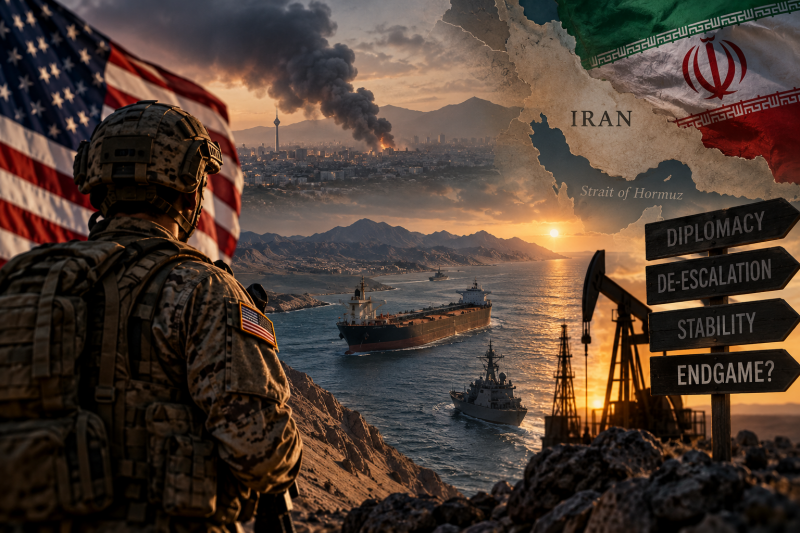
There is a question Washington needs to answer, and after nearly seven months of war, it is becoming increasingly difficult to avoid:
How does this end?
Not how do we win the next exchange of missiles.
Not how many additional Iranian military installations can be destroyed.
Not how many sanctions can be imposed, ships intercepted, weapons expended, or billions appropriated.
How does the war actually end?
Because as of September 17, 2026, the United States is approaching seven months of direct conflict with Iran. The war has expanded across one of the most strategically important regions on Earth. The Strait of Hormuz remains severely disrupted. Fighting involving Iran-aligned Houthis has intensified around Yemen and the Red Sea. Oil remains above $100 per barrel. American diesel prices recently crossed $6 per gallon. Tens of billions of dollars have already been spent.
And now Washington is discussing something Americans who lived through Iraq and Afghanistan should recognize immediately:
The “postwar strategy.”
President Donald Trump offered perhaps the most encouraging words we have heard in some time this week when he told reporters that the United States was “hopefully” approaching the end of the war. Trump also said Iran wants a deal and claimed he has heard from Tehran directly. Reuters reports that Trump is expected to meet Gulf leaders around next week’s United Nations General Assembly to discuss the conflict and possible postwar arrangements. (Reuters)
I sincerely hope those words are followed by diplomacy.
Because America desperately needs an off-ramp.
But Americans have every reason to ask what exactly comes after the shooting stops—and whether Washington is preparing to end American involvement or simply move it into another phase.
We Have Been Here Before
One of the most important lessons America should have learned during the last quarter-century is that destroying military targets is considerably easier than determining what comes afterward.
The United States possesses extraordinary military power.
That has never really been the question.
The harder questions are political.
What political outcome are we trying to achieve?
What constitutes victory?
What concessions are necessary to end hostilities?
What commitments will America make afterward?
How much will those commitments cost?
How long will American forces remain involved?
And, perhaps most importantly, what happens when the political reality on the ground refuses to conform to Washington’s plan?
Those questions become especially important when conversations begin shifting from military objectives to a “postwar strategy.”
Reuters reported September 16 that the administration expects discussions with Gulf Cooperation Council leaders from Saudi Arabia, the United Arab Emirates, Qatar, Bahrain, Kuwait and Oman around the U.N. General Assembly. Trump has simultaneously said Iran wants a deal and that he has heard from Iran directly. (Reuters)
That diplomatic contact is encouraging.
But diplomacy should be aimed at producing a sustainable end to hostilities—not merely creating the next stage of an open-ended American commitment.
There is an enormous difference between negotiating security arrangements after a war and nation-building. There is also an enormous difference between preventing an immediate return to hostilities and assuming responsibility for another country’s political future.
Americans deserve to know where that line is.
The War Americans Were Told Would Be Limited Has Become Something Much Larger
The conflict began February 28 with U.S.-Israeli attacks against Iran and Iranian retaliation against Israel and Gulf countries hosting American military installations. It has since evolved into a much broader regional struggle. Reuters reports that thousands have been killed and millions displaced across the fighting involving Iran, Israel and Lebanon. (Reuters)
Meanwhile, another front is becoming increasingly dangerous.
The Iran-aligned Houthis have made significant territorial advances in Yemen, including along the Red Sea coastline. Their advances have increased their ability to threaten shipping through the Bab el-Mandeb Strait—the narrow passage connecting the Red Sea to the Gulf of Aden.
That matters because the world is now confronting instability around two major maritime chokepoints at the same time.
On one side of the Arabian Peninsula sits the Strait of Hormuz.
On the other sits Bab el-Mandeb.
Reuters reported September 17 that fighting between Saudi Arabia and the Houthis had intensified dramatically. More than 100,000 Yemenis have reportedly been displaced amid renewed fighting. (Reuters)
The Houthis’ territorial advances have placed them along Yemen’s entire Red Sea coastline, according to Reuters, strengthening their ability to threaten shipping through the roughly 12-mile-wide Bab el-Mandeb passage. (Reuters)
That is not some obscure foreign-policy development occurring thousands of miles away with no connection to American life.
Those waterways help move the energy, manufactured goods and commodities that sustain the global economy.
And Americans are already paying for their disruption.
Three Ships
If you want one number demonstrating how abnormal the situation has become, consider this:
Three.
According to preliminary ship-tracking data reported by Reuters, only three commodity vessels transited the Strait of Hormuz on Wednesday, September 16.
Three.
That was down from 12 the previous day and far below the recent 10-day average of approximately 17. Reuters noted that the data may not capture vessels traveling with their automatic identification systems switched off, but the overall collapse in visible traffic illustrates how severely normal commercial shipping has been disrupted. (Reuters)
Before this war, roughly one-fifth of the world’s oil moved through the Strait of Hormuz, according to the Congressional Budget Office figures reported by Reuters. (Reuters)
Think about the scale of that.
Nearly 20% of global oil moving through one narrow body of water.
When that artery becomes unreliable, the consequences do not remain in Iran.
They reach Florida.
They reach Massachusetts.
They reach New Mexico.
They reach farmers, truckers, contractors, manufacturers, small businesses and families throughout America.
They eventually reach almost everyone.
Americans Are Paying at the Pump—and Far Beyond It
As of September 17, Brent crude was trading around $103.13 per barrel, while West Texas Intermediate was around $100.82. Both fell roughly 2% during Thursday trading as concerns about immediate supply disruptions eased somewhat, particularly after Saudi Arabia began rerouting additional crude through Oman and working to restore alternative pipeline capacity. (Reuters)
That sounds like good news.
And relatively speaking, it is.
But $100-plus oil is hardly cheap.
More importantly, crude oil is only part of the story.
Diesel has become a major problem.
The Associated Press reported September 11 that the national average price for diesel had climbed to approximately $6.06 per gallon, compared with about $3.71 a year earlier. (AP News)
That difference matters far beyond truck drivers.
Diesel powers an enormous amount of the machinery that moves America.
Tractor-trailers.
Farm equipment.
Construction machinery.
Delivery vehicles.
Industrial equipment.
Some rail operations.
Generators.
Heavy machinery.
When diesel becomes dramatically more expensive, transportation becomes more expensive.
When transportation becomes more expensive, groceries become more expensive.
Construction becomes more expensive.
Manufacturing becomes more expensive.
Shipping becomes more expensive.
Eventually those costs make their way into the price Americans pay for almost everything.
And petroleum itself is far more than gasoline.
Petrochemicals are incorporated into plastics, synthetic materials, pharmaceuticals, fertilizers, asphalt, lubricants, packaging and countless industrial products.
Energy disruptions therefore have a way of spreading throughout an economy.
That is why Americans should reject the idea that the economic consequences of this conflict can simply be measured by whatever number appears on the gasoline sign tomorrow morning.
The effects run much deeper.
Then There Is the Actual Price Tag
Wars have two price tags.
There is the price measured in human lives.
And there is the price measured in dollars.
Neither should be treated casually.
The Congressional Budget Office estimates that the Iran war had already cost approximately $38 billion through August 1, according to Reuters.
And the meter is still running.
CBO projects continuing costs of roughly $3 billion every month if the conflict continues at comparable levels. (Reuters)
That estimate doesn’t include everything.
Reuters reported that it excludes some recent strikes and does not account for future borrowing costs associated with financing the conflict.
CBO also found that the rapid consumption of American munitions could require five years to fully replenish some stockpiles. Defense Secretary Pete Hegseth previously requested nearly $90 billion in emergency funding to address munitions needs, warning lawmakers about critical shortfalls without additional funding. (Reuters)
Eighteen American service members have died in the conflict, Reuters reported. (Reuters)
That deserves more than a passing sentence.
Those are eighteen Americans who aren’t coming home.
Every one of them had a family.
Every one of them represents the most serious responsibility government can possibly exercise: sending Americans into harm’s way.
That responsibility demands extraordinary accountability.
$38 Billion and Counting
Consider the financial numbers in the context of America’s broader fiscal situation.
The national debt surpassed $40 trillion in August, Reuters reported. (Reuters)
Yet another multibillion-dollar foreign conflict is being financed largely by the same federal government already operating with enormous structural deficits.
The Committee for a Responsible Federal Budget reported this summer that the White House sought an $87.6 billion supplemental package, including more than $70 billion in military and related expenditures that included Iran-war costs and replenishment of weapons inventories. (CRFB)
Whatever one’s position on the military operation itself, those numbers deserve scrutiny.
National defense is unquestionably a legitimate and essential responsibility of the federal government.
But that does not mean every military expenditure automatically constitutes wise national-defense policy.
A country can simultaneously believe in maintaining the strongest military on Earth and insist that military force have clearly defined objectives.
In fact, those principles should reinforce one another.
A military designed to defend America should not be treated as an unlimited resource for solving every geopolitical problem on Earth.
Especially when Pentagon resources consumed in one theater cannot simultaneously be available somewhere else.
CBO specifically warned that depletion of important munitions—including missile interceptors—could affect America’s ability to respond to another major conflict. (Reuters)
That is a national-security tradeoff worth discussing.
The American People Have Been Skeptical for Months
Calling the war unpopular is not merely rhetoric.
There is polling behind it.
A Pew Research Center survey conducted March 16–22 found that 59% of American adults believed the original decision to use military force against Iran was wrong, compared with 38% who believed it was right.
The same survey found 61% disapproved of Trump’s handling of the conflict, while 37% approved. (Pew Research Center)
The partisan divide was substantial.
Republicans were much more supportive. Democrats overwhelmingly opposed the action. Republican-leaning independents were much more divided.
But public expectations have become increasingly pessimistic about the duration of American involvement.
A Reuters/Ipsos survey conducted August 21–24 found that 83% of Americans expected U.S. military involvement in Iran to continue for an extended period, while only 12% expected it to end within weeks.
Back in early March, 60% expected extended involvement.
That number had risen by more than 20 percentage points. (Ipsos)
Another Reuters/Ipsos survey conducted in June found that 52% believed U.S. military action in Iran had not been worth the costs and benefits, compared with 24% who believed it had been worth it. (Ipsos)
Those numbers don’t tell policymakers what decision they must make.
Leadership sometimes requires taking actions that are initially unpopular.
But in a constitutional republic, prolonged military action should never become disconnected from public accountability.
Especially when the mission itself keeps evolving.
Congress Is Asking Questions Too
This week, the House voted 220–204 for a war-powers resolution intended to end U.S. military action in Iran without congressional authorization.
Every Democrat voting supported the resolution, joined by seven Republicans.
It was the House’s third attempt to force an end to the conflict. Previous efforts have not ultimately reached the president’s desk, and President Trump would be expected to veto such a measure if one did. (AP News)
People can reasonably disagree about the resolution.
What should not be controversial is the underlying constitutional question.
Congress has a role in war.
That isn’t a partisan invention.
Article I of the Constitution gives Congress substantial war powers precisely because the Founders were deeply suspicious of concentrating the power to wage prolonged war in one individual.
The president serves as commander in chief.
Congress controls appropriations and possesses the constitutional power to declare war.
Those powers were deliberately divided.
After almost seven months of hostilities, tens of billions of dollars in expenditures and American deaths, Congress debating the scope and continuation of the mission is not an inconvenience.
It is Congress doing what a representative legislature is supposed to do.
Iran Is Hurting Too
None of this should create the impression that Iran has escaped consequences.
It hasn’t.
Iran’s economy is under enormous pressure.
Reuters reported earlier this month that American sanctions, restrictions on Iranian oil exports and disruption of financial networks have severely damaged Iran’s ability to finance imports and ordinary economic activity. Average monthly pay was reportedly covering less than one-third of basic household costs. (Reuters)
By September 17, Reuters was reporting that conditions had deteriorated so dramatically that some Afghan migrants were returning to Taliban-controlled Afghanistan because they could no longer make a living in Iran. (Reuters)
Iran has been hurt militarily.
It has been hurt economically.
Its petroleum exports have been squeezed.
Its government is under tremendous pressure.
The question is no longer whether America can inflict pain on Iran.
Clearly it can.
The question is what additional American strategic objective continued warfare achieves that diplomacy cannot.
That is a much more important question.
And the Nuclear Problem Hasn’t Disappeared
Any serious discussion of ending the conflict has to acknowledge the strongest argument made by those supporting continued pressure: Iran’s nuclear program remains unresolved.
Iran says its nuclear program is peaceful and that it does not possess nuclear weapons. The United States and its allies have long expressed concerns about Iran’s enrichment activities and the ability to verify the status of nuclear material.
That cannot simply be wished away.
A sustainable settlement therefore needs meaningful nuclear verification.
It needs enforceable commitments.
It needs inspection mechanisms.
It needs regional security arrangements.
And it needs consequences for violations.
But none of those things inherently require indefinite war.
In fact, verification is ultimately a diplomatic and technical process.
Missiles can destroy facilities.
They cannot inspect centrifuges.
Bombs can damage infrastructure.
They cannot establish monitoring regimes.
Military force can change negotiating leverage.
It cannot substitute permanently for negotiation.
Eventually adversaries have to talk.
The only question is how much destruction occurs before they do.
The Most Encouraging Development Right Now
Which brings us back to Trump’s comments this week.
“Hopefully we are towards the end of the war.”
Those may prove to be among the most important words of his presidency if they are followed by a genuine diplomatic settlement.
Trump says Iran wants a deal.
He says Tehran has contacted him directly.
Gulf leaders are expected in New York.
That creates an opportunity.
The administration has leverage.
Iran is under severe economic pressure.
The Gulf states have enormous incentives to restore commercial shipping.
Saudi Arabia has every reason to prevent further attacks on its infrastructure.
China has enormous incentives to stabilize energy markets.
Europe has economic incentives to see Hormuz reopened.
The pieces for serious diplomacy exist.
The question is whether political leaders are willing to use them.
What an Endgame Actually Needs to Accomplish
Ending the war does not require pretending Iran suddenly became a friendly government.
It isn’t.
Iran’s government has supported armed groups throughout the region, suppressed dissent at home and engaged in conduct that has generated legitimate security concerns among neighboring states.
Recognizing those realities does not require believing perpetual warfare is the answer.
A workable settlement would have to address several concrete problems: ending direct U.S.-Iranian hostilities, restoring secure commercial passage through the Strait of Hormuz, establishing credible nuclear verification, reducing attacks by regional armed groups, protecting American personnel and creating mechanisms capable of resolving future violations without immediately returning to war.
Those are difficult objectives.
But they are measurable objectives.
“Transform the Middle East” isn’t.
“Build a new Iran” isn’t.
“Stay until everything is stable” isn’t.
America has heard versions of those promises before.
Americans Deserve Relief—and Answers
For nearly seven months, Americans have watched another foreign conflict expand.
They are paying higher fuel prices.
Businesses are paying higher transportation costs.
Taxpayers have already absorbed tens of billions in direct military expenditures.
American weapons inventories have been depleted.
Eighteen American service members have died.
Global shipping remains disrupted.
And Washington is now discussing what comes after the war.
So this is precisely the moment Americans should be asking difficult questions.
Not because America should be weak.
Because strength without restraint can become its own form of weakness.
A strong country knows what it is defending.
A confident country knows what its interests are.
A responsible government understands that American lives and American treasure are not limitless resources.
And a constitutional republic demands that those entrusted with the power to wage war explain what they are trying to accomplish.
The American people don’t need another twenty-year experiment in reshaping a foreign country.
They don’t need another mission whose objectives quietly change every six months.
They don’t need another war that simply becomes part of the background of everyday life while Washington forgets how it started.
They need an endgame.
President Trump now says he hopes we are approaching one.
Good.
Then diplomacy should be given every serious opportunity to make that happen.
Secure the waterways.
Protect American forces.
Establish verifiable nuclear safeguards.
Negotiate enforceable regional security arrangements.
Bring the shooting to an end.
And resist the temptation to replace one war with an indefinite American project to determine what Iran must become afterward.
Because after seven months, $38 billion, American lives lost, $100 oil, $6 diesel and another region sliding deeper into instability, asking “When does this end?” isn’t isolationism.
It is one of the most basic questions citizens in a republic can ask their government.
And Washington owes them an answer.
Add comment
Comments