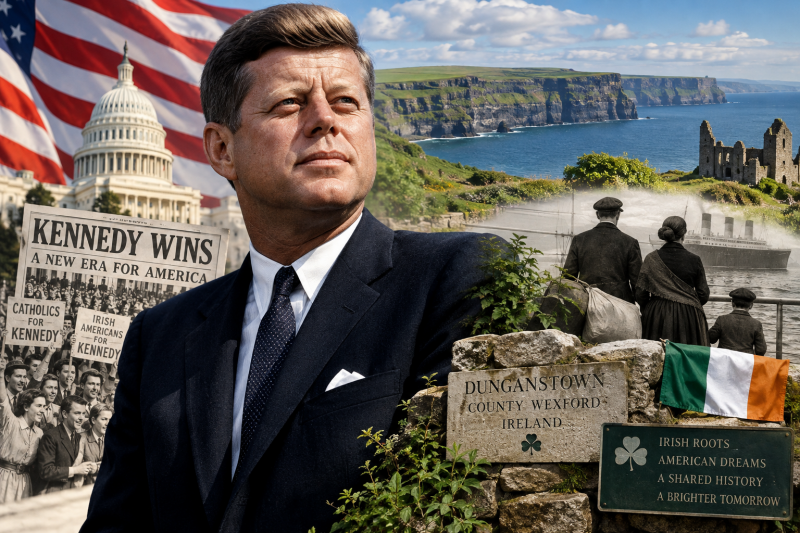
There are political victories, and then there are moments when an election becomes something much bigger than politics.
For Irish Americans, November 8, 1960, was one of those moments.
When John Fitzgerald Kennedy was elected president of the United States, he wasn’t simply a 43-year-old Democratic senator from Massachusetts defeating Republican Vice President Richard Nixon.
He was the great-grandson of Irish immigrants.
He was Catholic.
His family carried names like Kennedy and Fitzgerald.
And just a little more than a century before Americans elected him president, his ancestors had been part of an immigrant population that arrived on American shores poor, frequently unwanted, openly discriminated against and sometimes greeted with signs telling them that the Irish need not apply.
That is what makes Kennedy’s story so remarkable.
You cannot really understand what JFK represented to Irish Americans by beginning with Camelot, Harvard, Hyannis Port or the Kennedy fortune.
You have to go farther back.
You have to start with Ireland.
And you have to start with people who had almost nothing.
Before There Was a Kennedy Dynasty
The Kennedy story in America begins long before anyone could have imagined the name becoming synonymous with American political power.
John F. Kennedy’s paternal great-grandfather, Patrick Kennedy, came from Dunganstown in County Wexford. In the aftermath of the Great Famine, he left Ireland for America and settled in Boston, working as a cooper.
The National Park Service describes the larger story vividly. In 1847 alone, roughly 37,000 Irish immigrants settled in Boston. By 1855, the city’s Irish population exceeded 50,000 and had become its largest ethnic group. Many lived in overcrowded neighborhoods, worked dangerous and poorly paid jobs and encountered intense anti-Catholic and anti-Irish prejudice. (National Park Service)
Patrick Kennedy’s experience was hardly glamorous.
He worked. He married another Irish immigrant, Bridget Murphy. They started a family.
Then he died of cholera at only 35.
Bridget was left to support their children.
Think about that family trajectory for a moment.
A widowed Irish immigrant mother struggling to keep her family together in Boston eventually became the ancestor of an American president.
And the Kennedy side represented only half the story.
JFK’s maternal grandfather, John Francis “Honey Fitz” Fitzgerald, was born to Irish immigrant parents and became one of Boston’s most recognizable politicians. He served in the Massachusetts Senate, the U.S. House of Representatives and twice as mayor of Boston. On Kennedy’s paternal side, Patrick Joseph Kennedy rose through Boston politics as well, serving in the Massachusetts legislature and becoming an influential ward leader. (National Park Service)
This was part of something much larger happening across urban America.
Irish immigrants discovered that while America’s social establishment might close doors to them, American democracy offered another door: the ballot box.
Irish Americans became extraordinarily effective organizers in cities including Boston and New York. Political organizations helped immigrants navigate naturalization, find jobs, obtain emergency assistance and develop political influence. The Library of Congress notes that Irish Americans became a major political force in American cities during the late nineteenth and early twentieth centuries. (Library of Congress)
There were ugly sides to machine politics, including patronage and corruption.
But there was another side that sometimes gets forgotten.
Politics gave communities excluded from traditional institutions a way to build power.
Ward by ward.
Precinct by precinct.
Election by election.
Generation by generation.
That is the political world from which the Kennedys emerged.
The Presidency Was Still Different
Irish Catholics could eventually become mayors, legislators, members of Congress and governors.
The presidency was another matter.
In 1928, New York Governor Al Smith became the first Catholic presidential nominee of a major American political party. His Catholicism became a major campaign issue, with opponents raising fears that a Catholic president would somehow take orders from Rome.
Smith lost overwhelmingly.
Thirty-two years later, Kennedy confronted variations of the same suspicion.
His opponents did not simply question his policies. Some Americans questioned whether a Catholic could independently exercise the presidency at all.
That distinction matters.
Kennedy was being asked to prove something Protestant presidential candidates generally never had to prove: that his religion would not make him less loyal to the Constitution.
And Kennedy understood that winning the Democratic nomination would require proving that a Catholic could win outside heavily Catholic urban centers.
Wisconsin provided one early test. Kennedy defeated Minnesota Senator Hubert Humphrey there with roughly 56 percent of the Democratic primary vote, but his strength among Catholic voters allowed critics to argue that the victory proved precisely what they already knew—Catholics would vote heavily for Kennedy. (Jacaranda FM)
Then came West Virginia.
That changed everything.
West Virginia was overwhelmingly Protestant. If Kennedy could win there, he could begin destroying the argument that Catholicism made him nationally unelectable.
He didn’t simply win.
Kennedy defeated Humphrey by approximately 60.8 percent to 39.2 percent, carrying 50 of West Virginia’s 55 counties. Humphrey withdrew from the presidential race shortly afterward. (West Virginia Culture Archive)
Suddenly, Kennedy had demonstrated something enormously important.
A Catholic could win Protestant votes.
But the religious issue did not disappear.
“I Am Not the Catholic Candidate for President”
On September 12, 1960, Kennedy walked into perhaps the most important meeting of his presidential campaign.
He faced the Greater Houston Ministerial Association.
The room was filled with Protestant ministers.
Instead of avoiding the religious question, Kennedy confronted it.
He argued for an America in which church and state remained separate, in which religious authorities did not dictate government policy and in which citizens were not denied public office because of their religion.
Then came the sentence that defined the moment:
“I am not the Catholic candidate for President. I am the Democratic Party’s candidate for President who happens also to be a Catholic.” (The American Presidency Project)
Whatever someone’s politics, that speech deserves to be remembered as an important moment in the history of American religious liberty.
Kennedy was essentially asking the country a fundamental question:
Does citizenship come with a religious test?
The Constitution said no.
Kennedy challenged Americans to live up to it.
For Irish Catholics, this was deeply personal.
Their ancestors had spent generations hearing doubts about whether Catholics could be fully American. Now an Irish Catholic was standing before Protestant ministers and making the argument that his faith neither diminished his citizenship nor superseded his constitutional obligations.
That mattered.
And then Irish and Catholic America turned out.
Contemporary academic estimates cited in the Congressional Record found Kennedy receiving approximately 80 percent of the Catholic vote, compared with an estimated normal Democratic baseline of around 63 percent among Catholics. Researchers nevertheless concluded that religion probably produced a net national loss for Kennedy because anti-Catholic defections—particularly among Protestants in the South—outweighed his Catholic gains. (congress.gov)
In other words, Catholic support was enormously important, but Kennedy did not win simply because he was Catholic.
He also had to overcome the political cost of being Catholic.
And he barely did.
Kennedy received about 49.7 percent of the popular vote against Nixon’s 49.5 percent—a margin of roughly 118,000 votes in a country where nearly 69 million votes were cast. His Electoral College victory was clearer: 303 votes to Nixon’s 219, with 15 going to Harry Byrd. (National Archives)
The margin was tiny.
The symbolism was enormous.
What Kennedy’s Victory Meant to Irish America
This is where statistics stop telling the whole story.
For generations of Irish Americans, Kennedy’s election represented arrival.
Not assimilation in the sense of forgetting where they came from.
Arrival in the sense that the highest office in America was no longer reserved, culturally or politically, for someone from a particular religious or ethnic background.
The National Park Service describes Kennedy’s presidency as the culmination of more than a century of Irish-American upward mobility. (National Park Service)
That is exactly the right historical frame.
Patrick Kennedy had arrived from County Wexford during the famine era.
His great-grandson became president.
One generation struggled to survive.
Another entered neighborhood politics.
Another accumulated wealth and influence.
Then one reached the White House.
All eight of Kennedy’s great-grandparents had migrated to Boston from Ireland during the famine era. (JFK Library and Museum)
For an Irish American looking at that history, it is difficult not to feel the weight of it.
Because this wasn’t ancient history.
The distance between immigrant Patrick Kennedy leaving Ireland and John Kennedy taking the presidential oath was barely more than a century.
That is astonishing.
But What Did Kennedy Actually Do for Irish Americans?
This deserves a little nuance because mythology can sometimes overwhelm history.
Kennedy did not enter office with some sweeping legislative agenda exclusively for Irish Americans.
By 1961, Irish Americans were already deeply integrated into American political, economic and cultural life.
His greatest immediate contribution was arguably something less tangible but enormously consequential:
He shattered a barrier.
After Kennedy, being Catholic could no longer plausibly be treated as an automatic disqualification for the presidency.
And his approach was important.
He didn’t argue that Catholics deserved special political privileges.
He argued that they deserved equal citizenship.
There is a major difference.
Kennedy also took on immigration policy.
Years before becoming president, he had written A Nation of Immigrants. Then, on July 23, 1963, President Kennedy called on Congress to dismantle the national-origins quota system that had shaped American immigration law for decades. His proposal called for gradually eliminating national-origin quotas and replacing them with a system placing greater emphasis on family reunification and skills. (congress.gov)
Kennedy did not live to see that transformation enacted.
The Immigration and Nationality Act that fundamentally changed the system became law under Lyndon Johnson in 1965.
And there is an interesting wrinkle here: Ireland itself had not been filling its relatively generous quota under the older system, so abolishing national-origin quotas was not simply a special benefit for Irish immigration. Kennedy’s proposal was broader. It reflected his view of America as a country strengthened by immigration rather than permanently organized around ethnic preferences. (congress.gov)
That distinction matters.
Kennedy’s Irish-American legacy wasn’t about creating government favoritism for Irish Americans.
It was about removing barriers.
Then Kennedy Went Home
If the 1960 election represented Irish America’s arrival in America, Kennedy’s 1963 visit to Ireland represented something almost poetic.
From June 26 through June 29, 1963, the sitting president of the United States traveled through Dublin, Wexford, Cork, Galway and Limerick, addressed the Irish parliament and visited the homeland of his ancestors. (Office of the Historian)
He was the first serving American president to visit independent Ireland.
And Ireland went absolutely wild for him.
This wasn’t simply another diplomatic visit.
It was a homecoming.
In New Ross, County Wexford, Kennedy spoke about Patrick Kennedy leaving Ireland in 1848. He visited nearby Dunganstown and met relatives at the Kennedy homestead.
Imagine what that moment represented.
Patrick Kennedy had left that area amid the devastation surrounding the Great Famine.
His great-grandson returned aboard the presidential aircraft as leader of the United States.
That is almost too perfect a story to invent.
But it happened.
Kennedy understood the symbolism, too.
He was proud of being American, but he never treated Irish heritage as something that had to be erased in order to prove his American identity.
That combination resonated on both sides of the Atlantic.
Kennedy and a Changing Ireland
The visit mattered beyond sentiment.
Ireland itself was changing.
Under Taoiseach Seán Lemass, the country was moving away from decades of economic protectionism and toward greater international trade, industrial development and foreign investment.
Kennedy recognized what was happening.
His visit gave Ireland extraordinary international exposure. A State Department assessment afterward noted that within Ireland, no modern event had received comparable press, photographic and television coverage. (Office of the Historian)
Scholarly assessments have credited the visit with helping strengthen Irish-American relations, tourism, trade and cultural connections while easing some lingering tensions surrounding Ireland’s wartime neutrality. (Taylor & Francis Online)
And the relationship continued after Kennedy returned home.
In October 1963, Lemass made an official visit to the United States.
Kennedy and Lemass discussed Ireland’s growing economic connections with continental Europe and the possibility of increased American private investment in Ireland. Their joint statement explicitly recorded Kennedy’s continuing interest in Irish economic progress and their desire to strengthen cultural links between the two countries. (The American Presidency Project)
Kennedy wasn’t responsible for Ireland’s modernization. Lemass, T.K. Whitaker, Irish entrepreneurs, workers and policymakers were driving that transformation themselves.
But the American president understood it, encouraged it and gave it international visibility.
And that matters.
Five Months Later
This is the part of the story that remains difficult to reconcile with everything that came immediately before it.
Kennedy left Ireland on June 29, 1963.
Less than five months later, he was dead.
The road to Dallas wasn’t mysterious in its basic political purpose.
Kennedy was preparing for the 1964 election.
Texas mattered.
The Democratic Party there was divided between competing factions, and Kennedy wanted to ease those tensions before the coming campaign. The trip also included fundraising and opportunities for the president to appear before large crowds.
According to the Warren Commission’s reconstruction, Kennedy, Vice President Lyndon Johnson and Texas Governor John Connally had agreed on the November Texas trip during a June 5, 1963 meeting in El Paso. (National Archives)
Dallas was politically important partly because Kennedy had lost the city in 1960.
A motorcade offered the president something politicians have always wanted: direct exposure to ordinary voters.
The route from Love Field to the Dallas Trade Mart was designed to allow large numbers of people to see the president. (National Archives)
At 12:30 p.m. on November 22, 1963, that political calculation collided with history.
Shots rang out as Kennedy’s limousine passed through Dealey Plaza.
The president was struck.
Governor Connally was wounded.
John Fitzgerald Kennedy was pronounced dead at Parkland Memorial Hospital.
He was 46 years old.
What We Know—and What Remains Debated
Kennedy’s assassination has generated six decades of argument, suspicion, documentaries, books, investigations and conspiracy theories.
A responsible telling of his story has to distinguish established evidence from unresolved controversy.
The Warren Commission concluded that Lee Harvey Oswald fired the shots that killed Kennedy from the sixth floor of the Texas School Book Depository and found no evidence establishing a conspiracy. (National Archives)
Congress revisited the assassination years later.
The House Select Committee on Assassinations agreed that Oswald fired three shots and that the shots striking Kennedy came from behind, but it reached a different conclusion on the broader question. Based heavily on acoustical evidence available at the time, the committee said Kennedy was “probably assassinated as a result of a conspiracy,” while acknowledging that it could not identify another gunman or determine the extent of any conspiracy. It also concluded that the Soviet and Cuban governments and U.S. agencies were not involved. (National Archives)
That finding has itself remained controversial, particularly because the acoustical evidence underlying the two-gunman conclusion has been challenged.
There is another documented piece of the story that deserves attention without turning it into something it isn’t.
The House committee later concluded that Kennedy did not receive adequate protection. It found deficiencies in Secret Service preparation and information handling surrounding the Dallas trip. (National Archives)
Those are documented findings.
They are not, by themselves, evidence that government agencies participated in Kennedy’s murder. In fact, the same congressional investigation explicitly concluded that the Secret Service, FBI and CIA were not involved in the assassination. (National Archives)
Questions can be legitimate without pretending every theory is equally supported by evidence.
And perhaps that is the most responsible way to remember Dallas.
Separate what we know from what we suspect.
The Cruelest Part of the Story
For me, one of the most haunting parts of Kennedy’s story is the timing.
June 1963: Ireland.
November 1963: Dallas.
Only 148 days separated Kennedy’s arrival in Ireland from his assassination.
In Ireland, people crowded streets to see the descendant of famine immigrants return as president of the United States.
In Dallas, crowds again lined streets to see him.
The very accessibility that made presidential motorcades politically powerful also created vulnerability.
He went to Texas because presidents campaign, build coalitions, raise money, repair political divisions and meet the people they represent.
He went through downtown Dallas because the White House wanted people to see their president.
And somewhere along that route sat a sixth-floor window.
History can sometimes turn on something horrifyingly small.
More Than Camelot
Kennedy’s presidency deserves serious historical examination rather than mythology.
His administration had successes and failures.
The Bay of Pigs was a disaster. The Cuban Missile Crisis brought humanity frighteningly close to nuclear war before diplomacy helped resolve it. His civil-rights record evolved significantly during his presidency. Vietnam was becoming an increasingly difficult American commitment. His domestic agenda encountered substantial resistance in Congress.
He was a president, not a saint.
That distinction actually makes the Irish-American part of his story more meaningful.
Because the importance of Kennedy wasn’t that an Irish Catholic finally reached the presidency and governed perfectly.
It was that an Irish Catholic could reach the presidency at all.
That was the breakthrough.
The American experiment is supposed to mean that where your ancestors were born, how they worshipped, what neighborhood they came from or what surname they carried does not determine the limits of their descendants.
America has repeatedly failed to live completely up to that promise.
But occasionally someone comes along whose life demonstrates how powerful the promise can be.
Kennedy was one of those people.
From Wexford to Washington
When Patrick Kennedy left County Wexford during the famine era, he carried no political dynasty across the Atlantic.
There was no Kennedy fortune.
No Hyannis Port compound.
No Senate seat waiting.
Certainly no White House.
There was simply an immigrant trying to build a life.
His descendants climbed.
Through business.
Through education.
Through neighborhood politics.
Through Congress.
Through the Senate.
And finally through one of the closest presidential elections in American history.
Irish Americans helped build the urban political infrastructure that made such a rise possible. Catholic voters rallied overwhelmingly behind Kennedy in 1960. But Kennedy still had to prove that his appeal could cross religious boundaries, which is why West Virginia and Houston became so important.
Then, once elected, he turned what could have remained merely an ethnic political milestone into something broader.
He made the argument that an American did not have to choose between heritage and citizenship.
You could be proudly Irish.
Proudly Catholic.
And completely American.
Then he carried that message back across the Atlantic.
For four remarkable days in June 1963, Ireland looked at the president of the United States and saw one of its own descendants returning home.
For Irish Americans, the image ran in the opposite direction.
They could look at the White House and see themselves.
That may ultimately be Kennedy’s most enduring Irish-American legacy.
Not a particular government program.
Not a political party.
Not Camelot.
Possibility.
The possibility that the grandson or great-grandson of immigrants who arrived poor and unwanted could someday occupy the most powerful elected office in the country.
The possibility that religious prejudice could be confronted rather than accepted.
The possibility that heritage did not have to disappear for someone to become fully American.
And the possibility that America’s promise could become a little larger with every barrier that fell.
That is why November 22, 1963, felt like more than the death of a president to so many Irish Americans.
Something larger had been taken from them.
Only months earlier, Kennedy had stood in Ireland as living evidence of how far an immigrant family could travel in a few generations.
Then Dallas froze him permanently in history at 46 years old.
But Dallas could not undo November 1960.
It could not undo West Virginia.
It could not undo Houston.
It could not undo New Ross.
And it certainly could not erase the extraordinary journey from a famine-stricken Irish countryside to 1600 Pennsylvania Avenue.
Patrick Kennedy left Ireland searching for opportunity.
A little more than a century later, his great-grandson became president of the United States.
Whatever else anyone thinks about John Fitzgerald Kennedy, that remains one hell of an American story.
And one hell of an Irish one.
Add comment
Comments