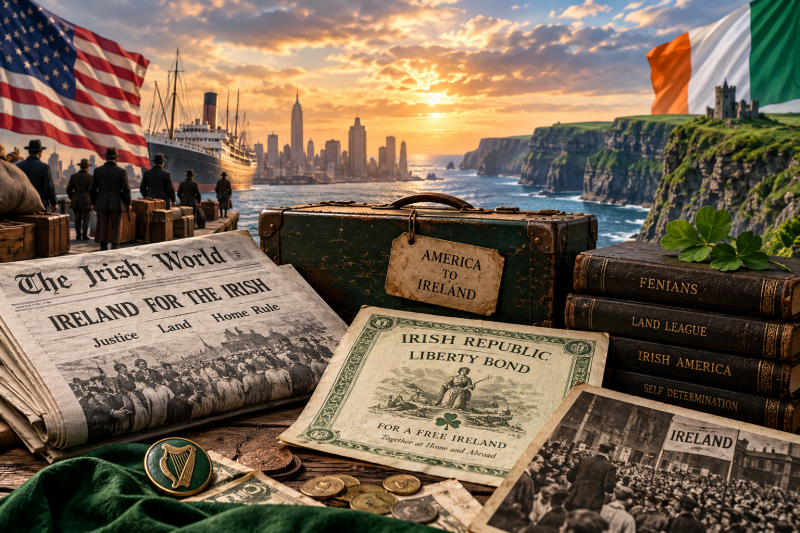
There is something almost unbelievable about the political relationship between Ireland and Irish America when you really stop and think about it.
Long before Facebook groups, email lists, online fundraising, Zoom meetings, text-message campaigns, or even international telephone calls, Irish people scattered across the United States were building political organizations capable of influencing events thousands of miles away.
They raised money in Boston.
They organized meetings in New York.
They printed newspapers in American cities that found their way into cottages and meeting halls back in Ireland.
They built organizations in Philadelphia, Chicago, San Francisco and countless smaller communities.
They hosted Irish political leaders on speaking tours across the United States. They lobbied American politicians. They financed relief efforts. They supported land reform. Some backed revolutionary organizations. Others pursued constitutional nationalism. And when Ireland entered its revolutionary period in the early twentieth century, Irish Americans helped provide money, publicity and political pressure on a scale that is difficult to appreciate today.
The Atlantic Ocean was enormous.
Communication was slow.
Travel took time.
And somehow they built what amounted to a transatlantic political network anyway.
That may be one of the most fascinating parts of the Irish-American story.
Irish America wasn’t simply remembering Ireland.
It was participating in Ireland.
Emigration Created Something Britain Could Not Easily Control
The Great Hunger transformed both Ireland and the United States.
Millions of Irish people left their homeland during the nineteenth century, with enormous numbers settling in America. What began as tragedy eventually created something politically significant: a massive Irish population living beyond the immediate reach of British authority.
Those emigrants didn’t leave their memories at the docks.
They remembered eviction.
They remembered hunger.
They remembered landlords.
They remembered political and religious discrimination.
And they remembered family members still living back home.
For many emigrants, Ireland wasn’t some abstract ancestral homeland discussed once a year over a pint. They had been born there. Their parents were there. Their siblings were there. Their neighbors were there.
That meant money began flowing back across the Atlantic.
Some of it was simply family support.
But those remittances had political consequences.
During Charles Stewart Parnell’s 1880 American tour, he argued that money earned by Irish people in America was indirectly sustaining Ireland’s landlord system because relatives were sending money home that ultimately helped families pay rent. Parnell told a Boston audience that, according to statistics he had gathered, perhaps one-sixth of Irish landlord rents were effectively being paid by Irish men and women living in America. (History Ireland)
Think about that dynamic.
Irish workers could leave Ireland, build lives in America, earn American wages—and portions of those wages could still end up sustaining the economic system they had escaped.
Political organizers recognized the contradiction.
What if some of that money could instead finance changing the system?
That question helped transform Irish America.
The Fenians Built an Early Transatlantic Network
One of the earliest powerful examples came from the Fenian movement.
The Irish Republican Brotherhood operated in Ireland while the Fenian Brotherhood developed in the United States. Irish-American veterans, laborers, immigrants and organizers became part of an international movement seeking Irish independence.
Money moved with them.
Historical records preserved in Ireland show that Fenian finances traveled from America to Ireland through international banking channels during the 1860s. Researchers examining government records have even uncovered American bank drafts used to move Fenian funds across the Atlantic. (History Ireland)
Women were part of this network as well.
Fenian women raised money for prisoners and their families, carried messages and helped maintain communications when male leaders were imprisoned or forced underground. A parallel Fenian Sisterhood in America collected money that was sent across the Atlantic to assist the movement and families affected by imprisonment. (History Ireland)
This wasn’t digital organizing.
It was arguably more impressive.
Every dollar had to be physically collected or transferred through nineteenth-century financial institutions. Every message had to travel by ship, courier, telegraph or mail. Every newspaper had to be printed, bundled and transported.
Yet an international political infrastructure emerged.
Ireland had developed something resembling a distributed political network generations before the internet existed.
Then Came the Land War
The American connection became even more consequential during the Irish Land War.
The Irish National Land League, founded in 1879, turned the land question into a mass political movement. It developed branches across much of southern and western Ireland and mobilized farmers, townspeople, activists and nationalist organizers around tenant rights and land reform. (Cambridge University Press)
But the struggle wasn’t confined to Ireland.
Across the Atlantic, Irish Americans organized.
And organized.
And organized.
Patrick Ford became one of the most important figures in that effort.
Ford had been born in County Galway and emigrated to America as a child. Eventually he became editor of the Irish World, one of the most influential Irish-American newspapers of the era.
Under Ford, the newspaper became much more than a publication.
It became political infrastructure.
Research published by Cambridge University Press credits Ford with helping organize roughly 2,500 local Land League units in the United States. By 1882, fundraising campaigns promoted through the Irish World had reportedly transmitted more than $343,000 to Ireland. (Cambridge University Press)
That was nineteenth-century money.
More importantly, much of it didn’t come from wealthy financiers writing enormous checks.
It came from ordinary people.
Workers.
Immigrants.
Families.
Local organizations.
Parish communities.
People giving what they could because they believed events thousands of miles away still mattered to them.
Newspapers Were the Social Media of Irish America
Money alone doesn’t build a movement.
Information does.
And Irish-American newspapers became the connective tissue of the diaspora.
The Irish World achieved circulation estimated between roughly 60,000 and 125,000 during the 1880s—remarkable numbers for an ethnic political publication of the period. Its influence didn’t stop at America’s shores.
Ford established a “Spread the Light” initiative through which emigrant subscribers helped send copies of the newspaper into Ireland. British officials became concerned about the ideological influence of American political ideas arriving through those newspapers. (Cambridge University Press)
Imagine the nineteenth-century information chain.
A farmer in Ireland reads an American newspaper.
That newspaper was written by an Irish immigrant.
It discusses events occurring in Ireland.
It interprets those events through ideas about liberty, democracy, property, natural rights and republican government circulating in America.
The newspaper then influences political conversations back in Ireland.
That’s an information feedback loop.
Ireland influenced Irish America.
Irish America absorbed American political ideas.
Irish America then transmitted a mixture of Irish nationalism and American political thought back to Ireland.
The Atlantic wasn’t separating these communities anymore.
It was connecting them.
The Boston Pilot Became a Fundraising Hub
The Irish World wasn’t alone.
During the severe agricultural distress surrounding the Land War, newspapers became fundraising institutions.
Parnell designated Boston’s Pilot, edited by Irish nationalist and former Fenian John Boyle O’Reilly, as an important channel for American relief donations. By April 1880, the newspaper had reportedly transmitted approximately $95,000 to Ireland. (History Ireland)
Even newspapers outside explicitly Irish-American nationalism became involved. The New York Herald established an Irish relief fund, while its owner, Gordon Bennett, personally contributed $100,000. (History Ireland)
The larger lesson here is important.
These newspapers weren’t merely reporting on political movements.
They were helping create them.
Today we talk about media, fundraising, organizing and communications as separate functions.
Irish America was combining them more than a century ago.
A newspaper could publish an argument, distribute information, announce meetings, solicit donations, identify organizers and reinforce a shared political identity simultaneously.
That is remarkably sophisticated grassroots organizing.
American Money Helped Sustain Political Organization
The financial connection eventually extended beyond relief and land agitation into parliamentary politics.
By the mid-1880s, American contributions were helping sustain the Irish nationalist political machine surrounding Parnell.
Historical research into Irish Parliamentary Party finances indicates that the bulk of subscriptions to its parliamentary expenses fund eventually came from America. The 1885 campaign alone reportedly cost about £15,000. (Cambridge University Press)
That mattered because political organization costs money.
Candidates need support.
Organizers need transportation.
Newspapers need printing.
Meetings need halls.
Political prisoners need legal assistance.
Families of activists sometimes need help.
Movements require infrastructure.
Irish Americans increasingly provided it.
The movement wasn’t controlled entirely from America, nor was Irish America politically unified. Far from it. Constitutional nationalists, revolutionary republicans, land reformers, Catholic organizations, labor activists and others regularly disagreed about strategy.
But that disagreement itself tells us something.
Irish America wasn’t simply a fundraising department for Ireland.
It had developed its own political ecosystem.
1916 Changed the Conversation Again
Then came Easter 1916.
The Rising initially produced complicated reactions both in Ireland and abroad. But the executions of its leaders dramatically changed public sentiment and gave Irish republicanism new international attention.
Irish-American organizations intensified their efforts.
Groups such as Clan na Gael and the Friends of Irish Freedom attempted to mobilize American opinion. John Devoy, one of the most important Irish-American republican organizers of his generation, spent decades maintaining connections between nationalist networks on both sides of the Atlantic.
By the time Ireland’s War of Independence began, Irish America possessed organizational infrastructure that had been developing for generations.
That infrastructure was about to be tested on an extraordinary scale.
De Valera Comes to America
In June 1919, Éamon de Valera arrived in the United States.
What followed was essentially an eighteen-month political organizing tour.
He traveled the country.
He addressed enormous crowds.
He met Irish-American organizations.
He sought recognition for the Irish Republic.
And he raised money.
A lot of money.
University College Dublin research estimates that de Valera’s American tour raised more than $5.7 million. (University College Dublin)
Contemporary U.S. government records later placed the American external Irish loans at approximately $6 million. State Department documents show that roughly $3.986 million of the proceeds eventually reached Ireland or provided benefits there. (Office of the Historian)
Those aren’t symbolic contributions.
That is serious political financing.
Irish Americans were effectively being asked to invest financially in the possibility of an Irish state.
The bond certificates promised repayment under conditions tied to the recognition and establishment of the Irish Republic. Whatever individual subscribers believed about the likelihood of repayment, purchasing them represented something larger than an ordinary investment.
It represented participation.
A factory worker in New York or shopkeeper in Boston could become financially connected to Ireland’s struggle for independence.
Once again, the diaspora wasn’t simply watching history.
It was helping finance it.
Money Was Only Half the Story
Irish America’s contribution during the revolutionary period wasn’t limited to political fundraising.
During the War of Independence, the American Committee for Relief in Ireland collected more than $5 million in humanitarian assistance, much of it supporting the Irish White Cross.
Meanwhile, the American Commission on Conditions in Ireland gathered testimony about events occurring there and ultimately produced an enormous report intended to inform international opinion. (University College Dublin)
That reveals another dimension of diaspora politics.
Money matters.
But legitimacy matters too.
Irish activists understood that Britain’s relationship with the United States mattered diplomatically. If Irish nationalists could influence American public opinion, newspapers, civic organizations and political leaders, they could internationalize what Britain preferred to treat largely as a domestic question.
Irish America therefore became a political amplifier.
Ireland could speak through America.
But Irish America Was Never One Thing
We should be careful not to romanticize the story into one perfectly coordinated movement.
It wasn’t.
Irish-American politics could be bitterly divided.
De Valera eventually clashed with influential Irish-American leaders including John Devoy and Judge Daniel Cohalan. Disputes developed over strategy, authority, political messaging and who actually had the right to speak for Ireland in America. Those tensions contributed to the creation of competing organizations. (UCD Decade of Centenaries)
That shouldn’t surprise us.
Diaspora movements develop their own interests.
After several generations, Irish Americans weren’t simply Irish people temporarily living overseas.
They were Americans of Irish heritage operating inside American politics.
Their understanding of Ireland could differ from people actually living there.
Their strategies could differ.
Their priorities could differ.
Yet the relationship endured.
A Political Network Before the Internet
That is the part of this history I keep coming back to.
We live in an age when organizing internationally requires almost no physical effort.
I can write something in Florida this afternoon and someone in Donegal can read it seconds later.
A campaign can raise thousands of dollars online before dinner.
An organizer can create a group chat connecting people across five countries in minutes.
Irish America had none of that.
They had newspapers.
Letters.
Church halls.
Fraternal organizations.
Railroads.
Steamships.
Telegraphs.
Public meetings.
Collection boxes.
And relationships.
Yet somehow they created a political communications network spanning an ocean.
The Library of Congress notes that by the late nineteenth and early twentieth centuries, Irish Americans had become a major force in American urban politics, developing sophisticated political organizations in cities across the country. (Library of Congress)
Some of those same organizational instincts were turned toward Ireland.
That may be the most valuable lesson in the entire story.
Technology makes organizing easier.
It doesn’t create organization.
People do.
The Dollars Represented Something Bigger
When we talk about American money flowing into Irish political movements, it is easy to reduce the story to numbers.
$95,000 here.
$343,000 there.
Millions in bonds later.
But behind every number were people.
A laborer dropping money into a collection.
A family subscribing to an Irish newspaper.
An immigrant buying a bond.
A parish hosting a speaker.
An organizer arranging a meeting.
An editor deciding what appeared on the front page.
A volunteer carrying a message.
An Irish political leader boarding another train to address another American audience.
The money mattered because the people behind it cared.
They believed obligations could cross generations.
They believed leaving Ireland didn’t necessarily mean abandoning Ireland.
And they demonstrated something that remains true today: political power doesn’t belong exclusively to governments, wealthy institutions or established elites.
Ordinary people who organize consistently can build extraordinary influence.
Irish America proved it long before anyone could send a tweet, launch a crowdfunding page or organize a nationwide campaign from a laptop.
They built networks one parish, newspaper, meeting hall and local chapter at a time.
They raised money dollar by dollar.
They carried ideas across an ocean.
And those American dollars became part of a much larger movement that transformed land ownership, political organization, international awareness and ultimately the struggle over Ireland’s political future.
The Atlantic looked enormous on a nineteenth-century map.
Politically, Irish America helped make it much smaller.
Add comment
Comments