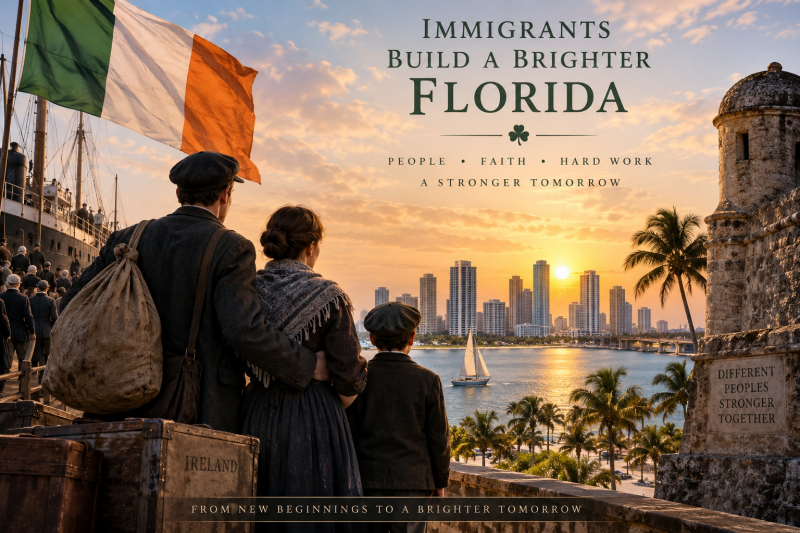
There is something almost effortless about the Florida we know today.
People fly into Orlando for Disney. They drive across bridges into the Keys. They spend winters along the Gulf Coast, crowd beaches from Clearwater to Panama City Beach, explore St. Augustine, cruise out of Miami and Port Canaveral, buy homes in communities that barely existed a generation ago, and pour billions of dollars into an economy built around movement, hospitality, construction, trade, tourism, and growth.
Florida welcomed a record 143.33 million visitors in 2025. Tourism supports roughly 1.8 million jobs and generated an estimated $133.6 billion in economic impact in 2024. The state’s economy continues to expand; the Bureau of Economic Analysis reported that Florida’s real GDP grew 3.1 percent in 2025, tied for the fastest growth among the states. (Visit Sarasota County)
But places do not simply become economic powerhouses.
People build them.
They clear land, construct roads, dig canals, establish businesses, build churches, teach children, work docks, lay transportation networks, create neighborhoods, raise families and slowly turn settlements into communities.
And among the people woven into Florida’s long and complicated story were Irish immigrants.
Their story is worth remembering today for another reason.
Because Americans have a remarkable habit of celebrating yesterday’s immigrants while being suspicious of today’s.
We look backward at Irish immigration and see courage, faith, family, hard work and perseverance.
Those descriptions are deserved.
What we sometimes forget is that many Americans living at the time did not see Irish Catholic immigrants that way at all.
They saw foreigners.
They saw poverty.
They saw people with unfamiliar accents and customs.
They saw Catholics whose religious loyalties were openly questioned.
They worried immigrants would take jobs, depress wages, change American culture and become politically powerful.
Irish Catholics were accused of being incapable of fully embracing American institutions because their allegiance supposedly belonged somewhere else.
Sound familiar?
History rarely repeats itself perfectly. The experiences of 19th-century Irish Catholics are not identical to those of Hispanic immigrants or Muslim Americans today. Different laws, racial classifications, countries of origin, religions and historical circumstances matter.
But some of the language is hauntingly familiar.
And that should make us think.
The Irish Were in Florida Earlier Than Many People Realize
Irish involvement in Florida did not begin with shamrocks in March or modern Irish pubs scattered across the state.
It reaches deep into Florida’s colonial history.
One of the most fascinating figures is Father Miguel O’Reilly, an Irish priest who served under the Spanish Crown in St. Augustine. O’Reilly purchased what is now known as the Father Miguel O’Reilly House in 1785. The property became associated with Catholic education and spirituality and remains one of St. Augustine’s oldest structures. (Visit St. Augustine)
Think about that for a moment.
An Irish Catholic priest was helping shape religious and educational life in Florida decades before Florida became an American territory in 1821 and nearly 60 years before Florida became a state.
The connection went beyond one priest.
Historical accounts describe Spanish officials actively considering Irish Catholic settlement as a way to populate Florida. During Spain’s second period of control, Governor Juan Nepomuceno de Quesada sought Irish Catholic settlers for the province. Florida was opened broadly to immigration in 1792, and Quesada appealed to Cuba’s governor regarding Irish Catholics who might settle there. (Project Gutenberg)
Florida, in other words, was already being shaped by migration long before anybody imagined interstate highways, beachfront condominiums or theme parks.
Its communities included Spanish, Minorcan, African, Cuban, Irish and other populations.
Even St. Augustine’s historic Tolomato Cemetery reflects that mixture. Records describe people of Spanish, Cuban, Greek, Minorcan, African, Irish and Haitian backgrounds among those buried there. (Visit St. Augustine)
Florida was never built from one single cultural thread.
It was woven.
Then Came the Great Irish Migration
The scale of Irish immigration to America during the 19th century is difficult to comprehend today.
The Great Hunger devastated Ireland beginning in the mid-1840s. The Library of Congress notes that Ireland had about 8.2 million people in 1841. A decade later, its population had fallen to 6.6 million. By 1891, only about 4.7 million remained.
Between 1820 and 1930, an estimated 4.5 million Irish immigrants arrived in the United States. Between 1820 and 1860, Irish immigrants represented more than one-third of all immigrants entering the country. During the 1840s, they accounted for nearly half. (The Library of Congress)
These were not simply people looking for slightly better wages.
Many were fleeing catastrophe.
Families were starving. Communities were collapsing. People boarded ships knowing they might never see Ireland again.
They arrived carrying little except their faith, family bonds, skills, determination and hope that somewhere across the Atlantic their children might have a future.
Irish immigrants became laborers, domestic workers, tradesmen, police officers, firefighters, soldiers, merchants, railroad workers, canal diggers, clergy and eventually business owners and political leaders.
Their labor helped build American infrastructure.
And some of that story passed directly through Florida.
The Florida Keys History Center documents one extraordinary example from 1831, when a ship carrying 230 Irish laborers bound for New Orleans wrecked near the Florida Keys. The men had been recruited for canal construction, part of the broader infrastructure boom in which Irish labor became deeply involved across the young United States. The episode itself became turbulent after their rescue, but the historical context is revealing: poor Irish laborers were being recruited for some of the hardest and most dangerous physical work in the developing South. (Monroe County)
They were helping create the infrastructure upon which commerce would grow.
Florida Had to Be Connected Before Florida Could Become Florida
Modern Florida’s economy depends heavily on movement.
People have to reach the beaches.
Agricultural products have to reach markets.
Tourists have to reach hotels.
Goods have to reach ports.
Workers have to reach cities.
Florida’s transformation accelerated dramatically during the late 19th and early 20th centuries as transportation networks expanded.
The Florida Department of State notes that railroads built by companies associated with Henry Flagler and Henry Plant helped reshape the state between the Civil War and World War I. Those transportation networks were accompanied by hotels, development and agricultural expansion. Citrus grown in South Florida could suddenly reach northern cities within days. Tourism became increasingly practical rather than adventurous. (Florida Department of State)
It would be historically inaccurate to claim that Irish immigrants alone built Florida’s railroads or created its tourism industry. Florida’s development depended upon workers and entrepreneurs from many racial, ethnic and national backgrounds, including Black Americans whose labor and contributions were too often exploited or excluded from the prosperity they helped create.
But Irish immigrants belonged to the broader labor, commercial, religious and civic networks that built the American infrastructure economy from which Florida benefited.
That distinction matters.
History should not be exaggerated to make a point.
It is powerful enough when we simply tell it accurately.
The Immigrants We Celebrate Today Were Not Always Welcome
This is the part of Irish-American history that gets sanitized.
We love St. Patrick’s Day.
We love Irish surnames.
We love Irish pubs, Irish music and stories about Irish firefighters and police officers.
Irish heritage has become so deeply incorporated into American identity that it can be difficult to imagine a time when being Irish Catholic made somebody an object of serious suspicion.
But that time absolutely existed.
The Library of Congress documents how hostility toward Irish immigrants grew from a combination of poverty, labor competition and religious prejudice.
Irish immigrants were often willing to accept low-paying jobs because they had few alternatives. That created resentment among native-born workers.
Then religion intensified the conflict.
Most famine-era Irish immigrants were Catholic, arriving in a predominantly Protestant country where anti-Catholic prejudice was widespread.
The hostility sometimes became violent.
In 1831, St. Mary’s Catholic Church in New York was burned. In Philadelphia in 1844, anti-Catholic riots left 13 people dead. (The Library of Congress)
The political movement that emerged from this atmosphere became known as the Know-Nothing movement, or the American Party.
Its members were explicitly nativist.
The Library of Congress preserves the 1854 membership questions of the American Party. Members pledged to exclude foreign-born citizens and Roman Catholics from public office.
Not merely undocumented immigrants.
Not criminals.
Catholics.
Even American-born Catholics.
That is worth remembering.
Because the people being treated as culturally incompatible outsiders were the ancestors of millions of Americans who today are considered completely ordinary parts of the American story.
Yesterday’s Suspicion Has Modern Echoes
This is where history becomes uncomfortable.
We should be careful with historical comparisons. Saying that Irish Catholics, Hispanic immigrants and Muslim immigrants have faced some similar forms of rhetoric does not mean their experiences are interchangeable.
They are not.
But there are recognizable patterns.
Foreigners are described as fundamentally different.
Their religion or culture is treated with suspicion.
The actions of individuals are used to characterize entire communities.
Economic anxieties become attached to immigrant populations.
National loyalty is questioned.
Political movements promise to protect an authentic America from people portrayed as changing it.
The specific targets change.
The underlying instinct is much older.
Current data shows that discrimination is not merely theoretical. A 2025 Pew Research Center survey found that 72 percent of Americans believed Hispanic people experience at least some discrimination, while 74 percent said the same about Muslims. Sixty-five percent said immigrants living legally in the United States experience at least some discrimination. (Pew Research Center)
Pew’s 2026 research provides another perspective. Fifty-nine percent of Muslim Americans surveyed said there is “a lot” of discrimination against Muslims in the United States. (Pew Research Center)
Among Hispanic adults, Pew found that 34 percent reported experiencing discrimination or unfair treatment because of their Hispanic background during the previous 12 months. Twenty-nine percent reported being criticized for speaking Spanish in public, 26 percent had been told to return to their home country and 25 percent reported being called offensive names. (Pew Research Center)
Those statistics do not prove that modern discrimination is identical to anti-Irish discrimination in the 1800s.
They demonstrate something simpler.
The American argument over who belongs is not over.
The Contradiction in Praising the Irish While Restricting Immigration
That tension became especially visible during President Donald Trump’s September 2026 visit to Ireland.
Trump spoke warmly about Ireland and Irish people, saying he loved Irish people and praising their friendliness and toughness. During meetings with Irish leaders, the centuries-old contributions of Irish emigrants to the United States were explicitly discussed. (RTE)
The admiration for Irish America is understandable.
Irish immigrants unquestionably helped build the United States.
But the historical comparison raises a legitimate policy question rather than an easy partisan conclusion: How would America’s celebrated immigrant communities have fared under substantially more restrictive immigration systems?
The Trump administration suspended the U.S. Refugee Admissions Program in January 2025, subject to limited case-by-case exceptions. It later imposed full or partial entry restrictions on nationals of numerous countries, citing national-security concerns, deficiencies in identity management, visa overstays and information-sharing problems. The administration argues that these restrictions protect public safety and national security. (The White House)
Those rationales deserve to be represented accurately.
A nation has both the authority and responsibility to control its borders.
Immigration law should mean something.
Screening matters.
National security matters.
The government has an obligation to know who is entering the country and to enforce legitimate laws.
But history also reminds us that broad suspicion of nationalities or religions can carry consequences far beyond legitimate screening.
That is where the Irish experience becomes relevant.
Many of the Irish arriving during the 19th century were impoverished refugees from famine and political conditions, people with few resources who belonged to a religion widely regarded with suspicion in the United States.
Had America judged their potential contribution exclusively by their poverty, nationality or the prejudices surrounding their faith, the country would have lost generations of future Americans.
America Has Tried Restriction Before
Immigration restriction is hardly new.
The Immigration Act of 1924 established national-origin quotas tied to earlier census populations. The system heavily favored immigration from Northern and Western Europe while limiting immigration from other regions. The national-origins framework remained influential until Congress replaced it through immigration reforms enacted in 1965. (National Archives)
That history is important because immigrant groups often become more acceptable after they become established.
Yesterday’s outsiders become today’s neighbors.
Their children become Americans.
Their grandchildren become governors, teachers, priests, entrepreneurs, soldiers, firefighters, doctors and presidents.
Eventually society forgets that anyone questioned whether they belonged.
Irish Americans experienced that transformation dramatically.
The same country that produced an organized political movement dedicated partly to keeping Catholics from public office eventually elected an Irish Catholic president in John F. Kennedy.
That does not mean immigration should be unlimited.
It means immigration debates should distinguish individuals from stereotypes.
Florida Is an Especially Good Place to Remember That
Florida’s identity itself makes the lesson difficult to ignore.
This state has been shaped by movement for centuries.
Spanish settlers.
Africans.
Minorcans.
Cubans.
Bahamians.
Irish.
Italians.
Jews.
Caribbean immigrants.
Latin Americans.
People arriving from virtually every other American state.
Florida became Florida because people kept coming here.
Some came for religious freedom.
Some came for work.
Some came for land.
Some came escaping political upheaval.
Some came because winter somewhere else was miserable.
Some came with money.
Others arrived with almost nothing.
And collectively they created communities.
That process continues.
Even Florida’s modern tourism industry remains international. In 2025, the state received roughly 9.3 million overseas visitors, and revised figures showed more than 3.17 million Canadian visitors. Ireland itself sent approximately 92,000 visitors to Florida that year, an increase of 9.6 percent from 2024. (Visit Florida)
Florida sells itself to the world.
That has helped make it prosperous.
An Immigrant Is More Than an Immigration Statistic
This may be the most important lesson.
Immigration debates naturally involve numbers.
Border encounters.
Visa overstays.
Refugee caps.
Deportations.
Work permits.
Population estimates.
Economic impacts.
Those numbers matter because governments cannot make serious policy without data.
But numbers can also make human beings disappear.
Behind every immigration statistic is somebody’s son or daughter.
Somebody’s mother.
Somebody’s father.
Somebody trying to protect a child.
Somebody looking for work.
Somebody leaving behind grandparents they may never see again.
Somebody walking into a strange grocery store for the first time and realizing they cannot understand the labels.
Somebody learning English.
Somebody starting a landscaping company.
Somebody opening a restaurant.
Somebody becoming a nurse.
Somebody buying a house.
Somebody building a church, mosque, business or neighborhood organization.
Somebody whose child will grow up sounding completely American.
That story should feel familiar to Irish Americans.
Because it is our story too.
Liberty Requires Both Order and Human Dignity
I do not believe compassion requires pretending borders do not matter.
And I do not believe enforcing immigration law requires forgetting the dignity of the immigrant.
Those ideas can coexist.
A free society can maintain secure borders while recognizing that immigrants are individual human beings rather than political abstractions.
It can enforce laws without turning nationality into guilt.
It can screen for genuine threats without treating an entire religion as suspicious.
It can expect newcomers to respect American constitutional principles while recognizing that newcomers have repeatedly enriched those principles by bringing their own experiences, traditions, businesses, faiths and ideas into American life.
That balance is difficult.
But self-government is supposed to be difficult.
The easy answer is always to divide people into categories.
Us and them.
Native and foreign.
Good immigrant and bad immigrant.
Deserving and undeserving.
History is messier.
The Irish know that better than most.
We Became Part of America Because America Eventually Made Room for Us
There is something deeply moving about walking through an old Catholic cemetery in Florida and seeing Irish names mixed among Spanish, Minorcan, Cuban, African and other names.
Those stones tell a story.
America was never finished.
Florida was never finished.
Each generation inherited something and added something.
Irish immigrants brought faith, labor, entrepreneurship, family traditions, community institutions and a stubborn determination to survive.
Other immigrant communities brought their own gifts.
Today’s immigrants will do the same.
Some will fail.
Some will succeed spectacularly.
Some will break laws.
Most will simply live ordinary lives.
Their children will grow up.
Their grandchildren will barely remember the accents.
And eventually Americans may look back at them exactly the way we now look back at the Irish.
That is the part worth remembering when politicians praise Irish-American contributions.
The Irish immigrant story did not begin with political power, parades and presidents celebrating Ireland.
It began with immigrants.
Poor ones.
Catholic ones.
Suspicious-looking ones, according to the prejudices of their time.
People accused of taking jobs.
People accused of changing the culture.
People accused of answering to a foreign religious authority.
People told they did not quite belong.
And yet they stayed.
They worked.
They worshipped.
They raised families.
They built businesses.
They served their communities.
They became Americans.
And Florida is one of countless places that carries pieces of their story.
So when we celebrate Irish immigrants who arrived generations ago, perhaps the most meaningful tribute is not simply raising a glass in March.
It is remembering who they actually were when they stepped off those ships.
They were immigrants.
And before America knew what they would contribute, America had to decide whether it was willing to see them as people.
That remains a question worth asking today.
Because somewhere in Florida right now, another family is beginning its American story.
We have no idea what their grandchildren will build.
Add comment
Comments