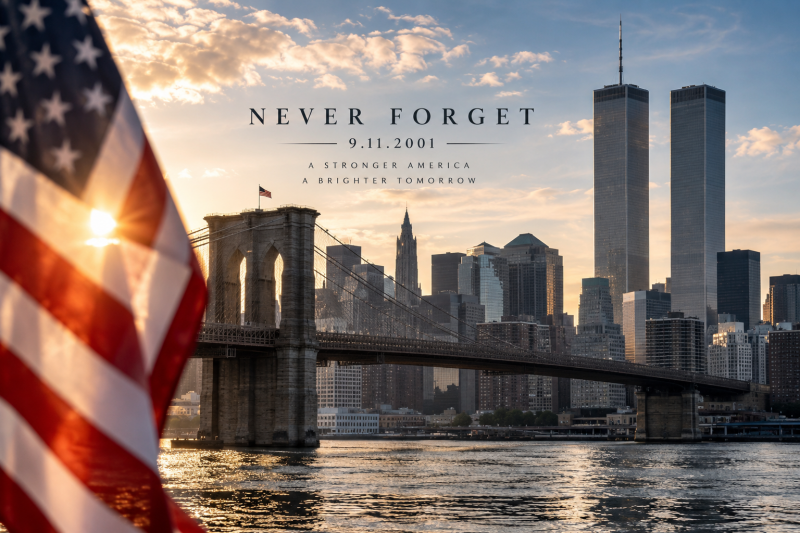
Twenty-five years later, September 11, 2001, still feels different from almost every other day in modern American history.
There are historical events we learn about. There are others we remember.
9/11 belongs firmly in the second category for millions of Americans.
We remember where we were. We remember the television coverage. We remember the second plane hitting the South Tower and the realization, almost instantaneously, that what initially looked like a terrible accident was something far worse.
We remember the towers falling.
We remember smoke rising from the Pentagon.
We remember a field outside Shanksville, Pennsylvania.
We remember firefighters climbing staircases while everyone else was trying to get down.
We remember people calling spouses, parents and children knowing they might never speak to them again.
But twenty-five years is also enough time to ask harder questions.
What did our government actually know before September 11?
Were there warnings?
Could the attacks realistically have been prevented?
Who planned them?
Did the hijackers receive assistance after arriving in the United States?
Why didn’t American intelligence, law enforcement, immigration and aviation-security agencies put the pieces together?
And perhaps just as importantly, what happened to America afterward?
Those questions deserve something better than partisan talking points or conspiracy theories.
They deserve evidence.
And remarkably, on the 25th anniversary of the attacks, Americans received a significant amount of new evidence.
On September 11, 2026, the CIA released 71 previously classified President’s Daily Brief products comprising more than 100 pages of intelligence analysis related to Osama bin Laden, al-Qaeda and the developing terrorist threat before 9/11. It was the largest single release of CIA PDB material connected to the attacks. At essentially the same time, the National Archives released newly declassified records from the 9/11 Commission, including 11 interview memoranda involving Sandy Berger, Richard Clarke, Condoleezza Rice, Michael Scheuer and George Tenet. (CIA)
Those documents don’t reveal a secret order allowing September 11 to happen.
They don’t establish that President Bill Clinton knew the plot.
They don’t establish that President George W. Bush knew the plot.
They don’t establish that the CIA knew four specific aircraft would be hijacked on September 11.
What they reveal is, in some ways, more unsettling.
America received years of strategic warning about al-Qaeda. Officials understood that bin Laden wanted to attack the United States. Intelligence reports contemplated attacks in New York and Washington. Hijacking was discussed. Terrorists using aircraft offensively was conceivable. Bin Laden had people and support networks inside America. By the summer of 2001, the intelligence system was flashing warnings that something major was coming.
And yet the pieces never came together.
That is the story worth understanding.
The Plot Did Not Begin in 2001
September 11 was an al-Qaeda operation.
That conclusion is supported by an enormous body of intelligence, financial records, travel records, communications, captured documents, testimony, forensic evidence and subsequent investigations.
The central architect was Khalid Sheikh Mohammed, commonly known as KSM.
KSM developed the concept of turning hijacked commercial aircraft into weapons and presented it to Osama bin Laden. Bin Laden eventually approved the idea and helped select personnel and targets.
According to the 9/11 Commission, the early target discussions included the World Trade Center, Pentagon, White House and U.S. Capitol. Bin Laden personally selected several early suicide operatives, including Khalid al-Mihdhar and Nawaf al-Hazmi, who would eventually participate in the September 11 attacks. (9/11 Commission)
This operation took years to develop.
That fact matters because the threat from bin Laden was already well understood long before the hijackers boarded their flights.
Al-Qaeda had bombed the American embassies in Kenya and Tanzania in August 1998. Seventeen American sailors were killed when the USS Cole was attacked in Yemen in October 2000. Authorities had disrupted other terrorist plots during the Millennium period.
Bin Laden was not an obscure figure.
Al-Qaeda was not an unknown organization.
The United States knew it had an enemy.
What it didn’t understand was exactly how that enemy intended to attack.
The Newly Released Intelligence Changes the Picture
One of the most consequential documents released in 2026 dates to July 3, 1998.
Its title was blunt:
“Reports That Bin Ladin is Planning Attacks Inside the US.”
The underlying sources were regarded as questionable, something that matters when evaluating intelligence fairly. Intelligence services receive enormous quantities of unverified reporting.
But CIA analysts nevertheless assessed that it was plausible bin Laden placed a high priority on attacking America.
That was more than three years before September 11.
By September 1998, another President’s Daily Brief examined “Bin Ladin’s Infrastructure in North America.”
The CIA was already examining bin Laden-linked individuals and organizations operating within the United States.
The picture becoming available to policymakers was therefore not simply of a terrorist leader hiding in Afghanistan.
It included the possibility of support infrastructure inside America itself. (CIA)
Then came something even more remarkable.
A September 10, 1998 intelligence product discussed reporting that terrorists might fly an explosives-packed aircraft into an American city.
That was nearly three years to the day before September 11.
It was not a description of the eventual plot.
It did not describe hijacked passenger jets.
It did not identify the World Trade Center.
It did not identify September 11.
It did not identify Mohamed Atta.
But it establishes something historically important:
The concept of terrorists using an aircraft offensively against an American target was not unimaginable before 9/11.
That matters because the phrase “nobody could have imagined it” has never adequately captured the intelligence record.
By December 1998, Hijacking Was Explicitly on the Radar
Another newly released PDB was titled:
“Bin Ladin Preparing To Hijack US Aircraft and Other Attacks.”
That document dates to December 4, 1998.
According to the intelligence, members of bin Laden’s network had received hijacking training, while individuals associated with a prospective operation had reportedly conducted a trial run through security at a New York airport. (CIA)
Again, this was not the September 11 blueprint.
The contemplated hijacking apparently fit the traditional terrorist model: seize an aircraft, take hostages and demand the release of imprisoned extremists.
That distinction is crucial.
Before 9/11, almost every institution involved in aviation security assumed a hijacker wanted something.
Money.
Prisoners.
Political concessions.
Transportation somewhere.
Negotiations.
The standard survival strategy therefore made sense under the old rules: cooperate, avoid unnecessarily provoking the hijackers and get the airplane safely onto the ground.
What al-Qaeda did was change the basic logic of hijacking.
The passengers weren’t the primary bargaining chips.
The airplane itself was the weapon.
America’s security architecture had been designed for the wrong threat.
Then Came the Summer of 2001
By 2001, the amount of intelligence concerning al-Qaeda had become extraordinary.
The 9/11 Commission later titled an entire section of its report:
“The System Was Blinking Red.” (9/11 Commission)
That phrase captures the atmosphere surprisingly well.
Intelligence reports pointed to an imminent al-Qaeda operation.
Something major appeared to be coming.
The problem was that much of the intelligence seemed to point overseas.
Threat reporting concerned American facilities, embassies, military personnel and interests across the Middle East, Europe and Asia.
The government’s strategic picture was increasingly clear:
Al-Qaeda intends to attack.
Its tactical picture was not:
Here is the attack.
That difference is enormous.
Intelligence professionals were not looking at one clean warning.
They were drowning in threats.
Some were reliable.
Some were vague.
Some were contradictory.
Some involved biological weapons.
Some involved explosives.
Others concerned kidnappings, embassies, American military installations or attacks in foreign countries.
Most never materialized.
That is the reality of intelligence work that hindsight can erase.
We know which clues mattered because we know what happened.
They didn’t.
The August 6 Presidential Daily Brief
Then came the document that would become famous:
“Bin Ladin Determined To Strike in US.”
President George W. Bush received it on August 6, 2001.
The PDB discussed bin Laden’s longstanding desire to attack America and reported that al-Qaeda members had resided or traveled in the United States for years.
It also said the organization apparently maintained a support structure capable of assisting operations.
Most consequentially, the document referred to FBI information indicating patterns of suspicious activity inside the United States consistent with preparations for hijackings or other attacks.
This was 36 days before September 11. (CIA)
Was that a specific warning of 9/11?
No.
There was no date.
No flight numbers.
No list of hijackers.
No named targets.
No location.
But describing it merely as historical background understates what the government already understood.
By then American intelligence had encountered reporting concerning:
attacks inside America;
possible attacks in Washington;
possible threats involving New York;
al-Qaeda infrastructure inside the United States;
aircraft hijacking;
hijacking training;
airport-security testing;
the concept of aircraft being used offensively;
and suspicious domestic activity consistent with hijacking preparations.
The categories were there.
What was missing was the bridge connecting them.
And That Bridge May Have Been Hazmi and Mihdhar
If there is one episode that best illustrates the systemic failure before September 11, it may be the story of Nawaf al-Hazmi and Khalid al-Mihdhar.
These weren’t hypothetical terrorists.
They became 9/11 hijackers.
American intelligence encountered them well before the attacks.
Both were associated with an important al-Qaeda meeting in Kuala Lumpur, Malaysia, in January 2000.
Intelligence officials developed information concerning Mihdhar’s American visa.
Hazmi’s travel into the United States became known.
Yet neither was promptly placed into every relevant American watchlisting system.
The 9/11 Commission later used their case as a textbook example of the government’s inability to integrate information across institutional boundaries. Different agencies possessed different fragments, and each expected another part of government to take responsibility. (9/11 Commission)
Hazmi and Mihdhar eventually entered America.
Under their real identities.
They lived openly.
They interacted with people in California.
They obtained driver’s licenses.
They explored flight training.
And the national-security system lost track of them.
That was not a failure to collect any intelligence.
It was a failure to use intelligence already collected.
Then There Was the Phoenix Memo
In July 2001, FBI Special Agent Kenneth Williams in Phoenix raised concerns about individuals connected to extremist activity attending American aviation schools.
He suggested examining whether there might be a larger pattern involving flight schools.
His warning did not identify the September 11 plot.
It did not identify Mohamed Atta.
It did not identify the four aircraft.
But it was another piece.
Extremist networks.
American flight schools.
A massive al-Qaeda threat surge.
It did not become part of a larger national picture in time.
And Then Zacarias Moussaoui
In August 2001, another warning surfaced.
Employees at a Minnesota flight school became suspicious of Zacarias Moussaoui.
His interest in operating a large commercial aircraft appeared unusual given his training and experience.
The FBI detained him on immigration grounds on August 16.
Agents in Minnesota became concerned enough to seek authority to search his computer and belongings.
The process stalled.
Moussaoui’s arrest became known to CIA Director George Tenet at some level, according to Tenet’s newly declassified 9/11 Commission interview.
But White House counterterrorism coordinator Richard Clarke said it never reached him. (National Archives)
That becomes extremely important when paired with something else Clarke told investigators.
Had he known that suspected al-Qaeda operatives Mihdhar and Hazmi were already inside the United States and that authorities had detained an extremist after suspicious flight training, Clarke said he would have responded much more aggressively.
He suggested aviation security could have been increased and a national search launched for Mihdhar and Hazmi.
We cannot know whether that would have stopped September 11.
Counterfactual history is not evidence.
But the episode shows just how close several pieces of the puzzle were to one another without actually being connected.
The Government Had Information. It Didn’t Have Integration.
This is probably the central lesson of everything now available.
CIA possessed foreign-intelligence pieces.
FBI possessed domestic-investigative pieces.
Immigration possessed travel information.
The State Department possessed visa information.
FAA controlled civil aviation.
NORAD defended American airspace.
Local offices developed their own leads.
But the United States did not have an institution capable of reliably taking all terrorism intelligence and building one unified operational picture.
That institutional gap is not something historians inferred later.
The government itself eventually acknowledged it.
The Office of the Director of National Intelligence and the National Counterterrorism Center were created after 9/11 specifically to improve intelligence integration and eliminate the fragmentation that had helped produce the pre-attack failure. NCTC’s stated mission today explicitly includes integrating, analyzing and sharing terrorism intelligence across the government. (ODNI)
There is a painful irony here.
Al-Qaeda protected its operation through compartmentation.
Different operatives knew different things.
America unintentionally did much the same thing with its intelligence.
CIA knew something.
FBI knew something else.
Immigration knew another piece.
A field office saw another.
People were doing their jobs inside their institutional lanes.
But the threat did not respect those lanes.
The Newly Declassified Interviews Make This Even Clearer
The 11 interview memoranda released by the National Archives in 2026 involve some of the most important counterterrorism officials in both the Clinton and Bush administrations. (ISOO Overview)
Their accounts don’t always agree.
That itself is valuable.
Richard Clarke believed the Bush administration wasn’t moving urgently enough against al-Qaeda.
Condoleezza Rice disputed the characterization that Clarke had been marginalized and emphasized that President Bush and senior officials were receiving frequent terrorism briefings.
Sandy Berger recalled explicitly warning Rice during the presidential transition that terrorism generally—and al-Qaeda specifically—would consume an enormous amount of the incoming administration’s time. (National Archives)
That means this cannot fairly be reduced to:
The Clinton administration knew and the Bush administration didn’t.
Nor can it fairly be reduced to:
Nobody warned the incoming Bush administration.
The truth is more complicated.
Both administrations took al-Qaeda seriously.
Both struggled with incomplete intelligence.
Both operated within institutions that had serious limitations.
And the attack plot crossed from America’s foreign-intelligence problem into America’s domestic environment faster than the bureaucracy adapted.
Rice herself described a structural gap between foreign and domestic intelligence during her Commission interview. Meanwhile Clarke said senior officials knew a major terrorist attack might be imminent and could not exclude the possibility of an attack inside America. (National Archives)
That is a much more useful historical lesson than partisan blame.
September 11
Then the warnings became reality.
On the morning of September 11, 2001, nineteen al-Qaeda operatives boarded four commercial aircraft.
American Airlines Flight 11.
United Airlines Flight 175.
American Airlines Flight 77.
United Airlines Flight 93.
At approximately 8:46 a.m., Flight 11 crashed into the North Tower of the World Trade Center.
For a few minutes, the country didn’t know what it was seeing.
A horrible aviation accident seemed possible.
At approximately 9:03, United Flight 175 struck the South Tower.
Everything changed.
America was under attack.
At 9:37, Flight 77 struck the Pentagon.
At 9:59, the South Tower collapsed.
At approximately 10:03, Flight 93 crashed near Shanksville, Pennsylvania.
At 10:28, the North Tower collapsed.
The 9/11 Commission reconstructed the sequence from air-traffic-control data, aircraft communications, phone calls, radar information, government records, witness accounts and other evidence. (9/11 Commission)
The Voices From the Airplanes Matter
One reason the historical record is so powerful is that parts of the attack were described in real time by people trapped inside it.
Flight attendants aboard Flight 11 reported that passengers and crew had been stabbed and that the cockpit could not be reached.
On Flight 93, passengers and crew used Airfones to contact families and authorities.
Through those conversations they learned that other hijacked aircraft had struck the World Trade Center and Pentagon.
They understood something the American hijacking doctrine had not yet adapted to:
This wasn’t a hostage situation.
They were aboard another weapon.
Thirty-seven calls were placed by 13 people aboard Flight 93 between the hijacking at 9:28 and the crash at 10:03.
The passengers and crew discussed what to do.
They voted.
At approximately 9:57, they attacked the cockpit.
The hijackers violently maneuvered the aircraft in an attempt to stop them.
They failed to regain a normal hostage situation because the passengers now understood the new rules.
Flight 93 crashed before reaching Washington. (National Park Service)
Whatever its exact intended target, the passengers’ revolt prevented the aircraft from reaching it.
Why Didn’t Fighter Jets Stop Them?
This question makes more sense when we remember what NORAD was originally designed to do.
Its traditional mission emphasized threats approaching North America from outside the country—Soviet bombers during the Cold War being the classic example.
September 11 presented something very different.
Commercial aircraft already inside American airspace were hijacked.
Transponders were switched off or altered.
Air-traffic controllers lost normal identification information.
Notifications moved through civilian and military command structures designed around conventional hijacking scenarios.
Time collapsed.
The system was simply not built around the idea that multiple domestic airliners would simultaneously become suicide weapons.
Again, the problem was not merely that individual people made mistakes.
The architecture itself was designed for another kind of threat.
Why Did the Towers Collapse?
Twenty-five years later, conspiracy theories still surround the World Trade Center.
The engineering record is considerably less mysterious.
The National Institute of Standards and Technology conducted an extensive investigation into the collapses of the Twin Towers.
Its findings concluded that the aircraft impacts severely damaged structural components, displaced fireproofing and ignited extensive fires across multiple floors.
Those fires continued to weaken the structures until collapse initiated.
NIST found no corroborating evidence supporting controlled-demolition explanations. (NIST)
World Trade Center 7 deserves separate mention because no aircraft struck it.
It sustained structural damage from the destruction around it and burned for hours.
Its sprinkler and firefighting conditions were severely compromised.
NIST concluded that uncontrolled fires produced a progressive structural failure. The agency describes WTC 7 as the first known tall building primarily brought down by uncontrolled fires and explains the unusual structural characteristics that contributed to that outcome. (NIST)
People are free to scrutinize government findings.
They should.
But scrutiny requires evidence.
At present, the available technical investigation does not substantiate the claim that the towers or WTC 7 were secretly brought down through controlled demolition.
Did the Hijackers Have Help Inside America?
This is one area where legitimate questions remain.
Hazmi and Mihdhar arrived in the United States poorly prepared for life here.
They spoke limited English.
They nevertheless received help finding housing, opening accounts, navigating daily life and obtaining driver’s licenses.
One of the most scrutinized figures is Omar al-Bayoumi, a Saudi national who encountered the two men in California and later helped them establish themselves in San Diego.
The 9/11 Commission documented substantial assistance from Bayoumi but said it had not found credible evidence at that time that he knowingly aided extremists. The Commission also noted uncertainty about whether his initial encounter with the future hijackers happened by chance or design. (9/11 Commission)
Other individuals assisted Hazmi and Mihdhar in various ways.
The Commission considered it plausible that the pair would have needed assistance because neither was well adapted to living in the West and acknowledged that significant questions about their earliest period in California remained unanswered. (9/11 Commission)
But this distinction must remain clear:
Receiving assistance is not automatically the same thing as receiving knowing assistance for a terrorist plot.
The record establishes that people helped them.
The historical dispute concerns who understood what they were actually helping them do.
The Commission ultimately found no evidence that substantial domestic financing funded the conspiracy and traced much of the operational money back toward KSM’s network. (9/11 Commission)
That leaves legitimate investigative questions without justifying claims the evidence cannot support.
Who Was Responsible?
On this point, the evidence is overwhelming.
Al-Qaeda carried out the attack.
Khalid Sheikh Mohammed was the principal architect of the aircraft plot.
Osama bin Laden approved it and helped shape its targets and personnel.
Mohamed Atta became the operational leader of the hijackers in the United States.
Nineteen al-Qaeda operatives executed the mission.
There is no comparable evidentiary foundation establishing that Iraq orchestrated September 11.
There is likewise no evidence in the newly released 2026 records showing that the American government planned the attack or possessed the complete operational plan and deliberately allowed it to proceed.
What the records establish is failure.
Not orchestration.
Those are profoundly different things.
Could 9/11 Have Been Prevented?
This may be the hardest question.
No document yet released says:
September 11. Four airplanes. New York. Washington.
There was no clean intelligence report containing the complete plot.
So saying American officials simply “knew 9/11 was coming” goes beyond the evidence.
But saying there was no meaningful warning goes too far in the opposite direction.
The evidence supports something more complicated:
There was extensive strategic warning, significant but fragmented tactical warning, and insufficient specific operational warning.
Could a better-functioning system have disrupted the plot?
Possibly.
The strongest candidate is Hazmi and Mihdhar.
These were actual members of the conspiracy whose connections to al-Qaeda had already brought them into the American intelligence picture.
Had they been watchlisted sooner, located and intensively investigated, authorities could potentially have uncovered additional connections.
Moussaoui represents another possible disruption point.
So does the Phoenix flight-school warning.
None guarantees prevention.
But when placed together, they demonstrate that September 11 was not simply invisible.
The dots existed.
The government failed to connect enough of them quickly enough.
The 9/11 Commission summarized the institutional failures under four broad categories:
imagination, policy, capabilities and management. (9/11 Commission)
That remains remarkably accurate.
Then America Changed
The attacks did more than destroy buildings and kill people.
They transformed the federal government.
The Department of Homeland Security was established in 2002 by consolidating 22 federal departments and agencies into one Cabinet department. (Department of Homeland Security)
Airport security changed dramatically.
Cockpit doors were hardened.
Passenger screening became federalized.
Watchlisting expanded.
Information sharing increased.
The Office of the Director of National Intelligence was created after the 9/11 Commission identified serious weaknesses in intelligence coordination.
The National Counterterrorism Center was created specifically to integrate terrorism intelligence across agencies. (ODNI)
Those institutions are essentially monuments to the failures that preceded them.
Their architecture answers the question:
What didn’t exist on September 10, 2001 that we wish had existed?
Security Expanded. So Did Government Power.
The USA PATRIOT Act followed quickly after the attacks.
It expanded government counterterrorism and surveillance authorities while making it easier for intelligence and law-enforcement information to move across the barriers that had complicated pre-9/11 investigations.
Some of those reforms addressed genuine problems exposed by the attacks.
But they also opened a debate that has never really ended:
How much power should government possess in the name of preventing another catastrophe?
That is not an easy question.
A government incapable of protecting its citizens has failed one of its most basic duties.
A government that abandons constitutional restraints whenever it is afraid creates another danger entirely.
The years after 9/11 forced Americans to confront both realities simultaneously.
Afghanistan Was the Direct War
The United States invaded Afghanistan in October 2001.
That action was directly connected to September 11.
Al-Qaeda maintained sanctuary there.
The Taliban regime protected bin Laden and his organization.
American military action rapidly toppled the Taliban government and badly damaged al-Qaeda’s infrastructure.
But what began as a counterterrorism mission gradually expanded.
Counterterrorism became counterinsurgency.
Counterinsurgency became nation-building.
Twenty years later, American forces withdrew.
The Afghan government collapsed.
The Taliban returned to power.
Osama bin Laden himself had been killed a decade earlier—in Pakistan in 2011.
That history does not fit comfortably into either “the war accomplished nothing” or “the mission was an uncomplicated success.”
Al-Qaeda’s original infrastructure was severely disrupted.
But America’s objectives expanded far beyond the destruction of the organization responsible for September 11.
Iraq Was Different
Iraq should not be folded into the 9/11 story as though Saddam Hussein directed the attacks.
The available evidence does not support that conclusion.
The 2003 invasion emerged from the broader post-9/11 security environment, including concerns over weapons of mass destruction and the possibility that hostile states could enable catastrophic attacks.
But Iraq was not demonstrated to be an operational participant in 9/11.
That distinction remains essential to understanding how a response to one attack evolved into a much broader era of American warfare.
The Costs Became Enormous
Brown University’s Costs of War project estimates that post-9/11 wars have cost approximately $8 trillion.
Its researchers estimate at least 940,000 people have died directly from war violence across the conflicts studied.
When estimated indirect deaths from destroyed health systems, displacement, food insecurity and infrastructure collapse are included, the project places the broader death toll at roughly 4.5 million to 4.7 million.
More than 38 million people have been displaced across major post-9/11 war zones. (Costs of War)
Those numbers do not mean every casualty was mechanically “caused by 9/11.”
They measure the enormous consequences of wars and operations conducted during the era that followed it.
That difference is important.
So What Do We Actually Know After Twenty-Five Years?
We know al-Qaeda planned and carried out September 11.
We know the operation developed over years.
We know the American government had been warning itself about bin Laden for years before the attacks.
We know intelligence contemplated attacks inside the United States.
We know Washington and New York appeared in threat reporting.
We know bin Laden-linked infrastructure inside America concerned intelligence officials.
We know aircraft hijacking was contemplated.
We know aircraft-as-weapons scenarios existed before 9/11.
We know Mihdhar and Hazmi crossed through America’s intelligence field of vision and were not stopped.
We know an FBI agent raised concerns about extremist interest in aviation training.
We know Moussaoui was detained after suspicious flight training during the very summer that American intelligence believed a major al-Qaeda operation was approaching.
We know those pieces were not effectively integrated.
We know America’s aviation defenses were designed largely around conventional hijacking rather than suicide attacks.
We know no released evidence establishes that senior American officials possessed the complete September 11 plan and deliberately permitted it.
And we know legitimate questions remain concerning people who interacted with and assisted some hijackers after they entered the United States.
That is already an extraordinary story.
It doesn’t need embellishment.
The Lesson Is Bigger Than 9/11
Perhaps the most sobering part of the newly declassified material is how ordinary many of the failures look.
A report sits in one database.
Another office assumes someone else is handling a lead.
A field agent notices something unusual.
A headquarters unit sees insufficient evidence.
An intelligence service has information it doesn’t fully distribute.
A watchlist isn’t updated.
A suspicious person receives attention, but the significance isn’t recognized.
Senior officials know danger is approaching, but they don’t know where to look.
Nothing about that requires a grand conspiracy.
It requires institutions built around boundaries that the threat itself doesn’t recognize.
That may be the most important distinction twenty-five years later.
September 11 was not simply a failure to predict the future.
It was a failure to understand information already present in the system.
And afterward, America faced another challenge entirely: how to build a government capable of connecting those dots without creating one so powerful that fear becomes a permanent excuse for surveillance, secrecy, endless war or abandoned constitutional limits.
Those two responsibilities are not opposites.
A free country has to do both.
It has to defend its people.
And it has to remain the kind of country worth defending.
Twenty-five years after September 11, that remains one of the most important lessons of that terrible morning.
Add comment
Comments