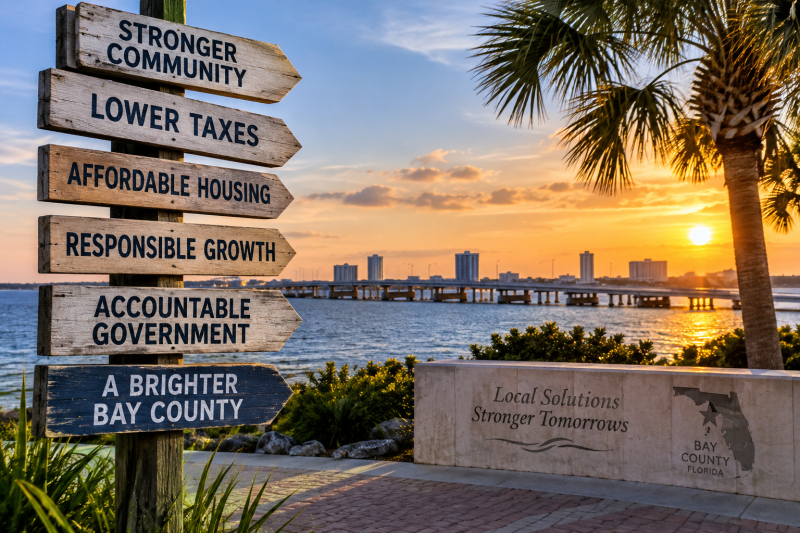
There is something I think we need to talk about in Bay County, and it has almost nothing to do with Washington.
Actually, that is part of the point.
We spend an incredible amount of political oxygen talking about presidents, Congress, national personalities, cable-news controversies, social-media battles, and whatever political outrage happens to be trending that particular morning.
Meanwhile, the road we drive on is still here.
The development going up down the street is still here.
Our property-tax bill is still sitting on the kitchen counter.
The cost of homeowners insurance is still coming out of our bank account.
The family trying to find an affordable place to live in Bay County is still doing the math.
And the decisions that shape much of our everyday experience are frequently being made not in Washington, but in county commission chambers and city halls.
That raises a worthwhile question: Would Bay County benefit from more serious competition outside the traditional two-party pipeline in local elections?
Not protest candidates. Not candidates running simply to make an ideological statement. Not people interested primarily in collecting a party nomination or putting a political label beside their name.
I mean credible independent and third-party candidates with professional experience, community roots, an understanding of local government, and actual ideas about governing.
Because local government is exactly where political competition can become intensely practical.
Local Government Is Where Politics Becomes Real
National politics is naturally ideological. Local government often isn’t.
A pothole doesn’t have a party registration.
Neither does a sewer line.
A building permit doesn’t care who someone supported for president.
The family trying to afford homeowners insurance probably isn’t particularly interested in whether their county commissioner generated the perfect social-media post about whatever happened in Washington that afternoon.
They want competent government.
Bay County’s five-member Board of County Commissioners oversees county government and establishes policy affecting residents across the county. (Bay County) And right now, the county is preparing its FY2027 budget, with public budget hearings scheduled for September 15 and September 23. (Bay County)
Those decisions matter.
Consider the scale involved.
Bay County’s FY2026 tentative budget showed roughly $706.9 million across all funds after interfund transfers, with approximately $185.8 million in ad valorem property-tax revenue. (Bay County)
That is real money.
And when government is handling hundreds of millions of dollars, taxpayers deserve genuine debate about priorities, efficiency, spending, infrastructure and long-term liabilities.
Political competition can help produce that debate.
Bay County Is Changing
This conversation becomes even more important because Bay County isn’t standing still.
According to the U.S. Census Bureau, the county had approximately 115,291 housing units by July 2025. The median value of owner-occupied housing during the 2020–2024 measurement period was about $310,500, while median gross rent was $1,484.
The county also recorded 2,072 building permits in 2025. (Census.gov)
Anyone who drives around Bay County can see development happening.
Growth itself isn’t inherently bad. Quite the opposite. Growing communities can create jobs, expand the tax base, attract investment, create housing and provide opportunities for small businesses.
The difficult question is how government responds to growth.
Does infrastructure keep pace?
Are existing taxpayers continually asked to absorb costs associated with expansion?
Are permitting processes predictable?
Are regulations protecting legitimate public interests, or unnecessarily increasing costs and restricting supply?
Are impact fees structured appropriately?
Are taxpayers getting measurable value for what government spends?
Those are local questions.
And they deserve local candidates willing to spend more time discussing them than discussing the latest controversy coming out of Washington.
Florida’s Property-Tax Debate Makes Fiscal Discipline Even More Important
There is another reason Bay County needs a serious conversation about local fiscal policy.
Florida is moving toward significant property-tax changes.
During the 2026 special session, the Legislature approved a proposed constitutional amendment called Save Our Homes from Excessive Property Taxes.
Among other provisions, the proposal would increase homestead exemptions for non-school property taxes. For qualifying existing Florida residents, the exemption would rise to as much as $150,000 beginning in 2027 and $250,000 beginning in 2028, with future inflation adjustments.
The proposal also calls for a schedule toward eliminating qualifying non-school homestead property taxation. (Florida Senate)
That distinction matters.
Property-tax elimination isn’t simply a completed fact. Constitutional changes require voter approval.
But the direction of the debate is unmistakable: Florida lawmakers are seriously reconsidering how much local government should rely upon property taxes.
Governor Ron DeSantis also signed legislation tightening the rules governing local property-tax increases. Under the new framework, exceeding the rolled-back rate can require heightened approval thresholds depending upon the size of the proposed increase. (FLGov)
Local governments therefore have every reason to start thinking several years ahead.
And this is where fiscal conservatism becomes something more meaningful than a campaign slogan.
If property-tax revenues become substantially constrained, governments basically have several choices.
They can cut spending.
They can become more efficient.
They can identify alternative revenues.
They can shift taxes or fees elsewhere.
Or they can use some combination of those approaches.
Simply moving the burden from one taxpayer to another doesn’t necessarily make government less expensive.
A homeowner may save money on one line of the household budget only to discover that government has recovered the revenue through higher sales taxes, assessments, fees or other charges.
That is why the smartest time to begin examining spending isn’t after revenue disappears.
It is before.
Insurance Remains Part of the Affordability Conversation
Florida’s property-insurance market also deserves some nuance.
There have been signs of improvement.
Citizens Property Insurance Corporation announced an average 8.8% decrease in 2026 homeowners multiperil rates statewide, while homeowners with wind-only policies were slated for an average reduction as well. (Public)
That’s encouraging.
But lower rates in one part of the market don’t erase the broader affordability pressures families have experienced.
Housing affordability is ultimately a combination of purchase price, interest rates, taxes, insurance, utilities, maintenance and income.
Bay County’s median owner-occupied home value was already approximately $310,500 during the Census Bureau’s 2020–2024 period, with median monthly owner costs for households carrying mortgages around $1,778. (Census.gov)
Those numbers help explain why local fiscal decisions matter so much.
Every additional recurring expense affects somebody’s household budget.
The Case for More Competition
This is where independent and third-party candidates can potentially contribute something valuable.
Competition forces questions.
Competition forces incumbents to explain decisions.
Competition forces candidates to develop actual platforms.
Competition can also give voters alternatives when neither major-party candidate represents what they want from local government.
But there is an equally important point that advocates for third-party politics sometimes overlook:
A different label doesn’t automatically produce a better candidate.
Being independent doesn’t make someone competent.
Being Libertarian doesn’t make someone fiscally responsible.
Being Republican doesn’t make someone conservative.
Being Democratic doesn’t make someone compassionate.
Labels are shortcuts. Governing requires considerably more.
A credible candidate should understand budgets, land use, infrastructure, public safety, procurement, taxes, economic development and the legal limits of the office being sought.
Candidates should also have demonstrated some ability to lead.
That experience can come from many places: running a business, managing employees, leading a nonprofit, organizing volunteers, serving in a church or civic organization, managing projects, participating in advocacy, coaching young people, serving in the military or solving problems within a neighborhood.
The exact résumé matters less than the evidence behind it.
Can this person organize people?
Can this person make decisions?
Can this person explain complicated issues?
Can this person work with people who disagree?
Can this person manage money?
Can this person admit when he or she is wrong?
Can this person say no?
Those questions matter more than whether someone can repeat a party’s talking points.
Third Parties Have a Candidate-Quality Problem Too
People who want stronger independent or Libertarian participation in local politics should also be willing to acknowledge an uncomfortable reality.
Third parties cannot expect voters to take them seriously if they don’t consistently recruit candidates whom ordinary voters can imagine governing.
Politics is ultimately about trust.
Voters aren’t selecting a philosophy textbook. They’re hiring someone.
That person may eventually oversee budgets, employees, contracts, infrastructure projects and decisions involving millions of taxpayer dollars.
A candidate therefore needs more than ideological purity.
Candidates need credibility.
They need professionalism.
They need enough understanding of government to know what the office can actually accomplish.
And perhaps most importantly, they need relationships within the community.
This is where local elections differ dramatically from presidential campaigns.
You Don’t Need Millions of Dollars to Meet Your Neighbors
A candidate for local office doesn’t need to introduce himself to 340 million Americans.
He needs to introduce himself to his community.
That changes the mathematics considerably.
Knock on a door.
Talk to the person who answers it.
Listen.
Walk to the next house.
Repeat.
Talk to people at community events.
Talk with neighborhood associations.
Participate in civic organizations.
Know local business owners.
Build relationships through churches, volunteer groups and community organizations.
Ask supporters to bring friends.
Recruit volunteers.
Train them.
Give them doors to knock.
Suddenly one candidate talking with voters becomes ten people talking with voters.
That’s grassroots organizing.
It isn’t glamorous.
It doesn’t generate the instant dopamine hit of a viral political post.
But local campaigns have always depended heavily upon relationships, familiarity and voter contact.
Callaway provides a timely illustration of how accessible local democracy can be. The League of Women Voters of Bay County is hosting a public candidate forum for the 2026 Callaway City Commission Ward 1 and Ward 2 races, giving residents the opportunity to hear directly from people seeking to govern their community. (City of Callaway)
That is politics at its healthiest: candidates standing before their neighbors answering questions about the community they actually share.
Don’t Promise What the Office Cannot Deliver
There is another habit local candidates should abandon: campaigning for a local office as though they’re running for Congress.
A county commissioner isn’t going to rewrite American foreign policy.
A city commissioner isn’t going to balance the federal budget.
A mayor isn’t going to solve every national cultural dispute.
Campaign for the office you’re actually seeking.
Tell voters what the city or county can legally do.
Explain what it costs.
Explain how you’ll pay for it.
If you propose cutting something, identify it.
If you oppose a tax increase, explain how you’ll balance the budget without it.
If you support infrastructure investment, explain the financing.
If you think regulations should be eliminated, identify the regulations.
That is how voters can distinguish philosophy from governing.
Limited Government Requires More Than Saying “Limited Government”
The most serious argument for smaller government isn’t that government should never do anything.
It’s that government should do the things legitimately entrusted to it competently, transparently and efficiently.
Local government has real responsibilities.
Public safety matters.
Roads matter.
Water and wastewater systems matter.
Emergency management matters—especially in a hurricane-prone community.
Planning matters.
Infrastructure matters.
The question isn’t whether these things should exist.
The question is how we provide essential services without allowing government to become unnecessarily expensive, intrusive or unaccountable.
That requires elected officials willing to scrutinize budgets line by line.
It requires measuring outcomes.
It requires competitive procurement.
It requires questioning programs that continue primarily because “we’ve always done it.”
It requires understanding the difference between an investment and an expense.
And it requires remembering something politicians sometimes forget:
Government money isn’t government money.
It belonged to somebody before government collected it.
Maybe Local Politics Should Be Local Again
None of this means national politics doesn’t matter.
Of course it matters.
Presidents matter.
Congress matters.
Governors matter.
Political parties matter.
But our obsession with national politics can sometimes prevent us from noticing how much power exists much closer to home.
Bay County residents are dealing with housing costs, insurance, growth, infrastructure, taxation and the everyday pressures that accompany a rapidly changing Florida.
Those problems won’t be solved by another Facebook argument about Washington.
They require people willing to show up locally.
And whatever party label those candidates choose—or don’t choose—the healthiest local political environment is one in which voters have genuine choices among credible people with competing ideas.
More competition doesn’t guarantee better government.
But uncontested ideas rarely produce accountability either.
The opportunity for independents and third parties in local politics, therefore, isn’t simply to run more candidates.
It’s to develop better ones.
People with résumés.
People with roots.
People who understand budgets.
People who have led organizations, businesses or community efforts.
People willing to knock on doors.
People willing to listen before speaking.
People capable of working with someone who voted differently.
People who understand that governing is ultimately about solving problems rather than winning arguments.
And people humble enough to remember that public office isn’t a personal achievement.
It’s a temporary responsibility entrusted to you by your neighbors.
Maybe that is the larger conversation Bay County needs.
Not how we can make local government look more like national politics.
But how we can make local politics local again.
Add comment
Comments