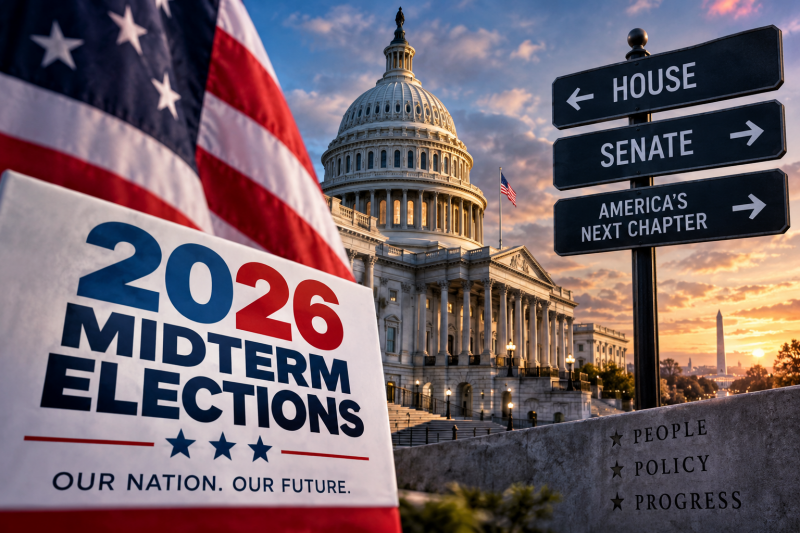
We are officially getting to the point in the 2026 midterm election cycle where I start paying considerably less attention to individual polls and considerably more attention to patterns.
One poll can be wrong.
Two polls can disagree.
A partisan poll can exaggerate an advantage. A pollster can underestimate turnout. A survey conducted over a particularly ugly news cycle can capture a temporary emotional reaction that disappears two weeks later.
That is why I have never been particularly interested in declaring an election over because somebody released a poll showing one candidate ahead by five points.
But when you begin seeing the same warning signs appearing across multiple states, different pollsters, different demographic groups, special elections and national surveys, something else is happening.
And right now, Republicans have some warning lights flashing.
Not because Democrats suddenly became overwhelmingly popular.
They haven’t.
Not because every Republican candidate is collapsing.
They aren’t.
And certainly not because the November election has somehow already been decided.
It hasn’t.
But the political environment Republicans are operating in today looks considerably more difficult than it did earlier in this election cycle.
The House currently looks favorable to Democrats.
The Senate, which once appeared to provide Republicans with a much more comfortable firewall, has become genuinely competitive.
And perhaps most importantly, Republicans are suddenly having to defend political territory that should not require this much attention.
Texas.
Iowa.
Alaska.
Those are not states Republicans want to be discussing as Senate battlegrounds two months before Election Day.
Yet here we are.
Start With the National Environment
Before getting into individual Senate races, we need to look at the broader environment because congressional elections don’t happen inside fifty separate political bubbles.
National conditions matter.
President Donald Trump’s approval rating has deteriorated considerably.
A Financial Times/Focaldata survey conducted August 28 through September 1 found just 33 percent of registered voters approving of Trump’s performance, the lowest figure recorded since the Financial Times began asking the question in May. His approval among Republicans had also fallen to 72 percent. (Financial Times)
The economic numbers underneath that poll were arguably even more concerning for Republicans.
Nearly two-thirds of respondents said the economy was moving in the wrong direction, while 57 percent said they were financially worse off under the Trump presidency.
That matters.
Political consultants can talk about messaging all day. Campaigns can spend millions of dollars producing beautiful television advertisements. Candidates can argue about statistics showing economic growth, investment or job creation.
But voters ultimately experience the economy through their own lives.
What does gasoline cost?
What does electricity cost?
What does a grocery cart cost?
Can I afford my insurance?
Can I afford my rent?
Can I buy a house?
Do I have more money left after paying the bills than I did a year ago?
Those questions frequently matter more politically than whatever number gets announced during the latest economic briefing.
And there is another issue Republicans cannot ignore: tariffs.
The same Financial Times survey found 56 percent of registered voters disapproved of Trump’s latest 50 percent tariff on roughly $20 billion of Canadian goods, including more than 60 percent of independents and nearly one-third of Republicans. (Financial Times)
I have said repeatedly that tariffs are taxes paid somewhere in the economic chain, and eventually those costs have a habit of finding their way to consumers.
You can call them protectionism.
You can call them economic nationalism.
You can call them leverage.
But when businesses face higher input costs, somebody eventually pays.
Usually, that somebody is us.
Add higher energy prices, persistent inflation concerns and the ongoing war with Iran, and Republicans are heading into a midterm election with precisely the combination an incumbent party generally doesn’t want: voters frustrated with Washington while believing their own financial situation has deteriorated.
The Generic Ballot Is Becoming Difficult to Ignore
This is where the picture becomes more interesting.
The latest Economist/YouGov generic congressional ballot released September 9 showed:
Democrats: 49 percent
Republicans: 38 percent
That’s an eleven-point Democratic advantage. (RealClearPolling)
Now, before anyone runs screaming toward the nearest television camera announcing a Democratic landslide, don’t.
That is one poll.
And it is substantially more Democratic than some other recent surveys.
Morning Consult had Democrats ahead by four.
The Financial Times/Focaldata survey had Democrats ahead by seven.
Rasmussen had Democrats ahead by five.
Harvard-Harris actually had Republicans ahead by two.
The point isn’t that Democrats are definitely ahead by eleven points nationally.
They probably aren’t.
The point is the average.
Silver Bulletin’s generic-ballot average had Democrats ahead by approximately 6.6 points as of September 8, virtually unchanged from their 6.5-point advantage at the beginning of August. (t.co)
That stability is important.
If Democrats had briefly jumped to a six-point advantage following some particularly damaging news cycle and then immediately fallen back to two or three points, I wouldn’t read too much into it.
Instead, their advantage has persisted.
Another polling model, Call the Map, estimated the generic congressional ballot around D+6.2, while calculating the broader national political environment at approximately D+7.5. (Call the Map)
Different methodologies produce somewhat different numbers, but they are telling broadly similar stories.
Democrats currently have a meaningful national advantage.
And there is real-world evidence supporting it.
Special Elections Are Telling Us Something Too
One of the reasons I pay attention to special elections is that they measure something polls are constantly trying to estimate:
Who actually shows up?
Polling models attempt to predict turnout.
Special elections give us actual ballots.
Axios calculates that Democrats have been performing approximately ten points better than their 2024 presidential baseline in special elections this year. (Axios)
That does not mean Democrats will outperform Kamala Harris’s 2024 performance by ten points everywhere in November.
Midterm turnout will be much larger.
Candidate quality matters.
Different districts contain different coalitions.
Campaign spending changes.
But when dozens of elections repeatedly move in the same general direction, I pay attention.
There is also an important complication for Democrats: redistricting.
Republican-drawn maps implemented since the presidential election have created an estimated nine-seat net structural advantage for Republicans, according to Axios’ analysis. That effectively gives Republicans a political seawall capable of absorbing some national movement against them. (Axios)
That’s significant.
It means Democrats cannot simply perform slightly better nationally and automatically assume they will win the House.
But Axios estimates that a roughly six-point Democratic generic-ballot advantage could still produce something around a 221–214 Democratic House majority.
For comparison, the 2018 midterms produced a roughly 6.5-point national swing toward Democrats and resulted in Democrats gaining 40 House seats. (Axios)
History doesn’t repeat itself mechanically.
The maps are different.
The coalitions are different.
The candidates are different.
But the comparison gives us some perspective.
A six- or seven-point national environment is not political background noise.
It can move seats.
Then There’s Texas
If you want one race that captures how strange the 2026 environment has become, look at Texas.
A new N+ Univision News survey conducted with YouGov found Democrat James Talarico leading Republican Ken Paxton 48 percent to 43 percent in the U.S. Senate race. (TelevisaUnivision)
Again, one poll doesn’t decide an election.
But this isn’t one isolated poll suddenly showing Texas competitive.
The University of Texas/Texas Politics Project had Talarico ahead 42–39 in August.
Emerson had Paxton ahead 47–46.
A Bush School/ReconMR survey had Talarico ahead 47–43.
Texas Southern University/YouGov had Talarico ahead 47–45.
Fox News had him ahead 51–48.
New York Times/Siena previously found the race tied 47–47. (The Texas Politics Project)
That is a pattern.
And that’s entirely different from finding one Democratic internal poll claiming Texas is competitive.
The newest Univision poll also found Paxton with a difficult favorability problem: 36 percent favorable and 49 percent unfavorable, while Talarico stood at 44 percent favorable and 35 percent unfavorable. (TelevisaUnivision)
Texas remains Texas.
Republicans have enormous infrastructure there. They have decades of statewide electoral success behind them. The electorate still contains millions of conservative voters.
But Republicans having to spend heavily to defend Texas creates problems far beyond Texas.
Every dollar spent protecting a Senate seat in Texas is a dollar unavailable somewhere else.
And Republicans suddenly have a lot of “somewhere elses.”
Watch the Latino Vote Closely
Texas also connects to another developing national story.
Republicans made significant gains among Latino voters during the Trump era, particularly in 2024.
Anyone assuming those voters permanently became Republicans made the same mistake political parties repeatedly make.
Voters don’t belong to political parties.
Political parties have to continually earn voters.
A Hart Research survey conducted for TelevisaUnivision across 17 competitive House districts found Democrats leading Republicans among Latino voters 58 percent to 35 percent on the congressional ballot. (Axios)
The Texas numbers were especially striking.
Across three competitive Texas congressional districts, Latino respondents reported having split 44–44 in the 2024 presidential election.
Their current congressional preference?
Democrats 56 percent. Republicans 36 percent.
Even more interestingly, approximately 11 percent of Latino respondents who said they voted for Trump in 2024 now say they support Democratic congressional candidates. (Axios)
That doesn’t mean Latino voters are “returning home” to Democrats.
I actually dislike that kind of political language.
No political party owns Latino voters.
No political party owns working-class voters.
No political party owns suburban voters.
No political party owns Catholics, union households, rural voters, Black voters or young voters.
Politicians who start believing they own constituencies eventually learn a painful lesson.
The survey also provides an important clue about what’s happening.
The economy ranked above immigration as Latino voters’ top concern. (Axios)
That should sound familiar.
People are voting based on their lives.
Imagine that.
Michigan Is Exactly What a Toss-Up Looks Like
Then we move to Michigan.
Two recent polls provide a perfect illustration of why I refuse to obsess over individual surveys.
A Detroit News/Glengariff poll had Republican Mike Rogers leading Democrat Abdul El-Sayed:
Rogers 46
El-Sayed 44
Then CNN’s new SSRS survey found:
El-Sayed 47
Rogers 44. (SSRS)
So who is winning?
Nobody knows.
That’s the answer.
Michigan is close.
That’s what the polls are telling us.
The interesting contrast is Michigan’s gubernatorial race, where CNN found Democrat Jocelyn Benson leading Republican John James 50 percent to 41 percent. (RealClearPolling)
That potentially creates substantial ticket splitting.
And I think we sometimes underestimate how willing voters are to do that.
Not every voter walks into the booth thinking, “I am a Republican, therefore every Republican receives my vote.”
Or the Democratic equivalent.
Millions of Americans evaluate candidates individually.
They like one Republican and dislike another.
They trust one Democrat and distrust another.
That’s healthy.
I’d actually like considerably more of it.
Susan Collins Has a Serious Maine Problem
Maine is another race Republicans cannot take for granted.
CNN’s new SSRS poll finds Democrat Troy Jackson ahead of Republican Sen. Susan Collins:
Jackson 48 percent
Collins 45 percent. (SSRS)
That’s close enough to remain a genuine toss-up.
But the underlying environment is difficult for Collins.
Her political brand has historically depended on independence.
She has survived because enough Maine voters viewed Susan Collins as something distinct from the national Republican Party.
That becomes considerably harder when a Republican president becomes deeply unpopular in the state and national politics overwhelms individual brands.
This doesn’t mean Collins cannot win.
If there is one Republican senator who has repeatedly demonstrated an ability to survive difficult environments in Maine, it’s Susan Collins.
But she has a fight.
Iowa Offers Republicans Some Better News
Not everything is moving toward Democrats.
Iowa is a useful example.
The latest Emerson College/Nexstar poll finds Republican Ashley Hinson leading Democrat Josh Turek in the Senate contest:
Hinson 50 percent
Turek 45 percent. (Emerson Polling)
That’s a solid result for Republicans.
Hinson increased her support by two points from Emerson’s August survey while Turek remained at 45 percent.
But here’s where things get fascinating.
The same poll has Democrat Rob Sand leading Republican Zach Lahn in the gubernatorial race:
Sand 49
Lahn 46.
Approximately six percent of respondents were effectively splitting their tickets between Hinson for Senate and Sand for governor. (Emerson Polling)
Trump’s approval in Iowa was also underwater at 44 percent approval to 52 percent disapproval.
So Iowa isn’t suddenly becoming a blue state.
What we’re seeing instead is an electorate willing to distinguish between candidates.
That makes candidate quality enormously important.
Alaska Might Be the Weirdest Race in America
Then there is Alaska.
Former Democratic Rep. Mary Peltola is giving Republican Sen. Dan Sullivan a serious race.
Alaska Survey Research polling released publicly in September showed Peltola narrowly ahead, roughly 51–49. (Call the Map)
But polling isn’t even the most interesting piece of evidence.
Alaska’s August nonpartisan primary produced:
Mary Peltola: approximately 82,000 votes
Sen. Dan Sullivan: approximately 69,000 votes. (Reuters)
And because Alaska apparently decided a normal Senate race wasn’t interesting enough, another Republican named Dan Sullivan qualified for the November ballot.
Yes.
Two Dan Sullivans.
The second, retired teacher Dan J. Sullivan Jr., received more than 4,000 votes in the primary and survived an effort by Republicans to remove him from the ballot. (The Wall Street Journal)
Combine that with Alaska’s ranked-choice voting system and Peltola’s existing statewide recognition, and the race becomes extraordinarily unpredictable.
The important national point isn’t necessarily that Peltola will win.
It’s that Republicans have to defend Alaska at all.
This brings us to the bigger picture.
Democrats need to gain four Republican-held seats to take control of the Senate.
That remains difficult.
Republicans began this cycle with a substantial structural advantage.
But Reuters now identifies nine Senate contests as competitive:
Alaska.
Georgia.
Iowa.
Maine.
Michigan.
New Hampshire.
North Carolina.
Ohio.
Texas. (Reuters)
Think about that map.
Texas and Alaska are now sharing a list with Michigan and Maine.
That’s not where Republicans expected to be.
Georgia Democratic Sen. Jon Ossoff is defending his seat against Republican Mike Collins.
North Carolina’s open Senate race between Democrat Roy Cooper and Republican Michael Whatley remains crucial.
Former Democratic Sen. Sherrod Brown is trying to return in Ohio against Republican Jon Husted.
New Hampshire remains an important Democratic defensive opportunity.
Michigan is essentially a coin flip.
Maine is a coin flip.
Iowa is competitive.
Texas is competitive.
Alaska is competitive.
The Associated Press summarized the change well this week: Republicans entered the cycle confident about retaining their Senate majority, but the battle has become considerably more open as Trump’s declining approval and dissatisfaction with the economy have reshaped the environment. (AP News)
That’s the story.
Not that Democrats are guaranteed to take the Senate.
They’re not.
The story is that Republicans no longer have the luxury of concentrating resources on two or three obvious races.
The battlefield expanded.
Republicans Have a Trump Problem—and a Trump Dependency
There is another fascinating contradiction developing inside the Republican coalition.
Republicans need Donald Trump.
And Donald Trump may simultaneously be hurting them.
Trump can motivate voters who don’t reliably participate in elections.
He has built one of the most loyal political followings in modern American politics.
Republican candidates cannot simply alienate those voters and expect to win.
But the Financial Times poll found 46 percent of voters saying Trump makes it harder for Republican congressional candidates to win, while 47 percent of independents said a Trump endorsement makes them less likely to support a candidate. (Financial Times)
Axios has reported Republican strategists privately wrestling with precisely this dilemma as Trump places himself at the center of the midterm campaign. (Axios)
Republicans need his voters.
But they also need voters who don’t like him.
That’s a difficult needle to thread.
And it becomes even harder when the election itself turns into a referendum on the president.
This Is Why Principle Matters More Than Party
There is a larger lesson here that extends beyond November.
Political parties eventually get themselves into trouble when winning becomes the principle rather than principles being the reason to win.
Republicans spent years attacking reckless spending.
Then Washington kept spending.
Republicans campaigned against endless foreign wars.
Now Americans are dealing with another war and the economic consequences surrounding it.
Republicans talked about affordability.
Families still feel squeezed.
Republicans warned about government overreach.
Yet concerns over surveillance, executive authority and centralized power haven’t disappeared simply because Republicans control Washington.
Voters notice inconsistencies.
Maybe not immediately.
Maybe not every voter.
But eventually they notice.
And Democrats should be careful before celebrating too much because this lesson applies equally to them.
If Democrats win because voters are angry with Republicans, that is not the same thing as voters issuing Democrats a blank ideological check.
Americans increasingly look politically homeless.
They distrust institutions.
They dislike Congress.
A new UMass Amherst poll found only 22 percent approving of Congress’ performance, while 68 percent disapproved. Even respondents’ opinions of their own representatives were strikingly weak. (UMass Amherst)
Meanwhile, the latest Economist/YouGov polling found only 16 percent saying they trust the federal government to do what is right either “just about always” or “most of the time.” (YouGov)
That isn’t a healthy political environment for anybody.
It is an electorate begging for competent, principled leadership.
So What Does the Election Look Like Right Now?
If I had to summarize the 2026 midterms today, I would put it this way:
The House currently leans Democratic.
Not guaranteed.
Not safely Democratic.
But Democrats have the better national environment, a sustained generic-ballot advantage and strong special-election performance. Republican redistricting gives the GOP a meaningful structural cushion, but current Democratic numbers appear strong enough to overcome it if they hold.
The Senate is a toss-up.
Republicans still possess structural advantages and Democrats have a difficult path requiring multiple pickups.
But the map has expanded enough that calling the Senate comfortably Republican no longer makes sense.
Texas is real.
Maybe Talarico wins.
Maybe Paxton wins.
But after repeated polls showing a close contest, dismissing Texas as fake competitiveness requires ignoring too much evidence.
Michigan and Maine are genuine toss-ups.
The polling is simply too close to call.
Iowa currently looks somewhat better for Republicans at the Senate level, but the gubernatorial race demonstrates that Iowa voters aren’t necessarily voting straight ticket.
Alaska is legitimately competitive.
And the primary results alone should prevent Republicans from taking it lightly.
The Most Important Number Isn’t Any Single Poll
Here is what I’m watching next.
Not whether the next Texas poll says Talarico +3 or Paxton +2.
Not whether Michigan moves one point.
Not whether somebody releases a national survey showing Democrats ahead by nine.
I’m watching whether the overall environment changes.
Silver Bulletin currently has the generic ballot around D+6.6. (t.co)
If that starts falling toward D+3 or D+4 during late September and October, Republicans should feel considerably better.
If it remains around D+6 or D+7, Democrats will continue to have a legitimate House advantage.
If it begins consistently approaching D+8, D+9 or D+10 among likely voters, then we need to start talking about something much larger.
Because at that point, districts nobody expected to become competitive can suddenly become competitive.
That’s how waves work.
You don’t recognize them because one obvious battleground changes hands.
You recognize them because places that weren’t supposed to be battlegrounds start appearing on television election maps.
Republicans Aren’t Doomed—but They Are Running Out of Room for Error
There are still nearly two months until Election Day.
That’s an eternity in politics.
Wars can change.
Economic conditions can change.
Candidates can make catastrophic mistakes.
Scandals happen.
Debates happen.
Campaigns can collapse.
Pollsters can be wrong.
Turnout can surprise everybody.
So no serious person should look at today’s polling and declare the 2026 midterms finished.
But serious people shouldn’t ignore what the numbers are saying either.
And right now they’re saying Republicans have a problem.
Not one poll.
Not one candidate.
Not one state.
A national environment problem.
When Texas becomes competitive, pay attention.
When Alaska becomes competitive, pay attention.
When Democrats consistently lead the generic ballot, pay attention.
When special elections repeatedly outperform presidential baselines, pay attention.
When Latino voters who moved toward Republicans begin moving back toward Democratic congressional candidates, pay attention.
When an incumbent president’s approval falls into the thirties while voters say they’re financially worse off, definitely pay attention.
None of those things individually guarantees an electoral wave.
Together, they tell us something important.
The 2026 midterms have changed.
Republicans still have time to change with them.
They can focus relentlessly on affordability.
They can demonstrate fiscal restraint instead of merely talking about it.
They can stop assuming voters will excuse policies they would have condemned under a Democratic administration.
They can give independent voters a reason to believe Republican candidates are independent representatives rather than extensions of the White House.
They can return to limited government, constitutional restraint, responsible spending and peace rather than expecting party loyalty to substitute for principle.
But time is getting short.
The biggest mistake Republicans could make right now would be convincing themselves that every bad poll is fake, every competitive race is an outlier and every warning sign is media spin.
That isn’t strategy.
That’s denial.
Democrats aren’t guaranteed a wave.
Republicans aren’t guaranteed a collapse.
But if Election Day were today, I would much rather be the party expanding the battlefield than the party desperately trying to shrink it.
And right now, that is exactly what appears to be happening.
The question over the next eight weeks isn’t whether Republicans are in trouble.
The polling increasingly tells us that they are.
The question is whether this is the high-water mark of Democratic momentum—or the beginning of something considerably bigger.
Read more articles from Stephen Despin on Medium here
Add comment
Comments