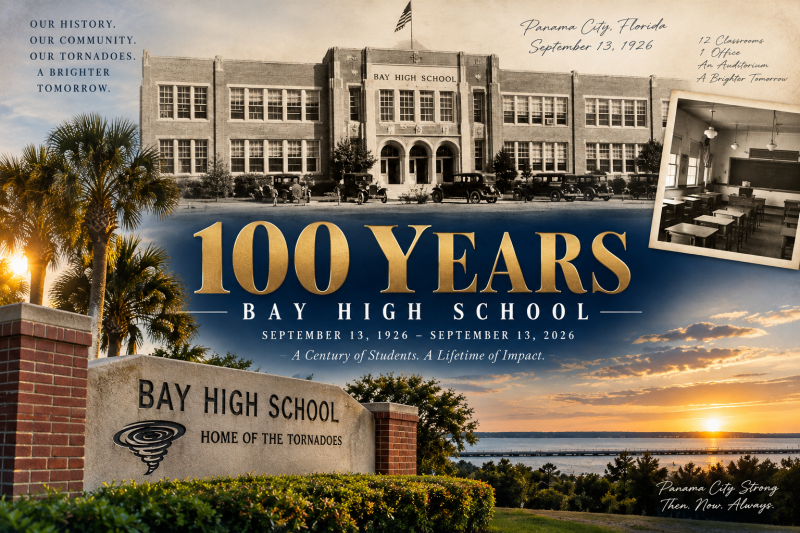
There are certain buildings that become so woven into a community that eventually they stop being just buildings.
They become landmarks.
They become meeting places.
They become repositories for generations of memories.
And sometimes, if they stick around long enough, they become a pretty good way to tell the story of the community itself.
Bay High School is one of those places.
On September 13, 1926, students walked through the doors of a new Bay County High School in Panama City. By today’s standards, it wasn’t exactly a sprawling campus. The building reportedly contained one administrative office, twelve classrooms and an auditorium.
That was it.
And yet, from those relatively humble beginnings came an institution that would educate generations of Bay County families and become one of the most recognizable pieces of Panama City’s identity.
The location itself tells you something about how much this community has changed.
When the new school opened, it was considered to be near the outskirts of Panama City, despite sitting only a little more than a mile from St. Andrews Bay. Today, you’d have a pretty difficult time describing Bay High as being on the outskirts of anything.
Panama City grew around it.
And that may be the most fascinating thing about looking back at Bay High a century later.
Because the history of Bay High isn’t really just the history of a school.
It’s the history of Panama City growing up.
It’s a story about education, local government, football, war, segregation, integration, hurricanes, demolition, rebuilding and generations of young people who walked through those halls on their way to becoming adults.
And as I started digging into that history, I discovered something else.
The story is actually a little more complicated than simply saying Bay High was founded on September 13, 1926.
In fact, that’s probably not technically correct at all.
Bay High’s Story Begins Before 1926
If we’re going to tell this story properly, we have to go back a little further.
Panama City already had a high school before the building we associate with the beginning of Bay High opened.
Ground was broken in October 1914 for Panama City High School at East Seventh Street and Harrison Avenue. The Gulf Coast Development Company donated more than five acres for the project, and the building reportedly cost approximately $25,000.
Pensacola architect S.J. Welch designed it, while Dobson and Olive of Montgomery handled construction.
The school was formally dedicated on October 4, 1915 and served students across grades one through twelve.
That alone gives us some perspective.
Bay County itself had only been created in 1913.
So within just a couple of years of Bay County becoming a county, local leaders were already investing in a substantial permanent school for Panama City’s children.
But Panama City wasn’t going to stay the same size for very long.
As the community grew, so did its educational needs.
And somewhere during the early 1920s, the identity that would become Bay High began taking shape.
Modern histories generally give 1924 as Bay High’s establishment year.
There’s actually some fascinating evidence supporting that date.
Tommy Oliver—whose name generations of Bay County residents would later know because of Tommy Oliver Stadium—reportedly entered Bay High as a freshman in 1924 and played on the school’s first football team.
And they weren’t simply the Tornadoes yet.
They were the Purple Tornadoes.
So by 1924, there was clearly something recognizable as Bay High. Students were attending it. A football team existed. An institutional identity was forming.
That means the school did not simply spring into existence when a new building opened in September 1926.
And the historical trail gets even more interesting.
One School, Several “Birthdays”
When you start looking through old records, Bay High seems to have several different birthdays depending on what exactly you’re measuring.
Southern Association accreditation records later listed 1923 in connection with Bay County High School’s accreditation history.
Modern school histories commonly use 1924 as the establishment date.
At least one later Florida High School Athletic Association directory used 1925.
And then, of course, there is September 13, 1926, when the purpose-built Bay County High School opened.
At first glance, those dates look contradictory.
I don’t think they necessarily are.
Instead, they appear to document different stages in the evolution of the institution.
The earlier accreditation date may reflect continuity with Panama City’s existing secondary-school program. The 1924 date appears to mark the emergence of the Bay High identity we recognize today. The following year brought the financing needed for a permanent county high-school building.
And 1926 gave that institution its new home.
That’s why September 13, 2026 should probably be understood not simply as “Bay High’s 100th birthday,” but more precisely as the 100th anniversary of the opening of the historic Bay County High School building.
That’s an important distinction.
And honestly, I think it makes the history more interesting, not less.
Building a County High School
By 1925, Bay County was ready to make a major investment in secondary education.
The Florida Legislature authorized the Bay County Board of Public Instruction to borrow up to $100,000 to construct a high-school building in Panama City.
For perspective, $100,000 was an enormous public investment in the 1920s.
But the wording of the legislation may be even more historically significant than the amount.
The law authorized financing for the purpose of erecting a high-school building in Panama City where the County High School for Bay County would be maintained.
In other words, the Legislature wasn’t necessarily creating a high school.
It was financing a building for the county high school.
That fits remarkably well with the other evidence showing Bay High operating as an institution before September 1926.
And it tells us something important about the people who actually “founded” Bay High.
There doesn’t appear to have been one founder.
This wasn’t a private academy created by one wealthy benefactor whose name belonged above the door.
Bay High was a public project.
It was built through local educational leadership, the Bay County Board of Public Instruction, state legislative authority and a community recognizing that its future required investment in education.
That makes Bay High’s founding, in a very real sense, a community story.
The Man Who Designed the Original Bay High
One of the more obscure pieces of this story is the architect behind the original school.
His name was Edwin Fitchner.
National Register of Historic Places documentation concerning another historic Bay County school identifies Fitchner as an architect engaged by Bay County and specifically notes that he was also hired to build Bay County High School and the Bay County Jail.
So when students arrived on September 13, 1926, they weren’t simply entering a generic schoolhouse.
They were entering a purpose-built civic institution designed during an era when Panama City itself was rapidly taking shape.
The building contained twelve classrooms, an auditorium and one office.
Imagine that for a moment.
One office.
Twelve classrooms.
One auditorium.
That’s what was needed to serve the new county high school.
Today, those numbers sound almost impossibly small.
But Panama City was a very different place.
The school sat near the edge of town.
There were still vast areas surrounding it that would eventually become neighborhoods, businesses, roads and everything else we now think of as central Panama City.
The city hadn’t swallowed Bay High yet.
Bay High was waiting for the city to catch up.
September 13, 1926
Then came opening day.
September 13, 1926.
It’s difficult not to wonder what that morning looked like.
What did those students think when they first saw the new building?
Were they nervous?
Excited?
Did parents stop outside to admire a building their tax dollars had helped create?
Did anyone walking through those doors imagine that people would still be talking about that morning a century later?
We know the dimensions of the school.
We know who designed it.
We know how the county financed it.
What we don’t yet know is almost equally fascinating.
Despite digging deeply into the surviving digital record, I have not found a sufficiently reliable contemporary roster identifying every teacher who walked into Bay County High that morning, nor have I found documentation strong enough to confidently identify the school’s principal on opening day.
Those records may still exist.
They could be sitting in an early Pelican yearbook, old Bay County Board of Public Instruction minutes, a commencement program, a surviving newspaper archive, Bay High’s own historical collection or the archives of the Historical Society of Bay County.
But history deserves more respect than filling gaps with guesses.
So until those records surface, those names remain part of the mystery.
What Happened to the Old Panama City High?
The opening of Bay County High School also changed the role of the earlier Panama City High School.
After the new high school opened in 1926, the older building became Panama Grammar School.
It continued educating children for decades, remaining in use until June 1965.
One secondary historical account places the final graduation from the old Panama City High School on July 4, 1926—just a couple of months before the new Bay County High School opened.
If that date is correct, imagine how quickly that transition occurred.
One generation of students graduated from the old school during the summer.
Then, in September, another generation entered the new Bay County High School.
It was almost literally one chapter closing as another opened.
Who Was the First Graduating Class?
This is another place where historical precision matters.
It would be tempting to say that Bay High’s first graduating class was the Class of 1927.
But that’s not necessarily true.
Remember, the Bay High identity appears to have existed before the 1926 building opened.
What we can say is that the Class of 1927 appears to have been the first senior class to graduate after the new Bay County High School building opened.
That’s slightly different from saying they were the first graduates in Bay High’s institutional history.
Unfortunately, I haven’t found a trustworthy digitized commencement program giving the exact number of graduates in that class.
That remains another tantalizing missing piece.
But by 1928, the United States Bureau of Education was listing Bay County High School in Panama City among accredited secondary schools.
So the institution had established itself quickly.
Then Came the Tornadoes
If you grew up around Bay County, you don’t need anyone to explain what the Tornadoes mean.
School identities become part of local geography.
Tornadoes.
Rams.
Bucks.
Marlins.
Dolphins.
Generations identify themselves with those names long after the diploma is framed or tucked into a drawer somewhere.
For Bay High, athletics became part of the culture remarkably early.
The school’s first known football team dates to 1924, with Tommy Oliver among its players.
Oliver’s story would eventually become inseparable from Bay High.
He became one of the school’s early athletic figures, and his name would later be immortalized through Tommy Oliver Memorial Stadium.
The stadium was established in 1945.
That date matters.
The country had just emerged from World War II, and communities everywhere were dealing with the terrible reality that some of the young men who had once filled their classrooms and athletic fields weren’t coming home.
For generations afterward, Tommy Oliver Stadium became more than a place to play football.
It became one of Panama City’s great gathering places.
Friday nights.
Marching bands.
Cheerleaders.
Parents in the stands.
Students under the lights.
Rivalries that somehow seemed like the most important thing in the world for about three hours.
That’s what schools create.
Not simply graduates.
Community.
But We Can’t Tell Bay High’s History Without Telling the Whole Story
Anniversaries naturally make us nostalgic.
And that’s good.
Communities should remember the things that bind generations together.
But celebrating history honestly also means acknowledging the parts that aren’t comfortable.
For much of Bay High’s early existence, not every child in Panama City could attend it.
Bay High developed during the era of Jim Crow segregation.
Black children in Panama City were educated separately.
And their story is every bit as much a part of Bay County’s educational history as Bay High’s.
During the 1927–28 budget year, the Bay County School Board worked with Panama City’s Black community to acquire land for a school under the Rosenwald program.
The school was constructed at 819 East 11th Street according to Rosenwald Fund specifications.
Interestingly, it was originally named Panama City High School.
That created an obvious identity problem, and by 1939 the school had been renamed in honor of philanthropist Julius Rosenwald.
That same year, Rosenwald graduated its first high-school class.
There were three graduates.
Think about that.
Three young people.
Three families.
Three diplomas representing something much larger than the number suggests.
By 1944, enrollment had grown to 125 students.
A new campus was eventually developed, and Rosenwald became one of the most important institutions in Panama City’s Black community.
Its teachers and administrators educated generations of students despite operating inside a system that intentionally separated children by race and historically provided unequal opportunities.
That story can’t be relegated to a footnote.
Because eventually, the histories of Rosenwald and Bay High would intersect directly.
1967 Changed Bay High Forever
The fight over school desegregation in Bay County eventually reached the federal courts.
Federal civil-rights records document litigation involving Bay County’s school system during the 1960s as the constitutional requirements established by Brown v. Board of Education collided with longstanding segregation throughout the South.
By 1967, Black senior-high-school students in Bay County were integrated into the county’s formerly white senior high schools.
Rosenwald’s final segregated high-school graduating class came that same year.
From that point forward, Bay High was no longer an institution reserved for one part of the community.
Its student body began reflecting a broader Panama City.
That’s one of the most important transformations in the school’s history.
Buildings matter.
Football traditions matter.
Championships matter.
But who is allowed through the front door matters even more.
And any honest account of Bay High’s century-long story should recognize both realities: the pride generations feel for their school and the fact that earlier generations of Black children were denied the opportunity to share equally in it.
History doesn’t become less meaningful when we tell the whole story.
It becomes more meaningful.
Panama City Kept Growing
By the 1970s, the little twelve-classroom school that had once stood near the outskirts of town belonged to another era.
Panama City had expanded dramatically.
Bay High had expanded with it.
Eventually, the original 1926 structure reached the end of its useful life.
Demolition began in 1976, almost exactly fifty years after the building opened.
A replacement building opened in 1977.
Think about how many lives had passed through the original structure during those fifty years.
Children became adults.
Some went to college.
Some joined the military.
Some started businesses.
Some raised families here.
Some left Bay County and never returned.
Others spent their entire lives here.
Some eventually watched their own children—and grandchildren—become Tornadoes.
By the time the original building disappeared, Bay High wasn’t simply a building anymore.
The institution had outgrown the bricks that created it.
Then Hurricane Michael Came
Every generation in Bay County has its defining memories.
For those of us living here today, October 10, 2018 is one of them.
Hurricane Michael came ashore as a Category 5 hurricane and tore through Panama City with catastrophic force.
Bay High was hit hard.
Buildings were damaged.
Athletic facilities were damaged.
The Cobb Gym floor suffered water damage. Weight-room and athletic infrastructure took hits. Goalposts and lighting were damaged. Baseball and softball facilities suffered extensive destruction.
And like so many institutions throughout Bay County, the school had to figure out what came next.
For a time, much of the student body and faculty operated from temporary modular classrooms.
Buildings that had served generations were eventually demolished because the damage was simply too severe.
But here’s where Bay High’s story begins sounding remarkably similar to Bay County’s story.
It got hit.
It suffered.
And then it rebuilt.
Rebuilding Without Forgetting
One of the most beautiful pieces of this entire history came out of the rebuilding process.
Several buildings badly damaged by Hurricane Michael were demolished to make room for what would become the Barbara W. Nelson Fine Arts Center.
The new facility is substantial.
Florida Architects describes a roughly 26,000-square-foot building containing a visual arts gallery, reception and concession areas, more than 700 fixed audience seats, wheelchair spaces, a stage, backstage facilities, a drama laboratory, classroom space, a green room and changing areas.
But the most interesting thing about it isn’t the square footage.
It’s the design.
The architects intentionally designed the building to reflect the historic presence of the original high school.
A front-wrap raised porch recalls the architecture of the school that stood there generations earlier.
I love that.
Because there’s something almost poetic about it.
The original 1926 building is gone.
Most of the people who walked through its doors on opening day are long gone.
The Panama City they knew is gone.
But a century later, pieces of that building’s identity have been deliberately woven into the modern campus.
The past wasn’t reconstructed brick for brick.
It was remembered.
A School Becomes Bigger Than a Building
Today, Bay High sits at 1200 Harrison Avenue in the middle of a Panama City that those students arriving in 1926 would probably struggle to recognize.
The city grew.
The county grew.
The campus grew.
The student body changed.
The buildings changed.
The country changed.
And Bay High changed with all of it.
The school itself now speaks proudly about having roughly 100 years of history and tradition and describes Bay High as Bay County’s flagship high school.
That’s a pretty remarkable journey from twelve classrooms and one office.
But perhaps the most important thing I’ve learned while digging through this history is that anniversaries aren’t always as neat as we’d like them to be.
We like exact dates.
Founded: 1924.
Opened: 1926.
One hundred years.
Simple.
History rarely works that way.
Bay High’s roots stretch backward through Panama City’s earlier public-school system.
Its accreditation history reaches into the early 1920s.
Its institutional identity appears clearly by 1924.
The Florida Legislature authorized financing for the permanent school in 1925.
And on September 13, 1926, students finally walked into the building that would define Bay High for the next half-century.
Each date tells a different part of the story.
One Hundred Years Later
So what exactly are we celebrating today?
We’re celebrating a morning.
September 13, 1926.
A group of young people walked into a brand-new school near the outskirts of a small Florida city.
There were twelve classrooms.
One office.
An auditorium.
There were teachers whose complete names deserve to be rediscovered.
There was an opening-day principal whose identity remains buried somewhere in the surviving archives.
There were seniors who would become the first class to graduate after the new building opened.
None of them could possibly have known everything that would happen over the next century.
They couldn’t know that their football stadium would eventually carry the name of one of their fellow early Tornadoes.
They couldn’t know another world war was coming.
They couldn’t know how dramatically Panama City would grow.
They couldn’t know that generations of Black students who were excluded from their school would eventually become part of the Bay High family.
They couldn’t know their original building would disappear fifty years later.
They couldn’t know a Category 5 hurricane would devastate their community.
They certainly couldn’t know that the school would rebuild again, incorporating architectural reminders of the very building they were entering that morning.
And they couldn’t know that one hundred years later, we’d still be talking about them.
But here we are.
That’s what makes local history so fascinating.
History isn’t only presidents, wars, elections and events that make national textbooks.
Sometimes history is twelve classrooms and an auditorium.
Sometimes it’s three students graduating from Rosenwald.
Sometimes it’s a football stadium on a Friday night.
Sometimes it’s an old school photograph tucked into somebody’s closet.
Sometimes it’s grandparents pointing toward a building and telling their grandchildren, “That’s where I went to school.”
Those stories matter because communities aren’t really built out of roads and buildings.
They’re built out of memory.
And for roughly a century now, Bay High has helped carry Panama City’s memory from one generation to the next.
So today, September 13, 2026, we aren’t simply celebrating an old building that opened one hundred years ago.
We’re remembering the generations who walked through it.
The teachers who taught there.
The families who supported it.
The athletes who represented it.
The students who once weren’t allowed inside it—and the generations who later helped create a more inclusive institution.
The people who rebuilt it.
And the thousands upon thousands of lives that crossed through Bay High on their way to somewhere else.
The original school is gone.
The Panama City of 1926 is gone.
But the institution remains.
And perhaps that’s the real story of Bay High.
Buildings come down.
Cities change.
Generations move on.
But if we’re careful enough to remember where we came from, a community’s story keeps going.
One hundred years after those doors opened, the Tornadoes are still here.
Add comment
Comments