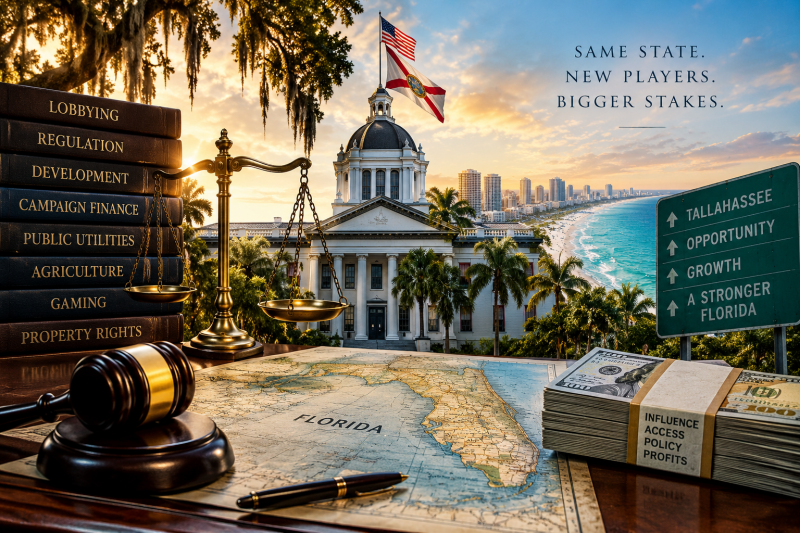
For generations, Florida politics had a reputation.
Everybody knew somebody.
The right family name mattered. The right business connections mattered. The right county mattered. And if you happened to know the right people in Tallahassee, that certainly didn’t hurt.
Florida even had a name for one particularly notorious manifestation of that old political order: the Pork Chop Gang.
These rural North Florida lawmakers accumulated extraordinary power during the middle of the twentieth century because legislative districts had failed to keep pace with Florida’s enormous population shifts. Florida Memory, the state’s historical archive, explains that this allowed representatives of a relatively small portion of Florida’s population to dominate the Legislature. Lobbyists cultivated relationships with lawmakers through what was openly called the “social lobby”—meals, parties, fishing trips and private gatherings where politics could be discussed away from public scrutiny.
That particular system eventually collapsed.
The Supreme Court’s reapportionment decisions, beginning with Baker v. Carr in 1962, helped force states toward population-based legislative representation. Florida’s districts changed. The Pork Chop Gang’s institutional power disappeared. (Florida Memory)
But here is the question I kept coming back to while digging through Florida’s modern political system:
Did the Good Ol’ Boy system actually disappear?
Or did it simply become more sophisticated?
After following campaign contributions, political committees, lobbying firms, regulated utilities, agricultural interests, land developers, gaming, automobile dealerships, medical marijuana, special districts and the extraordinary development story unfolding right here in Northwest Florida, I think the more useful answer is this:
Florida’s political economy today bears little resemblance to the smoke-filled rooms of the 1950s.
But the underlying question of who has access to government power—and what economic advantages government can create or protect—remains very much alive.
The modern system is cleaner, more professional, more transparent in important respects and vastly more complicated.
Instead of a fishing camp, there are political committees.
Instead of a handshake with the county courthouse crowd, there are government-affairs firms.
Instead of one powerful rural legislative bloc, there are party organizations, legislative campaign committees, trade associations, regulated industries, corporate political programs, consultants and professional lobbying networks.
That does not make the system inherently corrupt.
It does, however, make it worth understanding.
Because there is an enormous difference between a free market and a political market.
And sometimes Florida has a little too much of the latter.
Old Florida Money Never Entirely Left
You cannot understand modern Florida without understanding land.
Long before millions of people began pouring into the state, enormous agricultural, timber and real-estate holdings were already creating fortunes that would survive generations.
The Lykes family is one example. Its Florida business roots reach into the nineteenth century, eventually spanning cattle, citrus, shipping and other enterprises. Today Lykes Bros. remains a major land and agricultural company.
Another extraordinary example begins with Alfred I. du Pont and Edward Ball.
Du Pont accumulated enormous Northwest Florida timber holdings during the early twentieth century. After his death, Ball continued developing those interests. The St. Joe Paper Company was incorporated in 1936.
Today, The St. Joe Company is something entirely different from the old paper company—but the land legacy remains astonishing.
According to St. Joe’s 2025 SEC filing, the company owned approximately 165,000 acres in Northwest Florida at the end of 2025.
About 87% of that real estate was concentrated in Bay, Gulf and Walton counties, and approximately 90% was within 15 miles of the Gulf of Mexico.
Even more remarkable are its development rights.
A portion of its holdings lies within the Bay-Walton Sector Plan, which St. Joe says provides original development rights for more than 170,000 residential units, 22 million square feet of retail, commercial and industrial space, and more than 3,000 hotel rooms. (SEC)
Those numbers matter because political influence does not have to begin with a campaign contribution.
Sometimes it begins with geography.
If one company owns strategically located land on that scale, decisions involving highways, airports, water, sewer systems, schools, hospitals, zoning, environmental permitting and economic development inevitably interact with that company’s economic interests.
That does not establish wrongdoing.
It establishes something more fundamental:
Government decisions can create enormous economic value.
And that principle extends far beyond St. Joe.
Follow the Political Money—But Don’t Stop There
Campaign contributions are the easiest part of the system to see.
They are also probably the most misunderstood.
A contribution does not prove a politician was purchased.
Businesses contribute for many reasons. Individuals contribute because they believe in candidates or causes. Companies support political committees because government decisions affect their industries. Some donors give across party lines precisely because they want relationships regardless of who wins.
That is why campaign-finance data should be treated as a map of access and political activity, not automatic evidence of corruption.
But the scale is still revealing.
Florida’s political financing ecosystem includes enormous contributions from utilities, agriculture, real estate, healthcare, gambling interests, insurance companies, trial lawyers, corporations, wealthy individuals and ideological organizations.
Money frequently moves through layers.
A corporation may contribute to a trade association’s political committee.
That committee may support a legislative campaign organization.
That organization may spend on races around the state.
Another political committee may transfer money to another committee before expenditures eventually occur.
All of this can be perfectly lawful and disclosed.
But the more layers money travels through, the harder it becomes for an ordinary voter casually reading a campaign-finance report to understand where political resources originated.
That is why looking only at a candidate’s direct contribution list misses much of modern Florida politics.
The more important network looks something like this:
Economic interests → political committees and trade associations → parties and legislative committees → campaigns and political infrastructure → elected government → laws, regulations, appointments, contracts and appropriations.
And money is only one part of it.
Tallahassee Has an Influence Industry
Florida lobbying is not some shadowy activity occurring outside the system.
It is an established professional industry.
Lobbying itself is constitutionally protected political activity, and lawmakers need information from people who understand agriculture, insurance, medicine, energy, construction, technology and countless other specialized subjects.
The scale, however, deserves attention.
Florida Politics’ September 10, 2026 lobbying rankings estimated combined legislative and executive lobbying compensation of approximately $12.37 million for The Southern Group, $10.42 million for Ballard Partners and $8.13 million for Capital City Consulting.
GrayRobinson was estimated at about $3.43 million, Ronald L. Book P.A. at $2.85 million and several other major firms were also in the multimillion-dollar range. Florida Politics calculates those estimates using the midpoint of compensation ranges reported by lobbyists, so they should be understood as estimates rather than audited exact revenue. (Florida Politics)
Look at the client universe around major lobbying firms and you begin to see why this matters.
Utilities.
Developers.
Agriculture.
Healthcare.
Technology.
Local governments.
Transportation companies.
Universities.
Gaming interests.
Major corporations.
Trade associations.
These organizations frequently hire people who have spent years inside Florida government or politics.
That creates another important part of the modern system: institutional knowledge.
Former legislative leaders understand how legislation actually moves.
Former executive-branch officials understand agencies.
Former campaign professionals know lawmakers personally.
Experienced fundraisers know donors.
Government-affairs professionals know committee structures, appropriations, regulatory processes and the informal relationships that make Tallahassee function.
Again, none of that is automatically improper.
But influence is clearly about much more than writing campaign checks.
Political capital includes money, relationships, information, institutional knowledge, economic leverage and access.
And those resources are not distributed equally.
The Regulated-Monopoly Problem
Electric utilities provide perhaps the clearest illustration of why concentrated political influence deserves special scrutiny.
Florida Power & Light, Duke Energy Florida and other investor-owned utilities do not operate like restaurants competing for customers on the same street.
Electric utilities generally operate geographically defined systems under government regulation.
That changes the relationship between consumer and company.
If I dislike a grocery store, I can shop somewhere else.
If I dislike my electric utility, moving my house is generally not a practical competitive remedy.
Regulation therefore substitutes, at least partially, for ordinary market competition.
That makes the independence and credibility of the regulator enormously important.
Florida’s Public Service Commission does not simply emerge from an apolitical vacuum.
Under Florida law, the PSC Nominating Council consists of 12 members. Six are appointed by the House Speaker and six by the Senate President. The council nominates at least three people for each PSC vacancy, after which the governor generally selects from those nominees. (Florida Senate)
There is nothing inherently corrupt about that structure.
It is simply the structure.
But when utilities are simultaneously major participants in Florida’s political system, questions about regulatory independence are reasonable questions for citizens to ask.
The relevant standard should not be whether a company is profitable.
Profitable companies are essential to a healthy economy.
The relevant question is whether consumers trapped inside a government-regulated market receive the same institutional attention as sophisticated organizations capable of maintaining permanent political and lobbying operations.
That distinction matters.
Big Sugar Shows the Same Tension Differently
Florida agriculture provides another complicated case.
Sugar production supports jobs, communities and an enormous agricultural economy.
Farmers also need protection from frivolous litigation. Nobody should lose a legitimate agricultural operation because somebody moves next door and suddenly decides farming is inconvenient.
But property rights run in both directions.
Florida’s 2021 Right to Farm legislation strengthened liability protections for agricultural operations and expanded protections involving nuisance-related claims. The legislation passed overwhelmingly.
The controversy became particularly significant around sugar-cane burning because nearby residents had raised concerns involving smoke and particulate matter.
That creates a legitimate conflict between two principles:
The right of agricultural businesses to conduct lawful operations without abusive litigation.
And the right of neighboring property owners to seek remedies when they believe another property owner is materially interfering with the use and enjoyment of their own property.
The mistake is assuming one side owns the language of property rights.
Neither does.
A serious liberty-based approach should protect farmers from harassment while also being cautious whenever government broadly limits the legal remedies available to neighboring property owners.
That is precisely where political influence deserves scrutiny—not because every agricultural protection is wrong, but because the state is deciding whose rights prevail when rights collide.
Florida’s Automobile Market Offers a Cleaner Example
Sometimes the protectionism is easier to see.
Florida’s automobile franchise laws restrict how manufacturers can participate in retail automobile sales.
In 2023, HB 637 revised Florida law governing manufacturers and franchised motor-vehicle dealers. Among other provisions, it strengthened restrictions involving manufacturer ownership and operation of dealerships. The measure passed the Florida House 113-2 and the Senate 40-0, becoming Chapter 2023-233. (Florida Senate)
There are arguments supporting franchise laws.
Independent dealers say the system creates local competition among dealerships, protects franchisees from manufacturers that possess dramatically greater bargaining power and provides consumers with local service infrastructure.
Those arguments should be heard.
But there is another question that deserves equal consideration:
Why should government decide the business model through which a willing manufacturer sells a lawful product to a willing adult consumer?
That is the kind of question that cuts through partisan labels.
If traditional dealerships provide better prices and service, consumers can reward them.
If direct sales provide something consumers prefer, consumers can reward that model instead.
When government determines which business structures may compete, the market is no longer making the entire decision.
Government is.
That is textbook economic protectionism whether the protected industry happens to be politically popular or politically unpopular.
Medical Marijuana Created Another Government-Designed Market
Florida’s medical-marijuana system demonstrates the same phenomenon from another direction.
Under Florida law, a licensed Medical Marijuana Treatment Center generally must cultivate, process, transport and dispense marijuana for medical use. (Florida Senate)
That is vertical integration established by law.
Rather than allowing independent growers, processors, distributors and retailers to specialize freely throughout a broad marketplace, Florida created a heavily regulated system centered on licensed vertically integrated operators.
There are regulatory arguments for that design.
Marijuana remains uniquely complicated under federal law. Florida has legitimate interests in product safety, traceability, testing and preventing diversion.
But those objectives do not erase the economic consequence:
The state determines who may enter the market and the structure under which they may operate.
Licenses therefore become extremely valuable.
Once government restricts market entry, political battles over licenses and regulations become economically inevitable.
That is the recurring pattern.
Government creates scarcity.
Scarcity creates value.
Value creates political pressure.
Political pressure creates more incentive to influence government.
Gaming Makes the Trade-Off Explicit
Florida’s relationship with the Seminole Tribe provides an especially interesting case because the arrangement is both economically significant and legally complicated by tribal sovereignty and federal Indian gaming law.
The 2021 gaming compact between Florida and the Seminole Tribe was negotiated for 30 years and expanded gaming, including sports betting through the Tribe.
When announced, the state projected at least $2.5 billion in new revenue during the first five years and approximately $6 billion through 2030. (Florida Governor’s Office)
By 2024, Florida estimated compact revenue at approximately $750 million annually, and legislation dedicated most of that revenue toward environmental and water-related programs. (Florida Governor’s Office)
That is real public revenue.
It can finance real public benefits.
But exclusivity is still exclusivity.
Whenever government restricts competition in exchange for revenue, citizens should recognize the trade being made.
Government gains predictable money.
The protected participant gains market advantages.
Potential competitors face barriers.
Whether that trade is worthwhile is a policy question.
But it should never be confused with an ordinary competitive marketplace.
Then There Is Northwest Florida
This investigation became especially interesting when I brought it home.
The transformation around Bay County, Walton County and Northwest Florida is extraordinary.
ECP—Northwest Florida Beaches International Airport—has grown dramatically since opening.
Road networks are expanding.
New communities are appearing.
Commercial development is spreading.
Healthcare facilities are being constructed.
Tourism continues evolving.
And sitting in the middle of much of this geography is one of the largest landowners in Florida: St. Joe.
Here again, the easiest story would be the wrong one.
It would be easy to say government builds everything while a private developer gets rich.
The evidence does not support that simplistic characterization.
St. Joe invests substantial private capital.
It develops communities, hospitality properties and commercial assets. In some arrangements it finances infrastructure upfront. It has also directly contributed toward public facilities associated with growth.
At the same time, enormous amounts of public and government-backed infrastructure are being deployed throughout the same region.
Airports.
Highways.
Road extensions.
Water systems.
Sewer systems.
Economic-development projects.
Federal aviation grants.
State transportation money.
Local infrastructure.
That infrastructure produces legitimate public benefits.
Residents use those roads.
Visitors use the airport.
Emergency evacuation improves.
Companies gain transportation access.
Workers gain employment.
The region gains taxable economic activity.
But something else happens simultaneously:
Previously difficult-to-develop land becomes more valuable.
A thousand acres of timberland miles from major transportation infrastructure is one economic asset.
A thousand acres near an international airport, multilane highways, utilities, hospitals, shopping, schools and growing residential communities is another.
The land did not move.
The world around it changed.
And some of that change was financed publicly.
That Does Not Automatically Make It Corporate Welfare
This distinction became one of the most important findings of the entire investigation.
There are several fundamentally different forms of public-private economic interaction.
Government can directly subsidize a private company.
Government can reimburse a developer for infrastructure that eventually becomes public property.
Government can build infrastructure needed independently by the public that happens to increase nearby private property values.
Or government can intentionally build infrastructure to attract investment, jobs and development.
Those are not economically or morally identical.
Consider ECP.
As passenger volume grows, terminal expansion becomes a legitimate public necessity. The fact that better air service also makes nearby St. Joe holdings more attractive does not transform an airport terminal into a secret subsidy.
The better question is:
Did private development bear a reasonable share of the additional infrastructure costs it created?
That is where impact fees, developer agreements, infrastructure contributions and fiscal-neutrality requirements matter.
And it is a much more productive question than simply assuming every public-private partnership is corrupt.
This Is Where Florida’s Real Political Divide May Be
I increasingly think our conventional political labels obscure the deeper issue.
Florida is routinely described as a low-tax, business-friendly state.
In many respects, that is true.
Florida has also pursued genuine deregulation.
One excellent counterexample comes from occupational licensing.
Current Florida law expressly preempts most occupational licensing to the state, and most grandfathered local occupational licensing requirements expired on July 1, 2025. (Florida Senate)
That is a meaningful reduction in local barriers to work.
It also demonstrates why the story cannot simply be:
“Florida government protects insiders.”
Sometimes Florida dismantles barriers.
Sometimes it creates them.
Sometimes preemption protects economic liberty.
Sometimes centralized state authority can prevent local experimentation.
Sometimes regulation protects consumers.
Sometimes it protects existing businesses from competitors.
Sometimes public-private partnerships produce extraordinary economic growth.
Sometimes they can socialize costs while concentrating benefits.
The intellectually serious task is figuring out which is which.
The New Good Ol’ Boy System Isn’t Really About Boys Anymore
That may be the biggest conclusion from all of this.
The old system depended heavily on personalities.
The modern system depends on institutions.
Politicians come and go.
Governors leave office.
Legislative leaders term out.
Committee chairs change.
But institutions survive.
Major lobbying firms survive.
Trade associations survive.
Utilities survive.
Land companies survive.
Political consulting networks survive.
Party infrastructure survives.
Corporate government-affairs departments survive.
Political committees can be created, renamed or reorganized.
Relationships carry forward.
Institutional knowledge accumulates.
That means modern political power is often less about finding one mysterious person controlling everything and more about understanding a durable ecosystem.
That ecosystem contains elected officials, donors, corporations, lobbyists, attorneys, consultants, trade groups, regulators, local governments and economic-development organizations.
Most participants are doing entirely lawful work.
Many are pursuing legitimate interests.
Some produce enormous public benefits.
But when the same relatively small political ecosystem repeatedly determines the rules governing billion-dollar industries, citizens have every reason to demand transparency.
The Standard Should Be Simple: Same Rules, Open Competition
After going through all of this, I keep returning to a surprisingly uncomplicated standard.
Government should protect rights.
Government should enforce contracts.
Government should punish fraud.
Government should protect people and property.
Government should establish clear rules where genuine public necessities require them.
But government should be extremely reluctant to decide who deserves protection from competition.
A politically connected corporation should not receive privileges unavailable to a small business.
A politically powerful agricultural interest should not possess property rights that its neighbor does not.
A politically popular industry should not receive market protections we would condemn if granted to an unpopular industry.
A developer should pay the infrastructure costs legitimately attributable to its development.
A public utility operating without normal competition should face exceptionally transparent regulation.
And if government restricts competition, it should be able to demonstrate a compelling public reason beyond the preferences of the businesses already occupying the market.
Those principles should apply regardless of party.
Especially regardless of party.
Because cronyism does not become capitalism when our side does it.
Protectionism does not become liberty because the beneficiary happens to employ people we like.
And concentrated government power does not become harmless merely because the people exercising it share our politics.
Florida Has Changed. The Question Is Whether Our Institutions Have Kept Up.
Florida today is almost unrecognizable compared with the state governed by the Pork Chop Gang.
We are larger.
More urban.
More diverse.
More economically complex.
More globally connected.
And considerably more transparent.
But one lesson from old Florida remains relevant.
Whenever political power becomes concentrated, economic interests will organize around it.
That is not necessarily because businesspeople are bad.
It is because incentives matter.
If Tallahassee can determine whether your company receives a license, whether competitors can enter your market, what rates you may charge, what land can be developed, what infrastructure gets built or what legal liabilities your industry faces, you have an enormous incentive to understand Tallahassee.
And if those government decisions can be worth millions—or billions—of dollars, sophisticated political influence becomes a rational business expense.
That is why the best long-term solution is not merely stricter campaign-finance rules or demonizing lobbyists.
It is reducing the number of economic winners and losers government has the power to choose in the first place.
Transparency matters.
Disclosure matters.
Ethics rules matter.
Independent regulators matter.
Competitive procurement matters.
Strong conflict-of-interest laws matter.
But competitive markets provide something political ethics rules never can:
the ability to walk away.
When businesses must earn customers rather than political permission, consumers hold more power.
When government creates scarce licenses, exclusive territories, protected distribution systems or special privileges, political access becomes more valuable.
That relationship is almost mathematical.
The more economic value government can distribute, the more valuable influence over government becomes.
Florida Doesn’t Need Another Good Ol’ Boy System
It does not matter whether the modern version wears a seersucker suit, carries a corporate ID badge, manages a political committee or has a polished government-affairs résumé.
The principle is the same.
No family, corporation, industry, political party, donor network or government institution should be entitled to special treatment.
Florida’s remarkable growth should be an opportunity to build something better.
A state where entrepreneurs can enter markets without begging existing competitors for permission.
Where property rights belong to ordinary homeowners as surely as they belong to billion-dollar companies.
Where infrastructure decisions can withstand scrutiny.
Where public-private partnerships clearly identify who pays, who benefits and who assumes the risk.
Where regulators remember that captive consumers cannot simply choose another monopoly.
Where campaign-finance disclosures allow ordinary citizens to follow political money without needing a forensic accounting degree.
Where lawmakers can hear from powerful industries without forgetting the Floridian working two jobs who will never hire a Tallahassee lobbying firm.
And where economic freedom means more than being friendly to business.
It means being friendly to competition.
Those are two very different things.
Florida’s old Good Ol’ Boy system belonged to another era.
The fishing camps and rural legislative machines may be gone.
But the fundamental temptation behind them never disappeared: use political power to shape economic outcomes.
Today that temptation operates through much more sophisticated institutions.
The answer is not conspiracy theories.
It is not assuming every campaign contribution is a bribe.
It is not declaring every lobbyist corrupt or every public-private partnership corporate welfare.
And it certainly is not pretending one political party invented the problem.
The answer is much less dramatic—and much harder.
Follow the money.
Follow the law.
Follow the regulatory structure.
Follow the public infrastructure.
Ask who pays.
Ask who benefits.
Ask who is allowed to compete.
Ask who is prevented from competing.
And above all, ask one question every single time government grants somebody an economic advantage:
Would we still consider this fair if the beneficiary were someone we didn’t like?
If the answer is no, we probably haven’t created a free market.
We have created a political one.
And Florida can do better than that.
Add comment
Comments