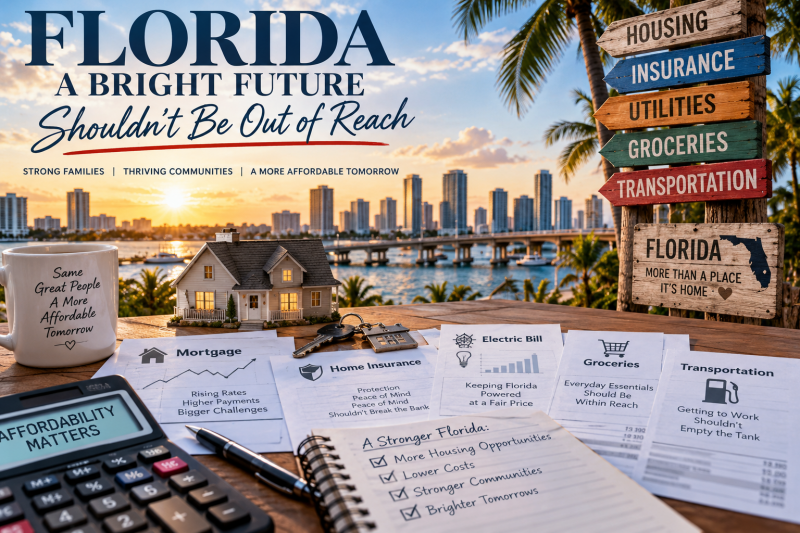
There is a conversation happening around kitchen tables all across Florida right now that cannot be captured by one statistic.
It is the homeowner opening an insurance renewal and wondering how another few hundred dollars fits into the budget.
It is the renter watching another lease renewal arrive while trying to save enough money to someday stop renting.
It is the young couple who technically earns a decent income but still cannot figure out how a $415,000 house, current mortgage rates, insurance, taxes and closing costs are supposed to fit into their lives.
It is the family filling up the car, buying groceries, paying the electric bill and realizing that somehow the paycheck disappeared again.
And that is why I think we need to change the way we talk about affordability in Florida.
This is no longer simply a housing affordability problem.
It is a household affordability problem.
Housing, insurance, property taxes, electricity, transportation, food, childcare and other necessities are stacking on top of one another. Individually, some of these costs may be manageable. Combined, they can turn what looks like a perfectly respectable household income on paper into a month-to-month financial balancing act.
The numbers demonstrate just how widespread that pressure has become.
United For ALICE’s 2026 Florida report estimates that, using 2024 income and cost data, 47% of Florida households were below its ALICE Threshold—meaning either below the federal poverty level or earning more than poverty-level income but still not enough to cover a locally adjusted basic household budget. That represented roughly 4.27 million Florida households. (United For ALICE)
That is an extraordinary number.
And it tells us something important.
Plenty of Floridians struggling with affordability are working.
They are not necessarily unemployed. They are not necessarily living in poverty. Many are doing exactly what we tell people they are supposed to do: work, raise families, pay their bills and try to put something away for tomorrow.
The arithmetic simply keeps getting harder.
The Florida Dream Has Become More Expensive
Start with housing.
Florida Realtors reported that the statewide median sale price for a single-family home reached $415,000 in August 2026, up slightly more than 1% from a year earlier. Condo and townhouse prices were just under $298,000. Meanwhile, single-family inventory declined about 13% year over year. (Florida Realtors)
A $415,000 median price does not mean every Florida family needs to buy a $415,000 home, obviously.
But it tells us where the market is.
And the purchase price is only the beginning.
A buyer has to account for the mortgage rate, down payment, property taxes, homeowners insurance, maintenance, possible HOA costs and—in some communities—flood insurance.
That changes the affordability calculation dramatically.
Someone can look at a mortgage calculator and think, “Maybe we can make this work.”
Then insurance gets added.
Then taxes.
Then utilities.
Then the reality of replacing an air conditioner in Florida.
Suddenly the house that looked barely affordable becomes financially dangerous.
Renters are not insulated from those costs either. Landlords ultimately operate properties with many of the same expenses: insurance, taxes, maintenance, financing, utilities and regulatory costs. Market conditions determine how much can actually be passed through in rent, but higher ownership costs do not simply disappear because the person occupying the property is a tenant.
That is why treating homeowners and renters as two unrelated constituencies misses the larger economic picture.
They are living in the same market.
The Problem Is Bigger Than Poverty
The ALICE numbers provide perhaps the clearest illustration.
For 2024, United For ALICE calculated that a single Florida adult needed about $35,904 annually merely to cover its basic Household Survival Budget.
For two adults with two young children in childcare, the figure was approximately $91,332.
And that is a survival budget—not an upper-middle-class lifestyle.
For that family, the estimated monthly expenses included roughly $1,524 for housing, $1,580 for childcare, $1,359 for food, $869 for transportation and $900 for healthcare, along with technology, taxes and miscellaneous necessities. (United For ALICE)
There is virtually no cushion in that model for building meaningful wealth.
The more financially secure ALICE “Stability Budget,” which incorporates savings and somewhat more sustainable spending assumptions, reached approximately $132,948 annually for two adults with two children in childcare. (United For ALICE)
Think about what that says about modern Florida.
A household can earn considerably more than the official poverty line and still struggle to establish genuine financial security.
That distinction matters because public policy discussions frequently divide people into two groups: poor and not poor.
Real life is considerably messier.
There is an enormous population between poverty and prosperity.
Insurance: Improving, but Still Part of the Equation
Florida’s property insurance story deserves more nuance than either political side often gives it.
The market has experienced serious problems. Florida lawmakers responded with substantial insurance and litigation reforms, and there is now measurable evidence that rate trends have improved.
Just yesterday, on September 22, the Florida Office of Insurance Regulation reported that the 30-day average requested homeowners rate change was -4.8%, compared with -1.1% a year earlier and +5.2% five years earlier. The agency also cited S&P Global data indicating Florida had a weighted homeowners insurance rate change of -0.92% in 2025 while the national weighted average increased 5.5%. (FLOIR)
Citizens provides another important data point.
Its 2026 approved rates reduced homeowners multiperil premiums by an average 8.8% statewide, effective July 1 for new policies and at renewal for existing customers. (Public)
Auto insurance is showing improvement too. Florida’s Office of Insurance Regulation reported in March that the state’s five largest auto insurance groups—which account for about 78% of the market—were indicating an average 8% rate reduction for 2026. (FLOIR)
Those are real improvements and should be acknowledged.
But declining rates and affordable rates are not synonymous.
If a household experienced years of significant premium increases, stabilizing or reducing that premium does not automatically restore the purchasing power it previously lost.
Florida also has unavoidable structural insurance risks.
We are a peninsula exposed to hurricanes, storm surge, flooding and enormous concentrations of expensive coastal property. Construction and replacement costs matter. Reinsurance matters. Catastrophe risk matters. Litigation costs matter.
There is no statute Tallahassee can pass that makes hurricanes stop hitting Florida.
The realistic question is how government can avoid making an inherently expensive risk environment unnecessarily more expensive.
Then Comes the Electric Bill
Utilities are another piece of the affordability puzzle because electricity in Florida is not optional in any meaningful sense.
Air conditioning is basic infrastructure for a Florida household.
Electric bills therefore matter.
Florida Power & Light’s approved 2026–2029 rate agreement put a typical 1,000-kWh residential bill in peninsular Florida at approximately $136.64 in January 2026, compared with $134.14 previously. In Northwest Florida, the corresponding bill moved from $143.60 to $141.36. (FPL)
Other utilities have experienced different changes.
Tampa Electric says its residential bill increased $8.88 per 1,000 kWh in January 2026, consisting of $5.51 in additional base rates and $3.37 in fuel and other charges. The utility says lower natural-gas costs may subsequently support bill reductions. (Tampa Electric)
That illustrates something frequently lost in political arguments over utilities.
There is no single “Florida electric bill.”
Customers are served by different utilities with different generation portfolios, capital projects, storm expenses, fuel costs and rate structures.
But the household does not care which accounting category produced the increase.
It cares about the amount at the bottom of the bill.
Transportation Is a Housing Issue Too
Florida’s development patterns make transportation inseparable from affordability.
Housing that appears cheaper can become considerably less affordable if living there requires longer commutes and another vehicle.
United For ALICE estimated basic transportation costs of $869 per month for a Florida household consisting of two adults and two children under its 2024 Survival Budget. (United For ALICE)
That is why housing policy cannot simply be about constructing units.
Location matters.
A $1,600 apartment 45 minutes from someone’s job can impose different household costs than an $1,800 apartment close to work, childcare, schools and groceries.
Florida’s own statutory housing strategy recognizes this principle. State law specifically calls for strategies involving urban infill, redevelopment of commercial property, existing infrastructure, mixed-use development and workforce housing located near employment and services. (Florida Senate)
That is an important insight.
Affordable housing and affordable living are not necessarily the same thing.
So What Is Actually Causing This?
There is no single villain.
That might be politically inconvenient, but it is economically important.
Florida’s affordability problem comes from several forces colliding.
Population growth increased demand for housing and infrastructure. Housing construction has not always occurred where or at the price points people need it. Land-use restrictions, lengthy approval processes, construction expenses and infrastructure requirements can raise the cost of producing housing.
Interest rates are largely outside Tallahassee’s direct control but dramatically affect mortgage affordability and development financing.
Insurance reflects catastrophe exposure, rebuilding costs, reinsurance, market competition, litigation and regulatory policy.
Electric bills reflect fuel costs, generation, grid investment, storm recovery and regulated utility decisions.
Transportation costs reflect vehicle prices, insurance, fuel, maintenance and development patterns.
Food prices are influenced by national and global supply chains, labor, energy, transportation, agriculture and monetary conditions.
Property taxes depend heavily on local government budgets, assessments, exemptions and Florida’s constitutional tax structure.
That distinction is essential because government should be honest about which levers it actually controls.
The Florida Legislature cannot set mortgage rates.
It cannot dictate global oil prices.
It cannot eliminate hurricanes.
It cannot repeal inflation by statute.
But Tallahassee controls enough of the cost structure that it is far from powerless.
What Could the Legislature Actually Do?
This is where the conversation becomes more useful.
Rather than pretending there is one magic affordability bill, lawmakers have several concrete policy levers. Each has benefits, costs and tradeoffs.
1. Attack Housing Costs by Increasing Supply
Florida has already moved significantly in this direction through the Live Local Act.
Current Florida law allows or requires affordable housing development under specified circumstances on property previously restricted to commercial, industrial or mixed uses, and the Legislature has continued revising those rules. The 2026 Legislature expanded portions of the framework involving public property, qualifying religious-institution property and other development rules. (Florida Senate)
Lawmakers could go further by examining permitting delays, minimum lot sizes, parking mandates, accessory dwelling units, manufactured housing, adaptive reuse and other regulatory barriers.
The economic theory is straightforward: when demand is strong and housing supply is artificially constrained, scarcity puts upward pressure on prices.
The tradeoff is equally real. State preemption can reduce local control, and rapid development can strain roads, water systems, schools and other infrastructure.
The question is therefore not simply “development or no development.”
It is how Florida adds housing without forcing existing taxpayers to absorb poorly planned growth.
2. Keep Housing Trust-Fund Dollars Focused on Housing
Florida already possesses substantial housing infrastructure through programs such as SHIP and SAIL.
The FY 2026–27 budget provides approximately $165.7 million for SHIP, $70.8 million for SAIL and $50 million for Hometown Heroes, according to the signed state budget. (Florida Governor’s Office)
SHIP money flows through local governments and can support locally designed housing strategies, while SAIL helps finance affordable rental development.
The Legislature could maintain predictable funding for these programs, evaluate their outcomes and concentrate resources where they measurably expand or preserve housing supply.
The key word should be measurably.
Government should not judge a housing program by how much money it spends.
It should judge it by what Floridians receive in return.
3. Reduce the Cost of Building Starter Homes
One of Florida’s challenges is that regulation can make the least expensive homes particularly difficult to build profitably.
Every additional month of permitting has a carrying cost.
Every unnecessary mandate has a cost.
Every fee eventually has to be absorbed somewhere.
The Legislature considered a “Florida Starter Homes Act” during the 2026 session as part of SB 948, addressing matters including residential lot regulation and off-site constructed dwellings. That Senate measure died in Judiciary, although related companion legislation passed in other forms. (Florida Senate)
A future Legislature could revisit those concepts while protecting legitimate safety, environmental and infrastructure requirements.
The objective would not be weaker houses.
Florida, of all places, needs strong construction standards.
The objective would be removing costs that do not produce a corresponding public benefit.
4. Approach Property-Tax Relief With the Entire Taxpayer in Mind
Property taxes are unquestionably part of housing affordability, but this issue requires careful arithmetic.
Florida has already placed major property-tax changes into the political process. The 2026 special session produced a proposed constitutional amendment that would significantly increase homestead exemptions for non-school property taxes while restricting certain uses of county and municipal property-tax revenue. If approved by voters, portions would begin taking effect in 2027. (Florida Senate)
Tax relief can increase disposable income for homeowners.
But property taxes also finance local services, and reductions can create pressure to reduce spending, raise other revenue or shift burdens elsewhere.
There is another wrinkle: renters.
A tax structure heavily targeted toward homesteaded owners may provide limited direct relief to renters, even though renters are also experiencing Florida’s affordability squeeze.
Any serious property-tax discussion therefore needs to ask not merely how much is being cut, but who receives the reduction, who ultimately bears the remaining burden and what happens to local spending.
5. Demand More Scrutiny of Utility Costs
Florida’s Public Service Commission regulates investor-owned utilities, meaning state policy already plays a substantial role in electricity pricing.
Lawmakers could strengthen transparency surrounding long-term capital spending, storm recovery, fuel adjustments and projected customer-bill impacts.
That does not mean rejecting infrastructure investment.
Florida is growing, and electrical infrastructure has to grow with it.
The better question is whether investments produce sufficient reliability and consumer value to justify their cost.
Ratepayers deserve to know.
6. Continue Measuring Insurance Reform by Consumer Outcomes
Florida’s recent insurance numbers are encouraging enough that lawmakers should resist both exaggerating the remaining crisis and declaring the problem permanently solved.
The appropriate test is straightforward:
Are more insurers competing?
Are insolvency risks declining?
Are Citizens’ policy counts moving toward sustainable levels?
Are rate filings stabilizing or declining?
Most importantly, are actual household premiums becoming more manageable?
The September OIR data showing additional requested homeowners rate decreases provide evidence of improvement. (FLOIR)
That progress should be measured over time rather than through political slogans.
Affordability Is Ultimately About Disposable Income
There is a larger principle underneath all of this.
A family’s standard of living is not determined by its salary.
It is determined by what that salary can buy.
Someone receiving a 4% raise while unavoidable household expenses increase 7% did not become 4% richer in any meaningful sense.
That person lost purchasing power.
This is why affordability deserves to become its own policy framework.
Before lawmakers create a new mandate, fee, regulation or spending program, one useful question is remarkably simple:
What does this ultimately do to the household budget?
Not theoretically.
Not five agencies removed.
What happens to the Floridian paying the bill?
That kind of thinking also guards against a common governmental mistake: attempting to solve costs created by one policy with subsidies created by another.
Sometimes assistance is necessary.
But a durable affordability strategy should also ask why something became so expensive in the first place.
If government restricts supply and then subsidizes demand, taxpayers can wind up paying government to compensate people for scarcity government helped create.
If regulation produces genuine health, safety or environmental benefits, those benefits may justify the expense.
But government should be capable of demonstrating that.
Florida Does Not Need One Giant Solution
That may ultimately be the biggest takeaway.
There is no Affordable Florida Act that can magically reduce every household expense.
The problem is too complicated.
The better approach is probably less dramatic and more practical: remove unnecessary barriers to housing construction, protect legitimate safety standards, scrutinize utility costs, maintain competitive insurance markets, evaluate housing programs based on results, examine the full consequences of property-tax changes and stop casually adding costs that eventually land on consumers.
Some of those changes involve government doing something.
Others involve government getting out of the way.
Knowing the difference is what matters.
Florida remains an extraordinarily attractive place to live. People continue wanting to build lives here for reasons that are easy to understand: opportunity, weather, beaches, communities, entrepreneurship and the simple freedom of creating a life in a place people genuinely enjoy calling home.
But economic success creates its own responsibility.
Growth is not much of a victory if the teachers, firefighters, nurses, tradesmen, restaurant workers, small-business employees and young families who keep Florida functioning increasingly cannot afford to live here.
And affordability should not mean making everyone dependent on Tallahassee.
Quite the opposite.
The goal should be an economy in which ordinary people can support themselves, build savings, buy property, raise families, start businesses and accumulate something they can eventually leave to their children.
That is what economic freedom looks like at the kitchen table.
And that is where Florida’s affordability debate ultimately belongs.
Not in a campaign slogan.
Not in a press conference.
Not in an argument about which political team deserves blame.
At the kitchen table, where a family opens the bills, looks at what came in, looks at what has to go out, and asks the question millions of Floridians increasingly understand:
How are we making more money than we used to—and somehow still feeling like we have less?
Until Florida’s affordability debate can answer that question, we are not really talking about the problem yet.
Add comment
Comments