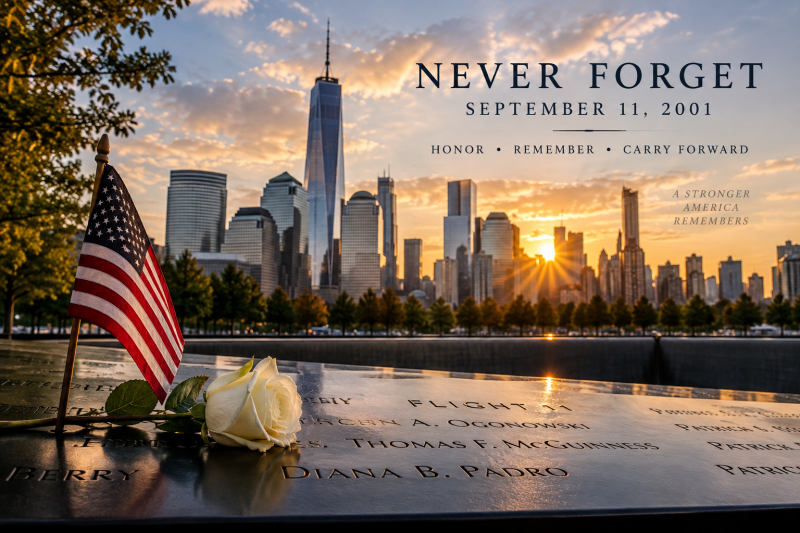
There are certain dates we remember because history books tell us they matter.
And then there are dates we remember because they changed us.
September 11, 2001, is one of those dates.
Twenty-five years have now passed since that Tuesday morning when Americans watched something almost unimaginable unfold in real time. For those of us old enough to remember it, there is still something different about September 11. You can hear the date and almost immediately remember where you were. You remember who you were with. You remember the television. You remember the confusion.
And then you remember the silence.
Because somewhere between the first reports coming out of New York and the moment we realized America was under attack, the world we thought we understood suddenly felt very different.
At 8:46 that morning, American Airlines Flight 11 struck the North Tower of the World Trade Center. At 9:03, United Airlines Flight 175 struck the South Tower. At 9:37, American Airlines Flight 77 crashed into the Pentagon. At 10:03, United Airlines Flight 93 crashed near Shanksville, Pennsylvania, after passengers and crew fought back against the hijackers.
The bipartisan 9/11 Commission would later describe September 11 as a day of “unprecedented shock and suffering” and conclude simply that America had been unprepared. (911 Commission)
By the time that terrible morning was over, 2,977 innocent people had been killed in the attacks.
They were office workers.
Firefighters.
Police officers.
Paramedics.
Flight attendants.
Military personnel.
Mothers and fathers.
Sons and daughters.
Husbands and wives.
Friends and neighbors.
They came from communities across America and countries around the world. The victims represented more than 90 nations. (911 Memorial)
That number—2,977—is important.
But we should be careful about allowing a number to become the memory.
Because 2,977 isn’t really a number.
It is 2,977 stories that ended before they should have.
Remember the People
This is what I find myself thinking about every September 11.
Behind every photograph we have seen from that morning was somebody’s ordinary Tuesday.
People woke up.
They made coffee.
They got their children ready.
They kissed their spouses goodbye.
They complained about traffic.
They hurried through airports.
They walked into offices.
They answered phones.
They probably thought about what they were having for dinner that night.
Nobody walked into the World Trade Center that morning believing he was walking into history.
Nobody boarded those airplanes believing her name would eventually be engraved on a memorial.
Nobody went to work at the Pentagon expecting their family to receive the phone call that every family fears.
That matters because when history becomes too large, we have a tendency to turn human beings into statistics.
We cannot allow that to happen with September 11.
The most important thing about that day isn’t the buildings.
It is the people.
And perhaps that is also where the deepest lesson of September 11 begins.
Every human life has immeasurable value.
Not because of someone’s occupation.
Not because of wealth.
Not because of political affiliation.
Not because of race, religion, social status, or nationality.
Simply because that person is a human being.
That morning, thousands of individual worlds disappeared.
Thousands of families were permanently changed.
Children grew up without parents.
Parents buried children.
Spouses suddenly found themselves alone.
Twenty-five years later, those empty chairs still exist.
That is what we are remembering.
Remember Who Ran Toward the Fire
There is another part of September 11 that deserves to be remembered just as fiercely.
When thousands of people were desperately trying to escape danger, others were running directly toward it.
Think about that for a moment.
Firefighters climbing stairwells carrying equipment while frightened civilians descended around them.
Police officers directing people toward safety.
Paramedics treating strangers.
Port Authority officers entering buildings everyone else was trying to leave.
Ordinary Americans helping one another down staircases and through smoke.
On September 11, 343 members of the New York City Fire Department were among those killed. Twenty-three NYPD officers were lost as well. (911 Memorial)
They knew something terrible was happening.
They went anyway.
That kind of courage deserves more than an annual social-media graphic.
It deserves gratitude.
Real courage is rarely the absence of fear. More often, courage is recognizing the danger and deciding that someone else’s life is worth risking your own.
We saw that courage in New York.
We saw it at the Pentagon.
And we saw it thousands of feet above Pennsylvania.
Remember Flight 93
There is something uniquely powerful about the story of United Flight 93.
The passengers and crew eventually learned through phone calls that other hijacked airplanes had been used as weapons.
Imagine receiving that information while trapped aboard another hijacked aircraft.
Imagine the fear.
Imagine calling someone you love knowing it might be the last conversation you ever have.
And then imagine making the decision to fight back.
That is what happened.
Passengers and crew developed a plan and attempted to regain control of the aircraft. The plane ultimately crashed in a field near Shanksville, killing all 40 passengers and crew aboard, but their resistance prevented the hijackers from reaching their intended target. (911 Memorial)
There was no guarantee they would succeed.
They acted anyway.
That is heroism in its purest form.
Not a desire for recognition.
Not certainty of victory.
Sacrifice.
People confronted with an impossible situation decided they would not simply surrender the lives of others without a fight.
Twenty-five years later, that still deserves to be told.
Remember What Happened Afterward
But September 11 did not end on September 11.
That is something we understand far better today than we did then.
Thousands of firefighters, police officers, construction workers, medical personnel, volunteers, residents, students, office workers and others were exposed to the toxic environment created by the destruction of the World Trade Center.
For many, the consequences emerged years later.
Cancer.
Respiratory disease.
Digestive disorders.
Mental-health conditions.
Chronic illnesses that followed people home long after the television cameras left Lower Manhattan.
The federal World Trade Center Health Program now serves more than 125,000 responders and survivors affected by the attacks and their aftermath. The program provides monitoring and treatment for certified 9/11-related conditions and continues supporting research into their long-term effects. (CDC)
And the story is still unfolding.
Current research is examining the long-term effects on people who were children in Lower Manhattan and nearby areas when the attacks occurred. Around 25,000 children lived or attended school near the World Trade Center that day, and a major federally funded study is being developed to better understand the consequences of their exposure. (Reuters)
Think about what that means.
A quarter-century later, September 11 is still claiming a price from people who survived it.
So when we say Never Forget, our responsibility cannot stop at remembering those who died that morning.
We must remember those who carried the aftermath with them.
The firefighters who developed cancer.
The police officers whose lungs never recovered.
The construction workers who spent months moving debris.
The survivors who still live with trauma.
The families who lost someone years afterward to an illness connected to what happened that day.
Remembering requires more than nostalgia.
It requires loyalty to those who sacrificed.
Remember How Americans Treated One Another
There is something else I miss when I think about the days following September 11.
I don’t miss the fear.
I don’t miss the anger.
I certainly don’t miss the uncertainty.
I miss how Americans looked at one another.
For a brief period, many of the divisions that normally seem enormous suddenly felt incredibly small.
Neighbors checked on neighbors.
People donated blood.
Churches filled.
American flags appeared on homes and businesses.
Strangers hugged strangers.
First responders were thanked simply for wearing the uniform.
Communities gathered for candlelight vigils.
People prayed.
There was a renewed understanding that underneath all of our disagreements, we shared something.
We were Americans.
We belonged to one another.
That doesn’t mean the country suddenly became perfect. It wasn’t.
It doesn’t mean Americans stopped disagreeing. We didn’t.
And it certainly doesn’t mean every decision made in the years following September 11 was correct.
But for a moment, Americans remembered something we sometimes forget:
A nation is more than a government.
A nation is its people.
Its families.
Its neighborhoods.
Its churches and synagogues.
Its firefighters.
Its police officers.
Its teachers.
Its shopkeepers.
Its volunteers.
Its parents raising children.
Its people quietly taking responsibility for one another.
That kind of solidarity cannot be legislated into existence.
It grows from culture, character, faith, family, community and a recognition that freedom carries responsibilities alongside rights.
And I think we could use a little more of it today.
Remembering Does Not Mean Abandoning Our Principles
There is another lesson worth carrying forward.
Fear is powerful.
When people are frightened, they understandably want protection. After September 11, Americans demanded that their government prevent another attack.
That responsibility was real.
But history also reminds us that a free people must be particularly careful about what they surrender when they are afraid.
The attacks led to enormous changes in American national security, foreign policy, surveillance and military power. Congress enacted the September 18, 2001 Authorization for Use of Military Force, empowering the president to use force against those responsible for the attacks and those who harbored them. (GovInfo)
The consequences of the post-9/11 era would extend across decades.
Americans can—and do—debate those decisions.
That debate should not diminish our remembrance.
In fact, it can deepen it.
Because the best way to honor Americans murdered by terrorists who despised a free society is not to become less committed to the principles of a free society.
Security matters.
So does liberty.
Justice matters.
So does constitutional government.
National defense matters.
So does accountability.
Those principles do not have to be enemies.
A nation confident in its values should be capable of defending both its people and the constitutional order that defines it.
Twenty-five years later, that remains one of the responsibilities September 11 handed to us.
Teach the Children Who Don’t Remember
Perhaps the most important challenge now is generational.
An American turning 25 this year has no personal memory of September 11.
Millions of younger Americans know 9/11 only as history.
To them, those shaky television images can feel the way Pearl Harbor once felt to my generation—something enormously important that happened before their own memories began.
That means our responsibility is changing.
For years, we said, Never Forget.
Now we also have to say:
Never stop teaching.
Tell them about the firefighters climbing the stairs.
Tell them about the police officers.
Tell them about the passengers aboard Flight 93.
Tell them about the office workers who helped coworkers escape.
Tell them about the volunteers who showed up afterward.
Tell them about the families who waited beside telephones that would never ring.
Tell them about the names engraved around the memorial pools where the Twin Towers once stood.
And don’t sanitize it.
History should make us uncomfortable sometimes.
Children should understand what hatred can produce.
But they should also understand what courage looks like.
Because September 11 showed us both.
We saw extraordinary evil.
And we saw extraordinary goodness responding to it.
Never Forget Means Something
“Never Forget” has been repeated so many times over the past quarter-century that there is a danger of allowing it to become just another phrase.
It shouldn’t.
Never Forget means remembering the names rather than only the number.
It means honoring firefighters after the anniversary ends.
It means caring for responders when they become sick.
It means teaching children what happened.
It means appreciating the ordinary blessings that thousands of people expected to return home to that evening but never did.
It means understanding that life is fragile.
It means holding your children a little tighter.
Calling your parents.
Kissing your spouse goodbye.
Forgiving someone.
Checking on your neighbor.
Praying for someone who is hurting.
Serving your community.
And perhaps it means recognizing that the people around us are rarely as different from us as our politics, algorithms and television screens sometimes convince us they are.
Twenty-five years is a long time.
Long enough for skylines to change.
Long enough for children to become adults.
Long enough for memories to fade around the edges.
But not long enough to forget.
It will never be long enough for that.
Tomorrow, somewhere in America, a firefighter will pull on a uniform.
A police officer will begin a shift.
A mother will make breakfast.
A father will leave for work.
A flight attendant will welcome passengers aboard an airplane.
Someone will kiss a spouse goodbye.
Millions of ordinary Americans will begin ordinary days.
That was September 11, 2001, too.
Until suddenly it wasn’t.
Maybe that is why remembering matters so much.
The people we lost weren’t characters in a history book.
They were us.
They were living ordinary lives in a free country, surrounded by people they loved, expecting tomorrow to come.
So on this twenty-fifth anniversary, remember the towers.
Remember the Pentagon.
Remember that field in Pennsylvania.
Remember the firefighters.
Remember the police officers.
Remember the paramedics.
Remember the passengers and flight crews.
Remember the workers.
Remember the families.
Remember those still suffering.
Remember the courage.
Remember the sacrifice.
Remember the way Americans reached for one another when everything seemed to be falling apart.
And above all else—
remember the people.
May God grant eternal rest to those we lost, comfort to the families who still carry their absence, healing to those who continue to suffer, and wisdom to a nation entrusted with their memory.
Twenty-five years later, we remember.
September 11, 2001.
Never forget.
Add comment
Comments