

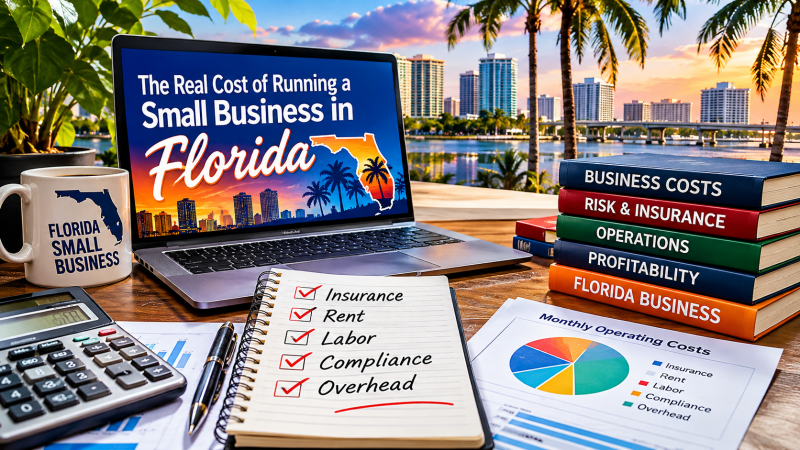
From insurance premiums and commercial rent to payroll, regulations, and everyday overhead, here’s what Florida entrepreneurs are really paying to keep their doors open.
Florida has built a reputation as one of America’s most attractive places to start and grow a business. We have no state individual income tax, a growing population, a strong tourism industry, and communities filled with hardworking entrepreneurs willing to take a chance on themselves.
On paper, that sounds like a pretty good place to do business.
And in many respects, it is.
But there’s another side to Florida’s business environment that doesn’t always make it into the conversation.
It’s the side where a restaurant owner finishes a busy Friday night, looks at the sales numbers, and wonders how much money is actually left after payroll, food costs, rent, and insurance.
It’s the contractor who has plenty of work lined up but struggles to find qualified employees at wages the business can afford.
It’s the independent retailer watching commercial rent increase while trying to compete with national chains and online shopping.
And it’s the small business owner who started a company hoping to build financial independence, only to discover that keeping the doors open can sometimes feel like the most expensive part of entrepreneurship.
Here’s the reality: Starting a business in Florida and operating a profitable business in Florida are two very different things.
As someone who works with businesses on growth, marketing, and long-term strategy, I believe we need to have a more complete conversation about what it actually costs to operate a small business in the Sunshine State.
Because the real cost isn’t just what you spend getting started.
It’s what you have to spend every single month just to stay in business.
And heading into 2027, those expenses deserve a much closer look.
The Numbers Tell a Story Florida Business Owners Already Know
Before we get into the individual expenses, let’s look at what Florida business owners are reporting.
According to the Federal Reserve’s 2026 Firms in Focus research, which examined Florida employer businesses, 68% reported increased costs for goods, services, or wages as a financial challenge during the preceding 12 months.
Another 58% reported difficulty paying operating expenses, while 54% experienced uneven cash flow. The same percentage identified weak sales as a financial challenge.
Those aren’t insignificant numbers.
They suggest that many Florida businesses are confronting multiple financial pressures simultaneously.
And there’s another finding worth considering.
In a June 2026 report, the Federal Reserve Bank of Atlanta found that 66% of surveyed Florida employer firms described their financial condition as either fair or poor in 2025. Among businesses seeking financing, covering operating expenses was the most frequently cited reason.
Think about that for a moment.
Business financing is often associated with expansion. We picture entrepreneurs borrowing money to purchase equipment, open another location, hire additional employees, or launch a new product.
But when businesses increasingly need financing to cover everyday expenses, it raises an important question:
Are we making it easier for small businesses to grow, or are we making it more expensive for them to survive?
The answer varies by industry, location, and business model. Still, the underlying pressures are real.
And one of Florida’s most significant challenges begins with something every business owner hopes they’ll never have to use.
Insurance: One of Florida’s Most Expensive Business Realities
If you’ve owned a business in Florida for any length of time, you probably don’t need me to explain why insurance deserves its own conversation.
Florida’s geography creates risks that businesses in many other states simply don’t face to the same degree.
Hurricanes, tropical storms, flooding, wind damage, and the potential interruption of business operations all complicate the insurance equation.
But commercial insurance goes well beyond protecting a building from storms.
Depending on the business, owners may need general liability insurance, commercial property coverage, workers’ compensation, commercial automobile insurance, professional liability coverage, cyber insurance, and business interruption protection.
Each serves a different purpose.
And each can add another expense to the monthly budget.
Just how significant is the insurance problem?
A January 2026 report from the National Federation of Independent Business found that 20% of surveyed Florida small business owners identified the cost or availability of insurance as their single biggest problem.
Nationally, that figure was just 9%.
That 11-percentage-point difference tells us something important: Insurance isn’t simply another nationwide business expense. It’s a particularly significant challenge for Florida entrepreneurs.
To put some actual dollar figures into perspective, NerdWallet analyzed insurance policies purchased by Florida businesses with less than $1 million in annual revenue between October 2025 and April 2026.
The reported median annual premiums included:
- General liability insurance: $873.
- Workers’ compensation insurance: $1,775.
Those figures are useful reference points, but they aren’t comprehensive insurance budgets. Actual premiums can vary substantially depending on the industry, payroll, property value, claims history, location, and coverage selected.
A coastal restaurant, for example, faces a very different risk profile from a home-based consulting business.
And a construction contractor employing several workers will generally have different insurance requirements from an independent graphic designer.
The coverage problem is just as important as the premium
One mistake business owners can make is focusing entirely on the monthly premium without fully understanding what the policy actually covers.
Florida’s Department of Financial Services explains that commercial property policies can vary considerably, including their deductibles, exclusions, coverage limits, and conditions.
Some policies may exclude flood damage. Others may contain separate windstorm or hurricane deductibles. Business interruption coverage can also depend on the specific cause of the interruption and the terms of the policy.
That means having insurance doesn’t automatically mean every disaster-related loss will be covered.
And for a small business operating with limited cash reserves, that distinction can be devastating.
What can business owners do?
Start by reviewing coverage before renewal rather than automatically accepting the next premium.
Ask your insurance professional to explain the deductibles, exclusions, coverage limits, and whether your business has meaningful protection against an extended interruption.
Compare quotes from appropriately licensed providers, examine potential risk-reduction improvements, and make sure you’re not paying for unnecessary overlapping coverage.
But don’t confuse reducing insurance expenses with simply reducing protection.
The cheapest policy isn’t necessarily the most affordable policy when something goes wrong.
Commercial Rent: The Price of Having a Place to Do Business
For many entrepreneurs, finding the right commercial location is an exciting milestone.
It makes the business feel real.
You finally have a storefront, an office, a workshop, or a place where customers can walk through the door.
But that location also introduces one of the largest recurring expenses a business may ever take on.
And Florida’s commercial real estate market hasn’t exactly made that decision inexpensive.
According to a 2026 Colliers retail market report summarized by Florida Realtors, statewide retail occupancy stood at 96.2% during the first half of 2026.
Retail vacancies remained below 4%, and average asking rents increased 2.1% over the preceding year.
The statewide average retail asking rent reached approximately $35.17 per square foot annually.
Now, that number might not sound particularly intimidating until you put it into an actual business budget.
Consider a small retail business leasing 1,500 square feet.
At $35.17 per square foot annually, the base asking rent would work out to approximately $52,755 per year.
That’s roughly $4,396 per month.
And that’s before considering additional occupancy expenses.
Depending on the lease, a tenant may also be responsible for common-area maintenance, property insurance, property taxes, utilities, maintenance, or other charges.
Those additional obligations are particularly important in triple-net leases.
Suddenly, the cost of having a storefront can become a major financial commitment before the business sells its first product.
Of course, Florida isn’t one uniform commercial real estate market.
A retail location in Miami, Tampa, Orlando, or Palm Beach may carry very different costs from a similar property in Panama City, Marianna, Chipley, or another smaller community.
The type of property matters, too. Office, retail, warehouse, and industrial properties operate in different markets.
Still, the larger lesson is the same.
A good location can help generate revenue, but an expensive location doesn’t guarantee profitability.
Florida did provide one important piece of tax relief
There’s some positive news worth recognizing.
Florida eliminated its state sales tax on commercial real property rentals effective October 1, 2025, for qualifying rental periods beginning on or after that date.
That change removed a recurring tax expense for many commercial tenants.
It’s a meaningful distinction because Florida had previously been unusual in imposing a state sales tax on many commercial leases.
But eliminating that tax doesn’t eliminate the underlying rent.
It also doesn’t remove the other expenses associated with occupying and maintaining commercial property.
For business owners, the practical takeaway is simple: Before signing or renewing a lease, understand the complete cost of occupancy, not just the advertised rent.
A location should make financial sense based on realistic sales projections, not simply the excitement of opening another storefront.
Labor: Employees Cost More Than Their Hourly Wage
Let’s talk about employees.
For many businesses, payroll is one of the largest expenses on the books.
And it’s also one of the most important investments a company can make.
Good employees help businesses deliver better service, retain customers, improve operations, and ultimately grow.
But hiring someone involves considerably more than agreeing on an hourly wage.
Florida’s minimum wage reached $15 per hour on September 30, 2026, completing the scheduled increases approved by voters through the state’s 2020 constitutional amendment.
That change has a direct impact on businesses employing hourly workers, particularly in restaurants, hospitality, retail, and other labor-intensive industries.
Consider a business employing five full-time workers earning $15 per hour.
Assuming each employee works 40 hours per week for 52 weeks, the annual base wages would total $156,000.
That’s $13,000 per month in wages alone.
Now add the employer’s share of payroll taxes, applicable unemployment taxes, workers’ compensation premiums, benefits, payroll administration, recruiting, and training.
The true cost of employment is higher than the wage appearing on an employee’s paycheck.
For example, the employer share of Social Security and Medicare taxes generally totals 7.65% on wages subject to both taxes.
On $156,000 in qualifying annual wages, that represents another $11,934.
That brings wages and those two federal payroll taxes to $167,934 annually, before other employment-related expenses.
And that’s for just five employees.
But the labor challenge isn’t simply about wages
There’s another side to this conversation.
Finding qualified, dependable employees remains difficult for many small businesses.
NFIB’s September 2026 national employment report found that 32% of surveyed small business owners had job openings they couldn’t fill.
Among owners hiring or attempting to hire, 87% reported receiving few or no qualified applicants.
Those are national figures, not Florida-specific measurements, but they illustrate a broader hiring challenge that NFIB’s Florida leadership has also discussed.
And the financial consequences extend beyond recruitment.
An unfilled position can mean missed sales, longer customer wait times, delayed projects, overtime expenses, and additional pressure on existing employees.
Replacing an experienced worker can also require significant time and training.
A balanced conversation about wages matters
I believe people who work hard deserve opportunities to earn a good living.
I also believe small business owners need enough financial flexibility to provide those opportunities without putting their companies at risk.
Those goals shouldn’t automatically be treated as competing interests.
A healthy business needs productive employees, satisfied customers, and sustainable margins.
The challenge is finding the right balance.
For owners, that means looking beyond the hourly wage and asking how to improve productivity, training, scheduling, employee retention, and operational efficiency.
Sometimes the answer isn’t hiring another employee.
Sometimes it’s giving the employees you already have better tools and systems to do their jobs.
Compliance: The Costs Nobody Mentions When You Start a Business
When people think about starting a business, they usually picture the exciting parts.
Creating a brand. Building a website. Finding customers. Making the first sale.
Very few entrepreneurs dream about tax filings, payroll reporting, licenses, permits, regulatory notices, or maintaining business records.
But those responsibilities come with the territory.
And while some compliance expenses are relatively small individually, they can become significant when combined.
Depending on the industry, location, and company structure, a Florida business may have to manage annual entity filings, local business tax receipts, sales and use tax obligations, payroll reporting, workers’ compensation requirements, professional licenses, building permits, inspections, and federal employment requirements.
Not every obligation applies to every business.
But every owner needs to understand which ones do.
Florida’s annual business filing requirements
For example, Florida limited liability companies generally must file an annual report with the Division of Corporations to maintain active status.
The standard annual report fee for a Florida LLC is $138.75.
Failing to file by the applicable deadline can trigger a $400 late fee.
That means a relatively routine administrative obligation can become considerably more expensive simply because an owner misses a deadline.
Corporations have different filing fees, and the rules vary by entity type.
Employment-related compliance adds another layer
Florida employers may also be responsible for reemployment tax.
The Florida Department of Revenue identifies the initial rate for new employers as 2.7%, applied to the first $7,000 in wages paid to each employee during a calendar year.
For a qualifying employee earning at least $7,000 annually, that equals $189 at the initial rate.
Actual employer rates can differ based on the applicable tax rate and account history.
Workers’ compensation requirements also depend on the type of business.
In Florida, non-construction businesses generally must secure workers’ compensation coverage when they have four or more employees, while construction businesses generally face a one-employee threshold, subject to statutory definitions and exemptions.
These are not necessarily unreasonable obligations.
Many exist to protect workers, customers, and the public.
But there’s a legitimate difference between recognizing the purpose of a regulation and ignoring the cost of complying with it.
A large corporation may have an entire department dedicated to accounting, human resources, legal compliance, and regulatory reporting.
A small business owner may be handling all those responsibilities personally.
And every hour spent navigating paperwork is an hour that can’t be spent serving customers, improving operations, or developing new business.
The real compliance burden includes time
This is the part I think gets overlooked.
Compliance costs aren’t limited to the amount paid to a government agency.
They also include bookkeeping software, accounting services, legal advice, professional licensing, recordkeeping, and the time necessary to keep everything organized.
For a business with only a handful of employees, that administrative burden can be substantial.
That’s why clear regulations, predictable requirements, accessible information, and efficient government services matter.
Small businesses need rules they can understand and reasonably follow without hiring an entire administrative staff.
Everyday Overhead: The Expenses That Quietly Eat Away at Profit
Insurance, rent, payroll, and compliance are easy to recognize because they tend to show up as major line items.
But some of the most persistent financial pressure comes from smaller recurring expenses.
Think about everything a business might pay for in an ordinary month.
Electricity. Internet. Phone service. Software subscriptions. Payment processing. Equipment maintenance. Cleaning supplies. Fuel. Vehicle expenses. Accounting. Advertising. Website hosting. Inventory storage. Repairs.
None of those expenses necessarily seems overwhelming by itself.
Together, however, they can consume a substantial portion of revenue.
And here’s where business owners need to be especially careful.
Revenue is not profit, and a busy business is not necessarily a profitable business.
A company can bring in $30,000 during a month and still struggle financially if expenses consume $29,000.
That’s particularly important when the owner is working long hours without accounting for the value of their own labor.
Let’s look at a hypothetical example
Imagine a small Florida retail business generating $35,000 in monthly sales.
Its monthly expenses might look something like this:
The Real Cost of Running a Small Business in Florida
Hypothetical example of a Florida retail business generating $35,000 in monthly revenue.
| Business Expense | Monthly Cost |
|---|---|
| Inventory and merchandise | $14,000 |
| Employee wages | $8,000 |
| Payroll taxes and employment costs | $900 |
| Commercial rent and occupancy | $4,800 |
| Business insurance | $900 |
| Utilities and internet | $650 |
| Marketing and advertising | $1,000 |
| Software and payment processing | $850 |
| Accounting, maintenance and miscellaneous | $900 |
| TOTAL MONTHLY EXPENSES | $32,000 |
| ESTIMATED OPERATING SURPLUS | $3,000 |
Note: Figures are hypothetical and provided for educational purposes. The estimated operating surplus may still need to cover owner compensation, debt payments, capital expenditures, and income taxes, depending on the business structure and accounting treatment. These figures do not represent statewide industry averages.
That leaves approximately $3,000.
On $35,000 in revenue, that’s an 8.6% operating margin in this simplified example.
And that remaining amount may still need to cover owner compensation, debt payments, capital expenditures, and income taxes, depending on how the business is structured and what has already been included in expenses.
These are illustrative figures, not statewide averages or a complete accounting statement.
But they demonstrate something important.
A relatively small increase in expenses can have an outsized impact on the money left over.
If monthly operating costs rise by $2,000 without a corresponding increase in revenue, the business’s remaining operating surplus falls from $3,000 to $1,000.
That’s a two-thirds reduction.
The business didn’t necessarily lose customers.
It didn’t necessarily make fewer sales.
It simply became more expensive to operate.
And that’s why business owners need to pay attention to profitability just as closely as they monitor revenue.
The Hidden Cost of Cash Flow: When Money Comes In Matters
There’s one more expense that deserves attention, even though it doesn’t always appear as a traditional line item.
The cost of waiting to get paid.
A contractor might complete a $20,000 project but wait several weeks for the final payment.
A consulting company might provide services throughout the month and invoice its client afterward.
A retailer might purchase inventory today that won’t sell for another 60 days.
Meanwhile, payroll, rent, insurance, and utility bills don’t wait.
This is why cash flow management is so important.
The Federal Reserve’s 2026 Florida employer business research found that 54% of surveyed firms experienced uneven cash flow.
That’s more than half.
And 38% reported challenges involving debt payments or interest rates.
Those findings illustrate how quickly everyday financial obligations can become difficult to manage, even when a business has customers and generates revenue.
Profitability and cash flow are not the same thing
Imagine a service business completes $15,000 worth of work in November.
Its expenses total $10,000.
On paper, the business has generated $5,000 in operating profit.
But what happens if customers haven’t paid their invoices yet?
The business may still need to cover payroll, software subscriptions, insurance, and other bills before collecting that revenue.
That’s a cash flow problem.
And if the owner relies on credit cards or expensive short-term financing to bridge the gap, the cost of operating the business increases further.
That’s why I encourage business owners to think about cash flow as part of their overall growth strategy.
Review payment terms. Invoice promptly. Make paying convenient. Follow up on outstanding balances. Consider deposits or milestone payments when appropriate.
Most importantly, maintain a realistic cash flow forecast.
A business shouldn’t have to guess whether it can afford next month’s bills.
Why Increasing Sales Isn’t Always the Answer
Here’s something I’ve noticed when talking with entrepreneurs about business growth.
When revenue slows or expenses increase, the first instinct is often to find more customers.
And sometimes that’s exactly what a business needs.
But not always.
If a company has inefficient operations, weak pricing, excessive overhead, or poor customer retention, bringing in more customers won’t automatically solve those problems.
In fact, it can make some of them worse.
Think about a contractor who consistently underprices jobs.
The contractor might book more projects, hire additional workers, purchase more materials, and generate higher revenue.
But if the pricing doesn’t adequately cover labor, insurance, transportation, materials, administrative costs, and a reasonable profit margin, every additional project can create more financial pressure.
The business is growing.
But its financial position isn’t necessarily improving.
Growth without profitability isn’t sustainable growth.
That’s why business owners should regularly evaluate a few fundamental questions.
Are you charging enough to cover your actual costs?
Do you know which products or services generate the strongest margins?
Are you measuring the cost of acquiring a customer?
How much revenue comes from repeat business?
Are there recurring expenses you no longer need?
And perhaps most importantly, are you building a business that can operate efficiently without requiring you to personally handle every single responsibility?
These aren’t complicated questions.
But the answers can reveal opportunities that simply spending more money on advertising might never address.
What Florida Small Business Owners Can Do Before 2027
The good news is that business owners aren’t powerless.
You may not control commercial insurance markets, regional rental rates, or broader economic conditions.
But you do have influence over how your business responds.
And sometimes relatively small operational improvements can produce meaningful financial results.
Here are five areas I would encourage Florida entrepreneurs to examine before the end of the year.
First, conduct a complete operating expense review
Pull your financial statements, bank transactions, insurance invoices, vendor agreements, and recurring subscriptions.
Look at the actual expenses your business has incurred over the past 12 months.
Not estimates. Not what you think you’re spending.
The real numbers.
Identify expenses that increased, services you’re no longer using, and contracts that might be worth renegotiating.
Even modest savings can improve profitability when they’re repeated month after month.
Second, calculate your actual profit margins
Don’t stop at gross revenue.
Understand the direct costs associated with delivering your products or services, along with the overhead required to keep the business operating.
Evaluate gross profit, operating profit, and cash flow separately.
If you don’t know how much money your business retains from each dollar of revenue, it’s difficult to make informed decisions about pricing, hiring, or expansion.
Third, review your pricing strategy
One of the hardest decisions for small business owners is raising prices.
Nobody wants to lose customers.
But maintaining prices that no longer cover expenses isn’t a sustainable solution either.
Review your costs, compare your offerings with the market, and consider whether your pricing reflects the value you’re providing.
Sometimes that means adjusting prices.
Other times it means restructuring service packages, eliminating unprofitable offerings, or improving operational efficiency.
The goal isn’t simply to charge more.
It’s to make sure the business can afford to deliver what it promises.
Fourth, invest in customer retention
Acquiring new customers matters.
But so does maintaining relationships with the customers you’ve already earned.
A business that consistently delivers good service, communicates effectively, and stays connected with customers has more opportunities to generate repeat purchases and referrals.
That might involve better follow-up systems, email marketing, customer relationship management software, loyalty programs, or simply being more intentional about staying in touch.
You don’t necessarily need an enormous marketing budget.
You need a strategy that makes sense for your business and produces measurable results.
Fifth, build a financial cushion
If there’s one lesson Florida’s unpredictable weather and economic environment should teach business owners, it’s the importance of preparation.
A major storm, equipment failure, unexpected repair, slow sales period, or delayed customer payment can disrupt operations quickly.
Having accessible financial reserves can make the difference between managing a temporary setback and facing a serious financial crisis.
There’s no universal reserve amount that works for every business.
A seasonal tourism business may need a different cushion than a consulting company with recurring monthly contracts.
But every owner should evaluate the risks their business faces and establish a realistic savings target.
Preparation may not prevent a problem.
It can, however, make that problem considerably easier to survive.
Florida Needs an Economy Where Small Businesses Can Do More Than Survive
I want to make something clear.
I believe Florida has tremendous economic potential.
Our communities are filled with entrepreneurs who take risks, invest their savings, employ their neighbors, and provide services that make everyday life better.
From family-owned restaurants and neighborhood retailers to contractors, professional service providers, and independent tradespeople, small businesses are an essential part of Florida’s economic foundation.
And I believe we should be doing everything reasonably possible to create an environment where those businesses can succeed.
That means maintaining a competitive tax environment.
It means ensuring regulations are understandable, predictable, and proportionate to the risks they’re intended to address.
It means continuing to examine insurance affordability and availability while maintaining responsible protections for policyholders.
It means supporting workforce development that actually connects people with the skills employers need.
And it means recognizing that economic development shouldn’t be measured exclusively by how many large corporations relocate to Florida.
It should also consider whether the local businesses already operating in our communities can afford to remain there.
There are legitimate policy tradeoffs involved in each of these issues.
Insurance reform must account for the cost of catastrophic risks. Labor policy must consider both worker compensation and employer sustainability. Regulations must balance public protections against administrative burdens.
Those conversations deserve serious consideration rather than easy political talking points.
Because a healthy business environment doesn’t happen simply because a state announces that it’s business-friendly.
It happens when entrepreneurs can realistically invest, compete, hire, innovate, and earn a sustainable return on the risks they take.
The Real Goal Isn’t Just Keeping the Doors Open
I’ve always believed entrepreneurship should be about more than simply creating another job for yourself.
It should create opportunities.
Opportunities to build financial independence. Opportunities to employ people and provide them with meaningful careers. Opportunities to serve customers, strengthen communities, and create something that can last beyond the person who started it.
But those opportunities become harder to realize when business owners spend most of their time worrying about whether next month’s revenue will cover next month’s expenses.
And that’s why understanding the real cost of running a business matters.
Insurance matters.
Rent matters.
Labor matters.
Compliance matters.
Overhead matters.
But none of those expenses exists in isolation.
They all influence how much money a business needs to generate, what it must charge customers, how many people it can employ, and whether it can afford to grow.
Florida remains a state filled with opportunity.
But opportunity alone doesn’t pay the bills.
A business needs more than customers walking through the door. It needs a financial foundation strong enough to turn those customers into sustainable profits.
As we approach 2027, I would encourage every Florida small business owner to spend some time examining the numbers behind their business.
Look beyond sales.
Look beyond revenue.
Look beyond how busy you’ve been.
Ask yourself whether the business you’re building is becoming stronger, more profitable, and more sustainable.
Because at the end of the day, the goal shouldn’t simply be to survive another year.
The goal should be to build a business that gives you, your employees, your family, and your community something worth growing for years to come.
About the Author
Stephen Despin Jr. is a business growth and digital strategy consultant specializing in helping small businesses, nonprofits, and mission-driven organizations improve visibility, strengthen customer relationships, and develop sustainable growth strategies.
Through Stephen Despin Consulting, he works with organizations to connect marketing, operations, and long-term business objectives with practical, measurable results.
Learn more at StephenDespin.net.
Add comment
Comments