

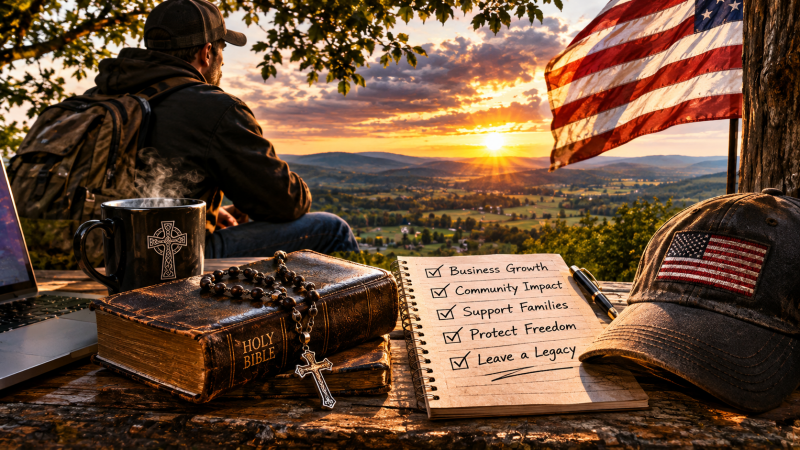
Why meaningful leadership, genuine relationships, and a commitment to something bigger than yourself are the foundations of lasting success.
There’s something I’ve come to appreciate after spending years working in politics, grassroots organizing, entrepreneurship, and digital marketing.
A lot of people want to make a difference.
Far fewer know how to turn that desire into something meaningful.
I’ve spent a considerable portion of my professional life working alongside people who wanted to change something. Business owners trying to build successful companies. Political candidates hoping to improve their communities. Nonprofit leaders working to help families. Grassroots advocates fighting for policies they believed would make people’s lives better.
I’ve also watched what happens when good intentions collide with poor leadership, ineffective strategies, organizational politics, and the temptation to prioritize personal recognition over actual results.
And I’ve learned something important.
Having a worthwhile mission is only the beginning. Building something capable of fulfilling that mission is an entirely different challenge.
That’s a lesson that has influenced nearly every decision I’ve made throughout my professional journey, and it’s ultimately one of the reasons I founded Stephen Despin Consulting.
I believe we need more businesses that care about their communities, more organizations that prioritize their missions, and more leaders who understand that success should be measured by more than their own personal accomplishments.
We need people who are interested in building something that lasts.
And I think that starts with changing how we think about leadership, business, and what it actually means to make a difference.
The Difference Between Looking Successful and Actually Accomplishing Something
We live in a world that places an enormous amount of emphasis on appearances.
Social media has made it easier than ever to present a carefully curated version of success. Businesses showcase impressive revenue milestones. Organizations celebrate membership numbers. Political figures announce endorsements, fundraising totals, and campaign accomplishments.
There’s nothing inherently wrong with celebrating success.
But there’s a difference between looking successful and actually accomplishing something meaningful.
A business can have thousands of social media followers and still struggle to generate customers.
A nonprofit can have an impressive public relations operation and still struggle to deliver meaningful assistance to the people it claims to serve.
A political campaign can generate enormous online engagement without building the relationships necessary to translate that engagement into actual participation.
And an organization can spend years talking about changing the world without ever developing the infrastructure necessary to make meaningful progress.
I’ve seen variations of all of these situations throughout my career.
The problem isn’t necessarily a lack of ambition.
It’s a lack of alignment between what people say they want to accomplish and what they’re actually doing to accomplish it.
Too often, organizations become so focused on maintaining their image, expanding their visibility, or pursuing the next opportunity that they lose sight of the reason they started in the first place.
Growth becomes the objective instead of a tool.
Recognition becomes more important than results.
And eventually, the mission takes a back seat to the organization itself.
I believe we need to reverse that thinking.
The organization should exist to serve the mission. The mission shouldn’t exist to serve the organization.
That distinction matters more than most people realize.
Why Relationships Still Matter More Than Algorithms
I’ve spent years working in digital marketing, digital organizing, grassroots advocacy, and online engagement.
I’ve watched technology completely transform how businesses communicate, how political campaigns operate, and how organizations build communities around shared interests.
I’ve seen firsthand what can happen when digital strategy is executed effectively.
But I’ve also learned something that technology hasn’t changed.
People still want to do business with people they trust.
They want to support organizations they believe in.
They want to feel like their participation actually matters.
And they want relationships that extend beyond a transaction, a social media interaction, or an automated email.
Technology can help us find people, reach people, communicate with people, and organize people.
But technology cannot manufacture genuine trust.
That’s something you have to earn.
For small businesses, that means understanding that marketing isn’t simply about getting someone to click an advertisement or visit a website.
It’s about building enough credibility and confidence that someone feels comfortable choosing your business.
For nonprofits, it means recognizing that supporters aren’t simply names in a donor database.
They’re people who have decided to invest their time, resources, or attention in something they believe matters.
For political campaigns and advocacy organizations, it means understanding that volunteers and supporters aren’t disposable resources.
They’re individuals with their own motivations, experiences, relationships, and reasons for caring about an issue.
The most effective strategies recognize the human element behind every metric.
Clicks matter.
Conversions matter.
Engagement matters.
But none of those things mean much if they never develop into meaningful relationships or tangible results.
That’s why I believe the future belongs to organizations that can combine modern technology with something much older and considerably more valuable:
Genuine human connection.
Small Businesses Are More Than Businesses
One of the things I appreciate most about entrepreneurship is the opportunity it creates for ordinary people to build something of their own.
I’ve always respected people willing to take a risk, invest their time and resources, and put their names behind something they believe in.
Small business owners aren’t simply selling products or providing services.
They’re creating opportunities.
They’re employing people, supporting families, purchasing from other businesses, sponsoring community events, and providing services their neighbors depend on.
The U.S. Small Business Administration’s Office of Advocacy reported that America had approximately 36.2 million small businesses in 2025, representing 99.9% of all U.S. businesses and accounting for approximately 46% of private-sector employment.
Those numbers help illustrate something that often gets overlooked in larger economic conversations.
Small businesses aren’t on the sidelines of the American economy.
They’re a significant part of its foundation.
And I think we should approach helping them succeed accordingly.
When I work with a small business owner, I don’t look at their marketing as an isolated problem.
I want to understand the business.
What are they trying to accomplish?
Who are their customers?
What makes them different?
Where are they losing opportunities?
What resources do they have available?
What does sustainable growth actually look like for them?
Sometimes the solution involves better search engine optimization.
Sometimes it involves improving their website, strengthening their brand positioning, developing a more effective content strategy, or creating a better system for converting visitors into customers.
Sometimes the biggest problem isn’t marketing at all.
It’s a lack of time, organizational structure, or strategic direction.
The objective is to identify what will actually move the business forward.
Because helping a small business grow isn’t simply about increasing website traffic or generating more impressions.
It’s about helping someone build something sustainable.
Something that creates opportunities for their family, their employees, and their community.
That’s meaningful work.
Nonprofits Need More Than Good Intentions
I’ve always believed that communities are strongest when people take an active interest in helping one another.
But wanting to help people and building an organization capable of consistently helping people are two different things.
Nonprofits face some particularly difficult challenges.
They have to communicate their mission, establish credibility, recruit volunteers, develop donor relationships, manage limited resources, and demonstrate that their work is actually producing results.
And they have to do all of that while competing for attention in an increasingly crowded digital environment.
I’ve encountered organizations with incredibly worthwhile missions that struggle simply because they don’t have the strategic infrastructure necessary to reach the people who could help them accomplish their goals.
They might have passionate volunteers but no effective recruitment system.
They might have a compelling mission but an unclear message.
They might have a growing supporter base but no sustainable engagement strategy.
They might be doing meaningful work in their communities without effectively communicating the impact of that work.
These aren’t necessarily mission problems.
They’re organizational and strategic problems.
And they’re solvable.
I believe nonprofit organizations deserve access to the same level of strategic thinking, digital expertise, and organizational development available to larger institutions and corporations.
Because the value of an organization shouldn’t determine whether it has access to the tools necessary to succeed.
Sometimes helping a nonprofit develop a stronger strategy can mean reaching another family, recruiting another volunteer, securing another community partner, or expanding a program that changes someone’s life.
That’s the kind of organizational growth worth pursuing.
Leadership Means Being Willing to Show Up
I’ve spent a lot of time thinking about leadership.
Not the titles.
Not the organizational charts.
Not the professional photographs or impressive biographies.
I’m talking about the kind of leadership that actually makes a difference in people’s lives.
The kind that requires responsibility.
The kind that requires accountability.
The kind that occasionally requires putting someone else’s interests ahead of your own.
Throughout my years in politics and grassroots organizing, I’ve learned that the ability to bring people together is one of the most valuable skills a leader can develop.
But bringing people together requires more than a compelling speech or an impressive social media presence.
It requires trust.
It requires consistency.
It requires understanding that people are more likely to commit themselves to something when they believe the people leading it are genuinely committed themselves.
And perhaps most importantly, it requires being willing to do the work when nobody is watching.
I’ve always believed that your character is revealed by what you do when there’s nothing to gain from doing the right thing.
That applies to business.
It applies to politics.
It applies to nonprofit leadership.
And it certainly applies to everyday life.
You don’t build lasting relationships by showing up only when you need something.
You don’t build strong organizations by abandoning people when circumstances become inconvenient.
And you don’t build a meaningful legacy by constantly calculating what everyone else can do for you.
Leadership is a responsibility.
It’s an opportunity to help other people accomplish things they might not have been able to accomplish on their own.
And I think we could use considerably more of that kind of leadership.
Turning Purpose Into Action
This is where everything I’ve learned throughout my professional journey comes together.
I didn’t want to spend the rest of my career simply talking about the problems I saw around me.
I wanted to build something that could help address them.
Something practical.
Something that brought together business growth, organizational development, community engagement, and meaningful civic participation.
That’s the philosophy behind the three initiatives I’m building.
Stephen Despin Consulting
Through Stephen Despin Consulting, I work with small businesses, entrepreneurs, political campaigns, nonprofits, advocacy organizations, and mission-driven leaders who want to accomplish something meaningful.
My work brings together digital marketing, business growth strategy, SEO, GEO, AI search optimization, online reputation, grassroots organizing, campaign strategy, and leadership consulting.
The goal is to help people develop strategies that connect their ambitions with the practical steps necessary to achieve them.
I believe good consulting should provide more than recommendations.
It should provide clarity, direction, and an actionable path forward.
Whether that means helping a small business improve its online visibility, helping a political campaign strengthen its grassroots operation, or helping a nonprofit develop a more effective supporter engagement strategy, the objective remains the same.
Help good people accomplish more of what they’re setting out to do.
Rise United Foundation
Rise United Foundation represents another important part of this vision.
It’s about recognizing that strong communities require people willing to invest in one another.
Through community support initiatives focused on families, young mothers, foster children, and individuals experiencing difficult circumstances, the foundation works to provide practical assistance and create opportunities for people to help their neighbors.
I believe community involvement shouldn’t be reserved for people with enormous financial resources.
Sometimes the most meaningful contributions come from people willing to donate their time, organize a collection drive, deliver supplies, or simply help someone who needs it.
We all have something to contribute.
And collectively, those contributions can accomplish extraordinary things.
Guardians of Liberty
Guardians of Liberty brings my experience in grassroots organizing and public policy back into the community.
It’s a community advocacy initiative dedicated to advancing the principles of a free society, individual liberty, personal responsibility, and accountable government.
I believe people should have a meaningful voice in the decisions affecting their lives.
I believe communities should be empowered to advocate for themselves.
And I believe protecting individual freedom requires active participation from people who understand that liberty isn’t something we can simply take for granted.
Through education, advocacy, grassroots engagement, and community organizing, Guardians of Liberty provides an opportunity for people to become more involved in the issues affecting their communities and their futures.
Three initiatives.
Different missions.
One underlying belief:
We can build stronger communities when we give people the tools, opportunities, and support necessary to make a difference.
Why Strategy Matters When Your Mission Matters
Here’s something I want to emphasize, particularly for entrepreneurs, nonprofit leaders, and people involved in advocacy.
Having a good idea isn’t enough.
Having a great mission isn’t enough.
Even having a tremendous amount of passion isn’t enough.
You need a plan.
You need to understand your audience, communicate your message effectively, develop the right relationships, establish priorities, and allocate your resources intelligently.
You need to know what you’re trying to accomplish and how you’ll measure whether you’re making progress.
This is where strategy becomes incredibly important.
I’ve seen organizations spend enormous amounts of time and money pursuing activities that generate attention without necessarily advancing their objectives.
I’ve seen businesses chase marketing trends without understanding whether those trends actually make sense for their customers.
I’ve seen campaigns prioritize online visibility while neglecting the relationships and organizational infrastructure necessary to turn supporters into active participants.
Activity isn’t necessarily progress.
Visibility isn’t necessarily growth.
And having a strategy document isn’t the same thing as having an executable strategy.
The best strategies start with understanding the actual problem.
Then they identify the opportunities, establish priorities, and create a realistic path toward measurable results.
That’s the approach I bring to my consulting work.
I don’t believe in handing someone a generic playbook and telling them to figure it out.
Every business is different.
Every organization has different resources.
Every campaign has different challenges.
And every mission deserves a strategy built around the people, circumstances, and objectives involved.
If you’re serious about accomplishing something, your strategy should reflect that.
Building Something That Outlasts You
Ultimately, I think this comes down to legacy.
Not the kind of legacy measured by how many people recognize your name or how impressive your professional accomplishments appear on paper.
I’m talking about the kind of legacy that continues making a difference after you’re no longer involved.
The business that provides employment opportunities for families in your community.
The nonprofit that continues helping struggling families.
The organization that develops new leaders who carry its mission forward.
The community relationships that remain long after a particular project or campaign has ended.
The children who grow up understanding the importance of hard work, responsibility, compassion, and keeping their word.
Those things matter.
I’ve always wanted to build something my family could be proud of. Something that reflects the values I believe in and creates opportunities for people beyond myself.
I’m still working toward that.
I don’t pretend to have all the answers, and I certainly don’t consider myself an expert on everything.
I’m an entrepreneur, a consultant, a father, and someone who has spent a considerable portion of his life trying to figure out how to make a meaningful contribution to the world around him.
I’ve made mistakes along the way.
I’ve learned some difficult lessons.
I’ve encountered people who reinforced my faith in humanity and others who reminded me why character matters so much.
But I haven’t lost sight of what I set out to accomplish.
I still believe people can make a difference.
I still believe communities can accomplish extraordinary things when people work together.
And I still believe that success means considerably more when it creates opportunities for others.
Let’s Build Something That Matters
If there’s one thing I’d like people to take away from this article, it’s that you don’t have to choose between being successful and doing something meaningful.
You can build a profitable business while treating people fairly.
You can lead an organization without making everything about yourself.
You can pursue professional opportunities without abandoning your principles.
You can grow an organization without losing sight of its mission.
And you can build something successful while remaining committed to the people and communities that helped make that success possible.
It takes work.
It takes patience.
It takes the right strategy.
And sometimes it takes finding the right people to help you get there.
That’s what I’m working to build through Stephen Despin Consulting and the broader initiatives I’m involved in.
I’m interested in working with people who have something they genuinely want to accomplish.
People who are building businesses, leading organizations, organizing communities, advancing causes, and creating opportunities for others.
You don’t have to have everything figured out.
You don’t need an enormous budget or a massive team.
You simply need to have a worthwhile objective and a willingness to do the work necessary to achieve it.
If that’s where you are, I’d like to hear from you.
Explore Stephen Despin Consulting to learn more about my digital marketing, business growth, grassroots organizing, advocacy, campaign, and organizational strategy consulting services.
You can also visit StephenDespin.net to learn more about my background, my work, and the ideas behind what I’m building.
And if you’d like to understand the personal experiences that helped shape this philosophy, I recently shared a deeper reflection on my journey through politics, the lessons I’ve learned about loyalty and integrity, and why I ultimately decided to build something different.
It’s called “Politics, Principles, and Purpose: Why I Decided to Build Something Different.”
I’d encourage you to give it a read.
Because there’s a story behind everything we’re building, and I think understanding that story helps explain where we’re going.
I’m not interested in building something simply for the sake of saying I built it.
I want to build something that matters.
Something that helps people.
Something that creates opportunities.
Something that strengthens communities.
And something that my family, my neighbors, and the people I’ve had the privilege of working alongside can look at years from now and know that it made a difference.
There’s a lot of work left to do.
Let’s get to it.
Add comment
Comments