

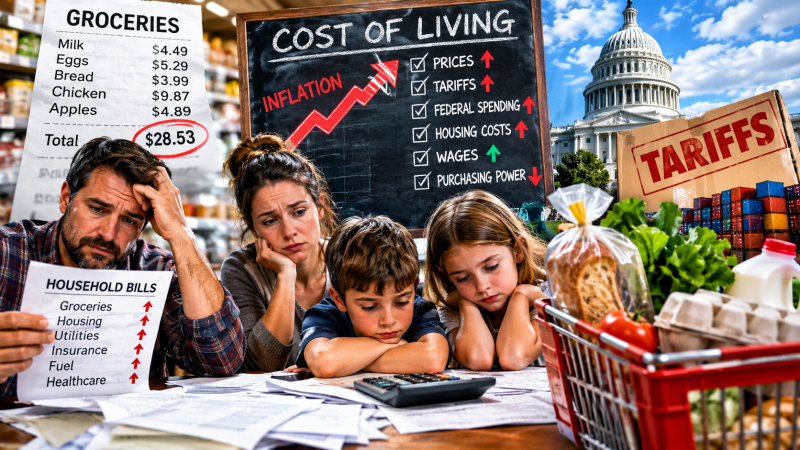
Inflation may have slowed from its peak, but grocery prices, housing costs, tariffs, and stagnant purchasing power continue to squeeze American families.
There’s a question I keep hearing from Americans across the political spectrum, and quite frankly, I think it deserves a much better answer than the one we're getting from Washington.
Why is everything still so expensive?
Walk into just about any grocery store, and you'll understand the frustration. A cart that once seemed reasonably affordable now leaves families wondering how they managed to spend so much without buying anything particularly extravagant.
Go to fill up your gas tank, renew your insurance, pay your electric bill, or look at what it costs to buy a home, and the story doesn't get much better.
Meanwhile, Washington keeps telling Americans that the economy is doing better, inflation is under control, or prosperity is just around the corner.
Depending on which political party is speaking, we're either experiencing tremendous economic success or suffering through a crisis entirely caused by the other side.
But here's what I think both parties keep missing.
Americans don't experience the economy through political talking points. They experience it through their bank accounts.
They experience it when the paycheck hits on Friday and most of it is already spoken for. They experience it when their children need new shoes, the car needs repairs, or an unexpected medical bill arrives.
And they certainly experience it when they're working just as hard as they were five years ago but somehow feel like they're falling further behind.
The uncomfortable truth is that America's cost-of-living crisis didn't happen overnight. It wasn't created by one president, one political party, or one economic policy.
It's the result of years of accumulated inflation, government spending decisions, supply disruptions, housing shortages, trade policies, and economic pressures that have steadily eroded what ordinary Americans can afford.
If we're serious about fixing it, we need to understand what's actually happening.
And that starts with clearing up one of the biggest misunderstandings in American economics.
Inflation Is Slowing. That Doesn't Mean Prices Are Coming Down.
Let's start with something that politicians, commentators, and even some economic analysts frequently fail to explain clearly.
There's an enormous difference between inflation slowing down and prices actually falling.
Inflation measures how quickly prices are increasing. When inflation slows, prices generally continue rising, just at a slower rate.
Economists call that disinflation.
When the overall price level actually declines, that's called deflation.
Those aren't interchangeable concepts.
Consider a simple example.
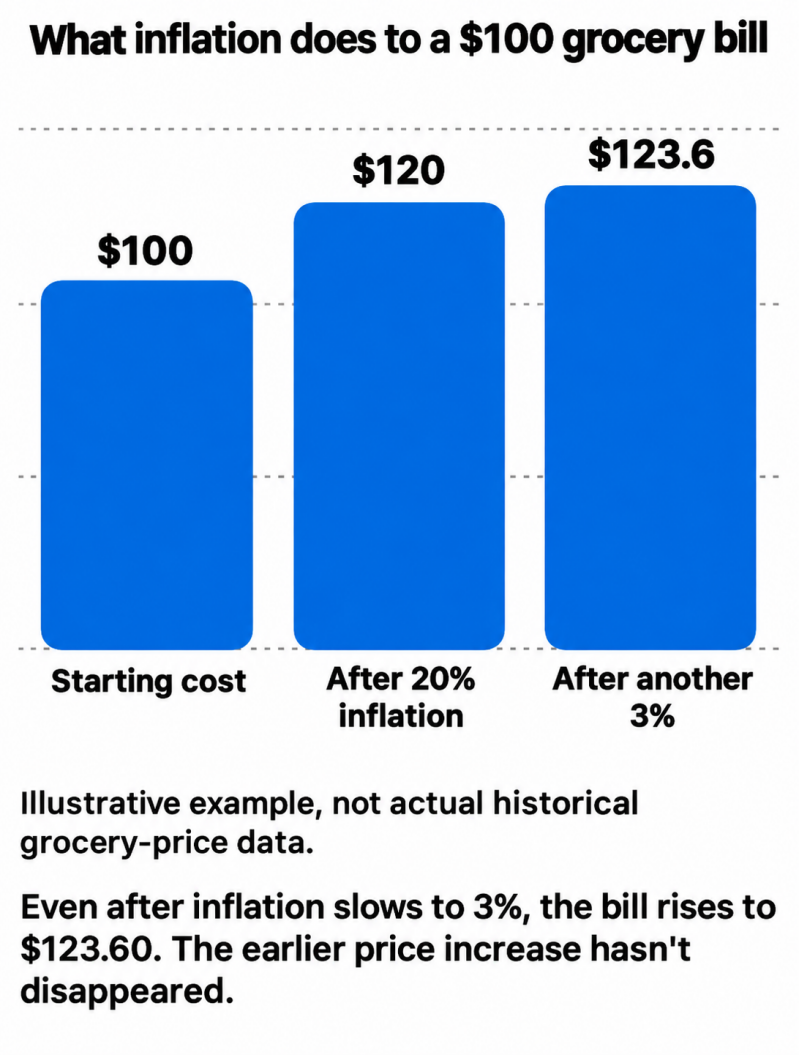
That's the distinction millions of Americans are living with.
The latest available national Consumer Price Index report, released by the Bureau of Labor Statistics on November 10, shows consumer prices increased another 0.4% in October 2026, following a 0.6% increase in September.
Food prices increased 0.5% in October alone, including a 0.4% increase in grocery prices. Shelter costs rose another 0.3%.
These aren't numbers suggesting that household expenses have suddenly returned to normal.
And according to the Bureau of Economic Analysis, the Personal Consumption Expenditures price index, the inflation measure closely watched by the Federal Reserve, increased 3.6% over the 12 months ending in September 2026.
That remains above the Federal Reserve's 2% longer-run inflation target.
So when someone in Washington announces that inflation is improving, that may be true relative to an earlier period.
But it doesn't mean families are getting their purchasing power back.
Slower price increases are not the same thing as affordable prices.
Until policymakers start acknowledging that distinction, Americans will continue hearing economic success stories that don't reflect their everyday reality.
The Grocery Store Is Where Economic Statistics Meet Reality
If you want to understand why Americans are frustrated, you don't need to begin with a complicated economic model.
Start in the grocery aisle.
Food is one of the few expenses that families cannot simply eliminate when money gets tight.
You can postpone a vacation. You can delay buying a new television. You might even put off replacing an aging vehicle.
But you can't stop feeding your children.
That's why grocery prices carry such enormous emotional and financial weight.
And the pressure extends well beyond the price printed on a package.
Farmers and food producers face expenses for equipment, fertilizer, labor, transportation, energy, insurance, and financing. Manufacturers face their own operating costs. Distributors must transport and store products, while retailers have employees, utilities, rent, and other overhead to cover.
When those costs rise, some of that pressure eventually reaches consumers.
Of course, that doesn't mean every price increase is justified or that businesses should escape scrutiny.
Competition matters. Market concentration matters. The ability of consumers to choose among competing retailers and suppliers matters.
But blaming every increase on corporate greed oversimplifies a much larger problem.
Businesses have always had incentives to make money. The important questions are whether their costs have increased, whether competition is strong enough to discipline prices, and whether consumers have meaningful alternatives.
If we want groceries to become more affordable, we need policies that make producing, transporting, and selling food less expensive.
That means looking seriously at energy costs, supply chains, trade restrictions, barriers to market entry, and unnecessary regulatory expenses.
It also means recognizing that families in smaller communities may have fewer shopping alternatives than those living in major metropolitan areas.
Affordability isn't just about what something costs. It's also about how many realistic choices consumers have.
And that brings us to another major part of this crisis.
Americans Are Earning More Dollars, but Are They Actually Getting Ahead?
One of the most misleading ways to measure economic success is to look at wages without considering what those wages can buy.
Suppose someone earned $50,000 several years ago and now earns $60,000.
On paper, that's a 20% increase.
Sounds pretty good, right?
But if the cost of maintaining the same standard of living increased by 25% during that period, that worker is actually worse off.
Their paycheck is bigger.
Their purchasing power is smaller.
That's why economists distinguish between nominal wages, which measure the actual dollar amount workers receive, and real wages, which adjust those earnings for inflation.
And the latest numbers help explain why so many Americans remain frustrated.
According to the Bureau of Labor Statistics, average hourly earnings increased 0.4% in October 2026.
Unfortunately, consumer prices also increased 0.4%.
The result?
Real average hourly earnings didn't increase at all that month.
The same report found that real average weekly earnings were unchanged from September to October.
Think about what that means.
Workers received more money in nominal terms, but rising prices absorbed the gain.
That's not the kind of economic progress most families are hoping for.
And it gets more concerning when we look at household finances.
The Bureau of Economic Analysis reported that real disposable personal income, which adjusts after-tax income for inflation, declined 0.3% in September 2026.
The personal saving rate stood at just 3.8%.
Now, these are national averages. Individual households experience very different circumstances depending on their wages, housing costs, debts, family size, and location.
But the broader point remains.
A growing economy doesn't automatically mean every household is becoming more financially secure.
We should be measuring economic progress by more than stock market performance, government revenue, or the number of dollars circulating through the economy.
We should be asking whether ordinary Americans can afford a decent home, reliable transportation, nutritious food, healthcare, and the opportunity to save for their future.
Because if people are working harder, earning more dollars, and still struggling to maintain the same standard of living, something isn't working.
Tariffs: The Tax Americans Keep Paying Without Always Realizing It
Let's talk about tariffs.
Few economic policies have been marketed to the American people as aggressively as tariffs, and few have been explained as poorly.
We're frequently told that tariffs make foreign countries pay their fair share, protect American industries, and encourage businesses to manufacture products here at home.
There are legitimate conversations to be had about national security, supply-chain resilience, and protecting critical industries.
But we need to be clear about how tariffs actually work.
A tariff is a tax on imported goods, paid to the U.S. government by the importer.
The foreign government doesn't simply write Washington a check.
An American business importing a product pays the tariff. That business must then decide whether to absorb the additional expense, negotiate a lower price with its supplier, or pass some of the cost along to its customers.
Frequently, the answer involves some combination of all three.
And the effects don't necessarily stop with imported products.
American manufacturers often rely on foreign components, raw materials, equipment, and machinery.
When those imports become more expensive, domestic production can become more expensive too.
In fact, research published by the Federal Reserve Bank of New York in 2026 examined the effects of the 2025 U.S. tariffs and found that approximately 26% of tariff increases passed through to consumer prices relative to less-exposed products, holding broader economic conditions constant.
The researchers found that 64% of the estimated consumer-price effect came directly through imported goods, while the remaining 36% came indirectly through more expensive production inputs and reduced competitive pressure. Some of those indirect effects took nine to twelve months to materialize.
That's an important finding.
Tariffs don't just affect the products arriving at our ports. They can affect the prices American businesses charge for goods manufactured right here in the United States.
And the consequences can extend throughout the economy.
Consider a small American manufacturer purchasing imported components.
If tariffs increase its production costs, that business faces a difficult decision. Raise prices and risk losing customers, absorb the costs and reduce profitability, or cut expenses elsewhere.
For a large corporation, those choices may be manageable.
For a small business operating on thin margins, they can be devastating.
Now, I understand the argument that tariffs can encourage domestic production. Under certain circumstances, protecting a strategically important industry may be worth accepting higher costs.
But we shouldn't pretend those costs don't exist.
Nor should we confuse protecting an industry with automatically improving the financial circumstances of American households.
If our goal is to make life more affordable, taxing the goods and materials Americans purchase deserves serious scrutiny.
Free and competitive markets have historically been powerful engines for reducing costs, improving products, and expanding consumer choice.
We should be working to make American businesses more competitive, not simply making their foreign competitors more expensive.
Those are two very different approaches to economic policy.
Washington Has a Spending Problem, and Both Parties Own It
Here's where the conversation gets particularly uncomfortable for Washington.
For years, Republicans and Democrats have argued about government spending while repeatedly approving budgets, emergency packages, and policy commitments that leave taxpayers with enormous deficits.
Each party has its preferred spending priorities.
Each party has its list of programs that supposedly cannot be touched.
And each party becomes considerably more concerned about fiscal responsibility when the other one controls the White House.
Meanwhile, the national debt continues growing.
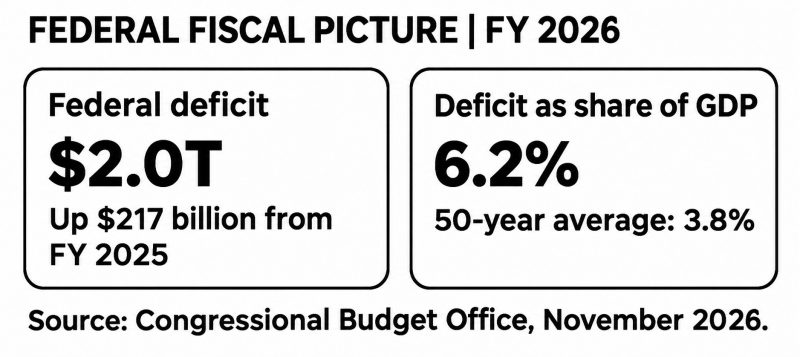
According to the Congressional Budget Office's November 9, 2026, fiscal review, the federal government recorded a deficit of approximately $2 trillion during fiscal year 2026.
That's $217 billion more than the previous year.
Federal spending increased approximately 6%, while revenues increased just 3%.
The deficit reached 6.2% of gross domestic product, compared with a 50-year average of approximately 3.8%.
And federal debt held by the public reached approximately 100% of GDP.
Now, does that mean every dollar of federal spending automatically creates inflation?
Of course not.
Government spending can support necessary public services, infrastructure, national defense, and economic stability.
And inflation has multiple causes, including monetary policy, supply constraints, energy prices, consumer demand, and global economic conditions.
But sustained deficit spending can contribute to inflationary pressure when it increases overall demand faster than the economy can expand its productive capacity.
Large deficits also create longer-term fiscal challenges, particularly when rising debt-service costs consume resources that could otherwise support public priorities or reduce the burden on taxpayers.
There's another distinction worth making.
The Federal Reserve, not Congress, directly manages the nation's monetary policy. Its interest-rate decisions and balance-sheet policies influence borrowing, spending, investment, and inflation.
Fiscal policy and monetary policy interact, but they're not the same thing.
We shouldn't pretend the federal budget is the sole cause of today's prices.
We also shouldn't pretend that Washington can spend trillions more than it collects indefinitely without consequences.
And this is where I believe fiscal responsibility needs to become something more than a campaign slogan.
If Washington expects families to live within their means, it should demonstrate a willingness to exercise meaningful spending discipline itself.
That means evaluating programs based on measurable results, eliminating waste, reviewing spending commitments, and making difficult budget decisions before the financial consequences become even more severe.
It also means acknowledging that balancing the budget will require serious discussions about major spending categories and revenues, not just eliminating a handful of politically convenient programs.
Fiscal responsibility isn't about which party gets to spend the money. It's about respecting the people who earned it.
Housing Has Become One of America's Biggest Affordability Problems
While grocery prices receive considerable attention, housing may be the single biggest obstacle preventing many Americans from getting ahead.
Think about what homeownership once represented.
A family could work hard, save money, purchase a modest home, and gradually build financial security.
That opportunity still exists, but for millions of Americans, the financial barriers have become considerably higher.
And the data support that concern.
According to Harvard University's Joint Center for Housing Studies, home prices increased approximately 54% nationwide between 2020 and 2025.
Its 2026 housing report also found that 22.7 million renter households, representing approximately 49% of renters, were spending more than 30% of their income on housing in 2024, the latest year for that measure.
Even homeowners are facing enormous financial pressure.
A family could work hard, save money, purchase a modest home, and gradually build financial security.
That opportunity still exists, but for millions of Americans, the financial barriers have become considerably higher.
And the data support that concern.
According to Harvard University's Joint Center for Housing Studies, home prices increased approximately 54% nationwide between 2020 and 2025.
Its 2026 housing report also found that 22.7 million renter households, representing approximately 49% of renters, were spending more than 30% of their income on housing in 2024, the latest year for that measure.
Even homeowners are facing enormous financial pressure.
Between 2019 and 2025, property taxes increased 31%, while average monthly homeowners insurance premiums jumped 72%.
That's not a minor inconvenience.
Those are expenses that directly affect whether families can afford to stay in their homes.
And the consequences reach far beyond housing itself.
When a larger percentage of someone's income goes toward rent or mortgage payments, less remains for groceries, transportation, savings, childcare, and retirement.
So why has housing become so expensive?
Part of the answer is supply.
In many communities, restrictive zoning laws, lengthy permitting processes, development fees, and regulatory requirements make it more difficult or expensive to build homes.
Construction labor shortages, land prices, financing costs, and material expenses create additional challenges.
Meanwhile, higher mortgage rates can make purchasing a home substantially more expensive, even when the sale price hasn't changed.
And homeowners who secured historically low mortgage rates may be reluctant to sell, limiting the availability of existing homes.
There isn't one simple solution.
But I believe we should begin by making it easier to build housing that people can actually afford.
Local governments should examine whether their regulations are unnecessarily restricting housing supply. States should look for opportunities to streamline permitting and encourage responsible development.
We also need meaningful transparency and accountability around property taxes and government spending.
Families shouldn't be expected to absorb endless increases without a clear explanation of where their money is going and what they're receiving in return.
At the same time, we have to recognize that expanding housing supply takes time, and new construction alone may not immediately meet the needs of the lowest-income households.
A serious housing strategy needs to address both long-term supply and the immediate pressures facing financially vulnerable families.
The goal shouldn't be to have government dictate every housing decision.
It should be to remove unnecessary obstacles, encourage investment, protect property rights, and expand the choices available to Americans.
Competition Is One of the Most Overlooked Tools for Lowering Prices
There's something interesting about the national conversation surrounding affordability.
We spend an enormous amount of time discussing what government should subsidize, regulate, or tax.
We spend considerably less time discussing how to make it easier for businesses to compete.
And that's a mistake.
Competition gives businesses an incentive to improve quality, control costs, and offer better prices.
When consumers have several realistic choices, companies must work harder to earn their business.
But when competition is limited, customers may have little alternative but to accept higher prices.
Consider healthcare.
In some communities, hospital consolidation and limited provider networks can leave patients with fewer choices and less bargaining power.
Consider housing.
When local rules prevent new construction, existing property owners face less competition from additional housing supply.
Consider small businesses.
Occupational licensing requirements, expensive permits, complicated compliance obligations, and other barriers can make it difficult for entrepreneurs to enter certain markets.
Some regulations serve legitimate public health and safety purposes.
Others impose costs that may have little relationship to protecting consumers.
We should be willing to distinguish between the two.
And we should be equally willing to enforce competition laws against genuinely anticompetitive behavior, regardless of whether the businesses involved are large or politically influential.
This isn't about being against successful companies.
It's about ensuring that success doesn't become an excuse to prevent others from competing.
Having worked with small businesses and entrepreneurs, I've seen how even relatively modest operating expenses can affect whether someone can expand, hire another employee, or keep prices competitive.
Every unnecessary barrier carries a cost.
Sometimes that cost is paid by the business owner.
Sometimes it's paid by employees.
And sometimes it's passed directly to customers.
If we're serious about lowering the cost of living, we should be making it easier for responsible entrepreneurs to start businesses, enter markets, and challenge established competitors.
More opportunity for businesses can mean more choices for consumers.
That's a principle policymakers from across the political spectrum should be able to appreciate.
Why Americans Don't Believe the Economy Is Working for Them
There's another part of this conversation that deserves more attention.
Economic statistics measure broad trends.
Families experience individual circumstances.
Those two things don't always move together.
Someone who purchased a home years ago with a low fixed-rate mortgage may be in a considerably stronger position than a young family trying to purchase its first home today.
A household with little debt may be better equipped to handle rising expenses than one relying on credit cards to cover necessities.
Someone receiving regular wage increases may be keeping pace with inflation, while another worker in the same community is falling behind.
And a retiree living on a fixed income may experience rising prices very differently from someone in the prime of their earning years.
That's why broad economic indicators, while useful, don't tell us everything we need to know about household financial security.
The personal saving rate is one indicator worth watching, but so are housing affordability, debt burdens, real disposable income, and the share of household earnings required to cover essential expenses.
The real question isn't simply whether the economy is growing.
It's whether people are able to participate in that growth.
Can a young couple afford to start a family?
Can a single parent cover the rent and still save for an emergency?
Can a small business owner afford to hire another employee?
Can a retiree maintain financial independence without constantly worrying about the next price increase?
Those are the questions that should shape our economic priorities.
And when Americans say they're struggling, policymakers shouldn't dismiss their concerns simply because a national statistic appears encouraging.
Averages don't pay the electric bill.
So What Would Actually Make Life More Affordable?
This is where I think the conversation needs to move away from political blame and toward practical solutions.
We don't need another round of promises that everything will magically become cheaper if the right political party wins the next election.
We need policies that address the actual forces driving costs higher while helping Americans earn, save, and build financial security.
I would start with six priorities.
First, get federal spending under control.
That means establishing credible fiscal targets, scrutinizing expenditures, improving transparency, and requiring lawmakers to explain how new spending commitments will be financed.
Reducing structural deficits won't instantly reverse years of inflation, but it can strengthen long-term fiscal stability and reduce one source of potential inflationary pressure.
Second, stop treating tariffs as a cost-free economic strategy.
Trade policy should account for national security and legitimate strategic concerns, but policymakers must also consider how tariffs affect consumers, domestic manufacturers, and small businesses.
If a policy makes everyday goods more expensive, Americans deserve to know what they're paying and what measurable benefit they're receiving.
Third, make it easier to build affordable housing.
That means reviewing zoning restrictions, permitting delays, development fees, and other barriers that limit supply.
It also means recognizing the importance of infrastructure, local conditions, and targeted assistance for households that the market cannot currently serve affordably.
Fourth, encourage real competition.
Reduce unnecessary barriers to entrepreneurship, enforce laws against anticompetitive conduct, and make it easier for consumers to compare prices and choose among providers.
Government shouldn't be protecting established businesses from competition.
It should be protecting the conditions that allow competition to flourish.
Fifth, focus on productivity and real wage growth.
Sustainable improvements in living standards depend heavily on workers producing more value over time and sharing in the benefits of that productivity.
That means supporting workforce training, apprenticeships, innovation, capital investment, and entrepreneurship.
Simply increasing the number of dollars in a paycheck doesn't accomplish much if prices rise just as quickly.
Finally, measure success by household purchasing power.
I want to see policymakers talk less about whether an economic report makes their party look good and more about whether Americans can afford the necessities of everyday life.
Track real wages. Track housing affordability. Track household debt. Track the cost of essentials.
And most importantly, explain those numbers in language ordinary Americans can understand.
Because economic policy should serve people, not political messaging.
The Goal Shouldn't Be to Return to Yesterday. It Should Be to Make Tomorrow More Affordable.
There's one final point I think deserves emphasis.
When Americans say they want prices to come down, I understand exactly what they mean.
They want their money to go further.
They want to walk into a grocery store without worrying about the total at checkout.
They want to buy a home without committing an overwhelming share of their income to the mortgage.
They want to work hard, provide for their families, save for retirement, and occasionally enjoy the fruits of their labor without feeling financially irresponsible.
Those aren't unreasonable expectations.
But returning every price to where it stood five or six years ago isn't necessarily realistic or even desirable.
Broad, sustained deflation can create serious economic problems of its own, particularly when falling prices reduce business revenues, discourage investment, and make existing debts harder to repay in real terms.
And not every product or service will follow the same price trend.
Some prices may decline as competition improves or production becomes more efficient. Others may remain elevated because of structural costs, supply constraints, or changes in demand.
The better objective is to restore and expand purchasing power.
That means creating an economy where wages and productivity grow faster than the cost of living over time.
Where businesses can compete without unnecessary government interference.
Where families can build savings instead of constantly draining them.
And where government recognizes that every dollar it taxes, borrows, or spends ultimately has consequences for the people it serves.
That's the kind of economic progress worth pursuing.
Washington Needs to Stop Celebrating Statistics and Start Listening to Families
I don't believe America's cost-of-living crisis can be solved by one president, one Congress, or one sweeping piece of legislation.
The problems are too interconnected, and many of them have been building for years.
But I also reject the idea that Americans should simply accept today's affordability challenges as the new normal.
We can make housing easier to build.
We can remove unnecessary barriers to competition.
We can pursue more responsible fiscal policies.
We can stop pretending tariffs don't affect American consumers.
And we can focus on creating the conditions for stronger real wages, greater productivity, and meaningful economic opportunity.
None of that requires abandoning our principles.
It requires taking them seriously.
It requires recognizing that economic freedom comes with responsibility, that government resources are not unlimited, and that public policy should be judged by its actual consequences rather than its political intentions.
Most importantly, it requires remembering who the economy is supposed to serve.
Not Washington.
Not political parties.
Not special interests.
The American people.
The parents trying to put food on the table. The small business owners struggling to keep their doors open. The young adults wondering whether homeownership will ever be within reach. The retirees watching their savings lose purchasing power.
These are the people who deserve more than another political argument about whose fault everything is.
They deserve serious leadership, honest explanations, and policies grounded in economic reality.
Because at the end of the day, Americans aren't asking for an economic miracle.
They're asking for something considerably more reasonable.
They want to work hard, get ahead, and build a better life for their families without feeling like the cost of simply living is constantly moving further out of reach.
And until Washington starts measuring economic success by that standard, the question isn't going away.
Why is everything still so expensive?
Add comment
Comments