

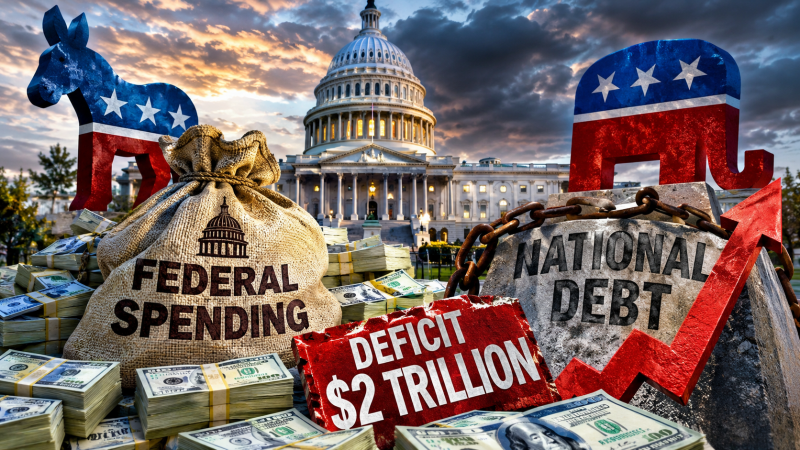
Washington doesn't have a revenue problem or a spending problem alone. It has an accountability problem that neither political party seems willing to confront.
There’s something almost impressive about Washington’s ability to spend money it doesn’t have, blame somebody else for the bill, and then turn around and ask Americans to trust it with even more.
Republicans campaign on fiscal responsibility. Democrats campaign on protecting working families. Both promise to make government work better, spend taxpayer dollars wisely, and build a stronger economy.
Then they get to Washington.
Suddenly, fiscal responsibility becomes negotiable. Spending restraint becomes somebody else’s responsibility. And the national debt? Well, apparently that’s only a national emergency when the other party occupies the White House.
Meanwhile, the American taxpayer keeps paying.
I’ve spent years working in public policy, grassroots advocacy, and government accountability. One thing that experience has taught me is that politicians are exceptionally good at explaining why the other side is responsible for a problem. They're considerably less enthusiastic about explaining what they intend to do differently.
Our federal budget is a perfect example.
And frankly, I think Americans deserve a much more serious conversation about it.
The Numbers Don't Care Which Party You Belong To
Before we start pointing fingers, we need to understand the size of the problem.
The federal government doesn't operate like a household or a small business. It has taxing authority, can issue debt, and manages obligations that extend across generations. But one fundamental reality remains: spending consistently more than you collect creates consequences.
And Washington has been doing exactly that for decades.
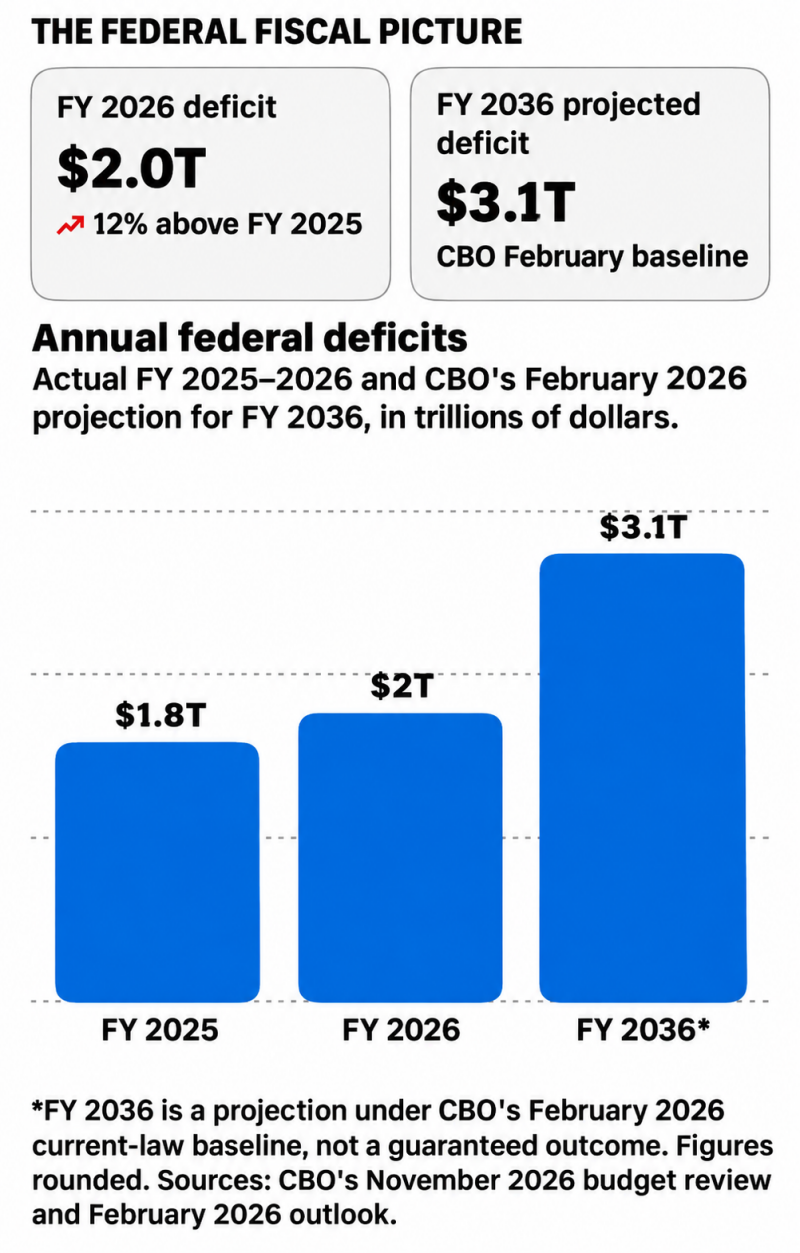
According to the Congressional Budget Office's November 9, 2026, budget review, the federal government finished fiscal year 2026 with a deficit of approximately $2 trillion.
That's $217 billion more than the previous year, an increase of roughly 12%.
Federal revenues actually increased by 3%. Unfortunately, federal spending increased by 6%.
Think about that for a moment.
Washington collected more money from Americans, spent even more than it collected, and still managed to dig the hole deeper.
The longer-term picture isn't particularly encouraging, either.
In its February 2026 outlook, CBO projected that federal debt held by the public would rise from approximately 101% of gross domestic product in 2026 to 120% by 2036 under then-current law.
For context, that's higher than the previous post-World War II peak.
These aren't numbers from a partisan campaign advertisement. They're projections from Congress's own nonpartisan budget analysts.
Now, reasonable people can disagree about the appropriate size and role of government.
We can debate military spending, healthcare programs, taxation, infrastructure, and social services. Those are legitimate policy discussions.
But we shouldn't have to debate whether the federal government needs a credible plan to pay for its commitments.
That should be common ground.
Republicans Have a Spending Problem. So Do Democrats.
Here's where this conversation gets uncomfortable.
Republicans have spent decades positioning themselves as the party of limited government, lower taxes, and fiscal discipline.
I happen to believe in those principles.
I believe individuals and businesses generally make better decisions about their own money than distant federal bureaucracies. I believe lower, simpler taxes can encourage investment, entrepreneurship, and economic opportunity. And I believe government should have to justify every dollar it takes from the people who earned it.
But supporting those principles doesn't mean giving Republican politicians a free pass when their actions contradict their campaign promises.
Tax cuts without corresponding spending discipline can increase deficits. Expanding federal programs while promising smaller government is contradictory. Approving enormous spending packages and then complaining about the national debt is hardly a convincing display of fiscal leadership.
Democrats have their own contradictions.
They frequently argue that wealthy Americans and large corporations should contribute more in taxes to support federal priorities.
That's a legitimate position to debate.
But raising revenue doesn't eliminate the need to prioritize spending, measure results, or address the long-term growth of federal commitments.
More revenue can help close a budget gap. It doesn't automatically make government efficient.
And protecting a program from scrutiny simply because its stated purpose is compassionate isn't good stewardship.
Here's what bothers me most.
Both parties have developed an unfortunate habit of treating fiscal responsibility as a campaign message rather than a governing obligation.
When they're in the minority, they discover the dangers of excessive spending. When they're in power, they discover all the reasons their particular spending priorities are absolutely necessary.
It's a convenient arrangement for politicians.
Not so much for taxpayers.
Tax Cuts Aren't Free. Neither Are Spending Promises.
We need to be able to discuss tax policy without turning every disagreement into a partisan loyalty test.
I'm generally supportive of policies that allow working Americans, families, and small businesses to keep more of what they earn.
I know what it takes to build a business, meet payroll, manage expenses, and make difficult decisions about where limited resources should go.
Money left in the private economy can support hiring, investment, savings, and growth.
But here's the part fiscal conservatives need to acknowledge: tax reductions don't automatically pay for themselves.
Some tax changes can encourage additional economic activity and recover part of their initial revenue cost. Whether they recover all of it depends on the specific policy, economic conditions, and behavioral responses.
We shouldn't pretend otherwise.
At the same time, progressives need to acknowledge that increasing tax rates doesn't provide an unlimited source of revenue.
Tax policy affects incentives, investment decisions, business activity, and economic behavior. There are practical and political limits to how much additional revenue can be collected.
The federal government has to consider both sides of the ledger.
If Congress wants to lower taxes, it should explain how the change affects future revenues and what adjustments, if any, will offset the cost.
If Congress wants to establish a new spending program, it should identify how the program will be financed and how its effectiveness will be measured.
And if lawmakers believe borrowing is justified for a particular national priority, they should make that case openly instead of burying the long-term cost in a massive legislative package.
That's not radical.
It's basic accountability.
We're Paying Interest on Yesterday's Political Decisions
One of the most troubling parts of our national debt isn't necessarily the debt itself.
It's the growing cost of servicing it.
Every year, the federal government must pay interest on outstanding Treasury securities.
That interest represents a real federal budget obligation. It competes with other priorities, contributes to borrowing needs, and reduces Washington's flexibility when emergencies arise.
And unlike a new infrastructure project or workforce training program, interest payments don't directly provide a new public service.
They're the cost of financing obligations already incurred.
CBO's February 2026 projections showed rising interest costs as a major driver of future deficits. Its longer-term outlook projected net interest spending reaching 6.9% of GDP by 2056 under current-law assumptions, exceeding projected spending on Social Security or Medicare individually.
That's a warning worth taking seriously.
Now, borrowing isn't inherently irresponsible.
There are circumstances when financing long-term investments or responding to genuine national emergencies can make economic sense.
But borrowing to cover persistent structural deficits year after year is a different matter.
Eventually, interest payments consume resources that could otherwise support legitimate public needs or remain in the hands of taxpayers.
And when elected officials promise expanded services without explaining how those services will be financed, they're often shifting part of the burden to people who won't have a vote until years from now.
Our children and grandchildren shouldn't inherit an ever-growing bill simply because today's politicians are unwilling to make difficult decisions.
That isn't fiscal responsibility.
It's political convenience at the expense of future generations.
$186 Billion in Improper Payments. And That's Not Even the Whole Picture.
If you want a particularly frustrating example of why Washington needs stronger accountability, consider what the Government Accountability Office reported earlier this year.
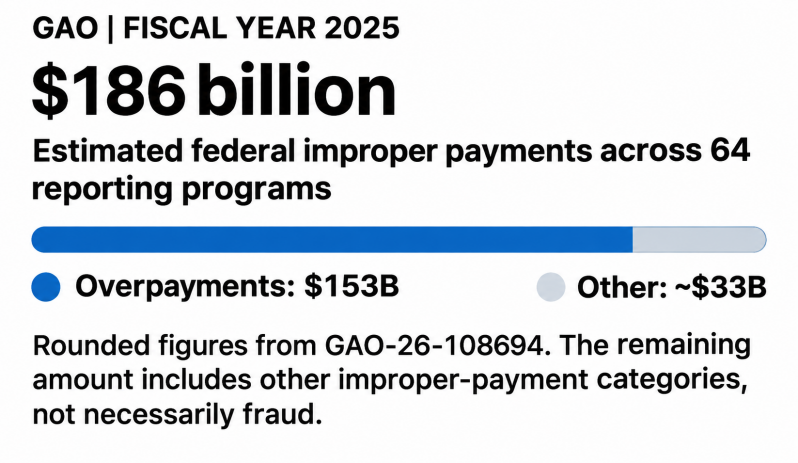
In April 2026, GAO found that 15 federal agencies had reported approximately $186 billion in estimated improper payments across 64 federal programs during fiscal year 2025.
That was approximately $24 billion more than the previous year's reported estimate.
And about $153 billion of the total, roughly 82%, consisted of overpayments.
Before anyone runs off claiming the government uncovered $186 billion in fraud, we need to be precise.
Improper payments are not synonymous with fraud.
They can include payments made in incorrect amounts, payments to ineligible recipients, insufficient documentation, and administrative or reporting errors.
Some may involve fraud. Others do not.
That distinction matters because good public policy should be built on accurate information, not exaggerated talking points.
GAO also explained that the increase in reported improper payments was partly attributable to additional program reporting and Medicaid eligibility and provider-screening issues. It would be misleading to characterize the entire increase as a sudden surge in fraud.
Still, the findings are deeply concerning.
GAO identified approximately $57 billion in estimated improper payments involving Medicare, $37 billion involving Medicaid, $21 billion involving the Earned Income Tax Credit, and approximately $10 billion each involving SNAP and the Shuttered Venue Operators Grant program.
Those five program areas accounted for roughly 73% of the total reported estimate.
These programs serve different purposes, and many provide meaningful assistance to people who genuinely need it.
But their importance makes accurate administration more necessary, not less.
When a government program is designed to help vulnerable Americans, administrative failures can hurt the very people it was created to serve.
Improper payments can also undermine public confidence and create additional costs for taxpayers.
GAO reported that cumulative improper-payment estimates since fiscal year 2003 have reached approximately $3 trillion.
That cumulative figure spans more than two decades, includes different kinds of errors, and shouldn't be mistaken for an amount that could necessarily be recovered today.
But it illustrates how persistent the problem has become.
And here's another important detail.
The $186 billion estimate doesn't capture every federal program susceptible to significant improper payments. Some programs were excluded because they did not report estimates.
In other words, even our understanding of the problem is incomplete.
For me, that's unacceptable.
Not because I believe every government employee is incompetent or every federal program is wasteful.
But because taxpayers have a right to know whether their money is reaching its intended destination and accomplishing its intended purpose.
That should be the bare minimum.
Washington Can't Even Get a Clean Government-Wide Audit
Here's another finding that deserves far more attention than it receives.
In March 2026, GAO reported that it could not express an audit opinion on the federal government's consolidated financial statements for fiscal years 2025 and 2024.
Why?
Among the major obstacles were longstanding financial management weaknesses at the Department of Defense, problems accounting for transactions between federal agencies, and deficiencies in preparing the government's consolidated financial statements.
This wasn't an isolated problem.
GAO has been unable to express an opinion on the government's accrual-based consolidated financial statements since its first audit covering fiscal year 1997.
Now, that doesn't mean every federal agency failed its individual audit. In fact, many received unmodified audit opinions.
But the inability to obtain a clean opinion on the government's consolidated financial statements after nearly three decades should concern every American.
Imagine a business owner telling investors that the company's consolidated financial records contained material weaknesses that prevented an auditor from expressing an opinion.
Would those investors simply shrug their shoulders?
Would they enthusiastically approve another round of spending without demanding improvements?
Of course not.
Yet in Washington, serious financial management deficiencies have somehow become an accepted part of doing business.
And both political parties have had opportunities to address them.
We can argue about the appropriate size of the Pentagon's budget. We can debate which defense programs are necessary and how America should protect its national security.
But regardless of where someone stands on military spending, surely we can agree that the Department of Defense should be able to account accurately for its financial activities and assets.
Supporting our military and demanding financial accountability aren't competing priorities.
They're complementary responsibilities.
Congress Has Turned Budgeting Into a Political Crisis Machine
The federal budget process is supposed to provide Congress with an orderly way to evaluate priorities, authorize spending, and fund government operations.
In practice, it has become a recurring exercise in brinkmanship.
Congress ordinarily considers 12 annual appropriations bills to fund much of the federal government's discretionary operations.
When lawmakers fail to complete those bills before the fiscal year begins on October 1, they often rely on temporary funding measures known as continuing resolutions.
And when negotiations become particularly difficult, Congress frequently combines multiple spending measures into enormous legislative packages.
The result?
Lawmakers are often asked to make consequential spending decisions under tremendous deadline pressure, sometimes with limited opportunities for meaningful public examination.
That's a terrible way to manage taxpayer money.
As of November 17, 2026, we're living through another example.
Congress has already enacted a continuing resolution funding federal agencies through December 11, 2026, because the regular appropriations process wasn't completed before the beginning of fiscal year 2027.
Here we go again.
Rather than consistently debating individual spending priorities through a transparent process, Washington repeatedly finds itself approaching another funding deadline.
Then Americans get the familiar political theater.
One party accuses the other of threatening a shutdown. The other accuses its opponents of holding the government hostage. Both sides flood the airwaves with accusations.
And somewhere in the middle, the actual discussion about spending priorities gets lost.
I don't believe shutting down government operations is a serious long-term fiscal strategy. Shutdowns can disrupt public services without resolving the underlying structural problems.
But I also don't believe Congress should be rewarded for repeatedly failing to complete one of its most basic constitutional responsibilities.
The power of the purse belongs to Congress.
It's time Congress started treating that power like a responsibility rather than a political bargaining chip.
The Real Problem Is Bigger Than Waste Alone
This is where I want to challenge something I hear frequently in fiscal policy discussions.
There's a popular belief that if Washington would simply eliminate waste, fraud, and abuse, our budget problems would disappear.
I wish it were that simple.
Reducing waste and improving payment accuracy should absolutely be priorities. But the scale of our structural deficits is much larger than the amount of improper payments identified in any single year.
Even if the entire $186 billion reported in estimated improper payments for fiscal year 2025 could somehow be eliminated and converted into federal savings—which is not a realistic assumption—it would represent less than one-tenth of the approximately $2 trillion deficit recorded in fiscal year 2026.
That's meaningful money.
It isn't a complete solution.
The deeper challenge involves the long-term relationship between federal revenues, mandatory spending commitments, discretionary priorities, economic growth, and interest on the national debt.
Programs such as Social Security and Medicare involve commitments to millions of Americans who have organized their lives around them.
Those commitments deserve serious consideration, not reckless political slogans.
But ignoring long-term financing challenges doesn't protect those programs. It simply makes future adjustments more difficult.
Likewise, defense spending deserves careful examination. Protecting national security is a legitimate federal responsibility, but that doesn't mean every procurement decision, overseas commitment, or spending increase is automatically justified.
And federal agencies shouldn't receive permanent budgetary protection simply because their missions sound worthwhile.
A good mission doesn't guarantee good management.
We need to stop confusing support for a program's purpose with unquestioning support for how that program spends money.
Washington Already Knows Where Some of the Problems Are
Perhaps the most frustrating part of this conversation is that Congress doesn't have to start from scratch.
GAO has already identified substantial opportunities to improve efficiency, reduce duplication, and strengthen financial management.
In its May 2026 annual report, GAO identified 97 new matters for congressional consideration and recommendations to federal agencies.
The report also documented approximately $774.3 billion in financial benefits from actions taken on GAO's duplication and cost-saving work since 2011.
And GAO estimated that implementing its remaining open recommendations and congressional matters could produce another $100 billion or more in future financial benefits. Those potential benefits aren't guaranteed annual savings, but they represent significant opportunities worth pursuing.
Think about what that means.
We already have a federal watchdog identifying problems, documenting possible solutions, and showing where improvements have generated financial benefits.
Yet hundreds of recommendations and matters remain unresolved.
This isn't exclusively a Republican problem.
It isn't exclusively a Democratic problem.
It's a failure of sustained institutional accountability.
We don't need another politician promising to reinvent government efficiency from the ground up.
We need elected officials willing to act on credible findings, measure the results, and explain publicly why recommendations remain unimplemented.
That's considerably less exciting than a campaign slogan.
It's also considerably more useful.
What Real Fiscal Responsibility Would Actually Look Like
I'm not interested in another round of political promises about eliminating waste while the federal deficit continues growing.
I want measurable reforms.
And I believe there's room for Republicans, Democrats, Libertarians, and independents to find common ground if they're willing to put taxpayers ahead of partisan credit.
Here are six reforms I believe Congress should seriously pursue.
1. Establish enforceable fiscal guardrails
Congress should adopt a credible, multiyear framework designed to stabilize and eventually reduce debt relative to the economy.
That framework should include transparent spending and revenue targets, measurable milestones, and consequences when lawmakers fail to meet them.
I'd support limits on the growth of appropriate categories of federal spending, with carefully defined exceptions for genuine emergencies.
But we need to be thoughtful about the design.
An inflexible annual balanced-budget requirement could force damaging tax increases or spending reductions during recessions, precisely when economic conditions are weakest.
A better approach would account for economic cycles while requiring Congress to explain deviations from its fiscal targets and establish a credible path back toward them.
Most importantly, lawmakers shouldn't be able to evade those limits through accounting gimmicks, unrealistic projections, or emergency designations that aren't genuine emergencies.
Fiscal rules are only meaningful when they're enforceable.
2. Make federal spending understandable to ordinary Americans
If taxpayers are financing government, they should be able to see where their money goes.
I'd like to see a comprehensive, publicly accessible federal spending dashboard that brings together existing Treasury, agency, and USAspending.gov information in a format ordinary Americans can actually understand.
For major programs, that means clearly identifying the responsible agency, annual appropriations and expenditures, program objectives, administrative costs, performance measures, and significant audit findings.
The information should be searchable, regularly updated, and available for independent analysis.
Sensitive personal information and legitimately classified national security details would still require protection.
But government shouldn't use complexity as an excuse for unnecessary secrecy.
Transparency isn't simply publishing thousands of pages of financial documents that most Americans will never have time to read.
Real transparency means making government information accessible, understandable, and useful.
3. Require meaningful performance audits
One of my biggest frustrations with government budgeting is how often success gets measured by how much money was allocated rather than what that money accomplished.
We need to change that.
Major federal programs should undergo recurring independent performance evaluations that examine whether they're achieving their stated objectives, using resources efficiently, and delivering measurable public benefits.
Congress should require agencies to publish corrective-action plans when significant deficiencies are identified.
Those plans should include deadlines, responsible officials, and measurable progress reports.
And when agencies repeatedly fail to address serious findings, Congress should conduct oversight hearings and consider appropriate corrective legislation.
That doesn't necessarily mean eliminating the program.
Sometimes the responsible answer is to improve administration, modernize outdated systems, or correct eligibility procedures.
The goal should be better outcomes and stronger stewardship, not simply cutting spending for the sake of announcing a cut.
4. Stop using massive spending packages to avoid difficult decisions
Congress should return to a more transparent appropriations process.
Individual spending bills should receive meaningful committee scrutiny, sufficient public review, and opportunities for amendments.
Major fiscal legislation should include clear estimates of its effects on spending, revenues, deficits, and debt.
I would also support requiring lawmakers to publicly identify significant changes made late in the legislative process.
If a provision is worth including, it should be worth defending.
No more pretending that an enormous last-minute spending package represents careful fiscal management simply because lawmakers managed to pass it before a deadline.
And no more treating questions about individual provisions as an inconvenience.
The public deserves to know what Congress is voting on before the vote happens.
5. Make long-term program sustainability a priority
We cannot have a serious conversation about federal spending while refusing to discuss the long-term sustainability of major federal commitments.
That includes Social Security, Medicare, Medicaid, defense, and the broader tax structure.
But these discussions need to begin with honesty and respect.
People who have spent decades paying into Social Security deserve to know their retirement expectations won't become collateral damage in a political fight.
Families relying on healthcare assistance deserve thoughtful policy rather than abrupt disruption.
And younger Americans deserve a realistic explanation of what these programs may cost in the future.
I'd favor a bipartisan commission with transparent proceedings, publicly available actuarial analysis, and a mandate to develop options that protect vulnerable Americans while improving long-term fiscal sustainability.
Its recommendations should receive serious congressional consideration, not disappear into another report collecting dust.
The solutions won't all be painless.
But pretending the problem doesn't exist will only make the eventual choices harder.
6. Make accountability apply to both political parties
This may be the most important reform of all.
We need to stop allowing politicians to define fiscal responsibility according to who's in power.
If a Republican president proposes a spending increase, Republicans should scrutinize it just as seriously as they would under a Democratic administration.
If a Democratic president proposes a costly new program, Democrats should demand the same rigorous fiscal analysis they expect from Republican proposals.
And if Congress passes legislation that increases the deficit, lawmakers should be prepared to explain why they supported it.
Not with a campaign slogan.
Not by pointing fingers.
With actual numbers, measurable benefits, and a credible explanation of the tradeoffs.
I would support publicly accessible congressional fiscal scorecards showing how lawmakers vote on major spending, tax, and debt-related legislation, accompanied by nonpartisan estimates of the fiscal effects.
Voters should be able to evaluate a representative's record rather than relying on campaign advertisements.
Because fiscal responsibility isn't a party affiliation.
It's a standard of conduct.
Fiscal Responsibility Is Also a Moral Responsibility
There's another dimension to this issue that I don't think gets nearly enough attention.
Government spending isn't just an accounting exercise.
It involves real people, real families, and real consequences.
Every dollar Washington spends ultimately comes from taxes, borrowing, or other government revenue sources.
Those resources have alternative uses.
They could support a family trying to build financial security, a small business looking to hire another employee, or a community investing in its future.
That doesn't mean every tax dollar is wasted.
Far from it.
There are legitimate public responsibilities that require collective investment, and a civilized society has obligations to protect human dignity and assist people facing genuine hardship.
But compassion and fiscal discipline shouldn't be treated as opposites.
In fact, I would argue that responsible stewardship is one of the ways we honor those obligations.
When government wastes resources, it reduces its ability to meet legitimate needs.
When it mismanages assistance programs, vulnerable people can suffer.
When it accumulates unsustainable obligations, future generations inherit difficult choices they had no role in making.
And when politicians prioritize reelection over responsible budgeting, they place their own political interests ahead of the people they're supposed to serve.
I believe we have a responsibility to leave our children something better than what we inherited.
That includes a government capable of fulfilling its legitimate obligations without continually transferring the cost of today's political decisions onto tomorrow's taxpayers.
It also means recognizing that government should not attempt to replace every responsibility belonging to families, communities, charitable organizations, businesses, and local institutions.
Problems should be addressed as close to the people affected as reasonably possible, while recognizing that some responsibilities genuinely require national action.
The goal shouldn't be the biggest government possible.
Nor should it be eliminating government functions without regard for consequences.
The goal should be a government that understands its responsibilities, respects its limitations, and uses the resources entrusted to it wisely.
The American People Deserve Better Than Another Blame Game
I don't expect Republicans and Democrats to suddenly agree on every spending priority.
They shouldn't have to.
Healthy disagreement is part of representative government.
But there ought to be a few things we can agree on.
Taxpayer money should be accounted for. Government programs should be evaluated on their results. Congress should complete its budgeting responsibilities transparently. And elected officials should be honest about the long-term consequences of their decisions.
None of those principles belongs exclusively to one political party.
They're simply the foundations of responsible government.
What frustrates me is watching politicians campaign against the very fiscal problems they help perpetuate once elected.
Republicans blame Democrats for excessive spending.
Democrats blame Republicans for irresponsible tax policy.
Both arguments can contain legitimate criticisms.
But neither party gets to claim the moral high ground simply by pointing out the other side's failures.
Not when the federal government is running trillion-dollar deficits.
Not when interest costs are placing growing pressure on future budgets.
Not when federal auditors continue identifying material financial management weaknesses.
And certainly not when the government's own watchdog has documented hundreds of opportunities to improve efficiency and accountability.
We don't need another election cycle filled with speeches about fiscal responsibility.
We need lawmakers willing to practice it.
That means making difficult decisions, acknowledging tradeoffs, and accepting political responsibility when the numbers don't add up.
It means recognizing that the federal budget isn't a partisan scoreboard.
It's a reflection of our national priorities, our obligations, and the promises we're making to future generations.
And it means understanding something Washington seems to have forgotten:
The money doesn't belong to Republicans. It doesn't belong to Democrats. It belongs to the American people.
They've earned the right to demand better stewardship of it.
Until both parties are willing to acknowledge their own contributions to the problem, the finger-pointing will continue.
The deficits will continue.
The debt will continue growing.
And taxpayers will continue paying.
The question isn't whether Washington can afford to become more accountable.
It's how much longer Americans can afford for it not to.
Add comment
Comments