

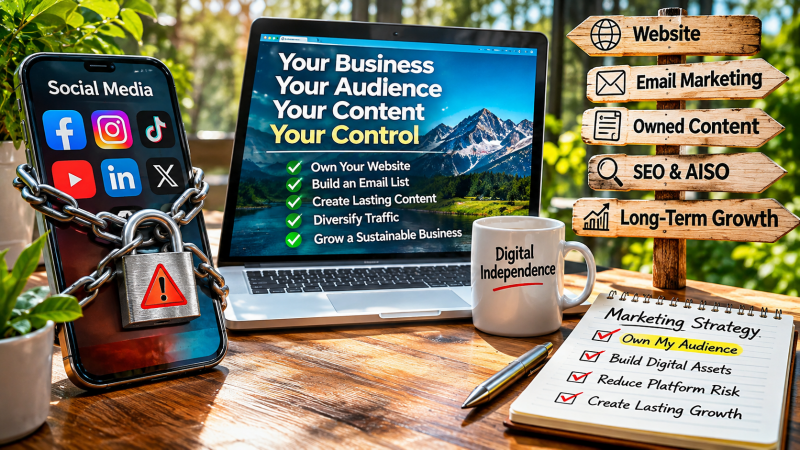
Your business might have 10,000 followers, 50,000 followers, or even 100,000 followers. But how many of those relationships do you actually own?
Imagine spending five years building a business’s social media presence. You publish consistently, create valuable content, engage with customers, run promotions, invest in advertising, and gradually build an audience of thousands of people.
Your following grows. Engagement improves. People recognize your brand. Customers begin discovering your business through your content.
Then, seemingly overnight, something changes.
An algorithm update cuts your organic reach in half. Your account gets temporarily restricted. A platform changes its policies. Your business page becomes inaccessible. Perhaps the platform simply falls out of favor with your target audience.
Suddenly, the audience you spent years building is no longer as accessible as it once was.
You haven’t necessarily lost your business. You haven’t lost your products, services, experience, or ability to serve customers.
But you’ve lost something incredibly valuable: reliable access to the digital audience you’ve spent years cultivating.
And that’s the problem.
We have entered an era in which businesses are investing enormous amounts of time, money, and creative energy into building audiences on platforms they don’t control, using distribution systems they don’t understand, under rules they have absolutely no authority to establish.
It’s a growing content ownership crisis, and I believe far too many business owners haven’t fully recognized what it means for their long-term growth.
Here’s something every business owner should understand:
Having followers is not the same thing as owning an audience.
And confusing those two things could become one of the most expensive marketing mistakes your business ever makes.
The Difference Between Owning Your Content and Owning Your Audience
Let’s start by clearing up an important misconception.
When we talk about content ownership, we’re not necessarily talking about whether a social media platform legally owns the photographs, videos, articles, or graphics you publish.
In many cases, you retain ownership of your original intellectual property.
For example, Meta has explained that users retain intellectual property rights to the content they share while granting the company permission to use that content under its terms.
TikTok’s current U.S. Terms of Service, updated July 15, 2026, similarly state that users generally retain ownership of their content while granting TikTok a broad license to use, distribute, reproduce, and adapt it for specified purposes.
LinkedIn’s User Agreement also recognizes that users own their original content while granting LinkedIn a worldwide, transferable, sublicensable license to use it.
These distinctions matter. Publishing something on a platform doesn’t automatically mean surrendering copyright ownership.
But copyright ownership and audience ownership are two entirely different conversations.
You might own every photograph you’ve published, every article you’ve written, and every video you’ve produced.
You don’t necessarily own the distribution channel connecting that content to your followers.
You don’t control the platform’s recommendation algorithm.
You don’t determine which posts appear in someone’s feed.
You don’t control the platform’s advertising policies, account enforcement decisions, or product development priorities.
And you generally cannot download a complete, usable list of your followers’ personal contact information and take those relationships wherever you want.
That’s the distinction businesses need to understand.
You can own the content without owning the relationship through which people discover it.
The content may belong to you, but the audience relationship is mediated by someone else’s platform.
That’s where the real vulnerability begins.
Social Media Is Rented Digital Real Estate
Think about it this way.
Imagine opening a retail store inside a shopping mall.
You invest in renovations, hire employees, build your customer base, create signage, and spend years establishing your reputation.
Business is good. Customers know where to find you.
But the shopping mall owns the property.
The management company determines the operating rules, controls access, establishes lease terms, and decides what happens if your agreement changes.
You own your business. You own your merchandise. You own your brand.
But you don’t own the building.
Social media works remarkably similarly.
Your Facebook page, Instagram account, TikTok profile, and LinkedIn company page are essentially storefronts on someone else’s digital property.
They are incredibly valuable storefronts. They offer access to enormous audiences and provide opportunities that would have been almost unimaginable to small businesses a generation ago.
But they are still rented space.
The platforms can change the rules. They can change the way content is distributed. They can introduce new restrictions, modify their business models, or discontinue features.
And businesses have very little control over those decisions.
This isn’t an argument against social media. Quite the opposite.
Social media remains one of the most powerful tools available to businesses.
The problem is treating a rented distribution channel as though it were a permanent business asset.
There’s a considerable difference between using social media to attract customers and making social media the foundation upon which your entire customer acquisition strategy depends.
One is a marketing strategy.
The other is a business risk.
The Algorithm Problem: Your Followers Aren’t Guaranteed to See Your Content
One of the biggest misconceptions in digital marketing is that having a large following guarantees consistent visibility.
It doesn’t.
A follower is not a guaranteed impression. An impression isn’t guaranteed engagement. Engagement isn’t guaranteed website traffic. And website traffic isn’t necessarily a customer.
Social media platforms use recommendation systems and algorithms to determine what users see, when they see it, and how frequently they encounter particular accounts.
Those systems are constantly evolving.
The result is that your ability to reach your own followers is influenced by decisions made outside your business.
Consider the scale of the opportunity we’re discussing.
According to Pew Research Center’s 2026 social media fact sheet, approximately 70% of American adults use Facebook, 51% use Instagram, 37% use TikTok, and 84% use YouTube.
These are enormous audiences.
But the same research demonstrates something else: platform usage varies considerably depending on age, education, income, and other demographic characteristics.
Your ideal customer isn’t necessarily using every platform, and even when they are, that doesn’t mean they’ll see your content.
This is why a social media following should never be treated as a direct measurement of your actual customer base.
You might have 20,000 followers and struggle to generate consistent website traffic.
Meanwhile, a competitor with 2,000 followers might have a well-developed email list, strong organic search visibility, and a website that consistently generates qualified leads.
Which business has the more sustainable marketing infrastructure?
The answer should be obvious.
The competitor has built something that extends beyond the reach of a single algorithm.
And that’s the direction more businesses need to move.
The Platform Can Change. Your Business Still Has to Survive.
Here’s another problem with depending too heavily on social media.
Platforms don’t make decisions based exclusively on what’s best for your business.
They make decisions based on their own business models, priorities, users, advertisers, regulatory environments, and competitive pressures.
That shouldn’t surprise anyone. These are private companies operating their own products.
Their responsibility isn’t to guarantee your business a particular amount of organic reach.
Consider how much the social media environment has changed over the years.
Facebook has evolved from a relatively chronological social network into a recommendation-driven platform.
Instagram has shifted substantially toward video and recommended content.
TikTok helped popularize an entirely different discovery model built around personalized content recommendations.
LinkedIn has continually developed its professional networking and content distribution experience.
Each platform has its own priorities, and those priorities can change.
Businesses must adapt.
But there’s a difference between adapting your marketing strategy to changing technology and allowing changes to someone else’s technology to determine whether your business can reach its customers.
If your entire customer acquisition strategy depends on a particular platform maintaining the same distribution model, you’re placing an extraordinary amount of trust in a company whose priorities may change tomorrow.
That’s not diversification.
That’s dependency.
The Website: The Digital Asset Every Business Should Be Building
If social media is rented property, your website is much closer to owning your own building.
You control the domain, the design, the structure, the messaging, the user experience, and the content you publish.
You determine how your services are presented, how customers contact you, where your calls to action appear, and how visitors move through the customer journey.
More importantly, your website can become the central destination connecting all your other marketing channels.
Think about what happens when someone discovers your business through a Facebook post.
They become interested.
They click through to your website.
They read an article, explore your services, look at your portfolio, and perhaps subscribe to your newsletter.
Now you’ve accomplished something important.
You’ve moved that person from a third-party platform into an environment where you have considerably more control over the relationship.
Your website isn’t simply an online brochure.
It’s your digital headquarters.
It’s where your brand identity, original content, products, services, customer information, and conversion opportunities can come together.
And unlike a social media post that might disappear from someone’s feed within hours, a well-developed website article can continue attracting visitors long after its original publication date.
That’s the difference between creating content for temporary visibility and building content as a long-term business asset.
Your Website Is Also an Investment in Organic Search
One of the most overlooked benefits of owning your website is the opportunity to build long-term organic search visibility.
When someone searches Google for a product, service, question, or solution, your website has an opportunity to appear in those results.
You aren’t waiting for someone to happen to encounter your latest social media post.
You’re positioning your business to be discovered when someone is actively looking for something you offer.
Google’s own Search Central documentation emphasizes the importance of original, useful, reliable, people-first content.
It specifically recommends creating content that is helpful, unique, well-organized, and maintained over time.
Google also makes clear that no particular ranking or indexing outcome is guaranteed.
That’s an important distinction.
Building a website doesn’t automatically generate traffic. Publishing 100 articles doesn’t guarantee search rankings.
But developing a useful, authoritative website creates an asset that can accumulate search visibility, establish credibility, and generate opportunities over time.
And that asset remains part of your business infrastructure.
You can optimize it, update it, expand it, restructure it, and improve it without having to ask a social media platform for permission to change its distribution algorithm.
Email Marketing: The Audience You Can Actually Take With You
If there’s one digital marketing asset I believe more small businesses should prioritize, it’s an email subscriber list.
Not because email is new or particularly exciting.
Quite the opposite.
Email has been around for decades, and that’s precisely part of its strength.
It’s a direct communication channel that doesn’t require your customers to discover a post in a social media feed before receiving your message.
When someone voluntarily subscribes to your newsletter, they provide you with a direct way to communicate with them.
You can share updates, announce new products, promote services, distribute educational resources, introduce special offers, and maintain relationships with people who have already expressed interest in your business.
You also have the ability to export your subscriber information and move between email marketing providers, subject to applicable privacy laws and consent requirements.
That’s a significant advantage.
Your email list isn’t dependent on a particular social media platform maintaining your organic reach.
Of course, email isn’t completely immune to outside forces.
Internet service providers control inbox delivery. Spam filters exist. Email platforms have their own terms and pricing structures. People unsubscribe.
But the fundamental relationship is different.
You have a direct communication channel and a portable list of subscribers who have given you permission to contact them.
Consider some of the available industry data.
Mailchimp publishes email marketing benchmarks based on activity across its platform. Its reported all-industry averages include approximately 35.63% open rates and 2.62% click rates.
These numbers shouldn’t be treated as universal performance guarantees. Open-rate measurements can be distorted by automated activity and privacy features such as Apple’s Mail Privacy Protection.
However, they demonstrate that email remains a measurable marketing channel with opportunities for businesses to develop meaningful customer engagement.
More importantly, email gives you another way to reach people without depending exclusively on social media distribution.
Imagine having 5,000 people on an appropriately permission-based email list.
You publish an important announcement.
Rather than hoping an algorithm distributes your announcement to a meaningful percentage of your followers, you can send it directly to those subscribers.
That’s a fundamentally different relationship with your audience.
Stop thinking about email subscribers as another marketing metric. Start thinking about them as relationships your business has permission to maintain.
Content Is an Asset. Stop Treating It Like Disposable Social Media Material.
Here’s where I think businesses have an enormous opportunity.
Every time you publish something valuable, you’re creating intellectual property that can potentially serve your business in multiple ways.
An educational article can become a newsletter.
A newsletter can become a series of social media posts.
A social media discussion can inspire another article.
A customer question can become a comprehensive website resource.
A video can become a written guide.
One original piece of research can become an entire content campaign.
Yet many businesses approach content creation backward.
They spend hours creating individual social media posts without developing a central library of original material.
They publish something, receive a little engagement, and move on to the next post.
Then they repeat the process.
The problem is that they’re constantly producing new material without necessarily building anything that compounds in value.
Instead, businesses should be developing what I call a content asset strategy.
The idea is straightforward:
Create original, valuable content on platforms you control first. Then distribute and repurpose that content across the platforms where your audience spends time.
For example, imagine a local home services company publishes an in-depth article explaining how homeowners can identify common roofing problems.
That article lives permanently on the company’s website.
From there, the business can create:
- A Facebook post highlighting three warning signs.
- An Instagram carousel explaining the most common problems.
- A short TikTok video demonstrating what homeowners should look for.
- A LinkedIn post discussing preventative maintenance.
- An email newsletter linking to the complete guide.
- A YouTube video expanding on the subject.
One original content asset becomes multiple opportunities to reach potential customers.
And every social media channel has a destination to send interested people.
If a particular platform becomes less effective, the original article still exists.
The content hasn’t disappeared.
The business hasn’t lost its investment.
It can continue building on that material.
That’s a much smarter approach to content marketing.
The Emerging AISO Opportunity: Owning Your Visibility in an AI-Driven Internet
There’s another reason this conversation is becoming increasingly important.
The way people discover businesses is changing.
Traditional search engines remain important, but consumers are increasingly interacting with artificial intelligence tools to research products, compare services, ask questions, and identify potential solutions.
Instead of searching only for a business name or a particular service, someone might ask an AI assistant:
“Who are the most reputable home service companies in my area?”
Or:
“What’s the best way to find an affordable digital marketing consultant for a small business?”
Or:
“What should I look for when choosing a local contractor?”
These changes create new opportunities for businesses that have invested in original, authoritative, well-structured digital content.
This is where Answer Engine Optimization (AEO) and AI Search Optimization (AISO) enter the conversation.
The goal is to make your business and its expertise easier for search engines and AI-powered discovery systems to understand, evaluate, and potentially reference.
Your website becomes an important foundation.
Your original articles establish topical expertise.
Your service pages communicate exactly what you offer.
Your business information establishes consistency.
Your educational resources answer the questions potential customers are asking.
And your broader digital presence helps establish credibility.
There are no guarantees that publishing an article will make an AI assistant recommend your business. AI discovery systems are complex, and their selection processes vary.
But one thing is clear: businesses that neglect their own websites and original digital content are missing an important opportunity to establish a durable online presence.
You cannot build a meaningful long-term AISO strategy around social media posts alone.
You need a substantial digital footprint that communicates who you are, what you do, whom you serve, and why your expertise matters.
And you need to own as much of that foundation as possible.
The Real Cost of Not Owning Your Audience
Let’s put this into perspective.
Imagine two competing businesses.
Both have been operating for five years.
Both have invested time and money in digital marketing.
Both have 10,000 social media followers.
But their strategies are very different.
Business A: The Social Media Dependent Business
- 10,000 social media followers.
- No meaningful email subscriber list.
- An outdated website with limited content.
- Almost all customer inquiries originate from social media.
- No consistent organic search strategy.
- No centralized library of original educational content.
Business B: The Owned-Audience Business
- 10,000 social media followers.
- 2,500 permission-based email subscribers.
- A professionally maintained website.
- A library of original educational articles.
- Consistent organic search optimization.
- Multiple channels generating website traffic and customer inquiries.
- A customer database managed through appropriate systems and permissions.
Now imagine both businesses experience a significant decline in organic social media reach.
Business A has a serious problem.
Its primary customer acquisition channel has become less effective, and it has few alternative ways to communicate with its audience.
Business B also experiences a decline, but its entire marketing operation doesn’t collapse.
It still has its website, email subscribers, search visibility, customer relationships, and original content.
It can continue communicating, attracting visitors, generating leads, and adapting its strategy.
Neither business is completely immune to disruption.
But one has built a much more resilient marketing infrastructure.
And that resilience has real economic value.
The difference isn’t necessarily how many followers they have.
It’s how much of their business they can continue operating independently of those followers.
How Businesses Can Start Reclaiming Their Digital Independence
So what should business owners actually do?
I’m not suggesting you abandon Facebook, Instagram, TikTok, LinkedIn, YouTube, or any other platform.
That would be a mistake.
These platforms provide extraordinary opportunities for brand awareness, community engagement, customer acquisition, and business development.
The goal isn’t to stop participating.
It’s to stop depending on them exclusively.
Here are seven practical steps businesses can start implementing immediately.
1. Establish Your Own Website as Your Digital Headquarters
If you don’t have a website, make that a priority.
If you already have one, start treating it as a central business asset rather than an online business card.
Make sure your website clearly communicates your services, provides useful information, establishes credibility, and gives visitors a reason to take action.
You should also have access to your domain registration, hosting arrangements, website content, analytics, and administrative credentials.
Don’t allow a single outside vendor to become the only person with control over your digital infrastructure.
2. Start Building an Email Subscriber List
Give people a compelling reason to subscribe.
That might be an educational newsletter, an industry update, a downloadable resource, exclusive information, or helpful advice.
Make subscribing easy.
Make unsubscribing easy, too.
Use proper consent practices and comply with applicable email marketing requirements.
Most importantly, communicate consistently and provide actual value.
A neglected email list isn’t particularly useful.
A well-maintained subscriber relationship can become one of your most valuable marketing assets.
3. Publish Original Content on Your Website
Stop allowing your entire content strategy to revolve around the next social media post.
Start publishing educational articles that answer real customer questions.
Create resources that demonstrate your knowledge and experience.
Explain common problems, discuss solutions, provide practical guidance, and address misconceptions within your industry.
Think about the questions customers ask before making a purchasing decision.
Those questions are opportunities to create valuable content.
Over time, your website can become a resource library that attracts visitors and establishes your business as a credible source of information.
4. Repurpose Your Content Across Multiple Platforms
You don’t need to create entirely different content for every platform.
Develop one strong original piece and adapt it for different audiences and formats.
Turn articles into short videos.
Turn videos into articles.
Turn articles into email newsletters.
Turn frequently asked questions into social media carousels.
The important distinction is that your website or another platform you control should serve as the central home for your original material.
Social media should help distribute it.
5. Diversify Your Traffic Sources
Don’t depend exclusively on Facebook.
Develop a broader strategy that includes:
- Organic Google search.
- AI-powered search and discovery.
- Email marketing.
- YouTube.
- Relevant social media platforms.
- Local business directories.
- Referral partnerships.
- Direct website traffic.
- Customer recommendations.
You don’t need to master every channel simultaneously.
Start with the channels most relevant to your customers.
The objective is to ensure that one algorithm change doesn’t determine whether your business can generate new opportunities.
6. Back Up Your Digital Assets
This is something I wish more businesses took seriously.
Maintain copies of your original articles, photographs, videos, graphics, marketing materials, and other important content.
Export your email subscriber information periodically.
Keep copies of your website content and maintain appropriate backups.
Secure your domain registrar, hosting account, website administration, and social media accounts with strong passwords and multifactor authentication.
Maintain an accurate record of who has administrative access to your digital properties.
You should never discover that your entire digital presence is inaccessible because one employee left, one contractor disappeared, or one account was compromised.
Digital asset management is part of business continuity planning.
7. Measure What Actually Matters
Stop evaluating your marketing strategy exclusively by follower counts and likes.
Those numbers can be useful, but they don’t necessarily tell you whether your business is growing.
Start measuring:
- Website visitors.
- Organic search traffic.
- Email subscriber growth.
- Qualified leads.
- Conversion rates.
- Customer acquisition costs.
- Returning visitors.
- Referral traffic.
- Revenue generated by individual marketing channels.
A business with 1,000 highly engaged potential customers can be considerably more successful than one with 50,000 followers who never become customers.
The objective isn’t to accumulate the largest possible audience.
It’s to develop meaningful relationships with people who are interested in what you offer.
Social Media Isn’t the Enemy. Dependency Is.
I want to be clear about something.
Social media is not going away.
It’s not suddenly becoming irrelevant, and I certainly wouldn’t recommend that businesses abandon the platforms where their customers spend their time.
In fact, Pew Research Center’s 2026 data demonstrates just how deeply social media is embedded in American life.
These platforms provide opportunities for businesses to connect with customers, build communities, establish credibility, and introduce their products and services to people who might never otherwise discover them.
That’s incredibly valuable.
But businesses need to understand the difference between using a platform and depending on it.
Use Facebook to introduce people to your business.
Use Instagram to showcase your work.
Use TikTok to educate and entertain.
Use LinkedIn to establish professional credibility.
Use YouTube to demonstrate your expertise.
But give those people somewhere meaningful to go.
Give them a website worth visiting.
Give them an opportunity to subscribe to your newsletter.
Give them resources worth bookmarking.
Give them a reason to establish a relationship with your business beyond simply following another social media account.
And most importantly, make sure the valuable content you’re creating contributes to something your business actually controls.
The Future Belongs to Businesses That Build Digital Assets, Not Just Digital Followings
There’s a broader lesson here that extends well beyond social media marketing.
Businesses that prioritize long-term sustainability understand that growth isn’t simply about generating attention.
It’s about building assets.
A customer database is an asset.
A permission-based email list is an asset.
A well-developed website is an asset.
An established organic search presence is an asset.
An extensive library of original educational content is an asset.
A recognizable brand with a reputation for delivering value is an asset.
These things take time to develop.
They require consistency, planning, and an investment of resources.
But they can continue generating value long after the initial investment.
Social media followers are valuable, too. However, the relationship is fundamentally different when another company controls the environment through which you reach them.
And that’s why I believe the next phase of digital marketing will increasingly reward businesses that understand the importance of owning their digital infrastructure.
The businesses that succeed won’t necessarily be the ones publishing the most frequently or accumulating the largest follower counts.
They’ll be the ones that understand how to turn attention into relationships, relationships into customers, and content into long-term business assets.
Because at the end of the day, you aren’t building a business to make a social media platform more successful.
You’re building a business to serve customers, create opportunities, generate revenue, and establish something that lasts.
Don’t build your entire business on digital property you don’t own.
Build your audience on social media. Build your relationships through direct communication. Build your authority through original content. And build your business on a digital foundation you control.
Your followers might belong to a platform’s ecosystem.
Your customers, your reputation, your original content, and your future shouldn’t be dependent on it.
That’s not just a better marketing strategy.
It’s a smarter way to build a business.
A Final Thought
If there’s one thing I’d encourage every small business owner to do after reading this, it’s take an honest look at their current digital marketing infrastructure.
Ask yourself one simple question:
If every social media platform disappeared tomorrow, how would people find your business?
If you don’t have a particularly good answer, you have some work to do.
And the best time to start building that foundation isn’t after something goes wrong.
It’s right now.
Stephen Despin is a digital marketing and strategy consultant specializing in digital growth, SEO, GEO, AI Search Optimization (AISO), content marketing, and business development. Through Stephen Despin Consulting, he helps businesses develop smarter marketing strategies, strengthen their digital presence, and build sustainable opportunities for growth.
Add comment
Comments