

Let’s talk about something that doesn’t get nearly enough attention in digital marketing.
You’re investing in your website. You’re publishing content, posting on social media, improving your search engine rankings, and perhaps even spending money on advertising. People are finding your business. Your website traffic is growing, and your social media posts are generating attention.
On the surface, everything looks pretty good.
But there’s a problem.
Your website visitors aren’t turning into paying customers at the rate you’d hoped. People visit your website, look around, and leave. Others might fill out a form, download a resource, or express interest in your services, only to disappear before making a purchase.
Meanwhile, you’re left wondering whether you need more traffic, a bigger advertising budget, or an entirely different marketing strategy.
Here’s what I’ve learned about digital marketing: Getting people to your website is only half the job. What happens after they arrive is what determines whether that attention translates into revenue.
I’ve always believed that effective marketing should accomplish more than generating impressive-looking numbers. It should help businesses build relationships, solve problems, attract qualified prospects, and generate measurable results.
That requires a strategy that connects the dots between attracting attention and earning a customer’s business.
This is where the marketing funnel comes in.
A well-designed marketing funnel gives potential customers a clear path from discovering your business to understanding your value, trusting your expertise, and ultimately deciding to buy from you.
More importantly, it helps you identify where that journey breaks down so you can fix the problem instead of throwing more money at advertising and hoping for the best.
Let’s explore how to build a practical marketing funnel that turns website visitors into paying customers, even if you’re running a small business without a massive marketing budget.
Understanding the Marketing Funnel: From Awareness to Purchase
Before we start improving conversions, let’s establish what a marketing funnel actually does.
A marketing funnel is the process through which potential customers move as they discover your business, evaluate your products or services, and decide whether to buy.
It’s called a funnel because businesses typically attract a larger audience at the beginning than the number of people who eventually become customers.
Imagine that 1,000 people visit your website this month.
Some discover your business through Google. Others click a social media post, follow a link in an email, or arrive through a paid advertisement.
Of those 1,000 visitors, perhaps 100 express interest by requesting information or downloading a useful resource. Twenty schedule consultations, and five ultimately become paying customers.
Those numbers are purely illustrative, not industry benchmarks. Your actual results will depend on your audience, industry, pricing, offer, and sales process.
But the example illustrates an important principle: Every stage of the customer journey influences the results you ultimately achieve.
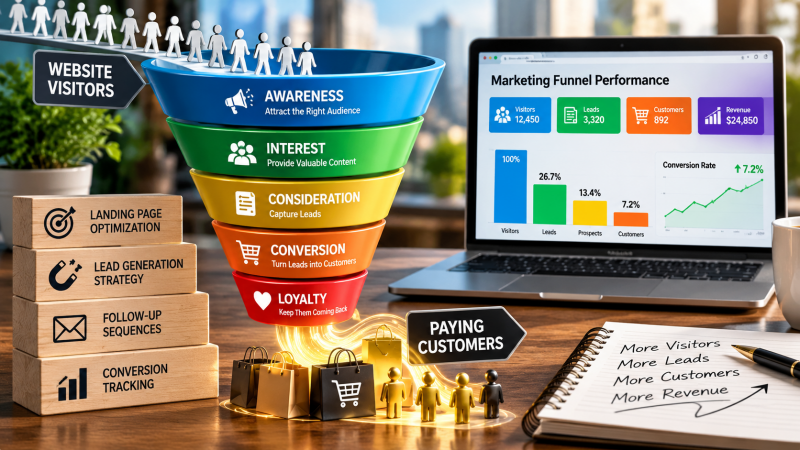
A practical marketing funnel typically includes five stages.
Stage One: Awareness
At this stage, potential customers discover your business.
They might find an article through a Google search, see one of your social media posts, click an advertisement, or hear about you from someone they trust.
They may not know much about your business yet. They might not even realize that the problem they’re experiencing has a solution.
Your objective isn’t necessarily to make an immediate sale.
It’s to attract the right audience, demonstrate relevance, and give people a reason to learn more.
For example, a local landscaping company might publish an article explaining how homeowners can reduce lawn maintenance costs. Someone searching for ways to simplify yard maintenance discovers the article and becomes aware of the company.
The content provides immediate value while introducing the business to a potential customer.
What to measure: Relevant website traffic, traffic sources, engaged sessions, and visits to important service or product pages.
Stage Two: Interest and Consideration
Now the visitor has discovered your business and wants to learn more.
They might explore your services, read customer testimonials, review your pricing, or compare your business with competitors.
This is where your website needs to do more than look attractive.
It needs to answer questions, demonstrate credibility, explain your value, and help visitors understand why your solution deserves consideration.
For our landscaping company, this might mean showcasing completed projects, explaining service packages, publishing customer reviews, and answering common questions about maintenance costs.
The visitor is no longer simply discovering a business. They’re evaluating whether that business can solve their problem.
What to measure: Service-page visits, pricing-page visits, return visits, clicks on important calls to action, and requests for additional information.
Stage Three: Lead Generation
Not everyone who visits your website is ready to purchase immediately.
Some people need more information. Others are researching their options, comparing prices, or waiting until the timing is right.
If you give those visitors no reason to stay connected, many will leave without providing any way for you to follow up.
That’s where lead generation becomes important.
You offer something useful in exchange for permission to continue the conversation.
It could be a downloadable guide, a checklist, a consultation, a quote, or a newsletter that provides genuinely valuable information.
The goal is to turn an anonymous visitor into an identifiable prospect who has chosen to hear from your business.
What to measure: Form submissions, qualified leads, lead conversion rate, and cost per lead.
Stage Four: Lead Nurturing and Conversion
Once someone expresses interest, your job isn’t finished.
In many cases, it’s only beginning.
Potential customers need reasons to trust you. They may have questions about pricing, concerns about implementation, or doubts about whether your solution is right for them.
A thoughtful follow-up process helps answer those questions.
This might involve educational emails, personalized recommendations, consultation calls, case studies, product demonstrations, or responses to common objections.
For our landscaping company, a follow-up email might explain how its maintenance plans save homeowners time, followed by examples of completed projects and an invitation to request a customized estimate.
Each interaction helps the prospect make a more informed decision.
What to measure: Lead-to-opportunity conversion rate, consultation bookings, qualified opportunities, sales acceptance rate, and lead-to-customer conversion rate.
Stage Five: Purchase and Retention
The prospect becomes a paying customer.
That’s the outcome we’ve been working toward, but there’s still an opportunity to create additional value.
A smooth onboarding experience, reliable service, helpful communication, and thoughtful follow-up can encourage repeat purchases, referrals, and long-term customer relationships.
For a service business, that might mean checking in after completing a project, offering a relevant maintenance package, or asking a satisfied customer for an honest review.
For an online retailer, it could mean providing useful product guidance and recommending complementary products when appropriate.
What to measure: Customer acquisition cost, purchase conversion rate, average order value, repeat purchase rate, customer retention, and customer lifetime value.
Here’s the big takeaway: A marketing funnel isn’t simply a series of web pages or automated emails.
It’s a connected customer journey designed to help the right people move from initial interest to a confident purchasing decision.
And when one stage doesn’t work properly, the entire process can suffer.
That’s why we need to examine what happens between those stages.
Find the Leaks Before You Spend Another Dollar on Marketing
Imagine filling a bucket with water while several holes allow it to drain.
You could increase the amount of water you’re pouring into the bucket, but you’d still be losing water through those holes.
Marketing works the same way.
If your website attracts plenty of visitors but very few become leads, increasing traffic may simply increase the number of people who leave without taking action.
Before investing more money in advertising or producing additional content, identify where your existing marketing funnel is losing potential customers.
Start With Your Website Analytics
One of the most useful tools for this job is Google Analytics 4.
Its Funnel Exploration reports allow you to examine the steps users take toward completing a goal and identify where the journey breaks down.
You can define funnel steps, compare audience segments, and investigate differences between devices and traffic sources.
Google provides instructions for setting up these reports in its official Funnel Exploration documentation.
Start by mapping the journey you want visitors to complete.
For example:
- A visitor arrives on your website.
- The visitor views a service page.
- The visitor clicks a consultation button.
- The visitor begins completing a contact form.
- The visitor submits the form.
- The business qualifies the lead.
- The lead becomes a paying customer.
Your funnel might have fewer or additional steps depending on your business model.
The important thing is to measure meaningful actions rather than tracking every available event simply because you can.
Once you establish your funnel, look for the biggest points of friction.
Are visitors arriving but leaving before viewing your services?
Are they viewing your pricing page but rarely requesting a quote?
Are they starting your contact form but failing to submit it?
Are leads coming in but never turning into customers?
Each problem requires a different solution.
Diagnose the Problem at the Right Stage
Let’s look at a few common scenarios.
Problem: High website traffic, few leads.
Your content or advertising might be attracting the wrong audience. Alternatively, your landing pages may not clearly communicate your value, or your calls to action may be difficult to find.
Potential solution: Review your traffic sources, search intent, landing page messaging, and conversion opportunities.
Problem: Plenty of service-page visits, few inquiries.
Visitors may understand what you offer but lack sufficient information to feel comfortable taking the next step.
Your pricing might be unclear. Your website might lack relevant testimonials. Your contact process might seem intimidating.
Potential solution: Improve your service descriptions, address common objections, make your next step obvious, and demonstrate credibility.
Problem: Plenty of leads, few sales.
The issue might be lead quality, slow follow-up, poor qualification, pricing, or a disconnect between what your marketing promises and what your sales process delivers.
Potential solution: Review lead sources, response times, sales conversations, follow-up consistency, and the reasons prospects decline.
Problem: Customers abandon the checkout process.
Your checkout might introduce unexpected costs, require unnecessary steps, or fail to communicate payment and delivery information clearly.
Research from the Baymard Institute has consistently identified checkout friction as a significant ecommerce problem. Its research reports an average cart abandonment rate of approximately 70%, although the precise figure varies by the studies included and the calculation method. (Baymard Institute)
That doesn’t mean every abandoned cart can be recovered. Some shoppers are browsing or comparing options rather than preparing to buy.
However, it does mean that businesses should examine the purchasing experience instead of assuming every abandoned cart reflects a lack of demand.
Look Beyond the Numbers
Analytics can tell you where people are leaving. They don’t always tell you why.
To understand the underlying problem, combine quantitative data with direct customer feedback.
Ask recent customers what convinced them to buy. Ask prospects who didn’t purchase what held them back. Review the questions people ask during sales calls.
Watch how real users navigate your website. Test your contact forms on a mobile phone. Read the messages visitors send when they cannot find information.
Sometimes, the most valuable marketing insight comes from asking a simple question:
What almost stopped you from becoming a customer?
Their answers may reveal problems you would never discover by looking at traffic reports alone.
Build Landing Pages That Give Visitors a Reason to Act
Your website homepage isn’t necessarily the best destination for every visitor.
Think about it.
Someone clicking an advertisement for a specific service has already demonstrated interest in that service. Sending that person to a generic homepage and expecting them to find the right information creates unnecessary work.
A dedicated landing page can provide a more direct path.
A landing page is designed around a particular audience, offer, or action. Instead of trying to explain everything your business does, it focuses on helping the visitor take one meaningful next step.
That next step might be requesting a quote, booking a consultation, downloading a guide, or purchasing a product.
Give Every Landing Page One Clear Purpose
Imagine you’re a digital marketing consultant offering free website audits.
A visitor clicks an advertisement promising to identify opportunities to improve their website’s performance.
They arrive on your landing page and immediately see a headline explaining the offer, a short description of what the audit includes, and a button to request it.
The page answers three essential questions:
- What are you offering?
- Why should the visitor care?
- What should the visitor do next?
Now imagine an alternative.
The visitor lands on your homepage, which contains several navigation menus, multiple service descriptions, links to your newsletter, social media accounts, blog articles, and a general contact page.
Nothing is necessarily wrong with the homepage. But the visitor must work harder to find the offer that originally interested them.
That additional friction can reduce the likelihood of conversion.
The lesson is simple: Match the landing page to the promise that brought the visitor there.
If your advertisement promises a free estimate, the landing page should prominently explain how to obtain that estimate. If your article offers a downloadable checklist, the next step should make that checklist easy to access.
The Essential Elements of a High-Converting Landing Page
A strong landing page doesn’t need elaborate animations or expensive design features.
It needs to communicate value clearly and make taking action feel straightforward.
Here are the elements I recommend prioritizing.
1. A specific, benefit-driven headline.
Your headline should communicate the primary value of your offer.
Instead of saying, “Welcome to Our Marketing Agency,” consider something more specific:
“Discover What’s Preventing Your Website From Generating More Leads.”
The second headline gives visitors a reason to continue reading because it addresses a recognizable business problem.
2. A clear explanation of the offer.
Tell visitors exactly what they’ll receive.
If you’re offering a consultation, explain what you’ll discuss. If you’re offering a downloadable guide, explain what readers will learn. If you’re selling a service, describe the outcome you’re working to achieve.
Avoid vague promises that could apply to almost any business.
3. A compelling call to action.
Your call to action, or CTA, tells visitors what to do next.
Use clear language such as:
- Request Your Free Audit
- Schedule a Consultation
- Get Your Custom Estimate
- Download the Guide
- Start Your Free Trial
The wording should accurately describe what happens when someone clicks.
Avoid making visitors guess whether a button will open a form, initiate a purchase, or take them to another page.
4. Credibility and trust signals.
People want to know whether they can trust the business they’re considering.
Relevant testimonials, authentic customer reviews, case studies, clear contact information, professional credentials, and transparent policies can help establish confidence.
Only use testimonials, credentials, and performance claims you can substantiate.
If you publish a case study, explain the circumstances behind the results rather than presenting an impressive percentage without context.
5. A friction-free experience.
Every unnecessary obstacle creates another opportunity for a visitor to leave.
Keep forms concise. Make the page readable on mobile devices. Ensure buttons work correctly. Explain what happens after submission.
If a visitor requests a quote, tell them whether they’ll receive an email, a phone call, or an online estimate.
Setting expectations makes the next step easier to understand.
Don’t Forget Mobile Visitors
Your landing page might look fantastic on a desktop computer but become difficult to navigate on a smartphone.
That matters because visitors frequently discover businesses while searching on mobile devices.
Check whether your headline is readable without excessive scrolling, whether your buttons are easy to tap, and whether forms are simple to complete using a phone.
Test the entire journey, from clicking the initial advertisement to successfully submitting the form.
A page that looks good but fails during the conversion process isn’t doing its job.
Test Improvements Instead of Guessing
You don’t need to redesign your entire website every time conversion rates disappoint you.
Start with a specific hypothesis.
Perhaps you believe visitors aren’t requesting consultations because your offer is unclear. You might test a more descriptive headline against your current version.
Or perhaps your contact form asks for too much information. You could test a shorter form while monitoring both submission rates and lead quality.
Change one meaningful element at a time when practical, collect enough data to make a reasonable comparison, and avoid declaring a winner based on a handful of conversions.
Remember that more form submissions aren’t automatically better if the additional leads are unqualified.
The objective is to improve the number of valuable actions your website generates, not merely the number of people clicking a button.
Turn Anonymous Visitors Into Leads With Valuable Lead Magnets
Here’s a common problem for businesses.
Someone visits your website, reads an article, learns something useful, and leaves.
You provided value, but the relationship ends there.
Unless that person returns independently, you might never have another opportunity to connect with them.
A lead magnet can help bridge that gap.
A lead magnet is a resource, tool, or offer that encourages a potential customer to provide their contact information in exchange for something useful.
The most effective lead magnets address a specific problem your target audience wants to solve.
They don’t simply exist to collect email addresses. They demonstrate your expertise and give prospects a practical reason to begin a relationship with your business.
What Makes a Good Lead Magnet?
The best lead magnets generally share three characteristics.
They’re relevant. They address a problem experienced by people who are likely to benefit from your products or services.
They’re useful. They provide tangible value rather than offering generic information someone could easily find repeated across dozens of websites.
They’re actionable. They help readers understand a problem, make a decision, or take a meaningful next step.
Consider a few examples.
Lead Magnet Examples That Generate Qualified Leads
The most effective lead magnets solve a specific problem for your target audience while creating a natural connection to your products or services.
| Business Type | Lead Magnet Idea | Potential Business Outcome |
|---|---|---|
| Digital Marketing Consultant | Website Marketing Audit Checklist | Attracts businesses looking to improve online performance. |
| Accountant | Small Business Tax Preparation Checklist | Connects with business owners seeking financial guidance. |
| Home Services Company | Seasonal Home Maintenance Checklist | Builds relationships with homeowners who may need professional services. |
| Business Coach | Business Growth Planning Worksheet | Attracts entrepreneurs looking to improve business performance. |
| Software Company | Industry-Specific Implementation Guide | Educates prospects researching potential solutions. |
| Online Retailer | Product Selection Guide | Helps shoppers choose the right product. |
Marketing tip: Choose a lead magnet that addresses a specific customer problem and naturally connects to a product or service your business provides.
Notice that each example connects the resource to a problem the business can help solve.
That connection is important.
If your lead magnet attracts people who have no interest in your services, you might build a large email list without generating meaningful revenue.
The goal isn’t to collect the most email addresses possible.
The goal is to attract the right people and create a natural bridge between the information they need and the solution your business provides.
Create a Lead Magnet Without Overcomplicating It
You don’t need to produce a 100-page ebook to get started.
In fact, a concise resource that solves one problem can be more useful than a lengthy document that overwhelms the reader.
Start by identifying the questions your customers ask most frequently.
What mistakes do they make before hiring you? What information do they need before making a purchase? What problems could they solve more efficiently with the right guidance?
Turn one of those questions into a practical resource.
For example, a digital marketing consultant could create a checklist titled “10 Things to Check Before Spending Another Dollar on Online Advertising.”
The checklist might help business owners review their landing pages, conversion tracking, calls to action, and lead follow-up processes.
The resource delivers immediate value while demonstrating the consultant’s understanding of digital marketing strategy.
A reader who discovers several weaknesses in their existing marketing might then decide to request professional assistance.
That’s how a lead magnet supports the broader marketing funnel: It helps potential customers recognize a problem and understand how your business might help solve it.
Make the Exchange Feel Worthwhile
If you’re asking someone for their email address, explain what they’ll receive in return.
Use a descriptive headline, provide a concise explanation of the resource, and make the next step obvious.
Keep the form as simple as practical.
For many downloadable resources, an email address may be sufficient. Other offers, such as a customized estimate, may legitimately require a name, phone number, location, or additional details.
Request only the information you need to deliver the offer or support the next step.
Be transparent about how you’ll use the person’s information, and obtain any consent required for your communications.
In the United States, commercial email must comply with applicable requirements under the CAN-SPAM Act. You can review the Federal Trade Commission’s official CAN-SPAM compliance guide.
Most importantly, deliver the promised resource promptly.
Nothing undermines trust faster than requesting someone’s information and then making it difficult to access what they signed up to receive.
Build a Follow-Up Sequence That Turns Interest Into Revenue
Let’s say someone downloads your lead magnet.
What happens next?
For many businesses, the answer is disappointing.
Perhaps the prospect receives a generic confirmation email. Maybe someone eventually sends a sales pitch. Or perhaps nobody follows up at all.
That’s a missed opportunity.
A person who downloads a relevant resource has demonstrated interest in a particular topic. That doesn’t automatically mean they’re ready to purchase, but it gives you a starting point for a useful conversation.
A thoughtful follow-up sequence helps maintain that relationship while giving the prospect more information, addressing concerns, and making the next step easier.
Start With the Immediate Follow-Up
Your first email should arrive promptly after the person requests your resource.
Deliver what you promised.
Thank them for their interest, provide access to the resource, and explain what they can expect next if they have opted into additional communications.
Keep the message focused.
The immediate objective is to fulfill the promise and establish a positive first impression, not to overwhelm a new lead with a lengthy sales pitch.
Follow Up With Useful Education
Your next communication should provide additional value related to the original resource.
If someone downloads a website optimization checklist, your next email might explain three common website problems that prevent businesses from generating leads.
You could then share an example of how addressing one of those problems can improve the customer journey.
The key is to help the prospect understand the issue more clearly.
This is also where your expertise becomes visible.
Rather than simply claiming that your business provides excellent service, demonstrate that you understand the challenges your audience faces.
Address the Questions That Prevent People From Buying
Every business encounters objections.
Customers may worry about cost, timing, complexity, reliability, or whether a particular solution will work for their situation.
Your follow-up content should address those concerns honestly.
For example, a marketing consultant might explain what happens during an initial consultation, what information a client should prepare, and how a marketing audit identifies opportunities for improvement.
A home services company might explain how estimates work, what affects project costs, and what customers should expect during scheduling.
Anticipating common questions makes the purchasing decision easier because prospects no longer need to guess what working with you will involve.
Show Evidence of Your Value
When appropriate, share relevant case studies, customer testimonials, examples of completed work, or explanations of your process.
Specific evidence is more persuasive than unsupported claims.
If you helped a client improve a business outcome, explain the starting situation, the actions taken, and the measurable results when those details can be shared accurately.
Include the context needed to understand the result.
Avoid suggesting that every customer will achieve the same outcome when results depend on factors outside your control.
Your objective is to help prospects evaluate your capabilities, not to promise results you cannot guarantee.
Make the Next Step Easy
Once you’ve provided useful information, invite the prospect to take an appropriate next step.
Depending on the business, that might be scheduling a consultation, requesting a quote, booking a demonstration, or purchasing a product.
A simple call to action could be:
“Ready to identify the biggest opportunities to improve your website? Schedule a consultation and let’s discuss your goals.”
The invitation should feel like a logical continuation of the conversation.
It shouldn’t create unnecessary pressure or imply that someone must purchase before they’re ready.
An Example Five-Email Follow-Up Sequence
Here’s a practical starting point for a service business that offers consultations.
The Five-Email Follow-Up Sequence
Turn new leads into qualified prospects with a strategic email sequence that delivers value, builds trust, addresses objections, and encourages action.
| Timing | Email Purpose | Example Content | Desired Action |
|---|---|---|---|
| Immediately | Deliver the Resource | Send the promised checklist, guide, or downloadable resource. | Access the resource |
| Day 2 | Educate | Explain three common mistakes related to the topic. | Read an educational article |
| Day 4 | Build Trust | Share a relevant case study, customer success story, or explanation of your process. | Explore your services |
| Day 7 | Address Objections | Answer common questions about pricing, timing, implementation, or expected outcomes. | Review the offer |
| Day 10 | Invite Action | Present a clear next step, such as scheduling a consultation or requesting a quote. | Book a consultation |
Marketing Strategy Tip: Treat this schedule as a starting point, not a rigid formula. Adjust the timing, messaging, and frequency to your audience, sales cycle, and offer. Prioritize helpful communication over aggressive selling, and honor subscriber preferences and applicable email marketing requirements.
These intervals are illustrative starting points, not universal rules. The right schedule depends on your industry, sales cycle, audience expectations, and the urgency of the problem you’re solving.
A business selling an inexpensive product might use a shorter sequence. A company selling complex services to other businesses might need a longer educational process.
Some prospects may also be ready to speak with you immediately, so don’t force everyone through the same sequence when their behavior indicates a different need.
Personalize the Follow-Up When It Matters
Not every lead has the same interests or purchasing intentions.
Someone who downloads a beginner’s guide may need educational content. Someone who visits your pricing page several times or requests a consultation may be much closer to making a decision.
Where appropriate, use these signals to tailor follow-up.
For example, you might separate subscribers who are interested in SEO services from those researching paid advertising.
You could also distinguish between prospects who have requested an estimate and people who are simply reading your newsletter.
This helps ensure that your communications remain relevant.
Be careful not to mistake every website interaction for buying intent. A single page visit is not proof that someone is ready to purchase, and your follow-up should respect the preferences and permissions they’ve provided.
Automate the Process Without Making It Feel Automated
Email marketing platforms and customer relationship management systems can automate many routine tasks.
They can deliver resources, schedule educational emails, assign leads, notify sales teams, and record important interactions.
Automation creates consistency, but it doesn’t replace good judgment.
A poorly designed automated sequence can send irrelevant messages, continue promoting a service after someone has purchased it, or overwhelm prospects with unnecessary communication.
Build appropriate safeguards into your workflows.
For example, stop a promotional sequence when someone becomes a customer, suppress messages when a person unsubscribes, and route consultation requests to the appropriate team member.
The purpose of automation is to make good marketing more consistent, not to make impersonal marketing happen faster.
Remove the Obstacles That Stop Customers From Buying
Sometimes, the problem isn’t a lack of interest or an ineffective email sequence.
Sometimes, customers are ready to buy but encounter unnecessary obstacles along the way.
These obstacles can be surprisingly ordinary.
A visitor can’t find your phone number. Your pricing information is vague. Your contact form requests too much information. Your checkout introduces unexpected fees. Or your website makes it difficult to understand what happens after someone submits an inquiry.
Each issue adds friction to the buying process.
And the closer someone gets to making a purchase, the more important it becomes to eliminate avoidable friction.
Be Transparent About Pricing
Not every business needs to publish a complete price list.
Some services require customized estimates, and some projects vary substantially in scope.
However, you can still help prospects understand how pricing works.
Explain what influences the cost, what your packages include, whether consultations are free or paid, and what information is needed to prepare an estimate.
When appropriate, provide starting prices or representative examples.
The objective is to help customers determine whether your offer fits their needs and budget before investing significant time in the sales process.
Make Contacting You Easy
Your website should make it obvious how visitors can take the next step.
If you want people to schedule consultations, provide a straightforward booking process.
If you want them to request quotes, create a clear quote-request form.
If customers prefer calling your business, make your phone number easy to find, particularly on mobile devices.
Don’t assume visitors will navigate through several pages to locate the information they need.
Reduce Unnecessary Form Fields
Every additional form field asks the visitor to invest more time.
Sometimes that information is essential. Often, it isn’t.
Review your forms and remove fields that don’t contribute meaningfully to qualification, service delivery, or the next step in the process.
For example, a basic newsletter signup rarely requires a phone number, company size, job title, and mailing address.
A consultation request might need more information, but the form should still be proportionate to the value being offered.
The right balance is to collect enough information to serve the prospect effectively without creating avoidable barriers.
Make the Buying Process Predictable
Customers want to know what happens after they take action.
If someone requests a quote, explain when they can expect a response.
If someone books a consultation, send confirmation and provide any necessary preparation instructions.
If someone makes a purchase, communicate the next steps clearly.
For ecommerce businesses, show relevant delivery costs, payment options, and return policies before customers reach the final stage of checkout whenever possible.
Baymard Institute’s research has repeatedly identified unexpected costs, delivery concerns, trust issues, and complicated checkout processes among the reasons shoppers abandon purchases. (Baymard Institute)
These findings reinforce an important point: Conversion optimization isn’t just about writing more persuasive headlines.
It’s also about creating an experience that helps customers complete the action they already want to take.
Measure Conversion Rates at Every Stage of the Funnel
Here’s where your marketing funnel becomes more than a useful concept.
When you measure the performance of each stage, you can begin connecting marketing activity to business results.
Instead of asking whether your website is getting enough traffic, you can ask more meaningful questions.
How many visitors become leads?
How many leads become qualified opportunities?
How many opportunities become customers?
How much does it cost to acquire a customer?
And, ultimately, how much revenue does your marketing generate relative to the resources invested?
These questions help you make better decisions about where to focus your time and money.
Start With the Conversion Rate Formula
A basic conversion rate is calculated by dividing the number of successful conversions by the number of relevant opportunities, then multiplying by 100.
Conversion Rate = (Number of Conversions ÷ Number of Opportunities) × 100
The definition of an opportunity depends on the stage you’re measuring.
For example, if 1,000 website visitors produce 40 leads, your visitor-to-lead conversion rate is:
40 ÷ 1,000 × 100 = 4%
If 40 leads produce eight qualified sales opportunities, your lead-to-opportunity conversion rate is:
8 ÷ 40 × 100 = 20%
If those eight opportunities produce two paying customers, your opportunity-to-customer conversion rate is:
2 ÷ 8 × 100 = 25%
In this simplified example, the business generated two customers from 1,000 website visitors.
That represents a visitor-to-customer conversion rate of 0.2%.
These figures are illustrative, not recommended targets. They also assume that the stages are consistently defined and that the leads, opportunities, and customers belong to the same cohort or measurement period.
In a real business, leads may take weeks or months to become customers. For that reason, compare conversion rates carefully and account for the time required for prospects to progress through the sales cycle.
The Metrics Every Business Should Understand
You don’t need to track hundreds of marketing metrics to build a useful funnel.
Start with the measures that help you understand performance and make decisions.
The Essential Marketing Funnel Metrics Every Business Should Track
Measure the performance of your marketing funnel, identify conversion bottlenecks, and understand how effectively your digital marketing strategy turns website visitors into paying customers.
| Marketing Metric | What It Measures | Why It Matters |
|---|---|---|
| Relevant Website Traffic | Visitors arriving from relevant search, social, referral, and advertising sources. | Helps determine whether your marketing attracts the right audience. |
| Visitor-to-Lead Conversion Rate | The percentage of relevant website visitors who become leads. | Reveals how effectively your website generates potential customers. |
| Landing Page Conversion Rate | The percentage of eligible landing-page visitors who complete the desired action. | Helps evaluate landing page messaging, offers, and calls to action. |
| Lead Qualification Rate | The percentage of generated leads that meet your defined qualification criteria. | Shows whether your marketing attracts prospects suited to your products or services. |
| Lead-to-Customer Conversion Rate | The percentage of leads who eventually become paying customers. | Connects lead generation and nurturing efforts to actual sales. |
| Customer Acquisition Cost (CAC) | The acquisition cost incurred for each new customer under your chosen cost model. | Helps evaluate acquisition efficiency and marketing investment. |
| Average Order Value (AOV) | The average revenue generated per order. | Helps ecommerce businesses understand transaction value and opportunities for growth. |
| Customer Lifetime Value (CLV) | The value a customer generates over a defined customer relationship period. | Helps inform customer retention strategies and sustainable acquisition spending. |
| Return on Ad Spend (ROAS) | The revenue attributed to advertising divided by advertising spend. | Helps assess advertising efficiency when attribution and revenue tracking are reliable. |
The Most Important Conversion Formulas
Conversion Rate: (Conversions ÷ Relevant Opportunities) × 100
Customer Acquisition Cost: Total Acquisition Costs ÷ New Customers Acquired
Return on Ad Spend: Attributed Advertising Revenue ÷ Advertising Spend
Marketing strategy tip: Track these metrics consistently and evaluate them together. High website traffic or lead volume does not automatically translate into revenue. Focus on attracting qualified prospects, improving conversions, and acquiring customers at a sustainable cost.
Each metric answers a different question.
A high visitor-to-lead conversion rate may indicate that a landing page is effective. But if those leads rarely become customers, the business may be attracting the wrong audience or failing to nurture prospects effectively.
Likewise, a low lead conversion rate doesn’t automatically mean your landing page is broken. If the page attracts highly qualified prospects for a complex, high-value service, its performance should be evaluated in that context.
The goal isn’t to maximize every metric independently. It’s to improve the performance of the entire customer acquisition process.
Calculate Customer Acquisition Cost
Customer acquisition cost, commonly called CAC, estimates how much a business spends to acquire a customer.
A simplified formula is:
Customer Acquisition Cost = Total Acquisition Costs ÷ Number of New Customers Acquired
Suppose a business spends $3,000 on a marketing campaign and associated acquisition activities during a defined period.
If those activities generate 15 new customers, the simplified acquisition cost is:
$3,000 ÷ 15 = $200 per customer
That figure is useful only if the cost and customer definitions are consistent.
A more comprehensive CAC calculation might include advertising, marketing software, agency fees, relevant staff time, sales expenses, and other acquisition costs.
Decide which expenses belong in the calculation and apply that definition consistently.
Also remember that dividing all marketing expenses by all new customers doesn’t necessarily tell you which individual channel produced the best results. Attribution, sales-cycle timing, and customers who interact with multiple channels complicate the picture.
Nevertheless, understanding your acquisition costs is an important step toward making marketing decisions based on business economics rather than impressions alone.
Measure the Revenue, Not Just the Leads
Let’s return to our hypothetical business.
Imagine it generates 1,000 website visitors, 40 leads, and two paying customers.
Now suppose the business improves its landing page and follow-up process.
Website traffic remains the same, but lead generation increases from 40 to 60. Better qualification and follow-up also help the business convert four of those leads into paying customers.
The business now generates twice as many customers from the same number of visitors.
That illustrates the potential value of improving conversion rates before increasing traffic.
The example is hypothetical, and the results aren’t guaranteed. Actual improvements depend on the underlying problems, the quality of the changes, and the behavior of the target audience.
But the principle is important: You can sometimes generate more revenue from your existing audience by improving the journey between discovery and purchase.
That is why conversion optimization deserves a central place in your marketing strategy.
Build a Practical Marketing Funnel for Your Business
By now, we’ve covered the major components of a marketing funnel.
The next step is turning those concepts into a system your business can actually implement.
You don’t need an expensive technology stack or a dozen automated campaigns to get started.
You need a clear objective, a defined customer journey, useful content, a reliable follow-up process, and a way to measure results.
Here’s how I’d approach building a practical funnel from the ground up.
Step One: Define the Customer You Want to Attract
Start by identifying the people most likely to benefit from your product or service.
What problems are they trying to solve?
What questions do they ask before making a purchase?
What alternatives are they considering?
What objections might prevent them from choosing your business?
You don’t need a complicated customer persona filled with assumptions about your audience’s personality.
Focus on information that affects purchasing decisions.
Review customer conversations, sales records, website search terms, customer feedback, and frequently asked questions.
Use those insights to create marketing that speaks directly to the problems your audience wants to solve.
Step Two: Choose One Primary Conversion Goal
Next, decide what you want visitors to do.
Are you trying to generate consultation bookings? Sell a specific product? Collect qualified quote requests? Encourage prospects to start a free trial?
Choose one primary conversion goal for the funnel you’re building.
You can still provide secondary options where appropriate, but the main objective should be clear.
If you try to make every page promote every service, product, newsletter, and social media account simultaneously, you risk diluting the message and making it harder for visitors to determine what to do next.
Step Three: Create a Relevant Entry Point
Identify how your target audience will discover the offer.
For some businesses, that might be a search-optimized article answering a common customer question.
For others, it could be a social media campaign, a paid advertisement, a referral, or an email newsletter.
Match the entry point to the audience’s intent.
Someone searching for an immediate solution may be ready to review your services. Someone researching a broad topic may benefit more from an educational article or downloadable resource.
Your goal is to attract relevant visitors and give them a logical next step.
Step Four: Build the Conversion Experience
Create a landing page or service page that explains the offer and makes the next action straightforward.
Ensure that the page communicates value, establishes credibility, answers common questions, and works properly on mobile devices.
Connect the page to a functional form, booking system, checkout, or other appropriate conversion mechanism.
Then test the entire process yourself.
Submit the form. Confirm the email arrives. Check that the lead appears in your tracking system. Verify that the next step works as expected.
A funnel isn’t complete simply because all its individual components exist. They need to work together.
Step Five: Create the Follow-Up Process
Decide what happens after someone converts into a lead.
Who receives the inquiry?
How quickly should the business respond?
What information should the prospect receive?
When should the next follow-up occur?
What happens if the prospect doesn’t respond?
What happens if they purchase?
Document the process so it doesn’t depend entirely on someone remembering to follow up.
For a small business, this could be as simple as a confirmation email, a task in a customer relationship management system, and a consistent process for responding to new inquiries.
For a larger business, it might involve segmented email sequences, lead scoring, automated notifications, and sales team workflows.
The right level of complexity depends on the business, not on how many features your marketing software offers.
Step Six: Configure Conversion Tracking
Set up analytics to measure the actions that matter.
Depending on your business model, you might track:
- Relevant landing-page views.
- Lead magnet downloads.
- Form submissions.
- Consultation bookings.
- Qualified leads.
- Completed purchases.
- Revenue associated with those purchases.
Distinguish between actions that indicate interest and outcomes that generate revenue.
For example, clicking a consultation button isn’t the same as completing a booking. Starting checkout isn’t the same as completing a purchase. Submitting a contact form isn’t the same as becoming a paying customer.
Accurate tracking requires clearly defined events and reliable data collection.
Use your analytics platform, CRM, and sales records together where appropriate to understand how prospects move through the funnel.
Step Seven: Improve One Bottleneck at a Time
Once the funnel is running, review its performance regularly.
Identify the stage with the most significant problem relative to your goals.
If visitors aren’t becoming leads, investigate your audience, landing pages, and offers.
If leads aren’t becoming qualified opportunities, examine targeting and qualification.
If qualified opportunities aren’t becoming customers, review pricing, trust, sales conversations, and follow-up.
Then develop a specific hypothesis, make a focused improvement, and measure the results.
Avoid changing everything simultaneously unless an urgent problem requires it. When too many variables change at once, determining which changes influenced the outcome becomes more difficult.
A practical marketing funnel improves through ongoing observation, testing, and refinement.
A Simple Example: Turning a Marketing Consultant’s Website Into a Customer Acquisition System
Let’s bring everything together with a realistic example.
Imagine an independent marketing consultant who helps small businesses improve their websites, search visibility, and lead generation.
The consultant publishes useful articles and attracts 2,000 website visits each month.
Despite that traffic, only a handful of visitors inquire about services.
Instead of immediately spending more on advertising, the consultant examines the existing customer journey.
The analysis reveals three problems:
First, the articles provide useful information but rarely direct readers toward a relevant next step.
Second, the website offers several services without clearly explaining which problems each service solves.
Third, visitors who submit inquiries receive inconsistent follow-up.
The consultant decides to rebuild the funnel around one specific offer: a website marketing audit.
Here’s how the improved process works.
Step One: Attract the right audience.
The consultant publishes articles addressing common website marketing problems, such as ineffective calls to action, poor landing page experiences, and weak lead follow-up.
Each article targets a relevant audience and answers a specific question.
Step Two: Offer a useful resource.
Readers can download a website conversion checklist that helps them identify common issues.
The resource provides immediate value and introduces the consultant’s approach to improving marketing performance.
Step Three: Create a focused landing page.
The landing page explains what the audit covers, who can benefit from it, and how to request one.
It includes a clear call to action, relevant examples of the consultant’s work, and a straightforward contact form.
Step Four: Follow up consistently.
After requesting the resource, subscribers receive helpful educational emails related to website conversion and lead generation.
People who request an audit receive a timely response and a clear explanation of the next steps.
Step Five: Track the results.
The consultant measures how many visitors download the checklist, how many request an audit, how many qualify for services, and how many become paying customers.
The data helps identify which articles attract potential clients and which parts of the process need improvement.
Over time, the consultant can compare performance across traffic sources, content topics, and offers.
Some articles may generate substantial traffic but few qualified leads. Others may attract smaller audiences with stronger purchasing intent.
That distinction matters.
The most valuable article isn’t necessarily the one that attracts the most visitors. It may be the one that consistently attracts the right prospects and contributes to profitable customer relationships.
This is how a collection of marketing activities becomes a coordinated acquisition system.
Instead of publishing content, running advertisements, and sending emails as disconnected activities, the consultant connects each activity to a defined customer journey.
The result is a clearer way to understand what works, what doesn’t, and where future improvements are most likely to create value.
Your First 30 Days: A Practical Marketing Funnel Makeover
If your current marketing funnel needs improvement, you don’t have to rebuild your entire digital presence overnight.
A focused 30-day plan can help you establish a baseline, identify problems, implement improvements, and begin measuring the results.
Here’s a practical framework.
Week One: Audit the Existing Funnel
Start by documenting how customers currently discover and purchase from your business.
Review your analytics, landing pages, contact forms, lead sources, and follow-up procedures.
Identify the steps a prospect takes from their first interaction to becoming a customer.
Look for missing information, broken links, unnecessary form fields, confusing calls to action, and inconsistent follow-up.
Establish baseline measurements wherever reliable data is available.
Your objective this week is to understand the current process before deciding what to change.
Week Two: Improve the Highest-Priority Conversion Point
Choose the problem that appears most likely to be limiting results.
For example, you might discover that visitors reach your service page but rarely request consultations.
Focus on improving that page.
Clarify the offer, strengthen the headline, address common objections, add relevant credibility signals, and make the next step easier to find.
If the problem is an unreliable form or broken booking system, fix that first.
Prioritize practical improvements over cosmetic changes that have no clear connection to customer behavior.
Week Three: Introduce Lead Capture and Follow-Up
Create a relevant lead magnet or improve an existing inquiry process.
Build a focused landing page, connect the form to your email or CRM system, and establish a reliable delivery process.
Then create a short follow-up sequence that provides useful information and introduces an appropriate next step.
Make sure the communication reflects what visitors requested and respects their preferences.
You don’t need dozens of emails. Start with a small sequence you can maintain and improve.
Week Four: Review the Data and Identify the Next Opportunity
Compare the results with your baseline.
Did the landing page generate more qualified leads?
Did form completion improve?
Are new inquiries receiving faster responses?
Are prospects progressing further through the sales process?
Have more visitors become paying customers?
Not every improvement will produce an immediate or statistically conclusive result within 30 days. Some businesses have longer sales cycles, and relatively small sample sizes can make early performance changes difficult to interpret.
That’s okay.
The purpose of the first month is to establish a more reliable process for measuring and improving performance.
At the end of the month, identify what you’ve learned and choose the next bottleneck to address.
Then repeat the process.
Over time, these incremental improvements can help you build a more effective and predictable marketing system.
Stop Chasing Clicks and Start Building a System
Here’s the biggest lesson I want business owners to take away from this discussion.
Your website shouldn’t simply exist to tell people that your business exists.
It should help the right people understand what you offer, why it matters, and how to take the next step.
Your content shouldn’t simply attract attention.
It should help potential customers solve problems, evaluate options, and discover whether your business is the right fit.
And your lead generation efforts shouldn’t end when someone submits a form.
They should connect to a thoughtful follow-up process that builds trust, answers questions, and makes it easier for qualified prospects to become customers.
That’s what a well-designed marketing funnel accomplishes.
It connects your marketing activities to the outcomes that matter most to your business.
Instead of looking at website traffic in isolation, you can understand how visitors become leads. Instead of measuring lead generation alone, you can determine how effectively those leads turn into customers. And instead of continually increasing your marketing budget, you can identify opportunities to improve the performance of the resources you’re already investing.
Of course, no funnel guarantees sales. Your results will still depend on the quality of your offer, the needs of your audience, your pricing, your competition, and your ability to deliver real value.
But a structured approach gives you something far more useful than guesswork: a process for identifying problems, testing improvements, and making informed decisions.
And you don’t have to implement everything at once.
Start by identifying where potential customers are dropping out of your existing buying process. Fix one meaningful problem. Measure the results. Then move to the next opportunity.
That’s how you turn marketing from a collection of disconnected activities into a system designed to generate measurable business growth.
Because at the end of the day, the goal isn’t simply to get more people to click.
It’s to give the right people a compelling reason to take the next step, a trustworthy path toward making a decision, and a clear understanding of why doing business with you is worth their investment.
That’s how clicks become customers.
And that’s how smarter marketing helps build stronger businesses.
Ready to Turn More Website Visitors Into Customers?
At Stephen Despin Consulting, I help businesses develop practical digital marketing strategies that connect website traffic, content marketing, search visibility, lead generation, and conversion optimization to measurable business goals.
If your website is attracting visitors but failing to generate the leads or sales you need, it may be time to take a closer look at what’s happening between the first click and the final conversion.
A focused marketing audit can help identify opportunities to improve your website, strengthen your customer acquisition process, and make better use of your existing marketing investment.
Want to find out what’s holding your marketing back? Let’s talk about building a strategy that turns more of your online attention into real business opportunities.
Visit StephenDespin.net to learn more about my consulting services.
Add comment
Comments