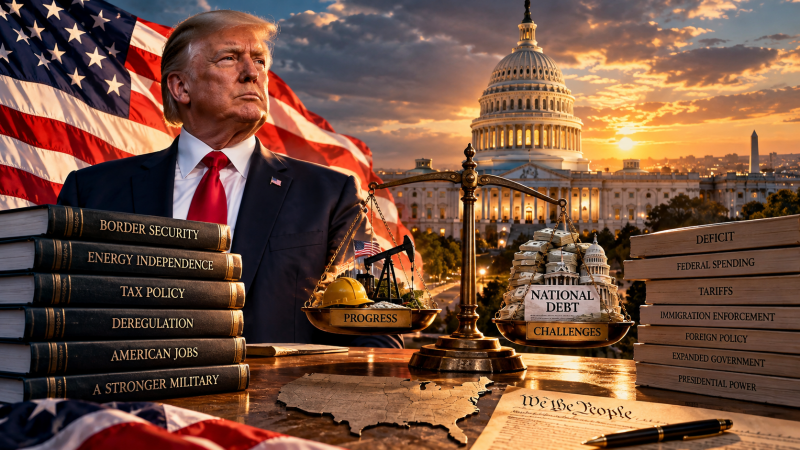
Donald Trump returned to the White House on January 20, 2025, promising something Washington rarely delivers: disruption.
Cut the bureaucracy. Slash regulations. Secure the border. Unleash American energy. Lower taxes. Stop wasting money. Put Washington back in its lane.
Nearly 20 months later, there is no question that disruption happened.
The more interesting question is what kind.
Because if we judge the second Trump administration by the principles I care most about—limited government, individual liberty, fiscal responsibility, constitutional restraint, decentralization, free enterprise, peace through strength rather than perpetual war, and respect for the dignity of the individual—the record is considerably more complicated than either Trump’s biggest supporters or his biggest critics tend to admit.
There are parts of this administration I genuinely like.
There are policies I have been waiting years to see Washington embrace.
There are also decisions that run directly against the principles of limited government, fiscal conservatism, free markets, federalism, and constitutional restraint.
And then there is the federal budget.
That may be the hardest part of the record to reconcile with the rhetoric.
This is not about whether someone likes Donald Trump personally. It is not about Democrats versus Republicans. It is not about defending a political team.
I want to look at the policy.
What has actually happened?
Where has Washington become smaller?
Where has it become larger?
Where has the administration returned power to individuals, businesses, and states?
And where has it accumulated more power in Washington—or specifically in the presidency?
Those questions produce a much more interesting picture of Trump’s second term.
Start With What the Administration Has Done Well
There is a temptation in modern politics to believe that criticizing a politician means pretending everything that politician does is wrong.
I reject that.
Good policy is good policy regardless of whose signature is on it.
And the Trump administration has pursued several policies that fit comfortably within a limited-government framework.
Deregulation Has Been One of the Clearest Wins
One of Trump’s most aggressive second-term initiatives has been deregulation.
In January 2025, Trump issued an executive order establishing a “10-for-1” regulatory policy: agencies introducing a new regulation generally must identify at least ten existing regulations, guidance documents, or rules for elimination.
The administration later expanded its deregulatory approach into energy, permitting, infrastructure, and other sectors.
That matters.
Regulations do not appear on a tax bill, but they still impose costs.
Businesses have to hire people to comply with them. Entrepreneurs have to navigate them. Projects can spend years sitting in regulatory limbo. Those expenses eventually work their way into prices, wages, investment decisions, and whether someone decides to open a business in the first place.
The administration has also moved aggressively on permitting reform.
The Department of Energy, for example, rescinded its previous NEPA regulations in 2025 and implemented new procedures intended to shorten environmental reviews and accelerate infrastructure and energy development.
By June 2026, the administration reported that federal agencies had adopted 195 additional categorical exclusions intended to speed NEPA reviews.
You can debate individual environmental decisions—and we should—but the larger principle matters.
Government should protect legitimate public interests without turning permission to build something into a decade-long bureaucratic obstacle course.
America needs housing.
We need transmission.
We need roads.
We need data centers.
We need nuclear power.
We need domestic energy.
We need entrepreneurs capable of building things without first becoming experts in navigating Washington.
Reducing unnecessary regulatory barriers is one of the strongest parts of Trump’s second-term agenda.
Energy Permitting Has Moved in the Right Direction
The same principle applies to energy.
The administration has accelerated oil, gas, geothermal, nuclear, mineral, and infrastructure permitting.
The Bureau of Land Management had approved more than 6,100 applications for permits to drill by mid-2026, according to the White House, while the administration has also taken steps to accelerate advanced nuclear development and permitting.
There is a broader lesson here that transcends fossil fuels.
Energy abundance is freedom.
Cheap, reliable energy makes nearly everything else cheaper. Manufacturing becomes more competitive. Transportation becomes less expensive. Data centers become easier to operate. Families spend less of their income keeping the lights on.
Government should not be picking energy winners and losers.
That means I am skeptical of federal subsidies designed to artificially favor renewable energy.
But consistency requires being skeptical of government favoritism toward fossil fuels too.
The better long-term approach is simple: create a technology-neutral environment where nuclear, natural gas, geothermal, solar, wind, hydroelectric power, and emerging technologies compete on reliability, price, scalability, and consumer demand.
The administration’s effort to reduce permitting barriers fits that philosophy far better than Washington trying to centrally engineer the energy marketplace.
Returning Education Authority Toward States Is a Worthwhile Direction
Education is another area where the administration has pursued decentralization.
The Department of Education announced in May 2026 that 18 states were using Ed-Flex authority, which allows participating states to waive certain federal requirements without repeatedly requesting individual permission from Washington.
That is closer to how education policy should work.
Education is fundamentally local.
Parents know their children better than federal bureaucrats do.
Teachers know their classrooms better.
Communities understand their schools better.
States can experiment, succeed, fail, learn, and compete with one another.
The farther decision-making moves from families and classrooms, the less responsive the system becomes.
The federal government can protect constitutional rights without micromanaging how every school district in America operates.
Reducing federal control and expanding state flexibility therefore represents a meaningful movement toward decentralization.
Parts of the Tax Agenda Are Defensible From a Limited-Government Perspective
The administration’s signature 2025 reconciliation law permanently extended important portions of the 2017 Tax Cuts and Jobs Act.
It also created or expanded tax preferences involving tips, overtime, child credits, auto-loan interest, business research expenditures, and other areas.
There are legitimate debates about the design of some of those provisions.
I generally prefer broad, simple tax reductions over politically selected deductions because every special deduction makes the tax code more complicated and creates another incentive for Washington to manipulate economic behavior.
But the underlying principle still matters:
People should be allowed to keep more of what they earn.
The problem is that tax cuts cannot be separated indefinitely from spending.
And that is where the story becomes much less comfortable.
Washington Is Still Spending an Extraordinary Amount of Money
If fiscal conservatism means anything, it has to mean more than cutting taxes.
Government has two sides of its ledger.
Revenue matters.
Spending matters too.
And Washington is still spending at levels that should concern anyone serious about limited government.
The Congressional Budget Office projects federal outlays of roughly $7.4 trillion in fiscal year 2026, equal to approximately 23.3% of GDP.
For comparison, federal spending has averaged roughly 21.2% of GDP during the previous 50 years.
That is not a small federal government.
It is an enormous one.
CBO’s August 2026 Monthly Budget Review estimated that the federal government had already accumulated a roughly $2 trillion deficit during the first 11 months of fiscal 2026.
Because of calendar-related payment shifts, direct year-over-year comparisons require some adjustment. After accounting for those timing effects, CBO estimated the FY2026 deficit through August was approximately $82 billion larger than during the comparable period a year earlier.
That should immediately complicate any claim that Washington has entered an era of fiscal austerity.
It hasn’t.
The Big Beautiful Bill Cut Taxes—but Added Trillions to Projected Deficits
This is where the administration’s signature legislative accomplishment becomes especially important.
The One Big Beautiful Bill Act, signed July 4, 2025, contained substantial tax relief and spending reductions.
But according to CBO, the legislation is projected to increase cumulative federal deficits by approximately $3.4 trillion between 2025 and 2034 compared with the agency’s January 2025 baseline.
Why?
CBO estimated approximately:
$4.5 trillion less federal revenue
offset by roughly
$1.1 trillion less direct spending.
That is still a net $3.4 trillion increase in deficits before additional borrowing costs.
Once CBO estimated the additional interest expense created by that borrowing, the projected cumulative deficit effect increased to roughly $4.1 trillion.
That distinction is incredibly important.
Tax cuts are not automatically spending cuts.
Reducing taxes while borrowing trillions to maintain a government Washington cannot afford simply shifts the cost.
Today’s taxpayer pays less.
Tomorrow’s taxpayer inherits the debt.
Fiscal responsibility requires both sides of the equation.
If government collects $5 trillion and spends $7 trillion, the fundamental problem is not that government failed to collect enough.
It is spending too much.
The Debt Problem Has Not Gone Away
Federal debt held by the public reached roughly $31.3 trillion by April 2026, according to the Government Accountability Office.
GAO warned that publicly held debt was already approximately the size of the entire U.S. economy.
CBO projects debt held by the public at approximately 101% of GDP in 2026.
Without substantial policy changes, CBO projects that figure reaching 120% of GDP by 2036.
There is another number that deserves far more attention.
Interest.
GAO reported that federal net-interest spending in fiscal 2025 exceeded federal defense spending.
Think about that.
Americans are now spending an extraordinary amount simply servicing previous borrowing before purchasing a single additional road, aircraft, Social Security benefit, federal salary, or government program.
Debt eventually becomes its own government program.
Except it provides no bridge.
No hospital.
No defense.
No tax relief.
No benefit check.
It is simply the bill from yesterday arriving today.
That is why fiscal conservatism cannot consist solely of tax cuts and eliminating unpopular programs.
Eventually Washington has to confront the major drivers of federal spending.
Neither party has shown much appetite for doing that.
DOGE Reduced Parts of Government—but Its Savings Didn’t Match the Fiscal Rhetoric
The Department of Government Efficiency became perhaps the most visible symbol of Trump’s effort to shrink Washington.
There were real reductions.
GAO reported that nearly 378,000 federal employees separated from federal agencies during 2025, while approximately 127,000 were hired. Most major agencies experienced workforce reductions exceeding 10%, and some lost more than 30% of their employees.
That is significant.
A smaller federal workforce can absolutely be consistent with limited government—particularly when positions, programs, and agencies have become redundant or functions can be returned to states or the private sector.
But headcount is not the same thing as fiscal reform.
And DOGE’s savings claims deserve scrutiny.
As of July 7, 2026, DOGE’s “Wall of Receipts” claimed approximately $110 billion in savings from contracts, grants, and leases.
GAO subsequently reviewed those claims and found problems.
According to GAO, some savings estimates were incorrect or lacked sufficient supporting evidence. The agency found that DOGE had not consistently followed its stated methodology, and investigators could not verify the calculation method for 96% of reported grant savings.
GAO also found that 108 of 264 leases listed as DOGE terminations were already being phased out before DOGE existed.
That doesn’t mean DOGE accomplished nothing.
It means government savings should be measured the same way we would measure anything else.
Show the receipts.
Verify them.
Count actual reductions in outlays—not hypothetical maximum contract values or expenses that were disappearing anyway.
Most importantly, compare the savings with total federal spending.
Even $110 billion would represent less than 2% of annual federal expenditures approaching $7.4 trillion.
Washington’s fiscal crisis cannot be solved through administrative trimming alone.
The arithmetic is simply too large.
Immigration Shows the Difference Between Limited Government and Powerful Government
Border security is a legitimate function of the federal government.
Countries have borders.
Immigration laws should mean something.
People who follow legal immigration procedures should not be placed at a disadvantage to people who simply bypass them.
Those principles are entirely compatible with limited government.
But enforcement power still requires limits.
This is where the second-term immigration agenda raises a broader philosophical question.
A government can be enforcing a legitimate law while simultaneously building enforcement machinery that deserves scrutiny.
The 2025 reconciliation legislation provided enormous resources to immigration enforcement.
Roughly $175 billion went toward the Department of Homeland Security and immigration-related enforcement initiatives, according to reporting on the legislation.
That means more officers.
More detention infrastructure.
More technology.
More federal enforcement capacity.
Anyone committed to limited government should therefore insist on something regardless of immigration politics:
Due process matters.
Warrants matter.
Property rights matter.
Federalism matters.
Accountability matters.
Constitutional restraints matter.
Government power does not become harmless because we agree with the reason it is being exercised.
That principle becomes particularly important because today’s enforcement infrastructure does not disappear when tomorrow’s president takes office.
Tariffs Are Taxes—and They Expand Presidential Economic Power
One of my biggest philosophical disagreements with Trump’s economic agenda remains tariffs.
I understand the argument for them.
China engages in unfair trade practices.
Some foreign governments subsidize strategic industries.
America allowed important manufacturing capacity to move overseas.
Supply-chain resilience matters.
National security matters.
Those are legitimate problems.
But tariffs remain taxes on imports.
And American businesses importing goods pay them.
Those costs can then be absorbed through lower margins, passed to consumers, pushed backward onto suppliers, or distributed among all three.
The bigger constitutional problem is how much trade authority has migrated from Congress into the presidency.
In February 2026, the Supreme Court ruled that the International Emergency Economic Powers Act did not authorize Trump’s sweeping IEEPA tariffs.
The administration responded by pursuing tariffs through other statutory authorities, including Sections 122, 232 and 301.
Whatever one thinks about tariffs economically, the institutional question should bother constitutional conservatives.
Article I gives Congress the power to impose duties.
Yet over decades, Congress has delegated enormous trade authority to presidents of both parties.
That is backwards.
Congress should legislate.
Presidents should execute the law.
The solution to congressional dysfunction should not be progressively transferring legislative power to the White House.
Then Came Iran
Foreign policy may represent the sharpest break between the administration’s limited-government rhetoric and its exercise of federal power.
U.S. combat operations against Iran began in February 2026 under Operation Epic Fury.
CBO estimated that by August 1 the conflict had cost the Department of Defense approximately $38 billion in operational, logistical, equipment-replacement, fuel, and related costs.
And that was not the endpoint.
CBO estimated continued operations could cost approximately $2 billion per month at the relatively lower intensity seen during May and June or approximately $3 billion per month at roughly July’s intensity.
The administration requested $87.6 billion in supplemental appropriations in June, including $67.1 billion for the Department of Defense. CBO estimated that approximately $42.3 billion of the request appeared directly connected to the conflict.
There are strategic arguments the administration and its supporters make for the operation.
But from a constitutional and noninterventionist perspective, another question comes first:
Where was Congress?
The Constitution gives Congress the authority to declare war.
The Founders did that intentionally.
They understood something human beings apparently keep relearning:
War concentrates power.
It expands government.
It increases spending.
It increases secrecy.
It strengthens executive authority.
It creates emergency powers that have a habit of surviving emergencies.
And it puts human beings—American servicemembers and civilians abroad—in situations where government decisions literally determine who lives and dies.
CBO has also concluded that the Iran conflict disrupted energy markets and contributed to higher inflation.
The agency estimated that disruption involving the Strait of Hormuz and Red Sea helped push annualized PCE inflation to 5.3% during the second quarter of 2026, with the direct energy-price effect contributing an estimated 2.3 percentage points.
War isn’t free.
Not financially.
Not economically.
And certainly not humanly.
The Bigger Concern: Presidential Power
There is a contradiction running throughout Trump’s second term.
In some areas, the administration is dismantling government authority.
In others, it is concentrating it.
That distinction matters.
Firing bureaucrats is not necessarily the same thing as shrinking government.
Moving power from an administrative agency into the White House can actually leave the federal government more centralized rather than less.
Trump issued nearly 230 executive orders during his first year back in office, according to an EY analysis—more than he issued during his entire first term and the largest first-year total in nearly a century.
Some of those orders reduced federal power.
Others exercised it aggressively.
This is where conservatives should remember a principle that used to be fundamental to the movement:
The presidency should not function as an elected monarchy.
If a president can impose sweeping economic policies, redirect billions of dollars, restructure agencies, initiate military operations, reinterpret statutes, and dramatically reshape domestic policy without meaningful congressional participation, the problem does not disappear because the president happens to be someone we like.
Every precedent survives the administration that created it.
Eventually your political opponent inherits the same authority.
That is why constitutional limits matter most when our own side controls government.
Shrinking Bureaucracy While Expanding the State
This is perhaps the central contradiction of Trump’s second term.
The administration has genuinely reduced portions of the federal bureaucracy.
It has cut regulations.
Reduced federal employment.
Accelerated permitting.
Expanded state flexibility.
Lowered taxes.
Challenged entrenched administrative practices.
Those are meaningful changes.
At the same time, Washington remains extraordinarily large.
Federal spending is approaching $7.4 trillion.
The annual deficit is around $2 trillion.
Debt held by the public is roughly equal to the nation’s annual economic output.
The administration’s signature legislative package is projected by CBO to add trillions to cumulative deficits.
Immigration enforcement received an enormous federal funding expansion.
Defense spending increased.
The United States entered another Middle Eastern conflict.
Tariffs expanded federal interference in international commerce.
And presidential power has continued a decades-long migration away from Congress and toward the executive branch.
That is not a simple story of “small government.”
Nor is it a simple story of “big government.”
It is something stranger:
a smaller bureaucracy in selected areas operating alongside a more powerful presidency and an extraordinarily expensive federal government.
That distinction is essential.
The Standard Has to Remain the Principle
This is where political tribalism becomes dangerous.
If I opposed trillion-dollar deficits under Joe Biden, I cannot suddenly become comfortable with trillion-dollar deficits under Donald Trump.
If executive overreach bothered me when Barack Obama said he had a “pen and a phone,” it should bother me when a Republican president stretches executive authority.
If undeclared wars were wrong under Democratic presidents, they do not become constitutionally healthy because a Republican orders them.
If tariffs are taxes, changing the president does not change their economic structure.
And if federal power is dangerous when controlled by people we distrust, then federal power does not magically become safe when controlled by people we support.
Principles that change depending on which party occupies the White House aren’t principles.
They’re preferences.
At the same time, opposition cannot become tribal either.
When Trump eliminates unnecessary regulations, I can support the policy.
When his administration reduces barriers to energy production and construction, I can recognize the benefits.
When Washington gives states greater flexibility, I can welcome decentralization.
When taxes are reduced, I can appreciate Americans keeping more of what they earn while still asking the obvious next question:
Where are the corresponding spending reductions?
That is how political accountability should work.
Not red jerseys.
Not blue jerseys.
Policy.
Principle.
Results.
The Question Washington Still Refuses to Answer
Trump came back to Washington promising to change Washington.
In many ways, he has.
But changing government and shrinking government are not necessarily the same thing.
The real test of limited government is not how aggressively a president uses federal power.
It is how much power government possesses when he leaves.
Are Americans freer?
Is Washington spending less?
Is the debt trajectory improving?
Has Congress reclaimed its constitutional responsibilities?
Have states regained meaningful authority?
Are individuals making more decisions for themselves?
Has the presidency become less powerful?
Are we less entangled in foreign wars?
Those are harder measurements than counting executive orders or agency layoffs.
They are also more important.
Because America’s fiscal and constitutional problems were never caused by one president.
They were created over decades by a political system that continually discovered new reasons to spend money, borrow money, regulate behavior, centralize authority, wage wars, declare emergencies, and transfer responsibility from Congress to the executive branch.
Donald Trump has challenged pieces of that system.
In other places, his administration has used and expanded the very powers limited-government conservatives once warned against.
That tension may ultimately be the defining feature of his second term so far.
Washington has fewer federal employees.
It has fewer regulations in important areas.
It has lower taxes than it otherwise would have had.
Yet it also has roughly $2 trillion annual deficits, rapidly accumulating debt, enormous federal expenditures, expanded immigration-enforcement capacity, another Middle Eastern war, continuing tariffs, and a presidency exercising extraordinary authority.
Those realities can exist simultaneously.
We should be mature enough to acknowledge both.
I don’t need a politician to be entirely good or entirely bad.
I need government to be accountable.
And the standard cannot be loyalty to a president, party, or movement.
The standard has to remain the same regardless of who controls Washington:
Does this policy protect liberty, respect human dignity, preserve constitutional limits, strengthen individual responsibility, keep government within its proper role, and leave the next generation freer than we found it?
That is a much tougher standard.
Washington desperately needs one.
Add comment
Comments