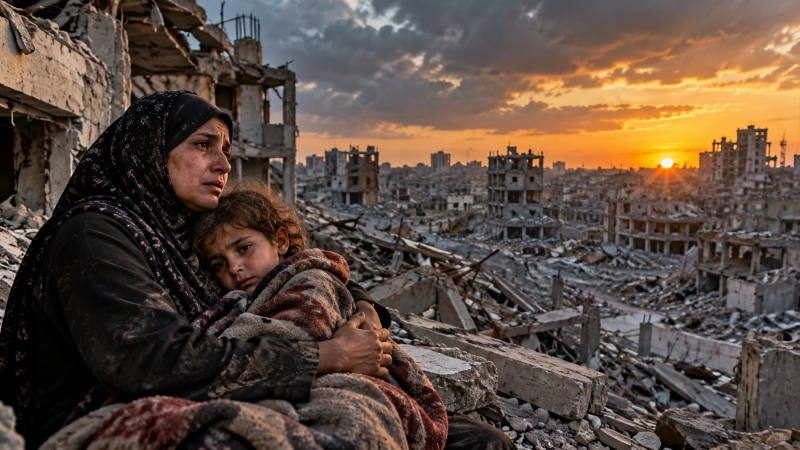
There is a phrase I keep seeing whenever Gaza comes up:
“There is no genocide in Gaza.”
Usually, that statement is delivered with absolute confidence. No qualification. No discussion of international law. No examination of the evidence. No acknowledgment of the investigations already conducted.
Just: “There is no genocide.”
At this point, however, that is not a serious description of where the evidence or international legal process actually stands.
You can support Israel’s right to exist and still acknowledge that.
You can condemn Hamas without qualification and still acknowledge that.
You can recognize the horror of October 7, 2023—the murders, hostage-taking and other atrocities committed against Israeli civilians—and still acknowledge that.
International humanitarian law does not work on the principle that one atrocity licenses another. The obligations imposed on governments during war do not disappear because their enemies commit horrific crimes.
And the question before us is no longer simply whether activists, protesters or commentators are using the word “genocide.”
An Independent International Commission of Inquiry established by the United Nations Human Rights Council has now formally concluded that Israeli authorities and Israeli security forces committed—and were continuing to commit—genocide against Palestinians in Gaza. The Commission concluded that four of the five underlying genocidal acts identified in the 1948 Genocide Convention had occurred and that the required genocidal intent was present. (United Nations)
Meanwhile, the International Court of Justice is still considering South Africa’s case accusing Israel of violating the Genocide Convention. The Court has not issued its final judgment on whether Israel bears legal responsibility for genocide.
That distinction matters enormously.
But so does the evidence.
Start With What “Genocide” Actually Means
One reason this conversation becomes so confused is that people often use “genocide” as though it simply means an exceptionally bloody war.
That is not its legal definition.
Under Article II of the 1948 Convention on the Prevention and Punishment of the Crime of Genocide, genocide requires certain prohibited acts committed with the intent to destroy, in whole or in part, a national, ethnic, racial or religious group.
Those underlying acts include killing members of the group; causing serious bodily or mental harm; deliberately imposing conditions of life calculated to bring about the group’s physical destruction in whole or in part; imposing measures intended to prevent births; and forcibly transferring children to another group. (United Nations)
That last component—intent—is crucial.
Civilian casualties alone do not automatically establish genocide.
Neither does destruction alone.
Neither does displacement alone.
War crimes and crimes against humanity can occur without genocide.
To establish genocide, the prohibited conduct must be connected to the specific intent to destroy the protected group, in whole or in substantial part.
That is exactly why the debate surrounding Gaza has been legally complicated.
It is also why the latest UN findings cannot simply be waved away with “there is no genocide.”
Investigators examined both sides of the equation: the acts themselves and the evidence concerning intent.
What the UN Commission Actually Found
In September 2025, the UN Independent International Commission of Inquiry on the Occupied Palestinian Territory, including East Jerusalem, and Israel published a 72-page legal analysis specifically examining Israel’s conduct under the Genocide Convention.
Its conclusion was extraordinary.
The Commission determined that Israeli authorities and security forces had committed four of the Convention’s five underlying genocidal acts against Palestinians in Gaza:
killing members of the group;
causing serious bodily or mental harm;
deliberately inflicting conditions of life calculated to bring about the physical destruction of the group in whole or in part;
and imposing measures intended to prevent births.
The Commission further concluded that statements by Israeli authorities provided direct evidence of genocidal intent and that the overall pattern of conduct provided circumstantial evidence from which, in the Commission’s analysis, genocidal intent was the only reasonable inference. (United Nations)
That is considerably different from saying, “Some UN official accused Israel of genocide.”
This was an investigation specifically applying the Genocide Convention’s legal framework.
The Commission examined military operations, civilian deaths and injuries, the siege and restrictions on humanitarian assistance, destruction of healthcare and educational infrastructure, forced displacement, treatment of children, reproductive harm, destruction of religious and cultural sites, and statements by senior Israeli officials. (United Nations)
People are free to challenge the Commission’s methodology or conclusions.
Israel certainly does.
But pretending those conclusions do not exist is no longer intellectually serious.
The Killing and Serious-Harm Elements
The first two prohibited acts in the Genocide Convention are comparatively straightforward conceptually: killing members of the protected group and causing serious bodily or mental harm.
The difficult question is not whether Palestinians in Gaza have been killed or seriously injured. That fact is indisputable.
The legal dispute concerns why the killings and injuries occurred, how military operations were conducted, whether particular attacks complied with international humanitarian law and, ultimately for genocide, whether prohibited acts were committed with the required destructive intent.
Long before the Commission’s genocide finding, the UN human rights office was documenting serious concerns about Israel’s use of explosive weapons with wide-area effects in densely populated Gaza.
A 2024 OHCHR investigation examined six attacks involving residential buildings, a school, refugee camps and a market and raised concerns about compliance with the fundamental humanitarian-law principles of distinction, proportionality and precautions in attack. Investigators relied on witness interviews, weapons expertise, satellite imagery, photographs, videos and other documentation. (OHCHR)
That evidence does not automatically prove genocide.
But it forms part of the larger evidentiary picture.
The Commission later went further, examining a much broader body of conduct and concluding that killing and serious bodily or mental harm constituted underlying genocidal acts. (United Nations)
Gaza’s Children Matter to the Legal Analysis
Perhaps one of the most disturbing portions of the Commission’s report concerns children.
The Commission concluded from cases it investigated that Israeli security forces had directly targeted children in circumstances where the children posed no threat.
Its legal analysis argued that the widespread and systematic targeting of children was relevant to genocidal intent because eliminating children affects not merely the current population but what the Commission called the group’s “biological continuity and future existence.” (United Nations)
That is an exceptionally serious finding.
It should not be repeated casually, but neither should it be ignored simply because its implications are uncomfortable.
When an international investigative body examining genocide specifically identifies treatment of children as evidence relevant to the physical destruction and future continuity of a protected population, the appropriate response is to examine the evidence—not retreat into slogans.
Genocide Can Be Committed Without Killing Everyone
Another misunderstanding is the assumption that genocide requires an attempt to kill every member of a population.
It does not.
The Convention explicitly says destruction can be intended “in whole or in part.” (United Nations)
Nor is genocide limited to executions or bombing.
One of the Convention’s prohibited acts is deliberately inflicting conditions of life calculated to bring about physical destruction.
That provision becomes particularly important in Gaza.
The Commission examined the siege, restrictions on humanitarian assistance, destruction of civilian infrastructure, displacement, access to food and water, healthcare destruction and other conditions affecting survival. It ultimately concluded that this third genocidal act had also occurred. (United Nations)
And these concerns have not simply vanished.
As recently as September 2026, UN humanitarian reporting described conditions in Gaza as remaining dire despite the October 2025 ceasefire agreement. OCHA reported continuing strikes, displacement, shortages of critical medical supplies and precarious access to water and sanitation.
During the first half of August 2026 alone, humanitarian organizations screened 36,240 children between six and 59 months old and diagnosed 2,613—7.2 percent—with acute malnutrition. Another 838 pregnant or breastfeeding women screened during that period were admitted for targeted supplementary feeding. (UN OCHA OPT)
Nearly a year after the ceasefire agreement, OCHA continued describing widespread destruction, immense humanitarian needs and restrictions affecting essential supplies and equipment. (UN OCHA OPT)
Those facts matter because genocide law explicitly recognizes that a population can be physically destroyed through deliberately imposed living conditions, not merely direct killing.
The Destruction of Reproductive Healthcare Matters Too
The fourth genocidal act identified by the Commission deserves considerably more attention than it receives.
The Genocide Convention covers “imposing measures intended to prevent births within the group.” (United Nations)
In March 2025, the UN Commission issued a separate investigation examining sexual, reproductive and other forms of gender-based violence. It concluded that the systematic destruction of sexual and reproductive healthcare facilities amounted to genocidal acts in the circumstances it examined. (United Nations)
Its September genocide analysis subsequently concluded that measures intended to prevent births constituted one of the four genocidal acts committed in Gaza. (United Nations)
Again, someone can dispute that legal interpretation.
But “there is no evidence” is not an accurate response.
There is evidence.
There is enough evidence that a UN investigative commission analyzed it under the Genocide Convention and reached a formal conclusion.
Then Comes the Hardest Question: Intent
This is where the strongest legal disagreement lies.
Israel argues that its objective has been defeating Hamas, rescuing hostages and defending Israelis following the October 7 attacks—not destroying Palestinians as a people.
That argument matters because genocidal intent cannot simply be presumed from a high civilian death toll.
The UN Commission nevertheless concluded that the evidence established the necessary intent.
Investigators analyzed statements from Israeli officials alongside patterns of military and governmental conduct. They applied the “only reasonable inference” standard associated with International Court of Justice genocide jurisprudence.
The Commission concluded that statements by Israeli authorities constituted direct evidence of genocidal intent and that the broader pattern of conduct provided circumstantial evidence supporting the same conclusion. (United Nations)
The Commission specifically concluded that President Isaac Herzog, Prime Minister Benjamin Netanyahu and former Defense Minister Yoav Gallant had incited the commission of genocide, while noting that it had not fully assessed statements from some other political and military leaders. (United Nations)
Israel categorically rejects these conclusions.
Its government has accused the Commission of bias, methodological failures and operating beyond its legitimate competence. Israel argues that allegations of genocide distort a defensive war against Hamas and has repeatedly challenged the credibility and neutrality of UN investigative mechanisms examining its conduct. (United Nations)
Readers should know that counterargument.
But Israel’s rejection of an investigation does not erase the investigation any more than the investigation itself constitutes a final judicial judgment.
Both facts belong in an accurate account.
What the International Court of Justice Has—and Has Not—Decided
This may be the single most important distinction in the entire debate.
You will sometimes hear that “the International Court of Justice ruled Israel committed genocide.”
That is incorrect.
The ICJ has not yet issued its final merits judgment in South Africa v. Israel.
South Africa filed the case in December 2023, alleging Israeli violations of the Genocide Convention in Gaza.
In January 2024, the Court ordered provisional measures. It subsequently issued additional or modified measures in March and May 2024. (International Court of Justice)
Provisional measures are not a final finding of genocide.
They are protective legal measures imposed while litigation continues.
And the litigation very much continues.
As of September 2026, the ICJ docket shows the case proceeding through further written stages following a May 2026 order fixing time limits for a Reply and Rejoinder. The docket recorded another procedural development as recently as September 22, 2026, when Colombia withdrew its declaration of intervention. (International Court of Justice)
So two statements should simultaneously be rejected:
“The ICJ has already convicted Israel of genocide.”
No.
And:
“There is no genocide case against Israel.”
Also no.
There is an active genocide case before the world’s principal judicial organ.
The final judicial determination remains pending.
The UN Finding and the ICJ Case Are Different Things
This distinction clears up much of the confusion.
The Independent International Commission of Inquiry is an investigative mechanism created by the UN Human Rights Council.
It has reached a conclusion: Israel bears responsibility, in its analysis, for committing genocide against Palestinians in Gaza. (United Nations)
The International Court of Justice is a court resolving disputes between states.
It has not yet reached its final judgment regarding Israel’s responsibility under the Genocide Convention.
Those propositions do not contradict one another.
An investigative body can reach a legal assessment before a court finishes adjudicating a case.
Indeed, the Commission itself explicitly acknowledged this distinction. Its report noted that the ICJ would make a final determination in the future while explaining that the Commission considered it appropriate, within its own investigative mandate, to assess Israel’s responsibility under the Genocide Convention. (Digital Library)
That is the accurate way to describe the situation.
Amnesty International Reached the Same Basic Conclusion
The UN Commission is also not alone.
In December 2024, Amnesty International published an extensive investigation concluding that Israel had committed genocide against Palestinians in Gaza.
Its investigation examined civilian killings, destruction of civilian infrastructure, mass displacement, restrictions on essential goods and humanitarian assistance, power restrictions, military operations and statements by Israeli officials. Amnesty said its investigation included extensive fieldwork, interviews and analysis of visual and digital evidence. (Amnesty International)
That does not transform Amnesty into a court.
But again, the growing body of documented analysis makes categorical dismissal increasingly difficult to sustain.
There is a legitimate legal debate over evidence, intent, methodology and the ultimate judgment the ICJ should reach.
“There is absolutely no evidence of genocide” is something different.
That statement conflicts with the existence of substantial investigations expressly concluding otherwise.
Hamas’s Crimes Do Not Resolve the Question
None of this requires minimizing what happened on October 7.
Hamas and other Palestinian armed groups committed horrific crimes against Israeli civilians, including killings and hostage-taking. UN bodies examining the conflict have themselves documented and condemned abuses by Hamas. (OHCHR Document Store)
Those crimes deserve accountability.
Israeli civilians deserve security.
Hostages deserve freedom.
But international humanitarian law is not reciprocal.
One side violating the law does not release the other side from its obligations.
That principle is particularly important for anyone who claims to believe in limited government, individual rights and the rule of law.
Government power does not become morally unlimited because officials invoke national security.
That principle should apply in Washington.
It should apply in Moscow.
It should apply in Tehran.
And it should apply in Jerusalem.
Rights worth defending are rights we defend when doing so becomes politically inconvenient.
Human Dignity Cannot Depend on Nationality
There is another principle here that transcends geopolitics.
Every human life possesses inherent dignity.
Israeli children murdered on October 7 possessed it.
Israeli hostages possessed it.
Palestinian children buried beneath collapsed buildings possess it.
Palestinian mothers giving birth amid a devastated healthcare system possess it.
Families searching through rubble possess it.
People starving inside displacement camps possess it.
Acknowledging one group’s humanity never requires denying another’s.
That should not be controversial.
Yet political tribalism repeatedly pressures us to treat human suffering like a scoreboard: acknowledging Palestinian suffering supposedly helps Hamas; acknowledging Israeli suffering supposedly excuses Israeli government policy.
I reject that entire framework.
Governments should be judged by their actions.
Armed organizations should be judged by their actions.
Individuals should retain their dignity regardless of which flag hangs over the territory where they happened to be born.
So, Is Gaza Genocide?
The most precise answer is more complicated—and more troubling—than either political camp often admits.
A UN Independent International Commission of Inquiry has formally concluded that Israeli authorities and security forces committed and continued to commit genocide against Palestinians in Gaza, finding four of the five underlying genocidal acts and concluding that the required genocidal intent existed. (United Nations)
Amnesty International independently reached a genocide conclusion. (Amnesty International)
UN experts and other human-rights mechanisms have raised genocide concerns at various stages of the conflict. (Amnesty International)
And South Africa’s genocide case against Israel remains before the International Court of Justice, which has issued binding provisional measures but has not yet rendered its final merits judgment. (International Court of Justice)
Israel rejects the genocide accusation and challenges the credibility, methodology and legal conclusions of the UN Commission. (United Nations)
Those are the facts.
And those facts make one thing abundantly clear:
“There is no genocide in Gaza” is not a neutral statement of settled fact.
At minimum, it presents as settled something that remains the subject of an active case before the International Court of Justice while ignoring a major UN investigative commission that has already examined the evidence and reached the opposite conclusion.
People can debate the Commission’s reasoning.
They can scrutinize individual incidents.
They can challenge evidence.
They can defend Israel’s stated military objectives.
They can wait for the International Court of Justice to make the definitive judicial determination of state responsibility.
What they cannot reasonably do is pretend the genocide allegation consists of nothing more than rhetoric shouted at demonstrations or posted on social media.
The evidence is extensive.
The legal allegations are specific.
The UN Commission’s conclusion is explicit.
And the international court case is real, active and unresolved.
For me, the deeper principle is simple.
No government gets an exemption from human dignity.
No military gets unlimited authority because its enemy committed atrocities.
No alliance should require us to stop asking questions.
No flag should blind us to civilian suffering.
And no commitment to truth survives very long once we begin deciding that facts only matter when they are politically convenient.
October 7 deserves truth.
The Israeli hostages deserve truth.
And Gaza deserves truth.
Where the final judicial judgment will land remains for the International Court of Justice to determine.
But after everything documented over the last three years, declaring that there is simply “no genocide in Gaza” does not settle the argument.
It avoids it.
Add comment
Comments