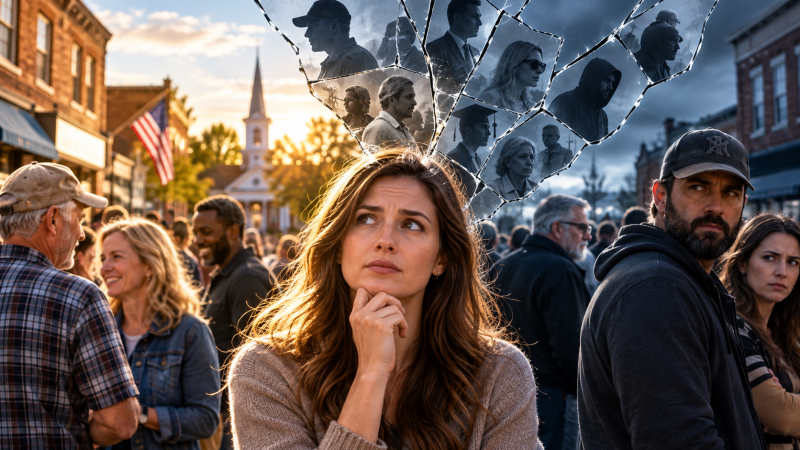
There is a strange habit I have noticed becoming more common in American life.
We assume the worst.
Not occasionally. Not just when somebody gives us a legitimate reason to be skeptical. Increasingly, it feels like suspicion has become our default setting.
Someone starts a business and does well? There must be something shady going on.
Someone struggles financially? They must have made terrible decisions.
A company donates money to a community project? Publicity stunt.
Someone apologizes? Damage control.
Someone changes their mind? They’re a hypocrite.
Someone does something generous and posts about it online? They only did it for attention.
Someone disagrees with us? They aren’t simply wrong. They must be stupid, dishonest, hateful, brainwashed, corrupt, selfish, or motivated by something sinister.
We have become remarkably comfortable pretending we know the motives of people we barely know.
And I don’t think we fully appreciate what that is doing to us.
This isn’t really an article about Democrats and Republicans. It isn’t about liberals and conservatives. Politics certainly contributes to the problem, and there is plenty of research demonstrating how partisan hostility affects perceptions of other people.
But what concerns me more is what has happened outside politics.
Something has changed in the way we interpret one another.
We aren’t merely becoming more skeptical of institutions. We’re becoming more skeptical of people.
That distinction matters.
Because institutions can be reformed. Elections come and go. Companies rise and fall. Technology changes.
But a society ultimately depends on millions of ordinary interactions between people who need some basic reason to believe the person standing across from them isn’t trying to screw them over.
And increasingly, we don’t seem very sure about that anymore.
The Numbers Tell a Pretty Uncomfortable Story
This isn’t just a feeling.
Americans really do trust one another less than they used to.
Pew Research Center’s 2025 examination of interpersonal trust found that the percentage of Americans saying “most people can be trusted” fell from 46% in 1972 to 34% in 2018. When Pew measured it again in its 2023–24 research, the number was still 34%. (Pew Research Center)
Think about what that means.
Roughly two-thirds of Americans are unwilling to say that most people can generally be trusted.
Trust in our immediate communities has weakened too.
In March 2025, Pew surveyed 9,482 American adults and found that only 44% said they trusted all or most of the people in their neighborhood. A decade earlier, that figure had been 52%.
Only 26% said they knew all or most of their neighbors. (Pew Research Center)
There is something particularly interesting buried in those numbers, though.
Americans trust the people around them more than they trust people generally.
Forty-four percent trust all or most of their neighbors, while only 34% say most people can be trusted. (Pew Research Center)
That difference might tell us something incredibly important.
The abstract person is frightening.
The actual person is less so.
“People these days” are terrible.
Dave across the street isn’t so bad.
“The public” can’t be trusted.
But Susan can probably hold your spare house key.
That gap between our perception of humanity and our experience with actual humans may be one of the most important clues to understanding the age of suspicion.
We Are Reacting to People We’ve Never Actually Met
Here’s where I think modern life gets really strange.
Imagine you meet someone new.
Before you know much about them, you notice a few things.
Maybe it’s the vehicle they drive.
Their clothes.
Their tattoos.
Their profession.
The neighborhood where they live.
Where they went to school.
Whether they attend church.
What kind of church.
The music they listen to.
The company they work for.
The newspaper they read.
The podcast they mention.
Their accent.
Their hobbies.
Their social media profile.
A bumper sticker.
A hat.
And almost instantly, a story begins forming in our heads.
We start filling in blanks.
We think we know what else they believe.
We think we know how they vote.
We think we know how they raise their children.
We think we know what they think about people like us.
Sometimes we might even believe we know whether they’re a good person.
Except we don’t.
We know a handful of signals.
Then we construct the rest.
Human beings have always categorized people. That’s hardly a twenty-first-century invention. Categorization is one of the ways our brains navigate an impossibly complicated social world.
The problem comes when the category becomes more real to us than the person.
Then we’re no longer responding to the individual standing in front of us.
We’re responding to everything we’ve been told people like them supposedly represent.
That’s an enormous difference.
And our modern information environment gives us an almost unlimited supply of material from which to build those stereotypes.
We Spend an Extraordinary Amount of Time Watching People Behave Terribly
Open almost any social platform and pay attention to what captures attention.
A customer screaming at a cashier.
A teacher saying something outrageous.
A police officer behaving badly.
A politician caught lying.
A business owner treating an employee horribly.
A parent losing control at a youth sporting event.
A passenger having a meltdown on an airplane.
A neighbor behaving ridiculously.
A pastor caught in hypocrisy.
A teenager destroying something.
A wealthy person acting entitled.
A poor person abusing assistance.
A conservative saying something hateful.
A progressive saying something absurd.
Whatever group someone already distrusts, the internet will happily provide an endless supply of examples confirming that distrust.
And here’s the problem:
Normal human behavior isn’t particularly viral.
Nobody uploads a video titled:
“Man Goes to Grocery Store, Buys Milk, Is Pleasant to Cashier, Returns Shopping Cart.”
Nobody shares:
“Local Woman Disagrees With Coworker, They Discuss It Respectfully and Continue Working Together.”
You don’t wake up to a breaking-news notification saying:
“Approximately 330 Million Americans Made It Through Yesterday Without Screaming at a Stranger.”
Ordinary decency is boring.
Outrage is content.
That means our digital window into humanity is not necessarily a representative sample of humanity.
It’s a highlight reel of human dysfunction.
And when you consume enough of it, something predictable can happen:
The exceptional begins to feel normal.
The unusual begins to feel common.
And the person standing in front of you starts carrying the burden of proving they aren’t like the worst example of whatever category you’ve placed them into.
Outrage Doesn’t Just Spread. We Learn It.
There is fascinating research behind this.
A 2021 study published in Science Advances examined more than 12.7 million tweets from 7,331 users and conducted two preregistered behavioral experiments.
Researchers found that when people received positive social feedback—likes and shares—for expressing moral outrage, they became more likely to express outrage again.
They also found that people adapted their expressions to the norms of their social networks. When outrage appeared normal within someone’s network, people became more likely to express it themselves. (PubMed Central (PMC))
That’s important because social media isn’t simply showing us what society thinks.
We’re learning how to behave from it.
We post something angry.
It gets engagement.
Our brain receives a reward.
We do it again.
Other people see what receives attention.
They adapt.
Eventually, outrage stops merely describing the culture.
It starts shaping it.
And I think some of those habits have escaped the screen.
We’ve imported the language and instincts of social media into ordinary human interaction.
We “call people out.”
We “destroy” arguments.
We “clap back.”
We search for hypocrisy.
We screenshot mistakes.
We assume hidden motives.
We interpret ambiguity in the least charitable way available.
Online, there is always an audience watching.
That creates an incentive not merely to disagree with somebody but to perform the disagreement.
And once you’ve practiced viewing people as avatars representing opposing categories long enough, it becomes harder to switch that instinct off when you encounter an actual human being.
Cynicism Has Somehow Become Synonymous With Intelligence
This might be the part that bothers me most.
At some point, we began treating cynicism as evidence of sophistication.
If you believe somebody might genuinely mean what they say, you’re naïve.
If somebody performs an act of kindness:
“What’s their angle?”
If a wealthy person gives money away:
“Tax write-off.”
If a business helps the community:
“Marketing.”
If someone publicly apologizes:
“Their lawyer probably told them to.”
If someone changes a long-held position:
“They’re just trying to save face.”
And here’s the frustrating part.
Sometimes those explanations are absolutely correct.
People manipulate.
Corporations spin.
Politicians lie.
Scammers scam.
Public relations campaigns exist.
Human beings sometimes have selfish motives.
Skepticism is necessary.
But skepticism and cynicism aren’t the same thing.
Skepticism says:
Show me.
Cynicism says:
I already know.
Skepticism waits for evidence.
Cynicism assigns motive before evidence arrives.
Skepticism protects you from being fooled.
Cynicism eventually convinces you that everyone is trying to fool you.
That’s a miserable way to live.
It’s also a dangerous way to build a society.
Because once every positive action is interpreted as manipulation, sincerity becomes impossible to prove.
The genuinely generous person and the performatively generous person become indistinguishable.
The sincere apology and the calculated apology become indistinguishable.
The person who genuinely learned something and the opportunist become indistinguishable.
Eventually, goodness itself becomes suspicious.
We Don’t Trust the Referees Either
This culture of suspicion doesn’t exist in isolation.
It developed during a period when Americans’ confidence in many major institutions also deteriorated.
Gallup’s July 2026 measurements found that average confidence across 14 major American institutions stood at just 27%, only one percentage point above its record low. (Gallup.com)
That includes institutions across government, business, media and civil society.
This matters beyond whether Americans approve of Congress, newspapers, corporations or any particular institution.
Institutions traditionally serve as social referees.
When people disagree about what happened, they need some institution, process or shared authority capable of establishing facts.
But what happens when nobody trusts the referee?
Every decision becomes suspicious.
Every statistic becomes propaganda.
Every investigation becomes a cover-up.
Every news story becomes manipulation.
Every corporate announcement becomes spin.
Every expert becomes somebody’s paid mouthpiece.
Every disagreement about facts becomes a disagreement about who gets to determine reality in the first place.
And once that happens, suspicion becomes self-reinforcing.
Evidence from an institution you distrust isn’t evidence.
It’s further proof that the institution can’t be trusted.
That is a difficult cycle to break.
Then There Is Loneliness
There’s another piece of this conversation that doesn’t receive nearly enough attention.
We are social creatures trying to navigate an increasingly disconnected social environment.
The U.S. Surgeon General’s 2023 advisory on loneliness and isolation described social connection as an important contributor not only to individual health, but also to community safety, resilience and prosperity. The advisory emphasized that our relationships with family, friends, coworkers and neighbors—and the environments in which those relationships exist—shape social connection. (NCBI)
That connection matters because trust isn’t primarily theoretical.
We learn trust through experience.
Someone keeps their word.
Someone helps us.
Someone listens.
Someone returns something we lost.
Someone shows up when they said they would.
Someone disagrees with us without humiliating us.
Someone watches our kid for ten minutes.
Someone checks on us after a storm.
Someone loans us a tool.
Someone brings food when somebody is sick.
Trust grows through thousands of tiny transactions that never make the news.
But those transactions require interaction.
And when interaction declines, stereotypes have more room to breathe.
It’s difficult for an abstract caricature to survive repeated contact with complicated human beings.
The Neighbor Data Reveals Something Hopeful
This is why I keep coming back to Pew’s neighborhood findings.
The numbers aren’t entirely bleak.
Yes, only 26% of Americans say they know all or most of their neighbors.
But 59% say they have a neighbor they’d feel comfortable asking to hold a spare set of keys for an emergency.
Seventy-six percent say they would bring in the mail or water plants for an out-of-town neighbor.
Sixty-seven percent say they’d bring a meal to a sick neighbor or friend. (Pew Research Center)
There’s an interesting mismatch in that same research.
Americans consistently describe themselves as more willing to help others than they expect others to be willing to help them.
While 76% say they’d bring in a neighbor’s mail or water their plants, only 52% believe a neighbor would be very or extremely likely to do the same for them.
While 67% say they’d bring a meal to someone who was sick, only 42% expect a neighbor or friend would do it for them. (Pew Research Center)
Stop and think about that.
Most of us say:
I’d help them.
But fewer of us believe:
They’d help me.
Maybe everybody is lying to the pollster.
That’s possible.
But there’s another possibility worth considering.
Maybe we systematically underestimate one another.
Maybe there are more decent people around us than our culture has trained us to expect.
We Have Turned Disagreement Into Diagnosis
One of the ugliest consequences of suspicion is the way disagreement has changed.
There was always conflict in America.
Our history is full of it.
But increasingly, we don’t simply disagree with an argument.
We diagnose the person making it.
They don’t disagree because they reached a different conclusion.
They’re brainwashed.
They’re ignorant.
They’re selfish.
They’re privileged.
They’re jealous.
They’re hateful.
They’re indoctrinated.
They’re a sheep.
They’re a grifter.
They’re evil.
Notice what all of those explanations accomplish.
They eliminate the need for curiosity.
Once I’ve decided you’re stupid, corrupt or malicious, I no longer have to understand why you think what you think.
I’ve explained you.
Case closed.
Research suggests we can also underestimate how internally diverse groups actually are. A study involving more than 9,400 participants found that American partisans substantially underestimated the diversity of policy attitudes among people belonging to the opposing party. Those perceptions of the other side were associated with greater animosity and perceptions of threat. (Cambridge University Press)
The political implications are obvious.
But the underlying human tendency extends much further.
We flatten people.
We take enormous, complicated populations and turn them into singular personalities.
Generations.
Religions.
Regions.
Professions.
Income classes.
Cities.
Rural communities.
College graduates.
People without degrees.
Business owners.
Government workers.
Teachers.
Police officers.
Young people.
Old people.
“Those people.”
The moment we start talking about millions of human beings as though they share one brain, suspicion becomes incredibly easy.
Local Communities Aren’t Immune
You can see this dynamic in towns all across America.
Someone moves into a rapidly growing community.
Longtime residents see an outsider changing the place they love.
The newcomer sees longtime residents resisting progress.
A developer sees opportunity.
A homeowner sees traffic.
A business owner sees customers.
A parent sees overcrowded schools.
A government official sees increased tax revenue.
An environmental advocate sees disappearing land.
Everyone is looking at the same growth.
Everyone is experiencing something different.
And instead of beginning with those different experiences, we often begin by assigning motives.
“They’re greedy.”
“They hate growth.”
“They don’t care about the community.”
“They just don’t want new people here.”
“They only care about money.”
“They want everything to stay exactly the same.”
Maybe.
Or maybe human beings can look at the same situation, prioritize different legitimate concerns and reach different conclusions.
That possibility has become strangely difficult for us to entertain.
We Are Still Deeply Local Creatures
For all the attention we give national media and social platforms, Americans still depend heavily on actual people for information about their communities.
Pew found in 2024 that 73% of Americans often or sometimes get local news from friends, family and neighbors—more than from television stations, radio stations or online forums. (Pew Research Center)
That means our everyday relationships don’t merely determine whether our communities feel pleasant.
They help determine what we believe is happening in those communities.
Trust spreads through relationships.
Unfortunately, so can suspicion.
A rumor passed between neighbors can shape how people view a local business.
A Facebook post can change how residents perceive an entire neighborhood.
One bad interaction with one employee can become a judgment about an entire organization.
One story about crime can alter how safe an entire community feels.
Pew’s research into local crime information illustrates this tension. Among Americans who get local crime information from friends, family and neighbors, 22% said that information exaggerates how much crime exists in their community. (Pew Research Center)
Again, perception matters.
Our experience of society isn’t determined only by what happens.
It’s also determined by what we believe is happening around us.
The Suspicion Feedback Loop
This is where everything begins feeding itself.
You expect someone to be hostile.
So you approach them defensively.
They sense your defensiveness.
They become defensive too.
You notice their reaction.
And you think:
See? I knew it.
Meanwhile, they’re walking away thinking exactly the same thing about you.
Neither person necessarily intended to create conflict.
Both leave with their worldview reinforced.
That’s how low-trust environments reproduce themselves.
Suspicion changes behavior.
Behavior generates reactions.
Reactions validate suspicion.
Repeat.
Eventually, distrust stops being a response to experience.
It becomes the lens through which experience is interpreted.
The Internet Makes Everyone Look Worse Than They Probably Are
This might be the simplest way I can put it:
The internet gives us unprecedented access to humanity’s worst moments without giving us proportional access to humanity’s ordinary goodness.
Millions of parents got their children ready for school this morning.
Millions of people went to work.
Someone helped an elderly person carry groceries.
Somebody stopped to help with a flat tire.
A nurse comforted a frightened patient.
A teacher stayed late.
A restaurant worker quietly gave someone extra food.
A neighbor checked on another neighbor.
A teenager did something kind without filming it.
A business owner gave an employee another chance.
Somebody forgave somebody.
Someone admitted they were wrong.
Someone resisted saying the cruel thing they wanted to say.
Someone changed their mind.
Someone showed grace.
Almost none of it will trend.
That’s important to remember.
Because our information environment is very good at showing us what is noteworthy.
It is not necessarily good at showing us what is normal.
Those are not the same thing.
Suspicion Can Become a Self-Fulfilling Prophecy
There is a practical consequence to all of this.
Trust makes cooperation cheaper.
When people trust each other, fewer safeguards are necessary.
Fewer contracts need twenty pages of fine print.
Fewer conversations need documentation.
Fewer interactions begin defensively.
Communities can solve problems informally.
Businesses can build lasting relationships.
Organizations can recruit volunteers.
Neighbors can depend on one another.
People can disagree without immediately preparing for war.
When trust disappears, friction increases everywhere.
Every interaction requires verification.
Every mistake looks intentional.
Every disagreement looks threatening.
Every relationship becomes transactional.
That’s exhausting.
And eventually people retreat.
Why talk to strangers?
Why volunteer?
Why join the organization?
Why attend the meeting?
Why participate in the community?
Why speak honestly if somebody might deliberately interpret what you say in the worst possible way?
Why give someone the benefit of the doubt if nobody gives it to you?
And there it is again.
The loop.
Giving Someone the Benefit of the Doubt Isn’t Weakness
I want to be clear about something.
I’m not arguing for blind trust.
There are bad people.
There are dishonest businesses.
There are corrupt institutions.
There are abusive relationships.
There are scammers.
There are manipulators.
There are people who will absolutely exploit kindness.
Discernment matters.
Accountability matters.
Evidence matters.
Boundaries matter.
Trust should sometimes be earned.
But there is an enormous distance between healthy skepticism and assuming every stranger is guilty until proven innocent.
We can hold two thoughts simultaneously:
Some people will take advantage of your trust.
And:
Most people you encounter are considerably more complicated than the stereotype you’ve constructed for them.
Maturity requires learning the difference.
Maybe We Need to Stop Pretending We Can Read Minds
One habit could change an enormous amount of our social behavior:
Stop assigning motives we cannot possibly know.
Criticize actions.
Question claims.
Challenge bad ideas.
Demand evidence.
Hold people accountable.
But be careful about claiming to know why somebody did something unless you actually know.
There’s a huge difference between:
“I disagree with what you did.”
and:
“I know what kind of person you are.”
One addresses behavior.
The other claims ownership of another person’s interior life.
We do far too much of the second.
Curiosity Is the Antidote to Suspicion
One of the most powerful questions in human interaction might be:
Why do you think that?
Not sarcastically.
Actually ask.
How did you reach that conclusion?
What happened to you?
What are you worried about?
What am I missing?
What would change your mind?
What do you think I’m misunderstanding?
Those questions don’t require agreement.
They require curiosity.
And curiosity does something suspicion cannot tolerate:
It introduces complexity.
Suddenly the caricature has a childhood.
A mortgage.
Kids.
A sick parent.
A business they’re trying to keep alive.
A job they’re afraid of losing.
Experiences you’ve never had.
Mistakes.
Contradictions.
Hopes.
Fears.
Reasons.
They become human again.
You still might think they’re completely wrong.
That’s fine.
Understanding someone does not require agreeing with them.
We May Actually Be Better Than We Think We Are
That’s the thought I keep coming back to.
Maybe America isn’t filled with quite as many terrible people as Americans increasingly seem to believe.
Maybe our perception of one another has deteriorated faster than our actual willingness to help one another.
The neighborhood data certainly gives us reason to consider it.
Most Americans say they would help a neighbor in ordinary situations, yet substantially fewer expect the same kindness in return. (Pew Research Center)
Maybe that’s the age of suspicion in one statistic.
We believe in our own capacity for decency more than we believe in everyone else’s.
But everybody else is somebody’s “me.”
The stranger you’re suspicious of is walking around with their own fears, responsibilities, experiences, prejudices, insecurities, hopes and people they love.
They’re probably worried about where society is heading too.
They may even be looking at you and wondering whether you can be trusted.
Someone has to break the cycle.
The Age of Suspicion Doesn’t Have to Be Permanent
We aren’t going to rebuild social trust with a slogan.
And we’re certainly not going to rebuild it by demanding that everyone agree.
Agreement isn’t the prerequisite for a healthy society.
Trust isn’t even the same thing as liking someone.
It’s something more basic.
It’s the willingness to approach another human being without automatically assuming malicious intent.
It’s leaving open the possibility that you don’t know everything about them.
It’s recognizing that one bad person doesn’t represent millions.
It’s remembering that viral behavior isn’t necessarily normal behavior.
It’s understanding that outrage is disproportionately rewarded by the systems competing for our attention.
It’s recognizing that cynicism isn’t wisdom.
And sometimes it’s simply giving another person enough room to surprise you.
We should absolutely remain skeptical.
Ask questions.
Verify claims.
Demand accountability.
Protect yourself when necessary.
But skepticism should be a tool we use.
It shouldn’t become the way we see humanity.
Because a society where nobody can be trusted eventually becomes a society where cooperation becomes nearly impossible.
And maybe the first step toward reversing that isn’t trusting everyone.
Maybe it’s something much smaller.
The next time someone disagrees with us, disappoints us, confuses us or simply comes from a world we don’t understand, we can resist that increasingly automatic urge to fill in everything we don’t know with the worst possible explanation.
We can ask instead.
We can listen.
We can judge the person standing in front of us by what that person actually says and does.
We can leave a little room for complexity.
A little room for misunderstanding.
A little room for redemption.
A little room for good faith.
And maybe even a little room for the possibility that most of the people around us aren’t enemies, villains, stereotypes or avatars representing everything wrong with society.
They’re people.
Complicated, imperfect, occasionally frustrating people.
Just like us.
And perhaps remembering that is where trust begins.
Add comment
Comments