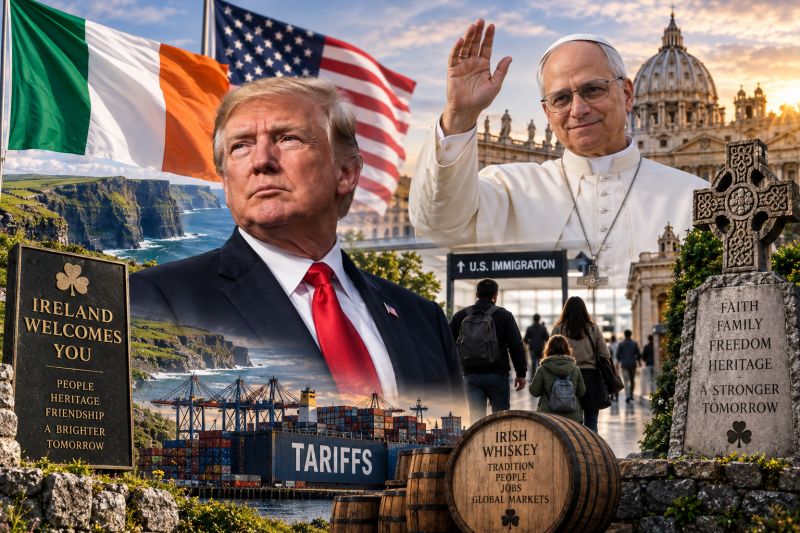
There is something almost irresistible about watching an American president stand in Ireland and talk about the Irish contribution to America.
Because, frankly, he is right.
The Irish did help build America.
We built its cities. We dug its canals. We laid its railroads. We served in its military, patrolled its streets, fought its fires, organized its workers, staffed its hospitals, filled its classrooms, built businesses, entered public service, raised families and became woven so deeply into the American story that separating Irish America from America itself is practically impossible.
Donald Trump understands the power of that story.
He certainly knows how to tell it.
During his St. Patrick’s Day events earlier this year, Trump praised the “amazing Irish American patriots” who helped America “thrive and prosper and prevail.” He talked about Irish-American inventors and builders. He celebrated Saint Patrick, called Irish-American heritage “a great heritage,” and said Irish Americans could be found throughout American life embodying excellence and success. (The American Presidency Project)
And now, during his September visit to Ireland, the president has again wrapped himself in the language of Irish-American friendship.
Some of what he said deserves recognition.
Trump publicly said he would “love” to see a united Ireland, calling it a “fantastic thing.” That was a remarkable departure from the traditional caution exercised by American presidents on the constitutional question, although any change in Northern Ireland’s status remains governed by the democratic consent provisions of the Good Friday Agreement. (Reuters)
He also announced Sunday that he intends to eliminate the 10 percent tariff on Irish whiskey after Taoiseach Micheál Martin, Irish Open champion Shane Lowry and others pressed him on the issue. That is good news for an industry for which the United States remains enormously important. (Reuters)
Those things matter.
But so does consistency.
And that is where I think we need to have a much more difficult conversation.
Because if we are going to celebrate Irish America, we cannot reduce Irish identity to shamrocks, golf courses, whiskey, Saint Patrick and flattering speeches.
We have to talk about immigrants.
We have to talk about families.
We have to talk about trade.
We have to talk about Catholic social teaching and the dignity of human beings.
We have to talk about peace.
And we have to be willing to ask whether the policies coming out of Washington actually reflect the affection for Ireland that American politicians so enthusiastically proclaim whenever there happens to be a shamrock bowl nearby.
The answer is considerably more complicated than the speeches suggest.
The Irish Contribution to America Is Not Political Flattery. It Is Historical Fact.
Before getting into Trump, we should establish something important.
The Irish contribution to America does not require Donald Trump’s validation.
It is written into American history.
The United States Census Bureau continues to document the enormous Irish-American presence in the country. It reported 116,641 U.S. residents born in Ireland in 2024 alone, alongside a vastly larger population claiming Irish ancestry. (Census.gov)
The migration story behind that population is inseparable from hardship.
Irish immigrants arrived in enormous numbers during and after the Great Famine. They frequently encountered anti-immigrant hostility and anti-Catholic prejudice. They settled heavily in places such as Boston, New York, Philadelphia and Chicago and gradually built institutions that became foundations of American urban life.
Churches.
Schools.
Labor organizations.
Neighborhood associations.
Political organizations.
Charitable societies.
Police departments.
Fire departments.
Construction trades.
The Irish-American experience is fundamentally an immigrant story.
That point matters enormously today.
In 2017, then-Taoiseach Enda Kenny stood in Washington and reminded Americans that Saint Patrick himself was an immigrant.
He described generations of Irish people who came to America seeking liberty, opportunity, safety and food and then helped build their adopted country. (Government of Ireland)
That wasn’t partisan rhetoric.
It was Irish-American history.
Which makes the current immigration debate particularly uncomfortable.
You Cannot Celebrate Irish Immigration in the Past While Pretending Irish Immigrants Do Not Exist in the Present
There is an easy way to celebrate immigration politically.
Celebrate immigrants who have been dead for 150 years.
Nobody has to make a difficult decision about them.
Nobody has to figure out what to do with their visa.
Nobody has to determine whether a family should be separated.
Nobody has to decide whether somebody who overstayed legal status decades ago, built a business, married an American and raised American children should be treated exactly the same as someone posing an actual danger to the community.
Dead immigrants are politically convenient.
Living immigrants are complicated.
And there are still Irish immigrants living that complication.
The Irish government was warning as early as 2025 that the environment for undocumented Irish people in the United States was likely to become substantially more difficult under the Trump administration. (The Irish Times)
Those concerns did not remain theoretical.
In February 2026, Ireland’s government confirmed that several Irish citizens had sought official assistance after being arrested and detained by Immigration and Customs Enforcement. Taoiseach Micheál Martin said he intended to raise concerns about the treatment of undocumented Irish people directly with Trump. (The Irish Times)
The numbers moved sharply.
Irish officials told the Dáil that the number of Irish citizens seeking consular assistance related to deportation increased from 15 in 2024 to 65 in 2025 — a 330 percent increase. (The Irish Times)
Now, perspective matters.
Those are not enormous numbers compared with immigration enforcement involving much larger immigrant populations.
But they expose an uncomfortable contradiction.
America celebrates the Irish immigrant who arrived in Boston in 1885 with almost nothing.
America romanticizes the Irish immigrant who came through Ellis Island.
America tells stories about the Irish laborer who worked himself to exhaustion so his children could have something better.
We put statues up to him.
We name streets after him.
We celebrate his descendants every March.
But when a modern Irish immigrant falls out of legal status, suddenly our historical memory becomes remarkably short.
That does not mean immigration laws should not exist.
They should.
A sovereign nation has both the authority and responsibility to control its borders, determine who enters, remove genuinely dangerous people and maintain an orderly immigration system.
But there is a tremendous moral and constitutional distance between enforcing law and abandoning proportionality.
A country can have borders without losing its humanity.
A country can enforce immigration law while respecting due process.
A country can prioritize violent criminals and genuine threats without treating every immigration violation as morally indistinguishable.
That distinction should be particularly understandable to Irish Americans.
Our ancestors were once the foreigners people were afraid of.
The Economic Relationship Is Much Bigger Than a Trade Deficit
Then there is trade.
Trump has repeatedly criticized America’s goods trade deficit with Ireland.
At the St. Patrick’s Day reception in March, he specifically pointed to what he described as a roughly $40 billion deficit and joked that something had to be done about it. (Roll Call)
The frustration fits Trump’s broader economic worldview: if America imports substantially more goods from another country than it exports there, he tends to view the imbalance as evidence that America is losing.
But Ireland demonstrates why bilateral trade balances can be misleading when separated from the larger economic relationship.
Ireland is an unusually globalized economy and a major pharmaceutical and technology production hub.
According to Ireland’s Central Statistics Office, Ireland exported €111.7 billion in goods to the United States during 2025, representing 42.9 percent of all Irish goods exports. Medical and pharmaceutical products alone represented more than half of Ireland’s total goods exports that year. (Central Statistics Office)
That dependence obviously makes Ireland vulnerable to American trade policy.
But the economic relationship runs both directions.
Enterprise Ireland reported this year that Irish investment in the United States had reached approximately $389 billion and that the ten largest Irish investors employ more than 125,000 Americans. (Enterprise Ireland)
Meanwhile, American companies have an extraordinary presence in Ireland.
More than 1,000 U.S.-linked operations employ over 218,000 people there — close to 10 percent of Ireland’s workforce. (RTE)
That is not a simple story of Ireland winning and America losing.
It is economic interdependence.
And tariffs disrupt both sides of that relationship.
The Tariffs Have Had Real Consequences
Irish policymakers had good reason to worry.
Internal Irish government analysis examining various tariff and trade-war scenarios warned that the country’s GDP could eventually be reduced by between 2.75 and 4 percent under more severe scenarios, while employment could decline between 2.5 and 3.25 percent. Those were modeled scenarios rather than measurements of what had already happened, an important distinction, but they demonstrate Ireland’s exposure. (RTE)
The Central Bank of Ireland separately modeled a scenario involving a 15 percent U.S. tariff on EU manufactured goods and estimated an overall Irish GDP reduction of approximately 0.6 percent, with pharmaceuticals contributing the largest portion of the decline. (Central Bank of Ireland - English)
Then came the volatility.
Ireland’s goods exports to the United States surged dramatically in early 2025 as companies front-loaded shipments ahead of anticipated tariffs. That makes year-to-year comparisons unusually tricky. But by the first half of 2026, Irish goods exports to the United States were down sharply from that artificially elevated 2025 period. (Central Statistics Office)
Irish whiskey provides perhaps the easiest example to understand.
The United States is the industry’s largest foreign market. Roughly 5.5 million cases were sold there in 2024 — about one-third of Irish whiskey sold globally. (Ibec)
The Irish Whiskey Association reported that exports fell 5 percent in 2025 after the introduction of a 15 percent tariff and repeatedly called for restoration of the previous zero-for-zero trading arrangement. (Ibec)
Trump has now announced that he intends to remove the remaining 10 percent tariff on Irish whiskey.
That decision should be welcomed on its merits.
Freeing trade is better than taxing it.
But removing a tariff your own administration imposed is not evidence that the tariff caused no damage in the first place.
And the whiskey episode illustrates something larger.
Tariffs are taxes imposed at the border.
Their costs do not magically disappear.
They can be absorbed by foreign producers, American importers, distributors, retailers or consumers in varying proportions depending on market conditions. They can reduce margins, alter supply chains and discourage investment.
For Irish-American communities, this isn’t merely an abstract debate about international economics.
Irish pubs import Irish products.
Irish-American retailers sell them.
American distributors move them.
Restaurants serve them.
American workers participate throughout that supply chain.
Trade barriers imposed on Ireland inevitably touch Americans too.
Then There Is the Question of Faith
This is where the contradiction becomes considerably more personal for many Irish Americans.
Catholicism is not the entirety of Irish identity.
Modern Ireland is far more religiously diverse and substantially more secular than the Ireland of previous generations.
Irish America has changed too. A 2023 survey discussed by The Irish Times found 47 percent of surveyed Irish Americans identified as Catholic, although only 12 percent said they regularly attended Mass. Among respondents under 35, Catholic identification was substantially lower. (The Irish Times)
Still, pretending Catholicism is somehow incidental to Irish history would be equally absurd.
For generations of Irish immigrants, the parish wasn’t merely somewhere you attended Mass on Sunday.
It was the center of community life.
It was where children were educated.
Where immigrants found assistance.
Where families celebrated marriages.
Where they buried their dead.
Where newcomers made connections.
Where neighborhoods developed identities.
Catholic institutions helped Irish immigrants survive in an America that was frequently hostile toward both their nationality and their religion.
Trump clearly understands the symbolic importance of Christianity when speaking to Irish audiences.
His St. Patrick’s Day remarks celebrated Saint Patrick and the Christian heritage associated with Ireland. (The American Presidency Project)
His official Easter message was explicitly Christian, celebrating Christ’s Resurrection, sacrificial love and victory over death. (The White House)
Which makes what happened on Easter Sunday itself especially jarring.
Easter Morning Was an Extraordinary Contrast
On April 5, Pope Leo XIV celebrated Easter by calling the world toward peace.
His message emphasized the victory of life over death, light over darkness and love over hatred. He urged humanity not to become accustomed to violence and called upon those possessing weapons to lay them down. (Vatican Press)
Trump’s Easter morning message concerning Iran could hardly have been more different.
In a social-media post, the president used explicit profanity while threatening Iran over the Strait of Hormuz and warning of hell if his demand was ignored. (Axios)
Whatever somebody thinks about Iran, American national security or the use of military force, the contrast was extraordinary.
On the morning Christians celebrate the empty tomb — the defining moment of the Christian faith — the Bishop of Rome was appealing for peace while the American president was publicly threatening another nation in language that would make most parents uncomfortable hearing from their children.
Then, one week later, the disagreement became personal.
Trump publicly attacked Pope Leo XIV, calling him “WEAK on crime” and “terrible for Foreign Policy” after the pontiff had criticized aspects of American military policy. (The Washington Post)
To be precise, Trump did not directly attack the Pope on Easter morning.
That happened the following Sunday.
The distinction matters because facts matter.
But the broader contradiction remains.
A president is certainly free to disagree with a pope.
Catholics themselves disagree vigorously over politics.
The pope is not the president of the United States. Catholic social teaching does not provide a ready-made American party platform. Prudential political judgments leave enormous room for legitimate disagreement.
But there is something profoundly strange about politicians invoking Catholic heritage when it is culturally useful while treating Catholic moral authority as disposable the moment it becomes politically inconvenient.
Faith cannot merely be decoration.
Catholicism Is Not a Campaign Prop
Catholic social teaching is difficult precisely because it refuses to fit comfortably inside American partisan categories.
It affirms human dignity.
It recognizes legitimate civil authority.
It recognizes the right of nations to regulate borders while insisting that migrants possess inherent human dignity.
It defends private property while insisting property carries social obligations.
It values markets while rejecting the idea that economic value is the highest measure of human worth.
It defends life.
It elevates the family.
It insists upon subsidiarity.
It emphasizes solidarity.
And it places extraordinarily demanding moral constraints around war and violence.
That means neither American political party gets to claim Catholicism without being challenged by it.
That is how it should be.
Faith is supposed to form politics.
Politics should never be permitted to rewrite faith.
And perhaps that is the biggest problem I have with the pageantry surrounding political appeals to Irish Catholics.
Do not tell us how much you admire our faith while expecting us to ignore it whenever its teachings become inconvenient.
Do not praise Saint Patrick while forgetting that Patrick was an immigrant.
Do not celebrate Irish immigrants of the nineteenth century while refusing to recognize the humanity of immigrants living among us today.
Do not praise Irish workers while embracing trade policies that can destabilize Irish industries and raise costs throughout American supply chains.
Do not celebrate Ireland’s Catholic inheritance while treating the pope like another political opponent when he challenges American power.
And certainly do not confuse reverence for Christianity with loyalty to any politician.
Those are very different things.
Ireland Is More Than a Political Backdrop
Trump’s visit also produced something that many people who care deeply about Ireland will understandably appreciate.
He expressed support for Irish unity.
He said he would “love” to see a united Ireland and described the prospect as “fantastic.” (Reuters)
For those who believe peaceful Irish reunification would represent the completion of a long historical journey, hearing an American president speak positively about unity is significant.
But even here, principle matters more than personality.
The Good Friday Agreement provides the framework.
The future of Ireland must be decided democratically and peacefully by the people who live there.
No coercion.
No romanticizing violence.
No return to sectarianism.
No American president gets to decide Ireland’s constitutional future.
Neither does London unilaterally in a moral sense.
The people do.
That is precisely what made the Good Friday Agreement such an extraordinary achievement: it replaced the bullet with the ballot and acknowledged that competing identities could coexist under a democratic framework.
America’s greatest contribution to Ireland should continue to be supporting that peace.
Friendship Requires More Than Compliments
Trump clearly has genuine economic and personal connections to Ireland.
His family’s Doonbeg resort matters economically to the surrounding community, and local residents have acknowledged the jobs and tourism it provides. (AP News)
His decision to remove the Irish whiskey tariff is welcome.
His positive remarks about Irish reunification will appeal to many Irish nationalists and Irish Americans.
His praise for the contribution of Irish Americans to the United States is historically justified.
None of that needs to be denied.
But friendship between nations cannot be measured by compliments.
It has to be measured by policy.
And that is why the relationship between Trump’s rhetoric and his record deserves scrutiny.
Irish America does not need another politician telling us that our ancestors were wonderful.
We know what they accomplished.
Their fingerprints are everywhere.
What matters is whether we have learned anything from their experience.
They arrived as immigrants.
They encountered prejudice.
They built families.
They formed communities.
They practiced their faith.
They worked.
They organized.
They fought for political representation.
They became Americans without ceasing to remember where they came from.
Eventually, people who were once portrayed as outsiders became so thoroughly American that presidents began competing to praise them.
There is a lesson in that.
Perhaps someday Americans will look backward at another immigrant community and wonder why their ancestors frightened us so much.
History has a habit of doing that.
We Should Judge Leaders by What They Do
I am glad an American president speaks proudly about Ireland.
I am glad he recognizes the contribution Irish Americans made to this country.
I am glad the Irish whiskey tariff is apparently going away.
And I believe peaceful Irish reunification, if freely chosen through the democratic framework established by the Good Friday Agreement, can be discussed openly without treating the subject itself as dangerous.
But none of those things should purchase silence.
Irish Americans should be capable of thanking a president when he gets something right and challenging him when we believe he gets something wrong.
That independence is part of our inheritance too.
Our loyalty should never belong blindly to a party, politician or political movement.
It should belong to principles.
To liberty.
To human dignity.
To family.
To community.
To constitutional government.
To peace whenever peace remains possible.
To the rule of law tempered by justice.
And, for those of us whose faith informs how we see the world, to something infinitely higher than political power.
Politicians come and go.
Administrations rise and fall.
Parties change.
Countries endure.
Faith endures longer still.
The relationship between Ireland and America survived British rule, famine, mass migration, civil war, two world wars, the Troubles, economic crises and generations of political change.
It will survive Donald Trump too.
Because the relationship was never created by a president.
It was created by people.
By millions of ordinary Irish men and women who crossed an ocean carrying very little except their families, their faith, their determination and the hope that tomorrow might be better than yesterday.
They did not merely come to America.
They helped make America.
Donald Trump is right about that.
The question worth asking is whether American policy today honors the lessons of their story as faithfully as American politicians honor their memory every March.
That is a much harder question.
And unlike a St. Patrick’s Day speech, it cannot be answered with applause.
Add comment
Comments