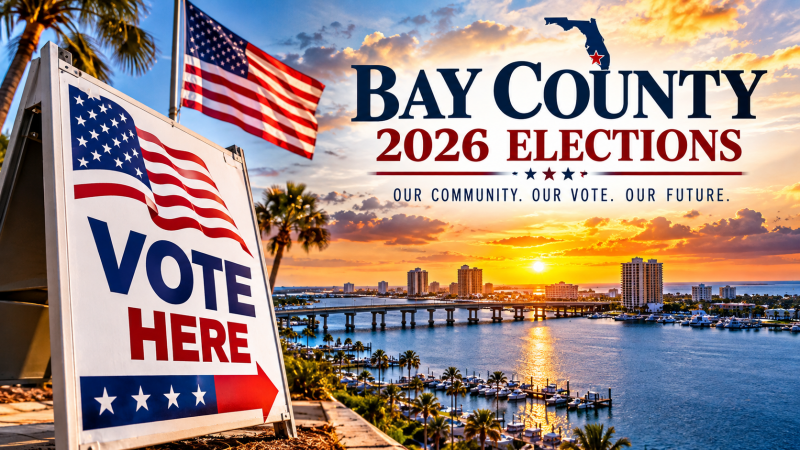
National politics gets most of the oxygen.
Turn on the television, scroll through Facebook, open X, or spend five minutes reading the news and you’ll hear plenty about Washington, Tallahassee, Congress, governors, presidents, and whatever national controversy happens to be dominating the day.
But here’s the funny thing about politics: some of the elections that have the most immediate impact on our everyday lives are the ones happening right here at home.
Who sits on our school board?
Who serves on our city commissions?
Who decides how our communities handle growth, infrastructure, public safety, development, utilities, budgets, and taxes?
Those decisions aren’t being made 900 miles away in Washington.
A lot of them are being made right here in Bay County.
And with the November 3 general election approaching, I wanted to take a serious look at what is actually happening across Bay County—not through partisan talking points, campaign mailers, or Facebook rumors, but through election results, candidate filings, campaign-finance reports, and what the candidates themselves have been saying.
There are some races that are already effectively over.
There are others that remain very much contested.
And perhaps most interestingly, despite all the political chatter we hear locally, there appears to be virtually no credible public polling of our major local races.
So let’s talk about what we actually know.
First, understand the Bay County electorate
Before looking at individual races, it helps to understand who is actually registered to vote here.
As of September 25, the Bay County Supervisor of Elections reported 128,101 active registered voters.
Of those:
75,183 are Republicans.
23,845 are Democrats.
29,073 are registered with another party or no major-party affiliation.
That works out to roughly 58.7% Republican, 18.6% Democratic, and 22.7% other. (Bay Votes)
That obviously creates an enormous structural Republican registration advantage in partisan elections.
But here’s something important that sometimes gets lost in the discussion.
A lot of the elections we’re talking about aren’t partisan elections.
You aren’t going to see an “R” or a “D” next to candidates in races like Callaway City Commission or Panama City Beach City Council. School board elections are also nonpartisan.
That changes the conversation considerably.
And almost 23% of Bay County’s registered voters aren’t registered with either major party anyway.
So while partisan registration gives us useful context, it doesn’t tell us who is going to win every local election.
Election Day is Tuesday, November 3, 2026. Vote-by-mail ballots began going out September 24, and the voter-registration deadline for the general election is October 5. (Bay Votes)
In other words, this isn’t some election six months down the road.
Voting is beginning.
Bay County Commission: Not much suspense left
If you were expecting a major November battle for the Bay County Commission, you aren’t getting one.
County Commission Districts 2 and 4 were scheduled for election this cycle. (Bay Votes)
In District 2, Robert Carroll was the only candidate to qualify.
In District 4, Scott Duvall was the only candidate to qualify. (AOL.com)
That means neither commission seat will give Bay County voters a competitive November election.
Regardless of how anyone feels about either individual, I think that’s worth noticing.
Local elections work better when voters have choices, candidates have to explain their positions, incumbents or officeholders have to defend their records, and the public gets a genuine debate over the direction of government.
This year, those particular choices are going to be found elsewhere on the ballot.
Bay County School Board District 2: Decided by fewer than 1,000 votes
School Board District 2 has already been settled.
Ginger Littleton defeated Michael Petty in August, receiving 16,132 votes to Petty’s 15,157.
That’s a difference of only 975 votes.
Littleton finished with approximately 51.5% of the vote, allowing her to win outright without a November runoff.
If anybody ever tells you local elections don’t matter because one vote doesn’t make a difference, remember races like this.
Thousands upon thousands of Bay County residents simply don’t participate in local elections, and margins can become surprisingly small.
School Board District 3 is the race to watch
If there is one countywide local election where we have meaningful voter data heading into November, it’s Bay County School Board District 3.
The race originally had four candidates:
Christopher Moore
Dr. John Haley
Colleen Koch
Glenn Manley
Incumbent Christopher Moore was first elected in 2022 and is seeking another term. WFSU reported during the primary that the campaign was being shaped by concerns including district finances, transparency, enrollment and student performance. (WFSU News)
The August results were remarkably close.
Moore received roughly 29%.
Haley received roughly 28%.
Koch received roughly 28%.
Manley received roughly 14%.
Because nobody received a majority, Moore and Haley advanced to the November runoff. (WJHG)
And here’s what makes this election particularly interesting.
The difference between Moore and Haley in August was tiny.
Moore received 9,013 votes.
Haley received 8,826.
That’s a difference of only 187 votes.
But almost 42% of voters supported neither Moore nor Haley.
Those voters now have another decision to make.
That’s why simply taking the August numbers and projecting them forward doesn’t work.
These aren’t the same electoral circumstances anymore.
The November electorate will be different, turnout will be substantially affected by statewide and federal races, and voters who supported Koch or Manley now have to choose between Moore and Haley—or leave the race blank.
There are also substantive differences in what the two candidates have emphasized.
Haley has talked about improving student performance and making Bay District Schools more competitive with charter, private, and virtual alternatives.
Moore has emphasized financial stewardship and budget transparency, arguing that improving outcomes requires the district to responsibly manage the money available to it. (WJHG)
That’s the kind of local policy debate voters should actually be having.
Not Republican versus Democrat.
Not Trump versus whoever happens to be on television that night.
What are we doing with our schools?
What are the outcomes?
Where is the money going?
Why are families choosing alternatives?
And what specifically should the school district do differently?
Those are local questions with local consequences.
School Board District 5
This one is straightforward.
Steve Moss was the only candidate to qualify for School Board District 5. (AOL.com)
So the real school-board attention heading into November belongs to District 3.
Now let’s come home to Callaway
This is where things get especially interesting for those of us living on this side of Bay County.
Callaway has two contested City Commission elections.
And unlike the County Commission races, voters actually have choices.
Callaway Ward 1: Bobby Birdsell vs. Karen Custer
Ward 1 features:
Bobby J. Birdsell
and
Karen Custer
Both are qualified candidates.
Campaign-finance filings show a small-dollar local campaign, which isn’t unusual in municipal politics.
As of the latest figures available, Birdsell had reported approximately $1,200 in monetary contributions and about $732 in expenditures.
Custer had reported approximately $2,114 in contributions and about $1,525 in expenditures. (Florida Money Watch)
Now, before somebody turns those numbers into something they aren’t, fundraising doesn’t tell us who is going to win.
Especially not in an election this small.
A few hundred dollars can dramatically change the fundraising percentages in a municipal campaign.
What it does tell us is that Custer has currently raised and spent more money than Birdsell.
That’s it.
There is no credible public scientific poll that I can find measuring Birdsell against Custer.
So when we’re trying to understand where this election stands, we’re largely looking at campaign activity, community engagement, candidate visibility, endorsements, local relationships, and eventually turnout.
And in a municipal election, those things can matter enormously.
Callaway Ward 2: Jamie Kirkland vs. Spring Overway
Ward 2 gives Callaway voters another contested election.
The qualified candidates are:
Jamie Kirkland
and
Spring Overway.
Shannon Aufdencamp entered the process but did not qualify for the ballot. (Florida Money Watch)
The financial picture here is interesting.
Kirkland’s filings showed no monetary contributions and roughly $302 in in-kind support.
Overway reported approximately $1,650 in monetary contributions, another $750 in in-kind support, and roughly $1,511 in expenditures. (Florida Money Watch)
Again, don’t confuse money with votes.
They’re two completely different things.
But campaign-finance reports are one of the few objective measurements available when there isn’t polling.
And I haven’t found credible public polling of this race either.
That makes Callaway’s elections particularly old-school.
Candidates have to meet people.
Talk to neighbors.
Show up.
Knock doors.
Answer questions.
Build relationships.
And convince a relatively small number of voters that they’re the right person to represent the community.
Personally, I think local politics could use a little more of that.
Panama City Beach has two competitive council elections
Head west and Panama City Beach voters have two contested City Council races.
And there’s considerably more money moving through at least one of them.
PCB Ward 1: Carlos Sanchez vs. Grant Wittstruck
The Ward 1 contest is between:
Carlos Sanchez
and
Grant Wittstruck.
A third candidate, Scott Heilmann, did not qualify. (The Ballot Brief)
This is an open seat, and every Panama City Beach voter gets to vote in the election; the ward establishes the residency requirement for the officeholder. (The Ballot Brief)
Sanchez brings a substantial military background. According to his campaign biography, he served more than 23 years on active duty in the Air Force as an Explosive Ordnance Disposal technician and retired as a Chief Master Sergeant after deployments that included Iraq and Afghanistan. His professional experience has also included government infrastructure and public-works roles. (The Ballot Brief)
Wittstruck is a local business owner and longtime Panama City Beach resident who has served on organizations and boards including the PCB Planning Board, Half-Cent Sales Tax Oversight Committee, Beach Care Services, Grand Lagoon Coalition, and Panama City Beach Chamber of Commerce Executive Board. (The Ballot Brief)
The candidates have emphasized issues familiar to anyone watching Bay County’s growth:
Public safety.
Infrastructure.
Utilities.
Transportation.
Neighborhoods.
Beaches.
Parks.
Growth.
Those aren’t abstract ideological questions.
They’re some of the biggest practical questions facing this entire county.
And the fundraising reflects the seriousness of the contest.
Current campaign-finance data show both candidates raising tens of thousands of dollars, with Wittstruck reporting the larger total. Recent county filings tracked by local election databases put Wittstruck above $50,000 and Sanchez above $28,000. (The Ballot Brief)
That’s real money for a municipal council election.
Yet despite the money being spent, I still can’t find a credible scientific public poll telling us what PCB voters actually think.
PCB Ward 3: Mary Coburn vs. Nick Atkinson
Ward 3 is:
Mary Coburn
versus
Nicholas “Nick” Atkinson.
Coburn is the incumbent and was first elected in 2022. (The Ballot Brief)
Atkinson is challenging her in November.
Every PCB voter also votes in this contest, despite the ward residency requirement. (The Ballot Brief)
Again, there is no credible public polling I’ve been able to locate.
That means anyone claiming they know exactly where this election stands should be able to show their work.
What’s the poll?
Who conducted it?
How many people were surveyed?
When was it conducted?
Were they registered voters or likely voters?
What was the methodology?
Without that information, a “poll” is just a number somebody said.
Lake Powell Community Development District
Here’s one that won’t generate nearly as many Facebook arguments but is nevertheless on the ballot.
Bay County has Lake Powell Community Development District Seats 2 and 5 up for election this cycle. (Bay Votes)
The contests are:
Seat 2: Alyssa Finneyfrock vs. Greg Porta
Seat 5: Kenneth Black vs. Tim Rosson
These are exactly the kinds of races that frequently receive little public attention even though special districts can make decisions involving assessments, infrastructure, facilities, and community services that directly affect residents.
If one of these appears on your ballot, don’t skip it simply because you’ve never seen the candidates on television.
Research them.
Florida House District 6
Moving one level up brings us to the Florida Legislature.
House District 6 is an open-seat contest between:
Tricia Berry, Republican
and
Stephanie Lyn Leonard, Democrat.
Both are officially qualified for the November general election. (Florida Division of Elections)
Again, I’ve found no credible public scientific polling of this matchup.
Given Bay County’s registration numbers, partisan registration provides useful context for understanding the electorate. But registration isn’t a poll, and it shouldn’t be presented as one.
That’s an important distinction.
Florida Senate District 2
The Florida Senate race features incumbent Republican Jay Trumbull against Democrat Lauren Donahoo.
Trumbull is officially qualified for reelection, and state election records list Donahoo as the qualified Democratic candidate. (Florida Division of Elections)
This district extends beyond Bay County, so Bay County registration numbers alone don’t describe its entire electorate.
And once again, there isn’t meaningful public polling available that gives us a reliable current measurement of the matchup.
Florida’s 2nd Congressional District
Then we get to Congress.
Florida’s 2nd Congressional District is an open-seat election this year.
The Republican nominee is Austin Rogers, who is officially qualified for the November ballot. (Florida Division of Elections)
He faces Democratic nominee Amanda Marie Green.
Despite the attention congressional races normally receive, I haven’t found credible public general-election polling of the Rogers-Green matchup.
That’s worth emphasizing because there’s an important difference between a poll and a forecast.
A poll asks voters who they support.
A forecast uses things like historical election results, partisan composition, fundraising, incumbency, national political conditions, and sometimes polling to estimate an outcome.
Those aren’t interchangeable.
If there aren’t actual surveys of voters, we shouldn’t pretend a statistical model is one.
So where do the Bay County elections actually stand?
This is the part where I think we need to be careful.
Political people love predictions.
Everybody wants to tell you who’s “winning.”
Everybody knows somebody who knows somebody who heard that an internal poll says something.
I’m not interested in pretending we know things that the publicly available evidence doesn’t establish.
Here’s what we do know.
Bay County remains overwhelmingly Republican by voter registration in partisan contests. Republicans account for roughly 59% of active registered voters countywide. (Bay Votes)
The County Commission races are essentially settled because Robert Carroll and Scott Duvall were the only candidates to qualify in their respective districts. (AOL.com)
School Board District 3 produced an extraordinarily close first round, with only 187 votes separating Christopher Moore and John Haley, meaning the November runoff starts from a primary result in which neither candidate came remotely close to a majority.
Callaway has two genuine head-to-head municipal contests.
Panama City Beach has two genuine head-to-head council contests.
And despite all of that political activity, reliable public polling of these local elections is virtually nonexistent.
That means we’re going into the final weeks with considerably less hard data than we have in gubernatorial, Senate, or presidential elections.
And frankly?
I don’t necessarily think that’s a bad thing.
Local elections should force us to do our homework
We’ve gotten incredibly lazy about politics.
Someone puts an R beside their name and half the population automatically loves them.
Put a D beside their name and another portion automatically supports them.
Then everybody spends the next four years complaining that government doesn’t work.
Local elections give us an opportunity to do something different.
There often isn’t a partisan label.
You actually have to learn who these people are.
You have to look at their background.
Look at their record.
Read their campaign-finance reports.
Listen to candidate forums.
Ask what they think about growth.
Ask what they think about taxes.
Ask what they think about spending.
Ask what they think about infrastructure.
Ask what they think about public safety.
Ask school-board candidates what they think about student performance, parental choice, budgets, classroom outcomes, teachers, discipline, and transparency.
And when somebody already holds office?
Look at what they’ve actually done.
Not what their campaign website says.
Not what their mailer says.
Not what their Facebook page says.
Look at the record.
That’s something I’ve learned after years of working in public policy and grassroots politics: campaign rhetoric is easy.
Governing is where people’s priorities become visible.
Bay County is changing quickly
This election also comes at an important moment for this community.
Bay County continues dealing with growth, housing affordability, infrastructure demands, traffic, stormwater, public safety, development, education, tourism, property taxes, and the challenge of maintaining the character of communities while accommodating new residents and investment.
Those issues aren’t going away after November 3.
In many cases, they’re going to become more important.
Which means these local offices matter.
A lot.
It’s easy to obsess over Congress while ignoring the people deciding what happens five minutes from your house.
It’s easy to argue about Washington while knowing absolutely nothing about your city commission.
It’s easy to complain about schools while skipping the school-board race.
It’s easy to complain about development while never attending a planning meeting.
And it’s really easy to complain about government after an election you didn’t bother researching.
We can do better than that.
There are still questions worth asking
Between now and Election Day, I think voters should be demanding specifics from these candidates.
How are you going to address infrastructure as Bay County grows?
What spending would you increase?
What spending would you reduce?
When should local government say no to development?
How should we deal with rising property-tax burdens?
How transparent should city and county government be with residents?
What metrics should we use to determine whether our schools are succeeding?
How do we improve public safety without sacrificing constitutional rights and individual privacy?
What should government stop doing?
That’s one of my favorite questions, because politicians are almost always prepared to tell you what government should do next.
They’re considerably less prepared to tell you what government shouldn’t be doing in the first place.
November 3 is about considerably more than Washington
There will be plenty of national political noise over the next several weeks.
Probably too much.
But when you walk into that voting booth—or fill out that vote-by-mail ballot—keep going after the congressional races.
Keep reading.
There are decisions much closer to home.
School Board.
City Commission.
City Council.
Special districts.
Florida House.
Florida Senate.
These races aren’t filler at the bottom of the ballot.
These are the people who can affect your roads, your neighborhoods, your schools, your taxes, your utilities, your development patterns, and your community.
And unlike national politics, you may actually run into these people at Publix.
That’s about as local as democracy gets.
So research them.
Ask questions.
Watch the forums.
Read the filings.
Ignore the Facebook rumors.
And when somebody tells you a candidate is “winning,” ask them for the data.
Because right now, in most of these local Bay County races, the honest answer is that we simply don’t have reliable public polling telling us where voters stand.
What we do have are candidates, records, campaign-finance reports, an August election that gave us useful information in the School Board race, and ultimately the most important poll of all:
The one Bay County voters will conduct on November 3.
That’s the one that counts.
Add comment
Comments