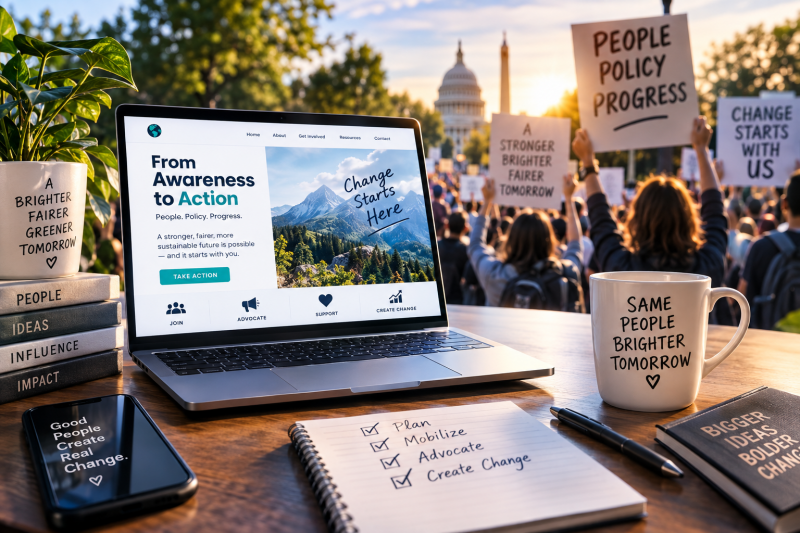
Digital advocacy is one of those things that looks incredibly easy from the outside.
Create a Facebook page. Make a graphic. Start a petition. Send some emails. Post a few videos. Maybe throw some money behind an ad.
Then wait for change to happen.
Unfortunately, that is how a lot of digital advocacy campaigns are actually built—and it is also why so many of them go absolutely nowhere.
A successful digital advocacy campaign is not a social media campaign.
It is an organizing campaign that uses digital tools to move real people toward real actions that produce a measurable outcome.
That distinction changes everything.
I’ve spent years working around digital organizing, grassroots advocacy, campaigns, coalitions, communications, and public policy. One of the biggest lessons I’ve learned is that the technology is rarely the hardest part.
The hard part is building the machine behind it.
You need a clearly defined objective. You need to understand who can actually deliver that objective. You need supporters. You need a message people understand. You need infrastructure capable of capturing those supporters. You need to move people through increasingly meaningful actions. You need data telling you what is working. And eventually, all that digital activity has to leave the screen and become something decision-makers can see, hear, count, or feel.
That is digital advocacy.
And if I were building a campaign completely from scratch today, this is how I would do it.
Step 1: Start With the Win, Not the Website
Before creating a logo, buying a domain, opening social accounts, or designing your first graphic, answer one question:
What specifically has to happen for us to win?
Not:
“We need to raise awareness.”
Not:
“We want people talking about this.”
Not:
“We want to educate the community.”
Those may be necessary parts of a campaign, but none of them is a measurable victory.
A campaign objective should describe an observable change.
For example:
We need the county commission to adopt Ordinance X before the end of the legislative session.
Or:
We need the state legislature to advance a specific reform through committee and secure enough support for passage.
Or:
We need a company to change a specific policy.
Or:
We need 5,000 residents to formally submit comments before a regulatory deadline.
Notice the difference.
Once you define the win, you can work backward.
This sounds elementary, but it prevents one of the most common failures in advocacy: confusing activity with progress.
A campaign can generate 2 million video views and accomplish nothing.
Another campaign might generate 400 constituent emails, 75 phone calls, 30 people at a public meeting, five local organizations joining a coalition, and three critical decision-makers changing their positions.
The second campaign may look smaller online while being infinitely more successful.
Reach is not the objective. Change is the objective.
Step 2: Build a Theory of Change
Once you know what winning looks like, determine how your actions could realistically produce it.
This is your theory of change.
Strip away the jargon and it is basically:
If we do X, we believe Y will happen because Z.
Suppose you are trying to change a local ordinance.
Your theory might look something like this:
If we identify residents affected by the ordinance, organize them into a visible constituency, document their experiences, generate constituent contacts to commissioners, build support among community organizations, earn local media coverage, and turn supporters out to commission meetings, then enough commissioners may support changing the ordinance because maintaining the existing policy becomes harder to justify politically and substantively.
Now you have a strategy.
More importantly, you can test it.
What if commissioners already support the proposal but staff members are the obstacle?
Different strategy.
What if the public overwhelmingly supports your position but nobody knows an administrative rule is preventing implementation?
Different strategy.
What if one committee chairman effectively controls whether the proposal ever receives consideration?
Very different strategy.
Never assume that “more pressure” automatically equals victory.
First understand where the decision actually gets made.
Step 3: Map Power Before You Map Audiences
This is where advocacy separates itself from ordinary digital marketing.
A business generally asks:
Who is likely to buy this product?
An advocacy campaign must ask:
Who has the power to make this decision, and who has the power to influence those people?
Start with the actual decision-maker.
Maybe it is five county commissioners.
Maybe it is a mayor.
Maybe it is a legislative committee.
Maybe it is a governor.
Maybe it is an agency administrator.
Maybe it is a corporate board.
Then build outward.
Who does that person listen to?
Constituents?
Donors?
Community leaders?
Business owners?
Subject-matter experts?
Local elected officials?
Religious or civic leaders?
Industry organizations?
Employees?
Local media?
Other lawmakers?
You are essentially creating a power map.
I like thinking about it in several layers.
At the center are the people who can directly produce the outcome.
Around them are people with direct influence over those decision-makers.
Around those people are organizations, communities, constituencies, media outlets, experts, and networks capable of influencing the influencers.
Your digital strategy should ultimately connect supporters somewhere inside that map.
Otherwise you are generating noise without leverage.
Step 4: Research Before You Message
Advocacy organizations frequently make the mistake of deciding what they want to say before learning what their audience actually thinks.
Research first.
And don’t limit research to demographics.
Age, location, income, education, and political affiliation can tell you something about an audience. They rarely tell you why someone cares.
You need to understand motivations.
What does your potential supporter already believe?
What worries them?
What language do they naturally use when discussing the issue?
What misconceptions exist?
What would make someone care who currently doesn’t?
What would prevent someone who agrees with you from taking action?
What action would they realistically take?
Current nonprofit practice reinforces the importance of this work. M+R’s 2025 Benchmarks found that 52% of participating organizations conducted some form of audience research during 2024. Surveys were the most common method, while organizations also used interviews, focus groups, and third-party data. Eighty percent used A/B testing to evaluate email or advertising messages. (M+R Benchmarks 2025)
You don’t necessarily need a massive research budget.
Talk to people.
Run surveys.
Read public comments.
Interview stakeholders.
Study local news coverage.
Analyze search behavior.
Review comments underneath related stories.
Talk to people who agree with you.
Then—and this is incredibly important—talk to people who don’t.
You will often learn more from the second group.
Step 5: Develop the Message Architecture
Once you understand the issue and audience, build the messaging framework.
Your campaign needs to answer five questions quickly:
What is happening?
Why should I care?
Who is affected?
What should change?
What can I personally do about it?
If people cannot understand those answers within a few moments, your campaign has a messaging problem.
Advocates often suffer from what I call the expert trap.
You have spent six months researching a 73-page policy proposal, so naturally you want to explain all 73 pages.
Your audience does not.
That doesn’t mean you dumb down the issue.
It means you organize information intelligently.
Your website can contain detailed research, citations, reports, FAQs, legislative language, and long-form analysis.
Your 30-second video has a different job.
Your Facebook post has another.
Your email subject line has another.
Your petition page has another.
The underlying message should remain consistent while the depth changes depending on the platform and audience.
Think:
One campaign. One central story. Many formats.
Step 6: Build the Digital Infrastructure Before You Drive Traffic
Now we finally get to technology.
Before launching publicly, I want the campaign infrastructure operational.
At minimum, that means a campaign website or landing page, email collection, analytics, an advocacy/action tool, supporter database or CRM, social channels, conversion tracking, and a system for managing volunteers and follow-up.
The website should answer three questions almost immediately:
What is this?
Why does it matter?
What do you want me to do?
Do not bury the action beneath six paragraphs of organizational history.
If the primary action is “Contact Your Commissioner,” that button should be impossible to miss.
If it is “Join the Coalition,” make that obvious.
If it is “Sign the Petition,” don’t make someone hunt for the petition.
Every additional unnecessary step creates friction.
And friction kills conversion.
Your analytics should track more than pageviews.
Track where people came from.
Track landing-page conversion.
Track email acquisition.
Track action completion.
Track repeat actions.
Track volunteer sign-ups.
Track donations when applicable.
Track which messages generate actions rather than merely engagement.
Because there is a major difference between the post that receives 10,000 likes and the post that produces 500 constituent emails.
The second one is probably more valuable.
Step 7: Build an Owned Audience
This might be the single most important piece of digital infrastructure.
Do not build your entire movement on rented land.
You don’t own Facebook.
You don’t own Instagram.
You don’t own TikTok.
You don’t own X.
Algorithms change. Platforms change. Accounts get restricted. Organic reach fluctuates. Entire networks rise and fall.
Your supporter database is different.
Email addresses and properly permissioned supporter information create an audience you can communicate with directly.
And despite endless predictions about email dying, the numbers continue telling a different story.
M+R’s 2026 Benchmarks found nonprofit email lists increased by an average of 5% during 2025. Advocacy emails generated an average click-through rate of 2.3% and a response rate of 1.4%. Across the year, nonprofit email programs generated an average of 0.14 advocacy actions per subscriber. (M+R Benchmarks 2026)
That is why almost every campaign action should create an opportunity to build the supporter file—with clear consent and appropriate privacy practices.
Someone signs a petition?
Invite them into the campaign.
Someone attends an event?
Give them an opportunity to subscribe.
Someone downloads research?
Ask whether they want updates.
Someone volunteers?
Capture their contact information and interests.
Social media creates discovery.
Your database creates continuity.
Step 8: Create an Engagement Ladder
This is where campaigns begin turning an audience into an organization.
Not everyone who encounters your campaign is ready to spend Saturday morning knocking doors or testify at a public meeting.
That’s fine.
Give people progressively meaningful ways to participate.
A typical engagement ladder might look like:
See → Follow → Subscribe → Sign → Share → Contact → Attend → Volunteer → Recruit → Lead
Someone sees a video.
They follow your account.
Later they subscribe to your email list.
Then they sign a petition.
Then you ask them to email their representative.
Then they attend an online briefing.
Then they attend a public meeting.
Eventually they volunteer.
Maybe that volunteer becomes a neighborhood captain who recruits ten additional people.
That transformation is the entire point.
Because advocacy is not about accumulating followers.
It is about developing participants.
Pew Research Center’s 2026 study of civic engagement illustrates how dramatically participation levels differ. Pew identified a highly engaged group it called “Mobilizers,” representing about 9% of U.S. adults. Among this group, 77% reported volunteering during the previous year and 65% reported contacting an elected official. Meanwhile, another 31% of adults fell into a “Spectator” group that followed news closely but participated much less frequently in direct civic activity. (Pew Research Center)
That is an incredibly useful way to think about advocacy.
There are people watching your campaign who agree with you but haven’t crossed the bridge from spectator to participant.
Your job is to build that bridge.
Step 9: Build a Content Engine, Not a Posting Schedule
I hate seeing advocacy strategies that basically amount to:
Monday: Facebook graphic.
Tuesday: Tweet.
Wednesday: Instagram Reel.
Thursday: Quote graphic.
Friday: Newsletter.
That’s a calendar.
It isn’t necessarily a strategy.
Every piece of content should serve a purpose inside the campaign.
I generally think of advocacy content as performing one of several jobs: education, storytelling, credibility, recruitment, mobilization, social proof, rapid response, or conversion.
Educational content explains the issue.
Storytelling shows the human impact.
Credibility content provides research, experts, documents, or evidence.
Recruitment content grows the audience.
Mobilization content asks people to act.
Social-proof content shows people that others are participating.
Rapid-response content connects the campaign to developments happening right now.
Conversion content drives someone toward a specific action.
You need the mixture.
If every post says “ACT NOW,” people eventually tune you out.
If every post simply educates without ever asking people to act, you have created a news outlet instead of an advocacy campaign.
Step 10: Use Social Media for Discovery and Distribution
Social media absolutely matters.
But understand its job.
Pew reported in 2025 that 42% of U.S. social media users considered these platforms important to them personally for getting involved with political or social issues. (Pew Research Center)
Americans also consume substantial amounts of news through social platforms. Pew’s 2025 data found that 38% of U.S. adults regularly got news through Facebook and 35% through YouTube, while 20% did so through Instagram and another 20% through TikTok. (Pew Research Center)
So social media belongs near the top and middle of your funnel.
Use it to introduce people to the issue.
Use video to explain complicated concepts.
Use graphics to make data understandable.
Use stories to humanize policy.
Use livestreams to bring people inside events.
Use short-form content to create discovery.
Use long-form content to establish authority.
Then direct people somewhere you control.
Social → Website → Action → Database → Follow-up → Deeper action.
That is a digital organizing funnel.
Step 11: Turn Supporters Into Messengers
Organizations naturally want people to share organizational content.
But people trust people.
One of the most important experiments in digital political mobilization remains a massive randomized study published in Nature involving 61 million Facebook users during the 2010 U.S. congressional elections.
Researchers found that social messages affected political expression, information seeking, and real-world voting behavior. Particularly important was the role of social transmission: close social relationships were instrumental in spreading real-world behavior. (Nature)
There is an enormous organizing lesson inside that research.
Your strongest distribution network may not be your organization’s account.
It may be your supporters.
Give them materials they can personalize.
Provide talking points.
Give volunteers graphics.
Create sample messages.
Provide links.
Give them short videos.
Create toolkits for community leaders.
Encourage people to tell their own stories rather than simply copying yours.
The campaign becomes dramatically more powerful when information travels:
Organization → Supporter → Friend
instead of only:
Organization → Public.
Step 12: Make Every Call to Action Specific
“Get involved.”
That’s terrible.
How?
“Make your voice heard.”
How?
“Stand with us.”
Doing what?
A strong advocacy call to action tells someone exactly what to do.
Email your commissioner.
Call these three legislators.
Register for Tuesday’s hearing.
Submit your public comment before 5 p.m. Friday.
Share your story with us.
Recruit three friends.
Join Saturday’s volunteer training.
Specificity reduces hesitation.
Whenever possible, explain the time commitment too.
“Send a message in under two minutes” feels manageable.
“Get involved in our movement” sounds like you’re asking someone to reorganize their entire life.
Step 13: Don’t Stop at Petitions
Petitions can be useful.
But collecting signatures is not the same thing as organizing.
A petition is usually best understood as an entry point.
Suppose 5,000 people sign.
Great.
What happens next?
Segment them geographically.
Identify which decision-makers represent them.
Ask them to send individualized messages.
Invite highly engaged supporters to calls.
Ask people with relevant experiences to submit stories.
Recruit volunteers.
Find community leaders.
Invite supporters to public meetings.
Ask a portion of them to make phone calls.
Now those 5,000 petition signatures become an organizing universe.
A database without follow-up is just a spreadsheet.
Step 14: Build an Email Journey Instead of Blasting Everyone
Someone who joined yesterday should not necessarily receive the same communication as someone who has volunteered for six months.
Build journeys.
A new supporter might receive:
Day 0: Welcome and explanation.
Day 2: Deeper educational content.
Day 4: Personal story.
Day 6: First low-friction action.
Day 9: Campaign update.
Day 12: Volunteer invitation.
That’s only an illustration; the actual cadence should reflect your campaign and testing.
Segment supporters by geography, interests, action history, volunteer status, donor history where applicable, and engagement level.
A person represented by Commissioner A should receive a different legislative action request from someone represented by Commissioner B when their officials occupy different positions or roles.
That isn’t merely personalization.
It is relevance.
Step 15: Build the Coalition Early
A campaign is stronger when the public sees multiple independent voices reaching similar conclusions.
Identify organizations with overlapping interests.
They don’t need to agree with you about everything.
In fact, some of the strongest coalitions are built by organizations that disagree about plenty but recognize common ground around one specific objective.
Create a coalition kit containing campaign background, factual resources, action links, sample social copy, graphics, talking points, important dates, and media information.
But don’t turn coalition partners into decorative logos.
Give them ownership.
Ask for input.
Let organizations communicate with their own audiences in their own voices.
Authenticity matters.
Step 16: Integrate Digital and Offline Organizing
This is where digital advocacy becomes real advocacy.
The objective isn’t to keep people online forever.
Digital tools should eventually produce phone calls, meetings, testimony, letters, public comments, volunteers, coalition partners, community events, constituent visits, earned media, and other meaningful civic participation.
A Facebook group with 20,000 members can look impressive.
Twenty residents showing up at a meeting where normally three members of the public attend may have far more immediate significance.
Digital organizing gives you scale.
Traditional grassroots organizing gives that scale physical form.
The strongest campaigns combine both.
Step 17: Build a Volunteer Leadership Pipeline
Eventually, campaign staff become the bottleneck.
That’s actually a good problem.
If every action requires staff approval, staff execution, and staff follow-up, your campaign cannot scale.
Develop leaders.
Start with simple responsibilities.
Ask someone to recruit five friends.
Then let them help host an online meeting.
Then perhaps coordinate volunteers in their neighborhood.
Eventually, they might train other volunteers.
Now instead of:
One organizer → 100 supporters
you begin creating:
One organizer → 10 leaders → 100 volunteers → thousands of contacts.
That is organizing.
Your organization stops being the center of every interaction and becomes the infrastructure allowing people to organize one another.
Step 18: Use Paid Media Strategically
Advertising can accelerate a campaign.
It cannot rescue a bad one.
Use paid media for clearly defined purposes: acquiring supporters, distributing important educational content, promoting events, expanding reach around campaign milestones, testing messages, or reaching legally permissible audiences relevant to the campaign.
And measure actions downstream.
Cheap clicks aren’t necessarily valuable.
A campaign paying $0.30 per click but generating almost no actions may be performing worse than one paying $1.20 per click whose visitors consistently become supporters.
Calculate:
Cost per acquired supporter.
Cost per completed action.
Cost per volunteer lead.
Cost per event registration.
Cost per donation, when fundraising is part of the program.
Digital advertising remains a meaningful investment for advocacy organizations. M+R reported nonprofit advertising investment increased 11% in 2024, while roughly half of participating organizations reported working with social media influencers. Among organizations running paid influencer campaigns, 65% used them for advocacy or volunteer asks and 77% for narrative or persuasion work. (M+R Benchmarks 2025)
But paid distribution should amplify strategy—not substitute for it.
Recent research provides another useful caution. A 2026 Nature Human Behaviour research briefing describing a field experiment with more than 60,000 participants found that removing political advertising from participants’ Facebook and Instagram feeds before the 2020 election produced no detectable effects on several measured political outcomes, including turnout and participation. (Nature)
That doesn’t mean digital ads are useless.
It means impressions alone aren’t magic.
Step 19: Measure the Funnel
This is where digital advocacy becomes a discipline rather than an art project.
Build a dashboard.
At the awareness level, measure things like reach, impressions, video views, website visitors, search traffic, and earned-media referrals.
At the acquisition level, measure email sign-ups, supporter conversion rate, cost per acquisition, and source.
At the engagement level, measure email clicks, return visits, petition signatures, event registrations, replies, and content shares.
At the mobilization level, measure completed emails to officials, calls, public comments, meeting attendance, volunteer shifts, testimony, and coalition participation.
At the leadership level, measure active volunteers, volunteer retention, recruiters, team leaders, and supporter-generated actions.
Finally, measure the thing that actually matters:
Are we getting closer to the campaign objective?
That last measurement prevents vanity metrics from hijacking strategy.
Step 20: Test Everything
Never assume your first idea is your best idea.
Test email subject lines.
Test calls to action.
Test landing-page headlines.
Test short copy against longer copy.
Test video.
Test static graphics.
Test personal stories against statistics.
Test different messengers.
Test different acquisition channels.
Test landing-page layouts.
Then make decisions based on evidence.
M+R found 80% of participating organizations using A/B testing for email and advertising messaging in 2024. (M+R Benchmarks 2025)
There is a reason.
Digital campaigning gives us something previous generations of organizers would have loved to have: immediate feedback.
Use it.
Step 21: Create a Rapid-Response System Before You Need One
Advocacy campaigns rarely operate in a perfectly controlled environment.
A legislator makes a statement.
A news story breaks.
A committee schedules a hearing.
Opposition launches an argument.
A new study gets released.
Suddenly you have hours—not days—to respond.
Create the system beforehand.
Who approves messaging?
Who monitors developments?
Who writes?
Who handles social?
Who updates the website?
Who communicates with coalition partners?
Who talks to reporters?
Who activates volunteers?
Rapid response isn’t simply tweeting quickly.
The goal is to turn developments into strategic opportunities.
Sometimes the correct response is a post.
Sometimes it is an email.
Sometimes it is an action alert.
Sometimes it is a press statement.
And sometimes the smartest response is nothing.
Strategy still comes first.
Step 22: Protect Trust Like It Is Your Most Valuable Asset
Because it is.
Do not exaggerate numbers.
Do not intentionally remove context from statistics.
Do not use misleading headlines.
Correct mistakes.
Cite sources.
Protect supporter information.
Clearly explain what people are signing up for.
Respect unsubscribe requests.
Avoid pretending an automated message is a spontaneous personal communication.
A campaign can rebuild a website.
It can rebuild an ad account.
It can rebuild a social following.
Rebuilding credibility is much harder.
People will forgive disagreement.
They are considerably less forgiving when they believe they have been manipulated.
Step 23: Build Around People, Not Platforms
Platforms will change.
Algorithms will change.
Artificial intelligence will change search.
Advertising rules will change.
Social networks will rise and decline.
But the fundamental mechanics of organizing are remarkably durable.
People care about something.
They discover other people who care about it.
Someone gives them a meaningful way to participate.
They take an action.
They develop relationships.
Some become more involved.
A smaller group becomes leaders.
Those leaders recruit more people.
Collective participation creates pressure, legitimacy, information, visibility, or community capacity.
Eventually that activity contributes to an outcome.
Technology makes that process faster and more scalable.
It does not replace it.
What the Entire Campaign Should Look Like
If I were drawing the whole thing on a whiteboard, it would look something like this:
Define the Win → Research → Map Power → Identify Audiences → Build Messaging → Create Infrastructure → Acquire Supporters → Educate → Activate → Segment → Escalate → Recruit Volunteers → Develop Leaders → Mobilize Offline → Influence Decision-Makers → Measure → Adapt → Win
Then there is one more step.
Keep the organization.
One of the biggest wastes in advocacy happens after victory.
The campaign wins, everyone celebrates, and the infrastructure disappears.
Don’t do that.
Those supporters are now more valuable than they were before the campaign.
They took action.
They built relationships.
They learned the process.
Some became volunteers.
Some became leaders.
Some donated.
Some recruited friends.
You have created civic infrastructure.
Maintain it.
Thank people.
Tell them what their participation accomplished.
Explain what happens next.
Continue providing value.
Keep the list healthy.
Keep leaders engaged.
Document what worked.
Conduct a post-campaign analysis.
Your next campaign shouldn’t start from zero.
The 30-Day Ground-Up Launch Plan
If you’re starting completely from scratch, I would break the first month into four phases.
Week One: Strategy
Define the measurable objective. Research the issue. Identify the decision-makers. Build the power map. Conduct audience research. Identify potential coalition partners. Establish campaign metrics.
Week Two: Infrastructure
Build the landing page. Configure analytics. Establish the supporter database. Set up email. Build action forms. Create social channels. Establish tracking. Draft the welcome sequence. Build volunteer intake.
Week Three: Content and Recruitment
Produce your core explainer. Create graphics and short-form video. Build FAQs. Prepare coalition materials. Develop your first acquisition campaign. Recruit an initial group of supporters and volunteers. Test your messaging before expanding.
Week Four: Public Launch
Launch the campaign. Begin supporter acquisition. Activate the email program. Distribute social content. Engage coalition partners. Begin earned-media outreach. Measure every stage of the funnel. Identify your most engaged supporters and personally contact them.
Then repeat the cycle:
Learn → Test → Improve → Scale.
The Part People Usually Miss
There is something important underneath all of this.
Successful digital advocacy isn’t really about digital.
It’s about people.
The Facebook post isn’t the campaign.
The email isn’t the campaign.
The petition isn’t the campaign.
The website isn’t the campaign.
The advertising isn’t the campaign.
Those are tools.
The campaign is the network of human beings those tools help you organize around a shared objective.
That’s the part too many organizations miss.
They collect followers instead of developing leaders.
They chase impressions instead of building relationships.
They celebrate engagement instead of measuring actions.
They confuse virality with power.
A million people seeing something can matter.
But sometimes what matters more is finding the right 1,000 people, turning 200 into participants, developing 20 into leaders, and giving those leaders the tools to organize hundreds more.
The research increasingly reinforces that distinction. Pew’s latest civic-engagement work finds enormous differences between Americans who merely consume information and those who translate attention into volunteering, organizational membership, contacting officials, and other forms of participation. (Pew Research Center) Research on social-network mobilization likewise demonstrates the importance of real social relationships in translating online communication into offline behavior. (Nature)
That is why I don’t judge a digital advocacy campaign by the size of its Facebook following.
I want to know:
How many supporters do you actually have?
How many can you contact directly?
How many will take action?
How many will take a second action?
How many will volunteer?
How many will recruit someone else?
How many will show up?
How many leaders have you developed?
And most importantly:
Did you accomplish what you built the campaign to accomplish?
Because that is the difference between digital marketing and digital organizing.
Marketing gets attention.
Advocacy gives that attention direction.
Organizing turns that direction into collective action.
And when all three are built together correctly, digital advocacy becomes something far more powerful than another campaign hashtag.
It becomes infrastructure for ordinary people to participate meaningfully in decisions that affect their communities.
That’s how you build a digital advocacy campaign from the ground up.
Not by starting with followers.
By starting with the win—and building people-powered infrastructure capable of getting you there.
Add comment
Comments