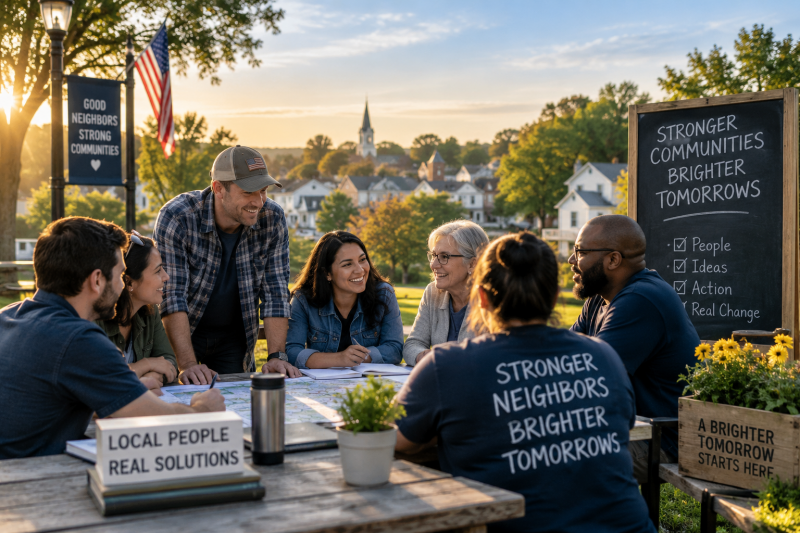
A Step-by-Step Guide to Turning Concern Into Action
There is a mistake people make when they hear the words grassroots organizing.
They picture a campaign headquarters.
They picture clipboards, yard signs, political rallies, professionally printed literature, consultants, databases, and somebody standing in front of a room giving a speech.
Those things can certainly become part of grassroots organizing. But they aren’t where organizing begins.
Real grassroots organizing usually begins with something much simpler.
A conversation.
A neighbor tells another neighbor, “Something needs to change.”
The other person says, “I’ve been thinking the same thing.”
And somebody finally asks the question that separates complaining from organizing:
“Okay. What are we going to do about it?”
That is the beginning.
I have spent a significant portion of my professional life working around grassroots engagement, digital organizing, coalition building, issue advocacy, campaigns, nonprofits, volunteers, and community organizations. And one lesson has remained remarkably consistent: the strongest grassroots organizations aren’t necessarily the organizations with the most money.
They’re the organizations with the strongest relationships.
You can buy advertising.
You can buy software.
You can buy mailers.
You can hire consultants.
You cannot simply buy genuine trust between people.
And trust is the currency of grassroots organizing.
That matters because Americans are already doing far more community work than we sometimes realize. According to Census Bureau and AmeriCorps research, more than 75.7 million Americans age 16 and older—28.3 percent of that population—formally volunteered through an organization between September 2022 and September 2023. Those volunteers contributed an estimated 4.99 billion hours of service.
Even more interestingly, roughly 137.5 million Americans—54.2 percent—reported informally helping their neighbors. (Census.gov)
Think about that.
More than half the country was already helping a neighbor somehow.
That means the raw material for grassroots organizing exists almost everywhere.
The challenge is turning relationships into organization, organization into action, and action into measurable results.
So let’s break down exactly how to do it.
Step One: Start With a Problem, Not an Organization
One of the easiest mistakes to make is creating an organization before understanding what you’re organizing around.
People start designing logos.
They create Facebook pages.
They argue over names.
They write bylaws.
They start discussing titles.
And nobody has clearly defined the problem.
Reverse the order.
Start with the problem.
Maybe your neighborhood has dangerous intersections.
Maybe parents are concerned about something happening in local schools.
Maybe small businesses are struggling with a particular regulation.
Maybe residents want a park cleaned up.
Maybe people are concerned about crime.
Maybe your community lacks recreational opportunities for teenagers.
Maybe residents believe a local ordinance needs to change.
Maybe you simply want neighbors to know one another again.
Whatever it is, define it.
And make it specific.
“Government is terrible” isn’t an organizing issue.
“Residents want the city to repair the pedestrian crossing at Main Street and First Avenue” is.
“We need better schools” isn’t specific enough.
“We want to establish an after-school tutoring partnership involving parents, teachers, churches, businesses, and volunteers” is much closer.
Specific problems create specific actions.
Specific actions create measurable results.
And measurable results give people something they can actually accomplish together.
Step Two: Listen Before You Lead
This might be the most important lesson in this entire article.
Do not assume you know what the community wants simply because you know what you want.
Go listen.
Before creating your campaign, initiative, coalition, or organization, spend time talking to people.
Not posting at them.
Talking to them.
Community organizing resources repeatedly emphasize one-on-one conversations because those conversations help organizers understand people’s motivations while identifying individuals who may already exercise informal leadership within their communities. (Commons Library)
Start with perhaps 20 conversations.
Talk with neighbors.
Talk with parents.
Talk with business owners.
Talk with pastors and other community leaders.
Talk with teachers.
Talk with nonprofit leaders.
Talk with veterans.
Talk with retirees.
Talk with young adults.
Talk with the person who has lived in the neighborhood for 40 years.
And don’t spend the entire conversation explaining your solution.
Ask questions.
What do you think is happening?
How does this affect you?
What do you think needs to change?
Has anybody tried fixing this before?
What happened?
Who else cares about this?
Who should I talk to?
Would you be interested in helping?
Then listen.
You’ll learn more from twenty genuine conversations than from twenty hours arguing with strangers online.
Step Three: Map Your Community
Now we’re getting into actual organizing.
Take out a notebook, spreadsheet, whiteboard, or digital document and begin mapping the community around your issue.
You’re trying to answer four questions:
Who is affected?
Who cares?
Who has influence?
Who has authority?
Those aren’t always the same people.
Imagine residents want a dangerous intersection improved.
The people affected might include nearby residents, pedestrians, parents, cyclists, businesses, and commuters.
The people who care might include neighborhood associations, disability advocates, parents, school officials, and public-safety organizations.
The people with influence might include respected neighborhood leaders, business owners, civic organizations, journalists, and community groups.
The people with actual decision-making authority might be transportation officials, city administrators, commissioners, council members, or another governmental body.
Your job is to understand the ecosystem.
Don’t think merely in terms of “supporters” and “opponents.”
That’s far too simplistic.
Think in terms of relationships.
Who knows whom?
Who trusts whom?
Who can convene people?
Who has expertise?
Who has information?
Who can explain the history?
Who can bring ten people into a room?
Who can speak credibly about the issue?
This is where grassroots organizing starts becoming strategic rather than reactive.
Step Four: Find Your Core Team
You do not need 500 people to begin.
You probably don’t even need 50.
You need a handful of dependable people.
I’d rather begin with five people who actually show up than 500 names sitting in a Facebook group.
Your first core team should ideally include different strengths.
You need someone who builds relationships naturally.
Someone organized enough to track tasks.
Someone who communicates well.
Someone who understands the issue.
Someone willing to ask people to participate.
Someone who knows the community.
Those roles can overlap.
At this stage, don’t become obsessed with titles.
You don’t necessarily need a president, vice president, executive director, communications director, political director, organizing director, deputy organizing director, assistant deputy organizing director and Supreme Commander of Facebook.
You need people willing to work.
The University of Kansas Community Tool Box recommends beginning coalitions with a core group, identifying necessary participants, recruiting them personally, and holding an initial meeting where people actually accomplish something, receive assignments, and leave knowing when they’ll meet again. (Community Tool Box)
That last part matters.
Never end an organizing meeting without a next step.
Otherwise you haven’t organized anything.
You’ve held a discussion.
Step Five: Write a Goal You Can Explain in One Sentence
Now answer this:
What exactly are we trying to accomplish?
If you need fifteen minutes to explain it, you’re not ready.
Try this formula:
We are organizing [WHO] to accomplish [WHAT] by [WHEN] because [WHY].
For example:
“We are organizing neighborhood residents to persuade the city to install safer pedestrian infrastructure at this intersection before the next school year because families currently lack a safe crossing.”
Notice what this does.
It identifies the constituency.
It identifies the desired outcome.
It establishes a timeframe.
It explains the reason.
Now everybody can repeat it.
That matters tremendously.
Grassroots organizations become stronger when volunteers can explain the mission without having to call the organizer.
Step Six: Establish the Facts
Before you mobilize people, understand the issue.
Research it.
If it’s governmental, find the ordinance, statute, budget item, meeting minutes, public records, policy documents, or agency responsible.
If it’s a community project, determine what resources already exist.
If someone tried solving the problem before, figure out what happened.
Talk with people on different sides of the issue.
This accomplishes two things.
First, you become more credible.
Second, you may discover that your original understanding was incomplete.
That’s a good thing.
Organizing should be grounded in reality, not in protecting our egos.
Create a basic research file containing your problem statement, background information, relevant data, key stakeholders, previous efforts, decision-making process, potential solutions and unanswered questions.
You don’t need a doctoral dissertation.
You need enough information to avoid organizing 100 people around something that isn’t true.
Step Seven: Understand Who Can Actually Say Yes
This sounds painfully obvious.
It isn’t.
Organizations regularly spend enormous amounts of energy pressuring people who cannot actually deliver what they’re demanding.
Before developing tactics, identify the decision-maker.
Who possesses the authority to produce the outcome?
Sometimes it’s a city council.
Sometimes it’s a county commission.
Sometimes it’s an agency director.
Sometimes it’s a school board.
Sometimes it’s a business owner.
Sometimes it’s a landlord.
Sometimes it’s a nonprofit board.
Sometimes it’s simply your neighbors.
Then understand the process surrounding that decision.
Are there hearings?
Committee meetings?
Budget deadlines?
Application windows?
Public-comment periods?
Board meetings?
Votes?
Administrative procedures?
You cannot develop an intelligent strategy without understanding how the decision gets made.
Step Eight: Build Relationships Before You Need Them
This is where grassroots organizing differs dramatically from internet activism.
Social media encourages us to collect attention.
Organizing requires us to build relationships.
They’re not the same thing.
A post receiving 50,000 views might produce less community power than ten genuine relationships with people who consistently take action.
Have coffee with people.
Attend neighborhood meetings.
Go to community events.
Introduce yourself to nonprofit leaders.
Meet business owners.
Talk with elected officials and public employees where appropriate.
Meet people who disagree with you.
Especially meet people who disagree with you.
Don’t enter every relationship asking:
“How can this person help me?”
Ask:
“What does this person care about, and where might our interests overlap?”
That small shift changes everything.
Coalitions work when people retain their differences while cooperating where their interests genuinely intersect.
You don’t need everyone to agree about everything.
You need enough agreement about the thing you’re working on.
Step Nine: Make a Specific Ask
One of the biggest volunteer-management mistakes is saying:
“Let me know if you want to help.”
That isn’t an ask.
That’s an escape hatch.
Ask for something specific.
“Can you attend Tuesday’s meeting?”
“Can you call five neighbors?”
“Can you bring two people?”
“Can you research this ordinance?”
“Can you speak during public comment?”
“Can you make ten phone calls?”
“Can you help set up chairs Saturday morning?”
People need to understand exactly what they’re agreeing to.
This also respects their time.
A person might not be able to “join the movement.”
They may absolutely be able to make five calls.
That five-call volunteer may eventually become one of your strongest leaders.
Give people somewhere to start.
Step Ten: Build a Ladder of Engagement
Not everyone is ready for leadership on Day One.
That’s perfectly fine.
Think of participation as a ladder.
At the bottom might be:
Following your page.
Then:
Joining your email list.
Then:
Attending a meeting.
Then:
Signing something.
Then:
Calling someone.
Then:
Bringing a friend.
Then:
Volunteering.
Then:
Owning a project.
Then:
Leading volunteers.
Then:
Training new leaders.
Your job isn’t merely moving people toward your organization.
It’s helping people discover their own capacity to lead.
That’s the real victory.
If everything collapses whenever you aren’t in the room, you haven’t built an organization.
You’ve built dependency.
Strong grassroots organizations distribute leadership.
Step Eleven: Build an Actual Contact List
Please do not make Facebook your entire organizing infrastructure.
Platforms change.
Algorithms change.
Groups disappear.
Accounts get suspended.
People stop checking apps.
Build a list you control.
At minimum, track:
Name, phone number, email, neighborhood or area, interests, skills, volunteer history, relationships, preferred communication method, follow-up date and notes—with appropriate consent and privacy practices.
Do not collect information merely because you can.
Collect information because it serves a legitimate organizing purpose, protect it appropriately, and don’t casually share people’s information.
Your list is not merely a database.
It’s a relationship map.
Step Twelve: Combine Digital Organizing With Human Organizing
Digital tools are incredible.
Use them.
Email can mobilize volunteers.
Text messaging can remind people about meetings.
Video can explain complicated issues.
Social media can introduce your work to thousands of people.
Online forms can recruit volunteers.
Virtual meetings can lower participation barriers.
And virtual engagement is now a meaningful part of American volunteering. Census and AmeriCorps research found that 18 percent of formal volunteers in 2023 served partly or completely online. Virtual and hybrid volunteers reported an average of 95 annual service hours, compared with 64 among people volunteering exclusively in person. (Census.gov)
Digital organizing isn’t fake organizing.
But digital communication should strengthen relationships rather than substitute for them.
Use social media to find people.
Use email to inform them.
Use texting to activate them.
Use video to educate them.
Then give people meaningful opportunities to participate.
A thousand followers who never act are an audience.
Fifty people who trust one another and know how to organize are infrastructure.
Step Thirteen: Develop Your Message
Good grassroots messaging should answer four questions quickly:
What’s happening?
Why should I care?
What can be done?
What do you want me to do?
That’s it.
Avoid unnecessary jargon.
People shouldn’t need a political science degree to understand your campaign.
And remember that stories and data serve different purposes.
Data establishes scale.
Stories establish meaning.
Suppose 300 residents have experienced the same problem.
That’s useful.
But explaining what happened to one family can help people understand why those 300 cases matter.
Use both.
Be accurate.
Be fair.
Correct mistakes.
Don’t manipulate statistics.
Don’t exaggerate because you think your cause is important enough to justify it.
Credibility takes years to build and minutes to destroy.
Step Fourteen: Plan Tactics Backward From the Goal
Don’t start by saying:
“Let’s hold a rally!”
Ask:
“What needs to happen for us to achieve our goal?”
Then work backward.
Maybe the decision-maker needs evidence of community support.
How can you demonstrate it?
Maybe officials need technical information.
Who can provide it?
Maybe nobody knows the problem exists.
Then public education becomes important.
Maybe officials agree with you but haven’t prioritized the issue.
Then demonstrating constituency interest may matter.
Maybe residents themselves need to change behavior.
Then your strategy may be education rather than governmental advocacy.
The tactic serves the strategy.
The strategy serves the goal.
Not the other way around.
Step Fifteen: Give Every Action a Purpose
Door knocking isn’t the goal.
Phone banking isn’t the goal.
Petitions aren’t the goal.
Public comments aren’t the goal.
Social media isn’t the goal.
Events aren’t the goal.
They’re tools.
Before doing anything, ask:
What will this action accomplish that moves us closer to the outcome?
Maybe you’re knocking doors to identify interested residents.
Great.
Then track them.
Maybe you’re circulating a petition to demonstrate public support.
Great.
Then determine how and when you’ll deliver it.
Maybe you’re holding a town hall to educate residents.
Great.
Then capture contact information and provide a next action.
Every tactic should feed the next tactic.
Otherwise you’re generating activity rather than building power.
Step Sixteen: Train People
Never assume volunteers know what to do.
Teach them.
If they’re knocking doors, demonstrate a conversation.
If they’re making phone calls, practice.
If they’re speaking at a public meeting, help them prepare.
If they’re recruiting volunteers, teach them how to ask.
If they’re entering data, establish procedures.
If they’re leading teams, teach leadership.
Training doesn’t have to be complicated.
It does have to exist.
A fifteen-minute practice session can transform someone’s confidence.
Remember that organizing isn’t merely deploying people.
It’s developing them.
Step Seventeen: Run Meetings People Actually Want to Attend
Nothing kills volunteer enthusiasm faster than terrible meetings.
Start on time.
Have an agenda.
Know why everyone is there.
Let people participate.
Make decisions.
Assign responsibilities.
Set deadlines.
Schedule the next meeting.
End on time.
The Community Tool Box specifically recommends inclusive first meetings where meaningful work gets done, assignments are made, and the next meeting is scheduled, followed by deliberate follow-up and continued recruitment. (Community Tool Box)
People are giving you something extraordinarily valuable.
Their time.
Respect it.
Step Eighteen: Follow Up—Relentlessly
Grassroots organizing is basically a giant follow-up operation.
Someone says they’re interested?
Follow up.
Someone attends a meeting?
Follow up.
Someone volunteers?
Thank them and follow up.
Someone misses an event?
Check in.
Someone agrees to complete a task?
Follow up before the deadline.
Someone does excellent work?
Tell them.
People rarely disappear because they suddenly stopped caring.
Sometimes life simply got busy.
A friendly text can reconnect someone immediately.
Don’t assume silence means rejection.
Step Nineteen: Measure Everything That Matters
You cannot improve what you refuse to measure.
But don’t fall into the trap of measuring only vanity metrics.
Followers are useful.
Views are useful.
Likes are useful.
But they aren’t necessarily organization.
Track things like:
How many one-on-one conversations happened?
How many people committed to an action?
How many completed it?
How many volunteers returned?
How many new leaders were developed?
How many residents attended?
How many calls were made?
How many doors were knocked?
How many decision-makers were contacted?
Did the desired outcome occur?
Did public understanding change?
Did your coalition grow?
The Community Tool Box’s evaluation framework recommends monitoring activities and accomplishments while examining outcomes, involving affected stakeholders in defining success, establishing indicators and then using the findings to improve the initiative. (Arise Toolkit)
Measure.
Learn.
Adjust.
Repeat.
Step Twenty: Celebrate Small Wins
This is wildly underrated.
Grassroots work can be exhausting.
People have jobs.
Families.
Children.
Bills.
Responsibilities.
They’re giving you evenings, weekends, phone calls and sometimes hours they could have spent relaxing.
Celebrate progress.
Maybe you recruited your first ten volunteers.
Celebrate it.
Maybe 40 residents attended a meeting.
Celebrate it.
Maybe an official agreed to meet.
Celebrate it.
Maybe you collected 500 signatures.
Celebrate it.
Maybe your proposal passed.
Definitely celebrate it.
People need to see that their participation matters.
Recognition reinforces ownership.
Step Twenty-One: Know the Legal Boundaries
If your organizing enters elections, lobbying, nonprofit advocacy or campaign activity, learn the applicable rules before spending money or using organizational resources.
For federal elections, the Federal Election Commission explains that individuals generally may provide uncompensated volunteer services to campaigns without those services becoming reportable contributions. Certain uncompensated online activities also receive federal exemptions, while paid internet advertising can trigger different rules, including potential disclaimer, expenditure or contribution requirements. (FEC.gov)
Different organizational structures matter too.
The IRS prohibits organizations recognized under Section 501(c)(3) from participating or intervening in campaigns for or against candidates. However, genuinely nonpartisan voter education, registration and get-out-the-vote efforts can be permissible, and 501(c)(3) organizations may address public-policy issues provided their communications don’t favor or oppose candidates. (IRS)
Federal, state and local rules aren’t identical.
If you’re entering regulated political activity, verify the rules governing your particular organization, jurisdiction and activity before proceeding.
Good organizing doesn’t cut corners.
Step Twenty-Two: Don’t Turn Every Disagreement Into a War
This is where a lot of modern organizing goes wrong.
Someone disagrees with 20 percent of your position, so suddenly they’re the enemy.
Stop doing that.
Communities aren’t social-media feeds.
You’re going to see these people again.
At church.
At the grocery store.
At school events.
At restaurants.
At youth sports.
At neighborhood meetings.
People can disagree strongly and still work together tomorrow.
In fact, some of the strongest coalitions are built among people who disagree on plenty of other things.
The question isn’t:
“Does this person agree with me about everything?”
It’s:
“Can we work together constructively on this?”
That’s a much healthier foundation for civic life.
Step Twenty-Three: Never Confuse Anger With Power
Anger can motivate people.
But anger by itself isn’t organization.
Ten thousand furious Facebook comments aren’t necessarily power.
Power is the ability to accomplish something.
That requires relationships.
Structure.
Strategy.
Leadership.
Communication.
Information.
Trust.
Discipline.
Follow-through.
Anger may get somebody into the room.
Organization keeps them there long enough to accomplish something.
This may be the hardest lesson.
Successful grassroots organizing sometimes means somebody else gets credit.
Let them.
Sometimes another organization has a better idea.
Support it.
Sometimes the person you recruited becomes a better leader than you.
Excellent.
Sometimes the community decides your original solution isn’t the right solution.
Listen.
The purpose of grassroots organizing shouldn’t be making the organizer important.
It should be making the community capable.
That’s an enormous distinction.
The best organizers gradually make themselves less necessary because they’ve developed other people capable of leading.
Step Twenty-Five: Build Something That Survives the First Victory
Suppose you win.
Fantastic.
Now what?
Many grassroots groups disappear immediately after accomplishing their first objective.
Sometimes that’s appropriate. Not every project needs to become a permanent institution.
But sometimes you’ve created something worth preserving.
You have relationships.
Trained volunteers.
Community knowledge.
Trust.
Contact infrastructure.
Leadership.
Don’t automatically throw it away.
Ask the people involved:
What did we learn?
What worked?
What didn’t?
What relationships should continue?
Are there other community needs people want to address together?
Do we need an ongoing organization, an occasional network, or simply a way to stay connected?
The answer doesn’t have to be another campaign.
Maybe the group organizes a neighborhood cleanup.
Maybe members help a local food pantry.
Maybe they host community conversations.
Maybe they help neighbors after a hurricane.
Maybe they mentor young people.
Grassroots infrastructure doesn’t have to exist exclusively for politics.
In fact, some of the healthiest community networks aren’t political at all.
They’re simply neighbors learning how to solve problems together.
What Your First 30 Days Could Actually Look Like
If you’re reading all of this thinking, Okay, but where do I literally start tomorrow?, here’s the simplest version.
Week One: Listen.
Identify the problem.
Research the basics.
Have five to ten conversations.
Ask every person who else you should talk with.
Don’t announce an organization yet.
Learn.
Week Two: Map.
Continue conversations.
Identify stakeholders.
Identify decision-makers.
Identify existing organizations.
Find three to five people willing to become a core team.
Create a basic contact list.
Week Three: Organize.
Bring the core group together.
Define the problem.
Set a measurable goal.
Assign initial responsibilities.
Develop your basic message.
Choose your first meaningful action.
Schedule the next meeting before leaving.
Week Four: Act.
Begin recruitment.
Train volunteers.
Execute the first action.
Collect information.
Follow up.
Evaluate what happened.
Adjust.
Then do it again.
That’s grassroots organizing.
It isn’t magic.
It’s disciplined relationship-building repeated over and over again.
The Most Important Thing to Remember
America doesn’t suffer from a shortage of opinions.
We have plenty of those.
What communities often need are more people willing to turn concern into constructive participation.
The data suggest the foundation is already there. More than half of Americans reported informally helping neighbors during the 2022–2023 period, while more than 75 million formally volunteered through organizations. (Census.gov)
People care about their communities.
They just don’t always know where to begin.
And perhaps that’s the greatest opportunity grassroots organizers have.
Not telling people what to think.
Not turning neighbors against one another.
Not convincing everyone to join another political tribe.
But helping ordinary people rediscover something that has always been true:
We are capable of doing things together that none of us can accomplish alone.
Your community doesn’t belong exclusively to politicians.
It doesn’t belong to government agencies.
It doesn’t belong to corporations.
It doesn’t belong to nonprofits.
It doesn’t belong to political parties.
It belongs to the people who live there.
The parents raising children there.
The people opening businesses there.
The teachers educating children there.
The firefighters answering calls there.
The retirees who spent decades building lives there.
The young people who will inherit it.
The families worshipping there.
The neighbors helping neighbors there.
Grassroots organizing, at its best, is simply the process of reminding people that they have agency.
You don’t need permission to meet your neighbors.
You don’t need permission to volunteer.
You don’t need permission to research a problem.
You don’t need permission to organize a cleanup.
You don’t need permission to attend a public meeting.
You don’t need permission to ask questions.
You don’t need permission to build a coalition.
You don’t need permission to serve.
And you certainly don’t need permission to care about the place you call home.
Start with one conversation.
Then have another.
Bring five people together.
Identify one problem.
Set one achievable goal.
Give everyone something meaningful to do.
Follow up.
Learn.
Adjust.
Build another relationship.
Develop another leader.
Win something small.
Then build from there.
Because grassroots organizing isn’t really about crowds.
It’s about people.
It’s about relationships.
It’s about trust.
And ultimately, it’s about ordinary neighbors realizing that they don’t have to wait for somebody else to come fix their community.
They can begin themselves.
Add comment
Comments