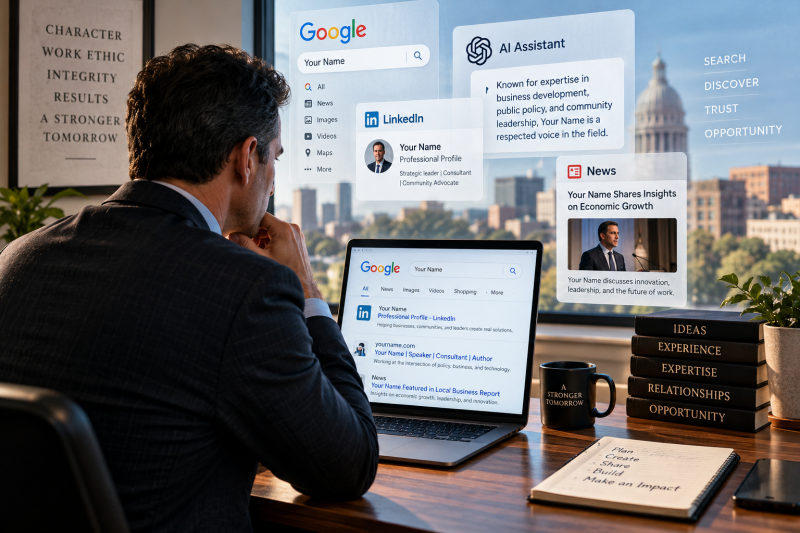
There was a time when your professional reputation mostly lived in other people’s heads.
Someone knew you.
Someone had worked with you.
Someone could make a phone call and say, “I know the right person.”
Your résumé mattered. Your references mattered. Your handshake mattered. Your reputation traveled through relationships, introductions, conference rooms, civic organizations, professional associations, churches, chambers of commerce, and conversations over coffee.
All of that still matters.
I would argue that it matters more than ever.
But something fundamental has changed.
Your reputation is now searchable.
Before someone hires you, meets with you, interviews you, invites you onto a podcast, considers you for a board, evaluates your company, responds to your pitch, quotes you in an article, refers you to a client, or even answers your email, there is a very good chance they are going to look you up.
And increasingly, they may not even search for you in the traditional sense.
They might Google your name.
They might search LinkedIn.
A journalist might search previous articles, interviews, posts, and quotations.
A potential client might ask an AI assistant, “Who are some people who understand digital organizing in Florida?”
Someone considering you for a speaking engagement might ask, “What does this person actually know about?”
A prospective employer may look at what you have published.
An elected official or community leader receiving an email from you may search your name before deciding how seriously to take it.
A business owner might encounter one of your articles before ever encountering your website.
And that changes the game.
Because your reputation is no longer only what people who know you say about you.
Increasingly, your reputation is also what the internet can verify about you.
That distinction is enormous.
Personal Branding Isn’t Enough Anymore
We have spent years talking about “personal branding.”
I have never particularly loved the phrase.
I understand what it means. There is certainly value in being thoughtful about how you present yourself professionally. But somewhere along the way, personal branding became associated with carefully staged photographs, polished bios, motivational posts, perfectly formatted LinkedIn profiles, and endless declarations of expertise.
Everybody became a “thought leader.”
Everybody became an “expert.”
Everybody became a “visionary.”
The problem is that saying something about yourself does not make it true.
Digital authority is different.
Personal branding is what you say about yourself. Digital authority is the body of evidence that helps other people determine whether they should believe you.
That evidence can include your website, LinkedIn profile, articles, interviews, media mentions, podcasts, professional experience, organizational affiliations, public presentations, citations, published research, community involvement, client work, and the consistency of the ideas you have contributed over time.
That is a much higher standard.
And I think that is healthy.
Authority should be earned.
Trust should be earned.
A reputation worth having should be built through the work.
Google itself provides an interesting framework for understanding this. Its Search Central guidance describes E-E-A-T: experience, expertise, authoritativeness, and trustworthiness. Google is careful to explain that E-E-A-T is not itself one single ranking factor. Instead, its systems use various signals intended to identify helpful content exhibiting those characteristics, with Google saying that trust is the most important element. (Google for Developers)
Think about those four words for a minute.
Experience.
Expertise.
Authoritativeness.
Trust.
Those aren’t really marketing concepts.
They are reputation concepts.
And increasingly, our digital information systems are trying to answer essentially the same question humans have always asked:
Why should I trust this person?
The First Meeting Often Happens Before You Arrive
Imagine you are scheduled to meet someone Thursday morning.
You have never met.
Wednesday evening, that person searches your name.
What do they find?
That is your first meeting.
Not Thursday.
Wednesday.
Maybe they find a strong LinkedIn profile that clearly explains what you have done.
Maybe they find several thoughtful articles demonstrating that you actually understand your field.
Maybe they find an interview where you explain a complicated issue clearly.
Maybe they find your company website.
Maybe they find an old professional biography.
Maybe they find community involvement that reinforces the values you claim to hold.
Maybe they find other credible people referencing your work.
By the time you walk into the room Thursday morning, that person already has a working impression of you.
The opposite can happen too.
They search your name and find almost nothing.
Or they find five different biographies that don’t match.
Your LinkedIn says one thing.
Your website says another.
An old organizational page describes a job you left seven years ago.
Your professional accomplishments exist, but none of them are easily discoverable.
You have twenty years of real-world experience, but somebody searching your name would never know it.
That doesn’t mean you lack credibility.
It means your credibility is difficult to verify digitally.
Those are two completely different things.
And in a searchable world, that distinction matters.
We Are Moving From Search Results to Answers
This is where the conversation gets even more interesting.
For most of the modern internet era, digital visibility worked something like this:
You typed something into Google.
Google gave you links.
You evaluated the links.
You clicked one.
You read the website.
That model isn’t disappearing, but it is changing rapidly.
Search engines increasingly provide AI-generated summaries. AI assistants can search the web and synthesize information from multiple sources. People increasingly ask conversational questions rather than typing two or three keywords.
Pew Research Center’s analysis of Google searches made by 900 U.S. adults during March 2025 found that 58% of participants encountered at least one Google search that produced an AI-generated summary. In the underlying collection of nearly 69,000 unique searches, roughly 18% generated an AI summary. (Pew Research Center)
By February 2026, Pew found that 60% of U.S. adults said they ever read AI summaries appearing at the top of search results. (Pew Research Center)
That is an extraordinary change in how information gets consumed.
Pew’s browsing analysis also found something particularly important for anyone thinking about digital authority.
When an AI summary appeared, users clicked a traditional search result during only 8% of visits, compared with 15% when no AI summary appeared. Users clicked links contained within the AI summary itself during just 1% of visits. (Pew Research Center)
In other words, increasingly, the answer may become the destination.
That has massive implications.
For years, businesses and professionals obsessed over whether somebody would click their website.
Now there is another question:
Will the information ecosystem understand who you are well enough to include you in the answer at all?
Welcome to the age of AISO.
SEO Still Matters. But AISO Changes the Question.
SEO—search engine optimization—isn’t dead.
Not remotely.
Your website still needs to be technically accessible. Search engines need to understand your pages. Titles matter. Structure matters. Keywords matter when used naturally. Internal linking matters. Helpful content matters. Search intent matters. Backlinks and citations matter.
But AI search introduces another layer.
I use AISO—AI Search Optimization—to describe the work of making people, organizations, expertise, and information sufficiently clear, credible, structured, and discoverable that AI-powered information systems can accurately understand and surface them.
Traditional SEO often asks:
“How can this page rank for this search?”
AISO increasingly asks:
“How can this person, organization, or idea become a trustworthy part of the answer?”
Those aren’t identical problems.
Consider a hypothetical accountant named Sarah.
Sarah can build a website saying:
“Sarah Smith is the leading small-business tax expert in Tampa.”
Wonderful.
According to whom?
Now imagine Sarah has written 40 detailed articles about small-business taxation.
She has been interviewed by local business publications.
She has spoken at chamber events.
Her biography clearly describes her credentials.
Her LinkedIn profile reinforces the same areas of expertise.
Other websites reference her work.
She has appeared on several business podcasts discussing tax planning.
Her firm’s website contains an organized archive of educational resources.
Her name repeatedly appears in credible contexts alongside small-business taxation.
Now the internet has something considerably more valuable than a claim.
It has corroboration.
That is digital authority.
AI Search Makes Earned Authority More Important, Not Less
There is a temptation to view AI optimization as another technical trick.
Find the secret prompt.
Discover the magic schema.
Stuff the right phrase onto enough pages.
Game the algorithm.
I think that misses the bigger picture.
Technical optimization matters. Structured information matters. Accessibility matters. Websites need to be crawlable by the systems people use to find information.
For example, OpenAI says public websites can appear in ChatGPT search and advises publishers that want their content discoverable in summaries and snippets not to block its OAI-SearchBot crawler. ChatGPT search itself provides links to relevant web sources so users can examine where information comes from. (OpenAI)
But technical accessibility cannot manufacture a lifetime of expertise.
You can optimize mediocre content.
You cannot optimize it into genuine experience.
That is why I believe the professionals positioned best for this next era won’t necessarily be the loudest.
They will be the easiest to verify.
There is an enormous difference.
Your Digital Authority Is an Ecosystem
One of the biggest mistakes professionals make is thinking they need one great platform.
“I have LinkedIn.”
“I have a website.”
“I post on Facebook.”
“I publish on Medium.”
Good.
But digital authority doesn’t live in one place.
Think of it as an ecosystem.
Your website establishes an owned home.
Your LinkedIn profile establishes professional context.
Long-form articles demonstrate how you think.
Media coverage creates independent validation.
Podcast appearances give people a sense of how you communicate.
Speaking engagements establish another layer of professional activity.
Professional directories help establish identity.
Organizational biographies connect you with institutions.
Social content demonstrates current activity.
Citations show that other people find your work useful.
Interviews create searchable third-party context.
And all of these things begin reinforcing one another.
That last part is important.
If your website says you specialize in economic development but everything else you publish is about fantasy football, the signal isn’t particularly strong.
If your website, LinkedIn profile, articles, interviews, speeches, and third-party mentions consistently demonstrate years of work around economic development, the picture becomes much clearer.
Consistency creates comprehensibility.
And comprehensibility matters tremendously in a machine-readable world.
LinkedIn Is Becoming More Than an Online Résumé
LinkedIn deserves special attention because far too many professionals still treat it as a place to update when they need a job.
That undersells what the platform has become.
For professionals, LinkedIn increasingly operates as a searchable reputation layer.
Someone can see where you have worked.
They can see what you write about.
They can see how you communicate.
They can see who engages with your ideas.
They can see mutual connections.
They can see articles you’ve written, organizations you’ve worked with, projects you’ve discussed, and conversations you’ve participated in.
And LinkedIn is becoming increasingly relevant to journalists and communications professionals as well.
Muck Rack’s 2026 State of Journalism research found that 20% of surveyed journalists identified LinkedIn as the most valuable social platform for their work, second to Facebook at 28%. Muck Rack also reported that 47% of journalists said they had spent more time on LinkedIn during the prior year. (Muck Rack)
For communications professionals, the concentration is even stronger. Muck Rack’s 2025 State of PR report found that 56% of PR professionals surveyed considered LinkedIn the most valuable social platform for their work. (Muck Rack)
That matters because LinkedIn isn’t merely where people advertise themselves anymore.
It is where professional ecosystems increasingly observe one another.
Journalists find potential sources.
Business owners find vendors.
Executives notice potential hires.
Organizations identify speakers.
Consultants find clients.
Community leaders discover people doing interesting work.
People encounter an article and think, “I should talk to this person.”
The strongest LinkedIn strategy, therefore, isn’t simply posting constantly.
It is giving people enough substance to understand what you actually know.
Publish What You Know
This is one of the simplest pieces of professional advice I can give.
If you know something useful, write about it.
You do not need to pretend you know everything.
In fact, please don’t.
The internet has enough people pretending to be experts in everything.
Write about the things you have actually done.
If you have spent twenty years building restaurants, write about restaurants.
If you manage construction projects, explain why projects go over budget.
If you run a nonprofit, discuss donor retention.
If you own a landscaping company, explain what homeowners misunderstand about maintaining a lawn.
If you have spent fifteen years in logistics, explain supply-chain problems.
If you are an attorney, explain the areas of law you genuinely practice, within the professional rules governing your communications.
If you work in technology, explain the problems companies repeatedly encounter.
If you organize communities, explain what actually gets people involved.
If you manage people, write about what you have learned from managing people.
The point isn’t to sound impressive.
The point is to be useful.
That distinction separates genuine authority from content marketing theater.
Useful people get remembered.
Useful articles get shared.
Useful explanations get cited.
Useful expertise gets referred.
Over time, those individual pieces begin accumulating into something larger.
They become a searchable record of what you know.
The Article You Write Today May Introduce You Five Years From Now
This is one reason I remain bullish on long-form writing.
Social posts are valuable.
But they move quickly.
An article can have a much longer life.
A thoughtful piece you publish today can appear in search results years from now.
Someone can send it to a colleague.
A journalist can find it while researching a story.
A potential client can discover it after searching a problem.
An AI system can encounter it while gathering information from the public web.
Someone can read three of your articles before contacting you, meaning your writing effectively conducted the first thirty minutes of the sales conversation before you ever knew the reader existed.
That is leverage.
Not fake “get rich while you sleep” leverage.
Actual intellectual leverage.
You did the thinking once.
The thinking remains available.
Media Coverage Is More Than Publicity
Professionals also need to rethink earned media.
Being quoted in a news article isn’t merely about getting your name in the newspaper.
It becomes part of your searchable record.
So does appearing on a podcast.
So does being interviewed by an industry publication.
So does speaking on a panel.
So does contributing expertise to a trade publication.
These appearances create something your own website cannot fully create:
third-party context.
There is a difference between me saying I understand something and a reputable journalist deciding that my perspective is relevant enough to include in a story.
That does not mean every media mention is an endorsement. Journalists quote people for countless reasons, and appearing in an article certainly does not prove that everything a person says is correct.
But it does add context.
The media landscape itself is also changing dramatically.
Muck Rack’s 2025 journalism research, based on responses from 1,890 journalists, found widespread adoption of AI tools among journalists and growing independent publishing outside traditional newsrooms. Its reporting on the survey said 77% of journalists were using AI tools in their work, while more than a third were self-publishing outside traditional newsroom structures. (Muck Rack)
That means the universe of people researching experts, organizations, executives, businesses, officials, and community voices is expanding beyond the traditional newsroom.
Your searchable reputation increasingly matters to them too.
Citations Are the Currency of Authority
Here is another concept I think professionals should understand.
A mention is good.
A citation can be better.
If someone publishes an article and references your research, that matters.
If a trade publication links to your analysis, that matters.
If another professional quotes an idea you developed, that matters.
If a journalist identifies you as someone with relevant experience, that matters.
If an organization links to your resource because it is genuinely useful, that matters.
Why?
Because authority becomes stronger when it isn’t entirely self-declared.
Think about academic research.
Scholars don’t establish credibility merely by announcing that they are brilliant.
Their work enters a larger network of scholarship. Other researchers engage with it. They challenge it. Cite it. Build on it. Sometimes disprove it.
Professional authority online increasingly works through a looser version of the same network.
You publish.
People discover it.
Some engage with it.
Some reference it.
Other sites mention you.
Search engines encounter those relationships.
AI systems encounter those relationships.
A web of context develops.
You stop being merely a name attached to a biography.
You become an identifiable source associated with particular subjects.
Your Website Is Digital Property You Actually Control
I love social media.
I have built a significant part of my professional life through digital platforms.
But I will always argue that serious professionals should have some form of digital property they control.
Usually, that means a website.
Why?
Because social platforms are rented ground.
Algorithms change.
Policies change.
Companies change ownership.
Features disappear.
Reach rises and falls.
Accounts get suspended.
Platforms gain popularity and lose it.
Your website gives you a permanent center of gravity.
Your biography lives there.
Your work lives there.
Your articles can live there.
Your interviews can be organized there.
Your services can be explained there.
Your contact information can be available there.
Your professional history can be documented there.
Everything else can point home.
There is something philosophically important about that to me as well.
I believe in ownership.
I believe people and small organizations should control as much of their own infrastructure as reasonably possible rather than becoming completely dependent upon giant centralized gatekeepers.
That doesn’t mean abandoning LinkedIn, Google, Medium, YouTube, or AI platforms.
Use them.
They are incredibly powerful distribution systems.
Just don’t mistake distribution for ownership.
Build on platforms. Own your foundation.
Reputation Cannot Be Automated
AI creates another temptation.
If content builds authority, and AI can produce content quickly, why not publish fifty articles a week?
Because volume isn’t authority.
Noise is not expertise.
And flooding the internet with generic content may accomplish exactly the opposite of what you intended.
The scarce resource in the AI era isn’t words.
We have more words than humanity could possibly read.
The scarce resources are increasingly:
Experience.
Judgment.
Original thinking.
Trust.
Credibility.
Firsthand knowledge.
Relationships.
Perspective.
Accountability.
AI can help organize thoughts.
It can assist with research.
It can identify gaps.
It can help analyze data.
It can make sophisticated capabilities accessible to small businesses and individuals who could never have afforded them before.
That democratization is exciting.
But the underlying ideas still need to be worth reading.
If you publish something under your name, you own it.
Check the facts.
Verify the sources.
Challenge your assumptions.
Correct errors.
Do not outsource your integrity to software.
Technology is a tool.
Your name is yours.
You Don’t Need to Become an Influencer
This is important.
When I tell professionals to build digital authority, I am not saying everyone needs to become an influencer.
You do not need to post breakfast photographs.
You don’t need a ring light.
You don’t need to manufacture controversy.
You don’t need to chase every trend.
You don’t need to share every thought that enters your head.
And you definitely do not need to spend your entire life online.
Digital authority can be remarkably quiet.
A well-maintained website.
A complete LinkedIn profile.
One thoughtful article every month.
Occasional professional commentary.
A few podcast appearances each year.
Media interviews when you genuinely have something useful to contribute.
A searchable archive of your work.
Consistency over time.
That’s enough to create something meaningful.
The goal isn’t fame.
The goal is credibility at the moment credibility is needed.
That might mean 300 people know exactly what you do rather than 300,000 people vaguely recognizing your name.
I would take the first one every time.
Start With an Audit
If you want to understand your digital authority, do something incredibly simple.
Search yourself.
Use an incognito or private browser window if you want a less personalized view.
Search your full name.
Search your name plus your company.
Search your name plus your city.
Search your name plus your profession.
Search the subjects you believe you are known for.
Look at images.
Look at news results.
Look at LinkedIn.
Then try AI assistants.
Ask questions someone unfamiliar with you might reasonably ask.
“Who is [your name]?”
“What does [your name] specialize in?”
“What has [your name] written about?”
“What organizations has [your name] worked with?”
Then look at the results critically.
Not emotionally.
Critically.
Is the information accurate?
Is it current?
Is your expertise clear?
Are there conflicting biographies?
Can someone determine what you actually do?
Can they find your best work?
Are important accomplishments documented anywhere?
Do credible third-party references exist?
Is outdated information outranking current information?
Does your own website appear?
Are you associated with the topics you actually want to be associated with?
You may be surprised.
Then Build the Missing Evidence
Once you know what is missing, don’t try to manipulate the answer.
Build the evidence.
If your biography is unclear, create a definitive biography.
If your expertise isn’t visible, publish useful material demonstrating it.
If your website is outdated, update it.
If your LinkedIn profile doesn’t reflect your current work, fix it.
If your articles are scattered across six platforms, create an archive connecting them.
If you’ve appeared in the media, maintain a media page.
If you’ve been interviewed on podcasts, organize those appearances.
If you have legitimate credentials, make them easy to verify.
If your organization has leadership pages, make sure your biography is accurate.
If you have years of experience but no public writing, start writing.
If you have meaningful insights but never share them, start sharing them.
Not because you need to impress strangers.
Because the public record should reasonably reflect the work you have actually done.
Consistency Beats Virality
One of the worst things social media taught us was to judge everything by immediate reach.
This post got 50,000 views.
That one got 300.
Therefore, the first one was 166 times more valuable.
Not necessarily.
Maybe the 300 people included three future clients, a journalist, a potential employer, and someone who will invite you to speak at a conference.
Professional content isn’t entertainment.
The objective isn’t always maximum attention.
Sometimes the objective is the right attention.
This is especially true with authority.
A technical article might never go viral.
But if it ranks in search results for three years and repeatedly reaches people actively looking for precisely that expertise, it may be one of the most valuable pieces of content you ever publish.
The internet has trained us to chase spikes.
Reputation is built through accumulation.
Don’t Manufacture Authority. Earn It.
There is an ethical line running through all of this.
Digital authority should reflect reality.
Do not invent credentials.
Do not exaggerate experience.
Do not buy fake media placements designed to look like journalism.
Do not create fake testimonials.
Do not pretend AI-generated material represents research you never performed.
Do not flood the web with fabricated biographies.
Do not call yourself the “nation’s leading expert” because you paid someone to put the phrase on a website.
You may fool an algorithm temporarily.
You may even fool a person temporarily.
But credibility built on deception is a liability waiting for discovery.
There is a much simpler strategy.
Do good work.
Document it.
Share what you learn.
Help people.
Participate in your profession.
Contribute to your community.
Build relationships.
Publish useful ideas.
Let other people evaluate them.
Correct yourself when you’re wrong.
Keep showing up.
That strategy isn’t flashy.
It is slow.
It is also incredibly difficult to counterfeit over ten or twenty years.
Your Offline Reputation Still Matters Most
There is an irony in an article about digital authority that I don’t want to overlook.
Your digital reputation should never become more important than your actual character.
You can optimize a website.
You cannot SEO your way around treating people badly forever.
You can polish a LinkedIn profile.
You cannot manufacture genuine relationships.
You can generate content.
You cannot automate integrity.
The best digital authority is simply the searchable reflection of a reputation that already exists in the real world.
Did you keep your word?
Did you treat people fairly?
Did you show up?
Did you do what you said you would do?
Did you help people when there wasn’t anything in it for you?
Did you contribute to your community?
Did you admit mistakes?
Did you leave organizations, businesses, and communities stronger than you found them?
Those things will always matter more to me than follower counts.
Technology should extend human reputation.
It shouldn’t replace human character.
The Internet Is Becoming a Giant Reference Check
For most of history, reputation was geographically constrained.
Your town knew you.
Your industry knew you.
Your customers knew you.
Your coworkers knew you.
Today, pieces of that reputation can travel globally in seconds.
That creates risks.
But it also creates extraordinary opportunity.
A small-business owner in Panama City can publish an idea read by someone in Dublin.
An engineer in Albuquerque can become known for solving a highly specific problem.
A teacher can share an approach that reaches thousands of other educators.
A local entrepreneur can become a nationally recognized source in a niche industry.
A professional without a massive advertising budget can establish credibility through years of useful work.
That is a remarkably democratizing development.
You no longer necessarily need permission from a major institution to publish.
You don’t need a television network to broadcast.
You don’t need a newspaper column to write.
You don’t need a publishing contract to distribute ideas.
The gatekeepers haven’t disappeared, and institutions still matter tremendously.
But the cost of entering the public conversation has collapsed.
With that freedom comes responsibility.
If everyone can publish, credibility becomes more valuable.
If everyone can generate content, original experience becomes more valuable.
If information becomes abundant, trust becomes scarce.
And scarcity creates value.
Your Reputation Is Already Being Built
Here is the part I hope every professional takes away from this.
You do not get to decide whether you have a digital reputation.
You already have one.
The only question is how accurately it represents you.
Every biography.
Every article.
Every interview.
Every LinkedIn post.
Every podcast.
Every media mention.
Every citation.
Every professional directory.
Every organization you have publicly worked with.
Every piece of useful information carrying your name.
They are all creating fragments of a larger picture.
Search engines assemble those fragments.
People assemble those fragments.
Journalists assemble those fragments.
Increasingly, AI systems assemble those fragments.
And somebody who has never met you can form an impression before you ever shake hands.
That can sound unsettling.
I see enormous opportunity in it.
Because it means professionals who have spent years doing meaningful work have an unprecedented ability to document that work, share what they know, participate in public conversations, and make their experience discoverable without waiting for somebody else to give them permission.
You don’t need to become famous.
You don’t need to become an influencer.
You don’t need to turn yourself into a product.
You need to make your real expertise understandable.
Your real experience discoverable.
Your work verifiable.
Your ideas useful.
Your information accurate.
Your principles consistent.
And your reputation trustworthy.
Because the next person considering hiring you may search your name first.
The next reporter looking for a source may find an article you wrote two years ago.
The next business owner looking for help may encounter your LinkedIn profile.
The next organization looking for a speaker may discover an interview.
And the next person asking an AI assistant a question about your field may encounter your work without ever knowing to search for your name in the first place.
That is the shift professionals need to understand.
We spent the last twenty years trying to get found on the internet.
The next era is about something considerably more important.
Being worth finding.
Add comment
Comments