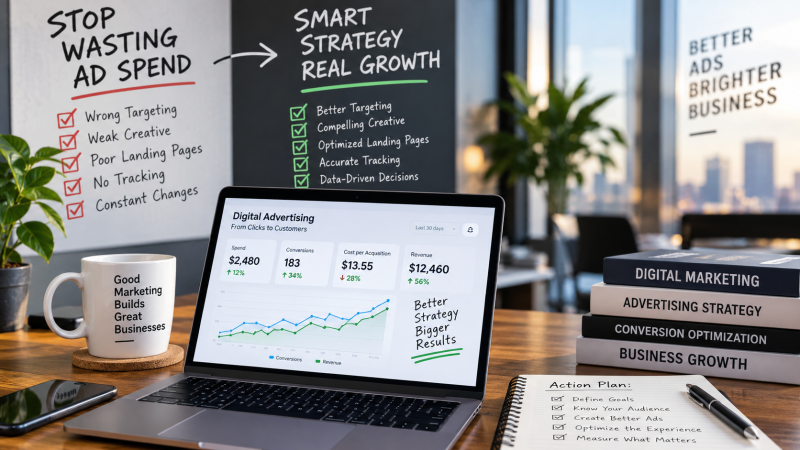
Digital advertising has never been more powerful.
It has also never been easier to waste money with it.
That might sound contradictory, but it really isn’t.
We are operating in an advertising environment where a small business can reach thousands of potential customers before lunch, a local contractor can compete for the same Google search as a national company, and an online retailer can put a product in front of someone at almost the exact moment they are considering buying it.
Artificial intelligence has made advertising platforms extraordinarily sophisticated. Algorithms can evaluate enormous numbers of signals, adjust bids in real time, test creative combinations, identify potential customers, and optimize campaigns faster than any human media buyer could possibly accomplish manually.
The money pouring into digital advertising tells you how valuable businesses believe these capabilities have become.
According to the Interactive Advertising Bureau and PwC, U.S. internet advertising revenue reached $294.6 billion in 2025, up 13.9% year over year. That is a remarkable number, particularly because 2025 lacked some of the major cyclical events—such as a presidential election or Summer Olympics—that helped boost advertising spending the year before. (IAB)
But here’s the problem.
More sophisticated advertising technology does not automatically create more sophisticated advertisers.
In some cases, it does the opposite.
The platforms have become so easy to use that businesses can launch campaigns without really understanding what is happening underneath them. Click a few buttons, upload a couple of images, choose a budget, tell the algorithm what you supposedly want, and off you go.
Then $500 disappears.
Or $5,000.
Or $50,000.
The dashboard may even tell you the campaign was successful.
Meanwhile, the business owner is sitting there asking a very reasonable question:
Where are the customers?
After years of working in digital marketing, campaigns, grassroots engagement, advertising, and communications, I have become convinced that most digital advertising failures aren’t caused by one catastrophic decision.
They’re caused by a handful of very ordinary mistakes repeated over and over again.
And today, those mistakes matter even more because artificial intelligence amplifies whatever you give it.
Feed the machine good information, and automation can be incredibly powerful.
Feed it garbage, and it can become incredibly efficient at wasting your money.
So let’s talk about five of the biggest digital advertising mistakes businesses are making today—and, more importantly, how to fix them.
Mistake #1: Optimizing for the Wrong Thing
This is probably the most important lesson in modern digital advertising:
The algorithm does not understand your business the way you do.
It understands objectives.
If you tell an advertising platform that success means generating website traffic, it will try to find people likely to generate website traffic.
If you tell it success means video views, it will find people likely to watch videos.
If you optimize for leads, it will attempt to generate leads.
And if you provide enough reliable conversion data, sophisticated systems can increasingly optimize toward deeper business outcomes.
That distinction matters enormously.
Imagine you own a roofing company.
You launch an advertising campaign and tell the platform you want traffic.
Congratulations.
You may get traffic.
But traffic isn’t what pays your employees.
Customers do.
The person most likely to click an advertisement is not necessarily the person most likely to purchase something.
This sounds obvious when you say it out loud, yet businesses still build campaigns around clicks, impressions, reach, engagement, page views and other metrics that may have very little relationship with actual revenue.
Those numbers aren’t useless.
They simply answer different questions.
Click-through rate can tell you whether your advertisement is attracting attention.
Cost per click tells you how expensive that traffic is.
Impressions tell you how often your advertising was displayed.
Reach tells you roughly how many people saw it.
But none of those measurements, by themselves, tell you whether the advertising actually made the business money.
Modern advertising systems make this even more important because machine learning depends heavily on the signals advertisers provide.
Google’s own guidance for Performance Max makes the point explicitly: accurate conversion tracking provides the measurement foundation its AI needs to understand what constitutes a valuable lead. Google even recommends optimizing toward a meaningful stage of the funnel rather than combining multiple funnel stages into a single bidding strategy. (Google Help)
Think about what that means.
The platform isn’t simply displaying your advertisement anymore.
It is learning.
And you are teaching it what success looks like.
If you tell the system that every form submission is equally valuable, it may optimize toward people who fill out forms easily.
But what if half those leads are junk?
What if one customer is worth $100 and another is worth $10,000?
What if your cheapest leads rarely close?
Suddenly, “cost per lead” isn’t nearly as useful as it looked.
How to Fix It
Start at the end of the funnel and work backward.
Ask yourself:
What action actually creates value for this business?
For an e-commerce company, that may be a completed purchase and its revenue value.
For a service business, it may be a qualified lead.
For a law firm, it may be a scheduled consultation.
For a restaurant, it might be a reservation.
For a subscription business, it could be a paid signup.
Then make sure your tracking infrastructure can measure that action as accurately as possible.
Your advertising objective should reflect your business objective.
Not the other way around.
The goal isn’t to generate cheap activity.
The goal is to generate profitable activity.
Mistake #2: Targeting Everyone Because You’re Afraid of Missing Someone
I hear versions of this constantly.
“Our customer is really everybody.”
Usually, no.
Everybody could theoretically become a customer.
That’s different.
If you sell pizza, technically almost everyone in your delivery radius could buy pizza.
But a 22-year-old college student ordering dinner at 11:30 p.m. and a 42-year-old parent ordering dinner for a family of five may respond to completely different messages.
Same pizza.
Different customer.
Different motivation.
Different advertisement.
Traditional digital advertising advice often focused heavily on manually building extremely narrow audiences. Modern AI-powered platforms have changed that equation considerably. Google’s newer advertising systems, for example, can use audience signals, customer intent, creative, search behavior and other information to discover additional converting audiences. (Google Help)
That doesn’t mean audience strategy disappeared.
It means its role changed.
The mistake today can happen at both extremes.
Some advertisers over-target so aggressively that they choke off the algorithm’s ability to discover customers.
Others simply turn on automation, target half the country and hope artificial intelligence figures everything out.
Neither is much of a strategy.
You still need to understand your customer.
You need to know who buys.
Why they buy.
What problem they’re trying to solve.
What objections they have.
What matters to them.
What doesn’t.
What language they use.
And what separates someone who merely looks like your customer from someone who actually behaves like your customer.
The technology should expand human insight—not replace it.
How to Fix It
Build your targeting strategy around customer intent and customer value, not stereotypes.
Start with your existing customers.
Which customers generate the most revenue?
Which have the highest lifetime value?
Which services are most profitable?
Where do your best customers come from?
What did they search for before contacting you?
What problem were they trying to solve?
Then give advertising platforms strong signals to work with.
Google specifically recommends using current remarketing lists and audience signals to help guide Performance Max campaigns. (Google Help)
And don’t confuse “broad targeting” with “no strategy.”
Broad targeting backed by strong conversion data, compelling creative and a clear offer can be extremely effective.
Broad targeting with terrible measurement is basically giving an algorithm your credit card and wishing it good luck.
Those are not the same thing.
Mistake #3: Running One or Two Ads Until Everyone Is Sick of Seeing Them
This one drives me crazy because it is so preventable.
A business spends thousands of dollars developing a campaign.
They create one graphic.
One headline.
One video.
One message.
And then they run it for three months.
Eventually performance declines and everyone starts blaming the platform.
Facebook doesn’t work anymore.
Instagram doesn’t convert.
Google is too expensive.
TikTok isn’t right for our customers.
Maybe.
But sometimes your customers are simply tired of seeing the same advertisement.
Creative is no longer decoration added after the advertising strategy is finished.
Creative is part of the targeting system itself.
Different messages attract different people.
Different hooks reveal different motivations.
Different formats work differently depending on where someone encounters the advertisement.
Someone watching a vertical video on Instagram Reels is experiencing your brand differently from someone actively searching Google for “emergency plumber near me.”
Your advertising should acknowledge that.
Meta’s own data illustrates the importance of building creative for the environment in which it appears. The company reports that campaigns using 9:16 Reels video with audio and key messages placed within the safe zone saw substantially lower costs per result than image-only campaigns in its studies. (Facebook)
Google makes a similar point from a different direction.
Its Performance Max guidance recommends providing a broad variety of relevant text, image and video assets so its systems can test combinations and determine what performs best. Google reports that advertisers improving Performance Max Ad Strength to “Excellent” average 6% more conversions. (Google Help)
The lesson isn’t that you should blindly chase an “Excellent” score.
The lesson is that creative diversity gives the system more opportunities to learn.
How to Fix It
Stop thinking in terms of creating “an ad.”
Create a creative system.
Develop multiple hooks.
Multiple headlines.
Multiple calls to action.
Multiple images.
Multiple videos.
Multiple customer problems.
Multiple value propositions.
Then test them.
Maybe one ad focuses on price.
Another focuses on convenience.
Another focuses on quality.
Another answers a common objection.
Another uses a customer testimonial.
Another demonstrates the product.
Another tells the founder’s story.
Another shows the problem before presenting the solution.
Now you’re learning something.
You’re not simply asking, “Did the ad work?”
You’re asking:
Why did this message work better than that one?
That information becomes valuable far beyond the advertising campaign.
It teaches you about your customers.
And that may be some of the most valuable marketing intelligence you can collect.
Mistake #4: Sending Great Advertising to a Terrible Landing Page
Imagine spending $5,000 to get potential customers through the front door of your store.
Then imagine that when they arrive, the door takes eight seconds to open.
Once inside, nobody tells them where anything is.
The signs don’t match the advertisement outside.
The checkout counter is hidden.
And the employee behind the desk asks them to fill out 17 boxes of information before they can buy anything.
You would immediately recognize the problem.
Yet businesses do the digital equivalent every day.
They obsess over advertising while ignoring what happens after the click.
That is a huge mistake.
An advertisement does not operate independently from the destination it sends people to.
The ad creates the expectation.
The landing page must fulfill it.
And speed matters.
Google’s current Core Web Vitals guidance recommends that Largest Contentful Paint—the measurement of how quickly the main content appears—occur within 2.5 seconds or less for at least 75% of visits. (web.dev)
This isn’t merely a technical SEO issue.
It affects business.
Real-world case studies collected by Google’s web.dev team have repeatedly found relationships between improved site performance and improved business outcomes. QuintoAndar, for example, reported a 5% improvement in conversions during the validation phase of a major performance project. Vodafone Italy previously reported 8% more sales after improving LCP by 31%. (web.dev)
That’s why I always tell people:
You cannot advertise your way out of a bad customer experience.
More traffic simply exposes the problem to more people.
How to Fix It
Before increasing your advertising budget, inspect the entire post-click journey.
Open the landing page on your phone.
Not your office computer.
Your phone.
Now pretend you’ve never heard of the business.
Can you immediately understand what is being offered?
Does the headline match the advertisement?
Is there a clear next step?
Can you easily call?
Can you easily purchase?
Can you easily submit the form?
Are you asking for information you don’t actually need?
Is the page cluttered?
Does it load quickly?
Does anything move unexpectedly?
Would you trust this company enough to enter your credit card information?
Every unnecessary step creates friction.
And every bit of friction costs money.
Your ad gets the customer to the door.
Your landing page gets them through it.
Mistake #5: Changing Everything Before the Campaign Has a Chance to Learn
This is the digital advertising equivalent of planting a seed Monday morning, digging it up Tuesday afternoon to see whether it grew, replanting it somewhere else Wednesday, watering it six times Thursday, and declaring gardening a scam on Friday.
Businesses do this constantly.
Campaign launches.
Day one looks good.
Day two looks bad.
Someone panics.
Budget changes.
Audience changes.
Creative changes.
Bid strategy changes.
Then the campaign performs differently.
Everyone panics again.
More changes.
At that point, nobody actually knows what caused anything.
This problem has become more significant as advertising platforms increasingly rely on machine learning.
Automated systems need data.
Google recommends allowing Performance Max campaigns sufficient time to gather information and specifically warns that frequent changes during the learning period can prolong that process and affect initial performance. Its broader guidance recommends running campaigns for at least six weeks when possible to gather enough data for meaningful performance comparisons. (Google Help)
For lead-generation campaigns, Google notes that the learning process can take one to two weeks and potentially longer for complex campaigns or those with low conversion volume. (Google Help)
That doesn’t mean you should leave a catastrophically bad campaign running for six weeks.
Common sense still applies.
If your tracking is broken, fix it.
If the landing page is broken, fix it.
If you’re advertising snow removal in Miami, please stop.
But don’t confuse responsible management with compulsive tinkering.
How to Fix It
Create your testing plan before launching the campaign.
Define:
What are we testing?
What constitutes success?
What is our primary conversion?
What is an acceptable cost per acquisition?
How long will we allow the test to run?
How much data do we need before making a decision?
What variable will we change next?
Then document your changes.
If you change the audience, creative, landing page, bidding strategy and offer simultaneously and performance improves 30%, what did you learn?
Almost nothing.
You know the campaign improved.
You don’t know why.
Disciplined marketing creates knowledge.
Random marketing creates anecdotes.
The Bigger Problem: Businesses Are Still Treating Advertising Like a Slot Machine
Put money in.
Pull lever.
Hope customers come out.
That isn’t strategy.
And artificial intelligence isn’t going to fix it.
In fact, AI may make disciplined strategy more important than ever.
Google’s newest advertising systems can automatically expand search matching, customize ad text and even select more relevant landing pages based on a user’s query. (Google Help)
Think about how dramatically the advertiser’s role is changing.
Ten years ago, a huge portion of digital advertising expertise revolved around manually manipulating platforms.
Which keyword?
Which bid?
Which audience?
Which placement?
Those things still matter, but increasingly the competitive advantage is moving somewhere else.
It is moving toward inputs.
Better customer data.
Better conversion signals.
Better creative.
Better offers.
Better websites.
Better understanding of customer psychology.
Better measurement.
Better strategy.
The machine can increasingly handle execution.
It cannot decide what your business should stand for.
It cannot magically turn a weak offer into a compelling one.
It cannot repair a broken sales process.
It cannot determine which customers you actually want unless you provide the information necessary to distinguish them.
And it certainly cannot rescue a business that doesn’t know what success looks like.
The Five-Mistake Audit I Would Run Before Spending Another Dollar
If your digital advertising isn’t performing, don’t immediately increase the budget.
Ask five questions.
Are we optimizing for the business outcome that actually matters?
Are we giving the platform enough quality information to identify our best potential customers?
Are we producing enough creative variety to continuously learn what messages resonate?
Does the experience after the click make it ridiculously easy for customers to take action?
Are we giving campaigns enough time and clean enough testing conditions to learn anything meaningful?
If the answer to any of those questions is no, fix that before blaming the advertising platform.
Because here’s something I’ve learned after spending years working in digital engagement and marketing:
The platform is rarely the entire problem.
And it is rarely the entire solution.
Advertising platforms are tools.
Extremely powerful tools.
But a hammer doesn’t know what you’re building.
You do.
Stop Chasing Clicks. Start Building a System.
The businesses that succeed in digital advertising over the next several years won’t necessarily be the businesses with the biggest budgets.
They will be the businesses with the best systems.
They will know their customers better.
They will measure what matters.
They will continuously produce and test creative.
They will build websites designed around customers rather than internal corporate preferences.
They will understand the difference between activity and results.
And they will learn how to use artificial intelligence without surrendering strategy to it.
That last part is important.
There seems to be this growing idea that AI means marketing is becoming automatic.
I think that’s exactly backward.
Execution is becoming more automated. Strategy is becoming more valuable.
When everyone has access to sophisticated targeting, automated bidding, generative creative tools and machine-learning optimization, merely possessing the technology stops being a competitive advantage.
Knowing what to tell the technology becomes the advantage.
Knowing your customer becomes the advantage.
Knowing what makes your business different becomes the advantage.
Having an offer worth responding to becomes the advantage.
Building trust becomes the advantage.
And understanding what all those numbers on the dashboard actually mean becomes the advantage.
Digital advertising isn’t magic.
It is a system.
Your customer sees something.
It earns their attention.
The message creates interest.
They click.
They arrive somewhere.
They evaluate what they see.
They decide whether they trust you.
They take an action.
Your business follows up.
A transaction happens—or it doesn’t.
Then you measure what happened, learn from it, improve the process and do it again.
Advertising is only one part of that journey.
Which is why throwing more money at an underperforming campaign without understanding where the system is breaking is usually one of the fastest ways to turn a marketing problem into a financial one.
So before you spend another dollar on digital advertising, don’t ask:
“How do we get more clicks?”
Ask a better question:
“How do we build a better path from attention to customer?”
Solve that problem, and suddenly digital advertising becomes a whole lot more powerful.
Add comment
Comments