

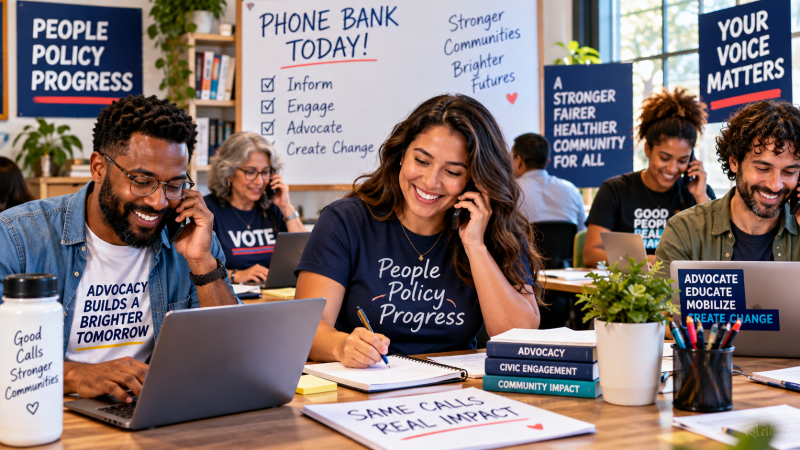
There is something incredibly powerful about a community coming together around an issue they genuinely care about.
Sometimes it starts with a conversation at the grocery store. Sometimes it’s a neighborhood meeting, a community Facebook group, or a concerned resident who decides they’ve had enough of watching an issue go unaddressed.
But eventually, every successful grassroots movement reaches a point where simply talking about a problem isn’t enough. You have to start organizing people, building relationships, communicating with decision-makers, and getting your message in front of the people who have the ability to make a difference.
One of the most effective ways to begin doing that is through a well-organized advocacy phone bank.
And no, you don’t need a massive organization, an expensive campaign headquarters, hundreds of volunteers, or a sophisticated political operation to pull it off.
You can organize a successful phone bank right in your own community with a handful of motivated people, a clearly defined objective, a reliable calling list, and a little preparation.
I’ve spent years involved in grassroots organizing, advocacy campaigns, and community engagement. One thing I’ve learned is that movements don’t grow simply because people agree with an issue. They grow because somebody takes the initiative to turn that agreement into organized action.
That’s precisely what a phone bank can accomplish.
Whether you’re advocating for criminal justice reform, property tax relief, educational freedom, government transparency, environmental protections, or another community issue, a phone bank gives ordinary residents an opportunity to become active participants in the decisions affecting their lives.
So let’s break down exactly how to organize one, recruit volunteers, develop an effective script, manage your calling operation, measure results, and turn a single evening of phone banking into the foundation of a much larger grassroots movement.
Understanding What an Advocacy Phone Bank Actually Accomplishes
First, let’s establish what we’re talking about.
An advocacy phone bank is an organized effort in which volunteers make telephone calls to individuals within a targeted community to educate them about an issue, gather opinions, identify supporters, encourage participation, or ask people to take a specific action.
Unlike traditional telemarketing, the objective isn’t selling a product.
It’s building relationships, raising awareness, and creating opportunities for people to participate in the democratic process.
Depending on your organization’s goals, a phone bank can accomplish several things.
Issue education: Introduce residents to legislation, proposed government policies, local developments, or community concerns they might not otherwise know about.
Supporter identification: Identify individuals who support your position and may be interested in becoming more involved.
Community engagement: Learn what residents actually think about an issue instead of assuming you already know.
Legislative advocacy: Encourage constituents to contact their elected representatives and express their opinions about pending legislation.
Volunteer recruitment: Identify people interested in attending meetings, helping organize events, distributing educational materials, or becoming community leaders.
Coalition building: Connect residents, organizations, neighborhood associations, and other community stakeholders around shared objectives.
Event participation: Encourage residents to attend public meetings, town halls, legislative hearings, rallies, and community forums.
The important distinction is that a successful advocacy phone bank isn’t simply about making as many calls as possible.
It’s about creating meaningful opportunities for engagement.
You might make 300 calls in one evening and never establish a meaningful connection. Alternatively, you might reach 35 people, identify 15 enthusiastic supporters, recruit five volunteers, and establish relationships with several influential community members.
Which phone bank accomplished more?
In my opinion, the second one.
The numbers matter, but what those numbers represent matters considerably more.
Start With a Clearly Defined Advocacy Objective
Before recruiting volunteers or downloading a calling list, determine exactly what you’re trying to accomplish.
This sounds obvious, but it’s one of the most important steps in organizing an effective phone bank.
I’ve seen grassroots efforts become unnecessarily complicated because organizers try to accomplish everything simultaneously.
They want to educate residents, recruit volunteers, identify supporters, collect petition signatures, promote an upcoming event, and encourage people to contact legislators.
All of those objectives can be valuable. However, trying to accomplish all of them in a single conversation can overwhelm both volunteers and the people receiving calls.
Start with one primary objective.
For example:
- Build community support for legislation ending qualified immunity.
- Identify residents who support property tax reform.
- Recruit volunteers for an upcoming grassroots organizing campaign.
- Encourage constituents to contact their state representatives about a pending bill.
- Identify community members interested in establishing a local advocacy organization.
- Build a contact network around government transparency and spending accountability.
Once you’ve identified your primary objective, establish measurable goals.
A first-time community phone bank might establish the following targets:
Advocacy Phone Bank: Initial Success Targets
Establish measurable goals before your phone bank begins. These initial targets provide a practical framework for evaluating volunteer participation, community engagement, and advocacy results.
| Objective | Initial Target |
|---|---|
| Volunteers recruited | 10 |
| Total calls attempted | 300 |
| Meaningful conversations | 50 |
| Supporters identified | 25 |
| New volunteers recruited | 5 |
| Legislative contacts generated | 20 |
| Follow-up conversations scheduled | 10 |
These are illustrative planning targets, not industry benchmarks or guaranteed outcomes.
Your actual numbers will depend on the size and quality of your calling list, the number of volunteers, the time available, and the nature of your campaign.
The point is to establish measurable expectations.
You should finish your phone bank knowing whether you accomplished what you set out to do.
A clearly defined objective also makes recruiting volunteers considerably easier because people understand exactly what they’re being asked to help accomplish.
Identify the Right People to Call
Your calling list is the foundation of your phone bank.
You can have the best volunteers, the most compelling script, and the most enthusiastic organizers in the world, but none of that matters if you’re calling the wrong people.
The first question is simple:
Who are you trying to reach?
For community advocacy, there are several potential audiences.
Existing Supporters
These are people who have already expressed interest in your organization or the issue you’re advocating for.
They might be previous petition signers, event attendees, newsletter subscribers, volunteers, or individuals who have contacted your organization.
These are often excellent people to contact when you’re trying to recruit volunteers or build momentum around an upcoming advocacy effort.
Community Residents
Sometimes your greatest opportunity is reaching people who haven’t heard about your issue.
For example, imagine you’re organizing a campaign to reform local property taxes.
You don’t necessarily need to begin by contacting people who already follow your organization on social media.
You want to reach homeowners, renters, local business owners, and other residents who may have a genuine interest in the issue.
A phone conversation can introduce them to the problem, explain your proposed solution, and determine whether they’d like to become involved.
Previous Petition Signers
People who have signed a petition have already demonstrated some willingness to participate.
They may be interested in additional opportunities to support the campaign.
A phone call gives you an opportunity to move beyond a signature and establish an actual relationship.
Community Leaders and Influencers
Don’t overlook neighborhood association leaders, business owners, civic organization members, community advocates, and individuals who are already active in local affairs.
These individuals may have access to networks that can significantly expand your reach.
One conversation with the right community leader can sometimes introduce your organization to dozens of potential supporters.
Where Do You Get Your Calling List?
There are several ways to develop a calling list:
- Existing organizational membership databases.
- Previous event registration records.
- Petition signers who consented to follow-up contact.
- Volunteer and supporter databases.
- Publicly available contact information, where its use is lawful.
- Community organizations willing to coordinate outreach.
- Contact lists collected through your organization’s website.
Be careful about purchasing lists or collecting information without understanding how it can legally be used.
Just because a telephone number is publicly available doesn’t mean every type of automated or prerecorded outreach is permissible.
You should also establish clear procedures for handling personal information, honoring requests not to receive additional calls, and restricting access to your contact database.
My recommendation: Start with people who have an existing connection to your organization or the issue. Build your calling operation from there.
You can expand into broader community outreach as your organization develops the resources and procedures to manage it responsibly.
Choose the Right Phone Banking Technology
You don’t need expensive technology to host your first phone bank.
In fact, I’d recommend keeping things relatively simple until you’ve established a consistent operation.
There are several approaches.
Option One: Traditional Manual Phone Banking
This is the simplest approach.
Volunteers receive an approved calling list, a script, and instructions for documenting the results.
They use their own phones or organization-provided phones to make individual calls.
Advantages include:
- Minimal startup expenses.
- Easy volunteer onboarding.
- Little technical preparation.
- Greater flexibility.
- Direct control over conversations.
The downside is that manually managing larger calling lists can become time-consuming.
You also need a reliable way to prevent duplicate calls and document results.
Option Two: Virtual Phone Banking
Virtual phone banking allows volunteers to participate from home using their computers or smartphones.
An organizer distributes access to the calling platform, provides training materials, and coordinates the event through a video conference or messaging channel.
This approach is particularly useful when recruiting volunteers from multiple communities.
You aren’t limited to people who can physically attend an event.
Option Three: Dedicated Phone Banking Platforms
If you’re planning to organize recurring phone banks, dedicated software can make the process considerably easier.
Platforms worth evaluating include:
Scale to Win: A platform focused on organizing outreach, including phone banking and text messaging.
CallHub: Provides calling campaigns, volunteer phone banking tools, and contact management capabilities.
OpenVPB: An open-source virtual phone banking solution designed for organized calling campaigns.
CampaignHQ: A campaign technology platform worth evaluating for organizations interested in coordinating volunteer outreach and phone banking.
Official websites:
- Scale to Win: scaletowin.com
- CallHub: callhub.io
- OpenVPB: openvpb.com
- CampaignHQ: campaignhq.com
Before selecting a platform, consider:
- How many volunteers will be making calls?
- Can multiple volunteers work from the same contact database?
- Can you track call attempts and conversation outcomes?
- Can volunteers access approved scripts?
- Does the platform support live calling?
- Can you export your contact data?
- Does the platform provide appropriate privacy and security protections?
- What calling methods does the platform use, and what legal requirements apply?
- One particularly important consideration is the distinction between manually initiated live calls and automated or prerecorded calls.
Federal and state telephone solicitation and communications laws can impose different requirements depending on the technology, recipient, purpose, and circumstances.
For an initial grassroots operation, live, manually initiated calls are generally the simplest approach to manage from a compliance perspective.
That doesn’t eliminate every legal obligation, but it avoids assuming that automated calling features are automatically permissible.
Build an Effective Advocacy Phone Script
Now we get to one of the most important parts of the entire operation.
Your script.
A good advocacy phone script provides volunteers with structure, confidence, and a consistent message.
A bad script makes volunteers sound like they’re reading a corporate telemarketing pitch.
Nobody wants that.
People can recognize an impersonal sales pitch almost immediately. If your volunteers sound robotic, overly rehearsed, or confrontational, you’re going to lose opportunities to establish meaningful relationships.
The goal is to create a conversation, not deliver a speech.
I recommend building your script around five components.
Component One: Introduce Yourself
Start with a friendly introduction.
Tell the person who you are and why you’re calling.
For example:
“Hi, my name is Stephen, and I’m a local volunteer with [Organization Name]. We’re reaching out to people in the community because we’re working on an issue that could have a real impact on residents here.”
Keep it simple.
Don’t overwhelm someone with your organization’s entire history before they’ve had an opportunity to understand why you’re calling.
Component Two: Explain the Issue
Give the person a concise explanation of what you’re advocating for.
Avoid unnecessary political jargon, complicated legislative language, and lengthy explanations.
For example:
“We’re working to build support for legislation that would reform qualified immunity and strengthen accountability when constitutional rights are violated. We believe people should have meaningful access to justice when their rights are violated, and we’re working to bring more attention to the issue.”
The explanation should be accurate, understandable, and supported by verifiable information.
If you’re discussing legislation, make sure your volunteers understand its current status.
There is a significant difference between a bill that has been introduced, a bill that has passed one legislative chamber, and a bill that has become law.
Never allow volunteers to unintentionally misrepresent the status of legislation.
Component Three: Ask an Open-Ended Question
This is where the conversation becomes interesting.
Instead of immediately asking someone whether they agree with your position, give them an opportunity to express their thoughts.
Examples:
- “Have you heard much about this issue?”
- “Is this something you’ve been concerned about?”
- “What are your thoughts on the proposal?”
- “Do you think this is something our community should be paying more attention to?”
Open-ended questions provide valuable information.
They also help people feel like participants in the conversation rather than targets of an organizational campaign.
Component Four: Make a Specific Ask
Once you’ve established some common ground, ask the person to take a specific action.
This is where many grassroots organizations miss opportunities.
They have a great conversation, thank the person for their time, and end the call without asking them to do anything.
Don’t make that mistake.
Depending on your campaign, ask whether they’d be interested in:
- Signing an advocacy petition.
- Contacting their elected representative.
- Attending an upcoming community meeting.
- Participating in another phone bank.
- Joining your organization’s volunteer network.
- Sharing educational materials with friends and neighbors.
- Receiving updates about the legislation.
Make the request clear and reasonable.
You’re not asking someone to dedicate their entire life to your organization.
You’re asking them to take one meaningful step.
Component Five: Thank Them and Close the Conversation
Regardless of whether someone agrees with you, thank them for their time.
A simple closing might be:
“I really appreciate you taking a few minutes to talk with me. We’re trying to get more people involved in these conversations, and hearing directly from residents is incredibly valuable. Thanks again, and have a great evening!”
Never make someone feel pressured to support your organization.
Respectful conversations build credibility, even when people disagree.
Train Your Volunteers Before the Phone Bank Begins
One of the biggest mistakes new organizers make is assuming that volunteers automatically know how to make effective advocacy calls.
They don’t.
Some people are naturally comfortable speaking with strangers. Others become nervous simply thinking about picking up the phone.
Your job as an organizer is to make the process approachable.
You don’t need a three-hour training session.
For a small community phone bank, a 20-to-30-minute orientation can provide a solid foundation.
I recommend covering the following topics.
Explain the Mission
Start by explaining why everyone is there.
Give volunteers a clear understanding of the issue, the organization’s position, and the specific objective of the phone bank.
People are more confident when they understand the bigger picture.
Review the Script
Walk through the script together.
Explain which portions should remain consistent and where volunteers can use their own conversational language.
The script should provide guidance, not restrict natural conversation.
Teach Active Listening
This is incredibly important.
Volunteers need to understand that their job isn’t simply to talk.
It’s to listen.
If someone raises a concern, allow them to finish explaining it.
Don’t interrupt.
Don’t immediately argue.
Don’t assume you already know what they’re going to say.
A successful advocate understands that listening is an essential part of organizing.
Prepare Volunteers for Difficult Conversations
Not everyone will be interested.
Some people will disagree.
Some will hang up.
Others may be frustrated that someone called them.
That’s part of organizing.
Teach volunteers not to take negative interactions personally.
If someone isn’t interested, thank them and move on.
If someone becomes hostile or abusive, end the conversation politely.
Nobody should feel obligated to remain on an uncomfortable call.
Practice Through Role-Playing
Before the phone bank starts, have volunteers practice a few sample conversations.
One volunteer plays the resident while another practices the script.
Introduce different scenarios:
- Someone who enthusiastically supports the issue.
- Someone who has never heard of the issue.
- Someone who disagrees with your position.
- Someone who has questions about the legislation.
- Someone who is interested in volunteering.
This simple exercise can dramatically improve volunteer confidence.
Most importantly, remind everyone that they don’t need to have every answer.
If someone asks a question they cannot answer accurately, they should acknowledge it and arrange a follow-up.
It’s considerably better to admit that you don’t know something than to provide incorrect information.
Organize the Physical Phone Bank Location
If you’re hosting an in-person phone bank, location and organization matter.
You don’t need an expensive office.
A community center, library meeting room, organizational headquarters, or other suitable meeting space can work.
You could even host a small phone bank in a volunteer’s home.
The important thing is creating an environment where people can comfortably make calls.
Here are some things to consider.
Seating: Provide enough chairs and tables for volunteers to work comfortably.
Internet: Make sure everyone who needs digital access has a reliable connection.
Power: Have charging stations and accessible electrical outlets.
Printed materials: Provide scripts, issue summaries, frequently asked questions, and contact information.
Sign-in: Maintain an attendance record so you can follow up with volunteers.
Organization: Designate a person responsible for distributing calling lists, answering questions, and troubleshooting problems.
Breaks: Give volunteers opportunities to step away, get refreshments, and recharge.
I also recommend keeping the room relatively quiet.
Phone banking is about conversations. If everyone is talking loudly over one another, volunteers will struggle to communicate effectively.
For smaller operations, separate calling areas can help.
For larger operations, consider assigning volunteers to designated tables or workstations.
Establish a Strong Volunteer Management System
Your volunteers are the backbone of the operation.
Treating them like an endless supply of free labor is a great way to discourage participation.
People volunteer because they believe in something.
They want to contribute, feel useful, and see that their efforts are making a difference.
Your job is to create an environment where those things happen.
I recommend assigning a phone bank coordinator who is responsible for managing the event.
That person should:
- Welcome volunteers.
- Explain the objective.
- Distribute calling assignments.
- Review the script.
- Answer questions.
- Monitor progress.
- Help resolve technical problems.
- Collect completed calling results.
- Recognize volunteer contributions.
For larger events, consider appointing team leaders.
Each team leader can oversee a small group of volunteers, answer questions, and make sure everyone has the resources they need.
This also creates opportunities to identify future organizational leaders.
Someone who demonstrates excellent communication skills, reliability, and enthusiasm during a phone bank might eventually become a county captain, volunteer coordinator, or local affiliate leader.
That’s how grassroots organizations develop leadership from within.
Measure Your Results and Track Every Conversation
Here’s something I cannot emphasize enough:
If you’re not documenting your calls, you’re leaving valuable organizing intelligence on the table.
Every completed conversation provides information that can help your organization improve future outreach.
You need a standardized system for documenting call outcomes.
At a minimum, I recommend tracking:
Advocacy Phone Bank: Conversation Tracking Checklist
Track every conversation to identify supporters, measure engagement, recruit volunteers, and create meaningful follow-up opportunities.
| Data Point | Purpose |
|---|---|
| Contact Name | Identify the person reached. |
| Telephone Number | Maintain accurate contact records. |
| Call Date | Document outreach history. |
| Volunteer Name | Identify who made the call. |
| Call Outcome | Track whether contact was established. |
| Issue Position | Identify support, opposition, or uncertainty. |
| Interest Level | Identify potential supporters and volunteers. |
| Requested Action | Record the person's next step. |
| Follow-Up Date | Ensure commitments aren't forgotten. |
| Notes | Capture relevant information from the conversation. |
Standardized Call Outcome Categories
| Outcome | Description |
|---|---|
| Supporter | Expressed support for the issue. |
| Undecided | Interested but needs additional information. |
| Opposed | Expressed disagreement. |
| Interested Volunteer | Wants to become more involved. |
| Legislative Contact | Agreed to contact an elected representative. |
| No Answer | Nobody answered. |
| Voicemail | Reached voicemail. |
| Disconnected | Number is no longer in service. |
| Do Not Contact | Requested no additional calls. |
Every conversation is an opportunity to build a relationship. Track your results, protect personal information, honor contact preferences, and follow up with people who want to become involved. Turn conversations into connections, connections into volunteers, and volunteers into community leaders.
Establish Standardized Call Results
Every volunteer should use the same outcome categories.
For example:
Supporter: Expressed support for the issue.
Undecided: Interested but needs additional information.
Opposed: Expressed disagreement.
Interested Volunteer: Wants to become more involved.
Legislative Contact: Agreed to contact an elected representative.
No Answer: Nobody answered.
Voicemail: Reached voicemail.
Disconnected: Number is no longer in service.
Do Not Contact: Requested no additional calls.
These categories make reporting considerably easier.
They also allow organizers to identify opportunities for additional engagement.
For example, someone who supports your position but doesn’t have time to volunteer might still be willing to sign a petition.
Someone who is interested in volunteering might be an excellent candidate for a leadership position.
Someone who has questions about the legislation might benefit from receiving an educational resource.
The objective is to turn raw calling data into actionable organizing intelligence.
Protect Your Data
Contact databases contain personal information.
Limit access to authorized volunteers, use secure platforms, establish appropriate retention procedures, and never distribute sensitive contact information unnecessarily.
Honor opt-out requests promptly.
Your organization’s credibility depends partly on how responsibly it handles the information entrusted to it.
Understand the Research: Do Advocacy Phone Banks Actually Work?
This is where things get particularly interesting.
There is a substantial body of academic research examining telephone outreach, political mobilization, voter engagement, and grassroots organizing.
And the findings are worth understanding because they challenge some common assumptions.
For example, a 2000 randomized field experiment conducted by political scientists Alan Gerber and Donald Green examined approximately 30,000 registered voters in New Haven, Connecticut.
The researchers compared personal canvassing, direct mail, and telephone calls.
Their findings showed that personal canvassing substantially increased turnout, direct mail produced a smaller increase, and the telephone calls used in that particular experiment did not produce a measurable turnout increase.
The study was published in the American Political Science Review.
This is important because it demonstrates that simply making telephone calls doesn’t automatically produce meaningful behavioral change.
But the research doesn’t end there.
A 2005 study by David Nickerson examining a statewide partisan mobilization experiment in Michigan found that volunteer phone calls increased voter turnout by approximately 3.2 percentage points.
That’s a meaningful difference.
Another study, published in American Politics Research in 2009 by Shang Ha and Dean Karlan, examined different approaches to get-out-the-vote phone calls.
Their findings suggested that interactive calls were more effective than standard calls in increasing turnout.
The researchers emphasized the importance of focused messaging and meaningful interaction.
David Nickerson’s 2007 study, published in the American Journal of Political Science, also examined the relationship between phone bank quality and effectiveness.
His research highlighted factors including call timing, interaction, pacing, and message delivery.
The broader lesson is that quality matters.
A phone bank isn’t automatically effective because volunteers complete a certain number of calls.
The quality of the conversations, the relevance of the message, and the ability to create meaningful engagement all matter.
And there’s another important distinction.
These studies primarily examine voter mobilization and electoral participation. They should not be interpreted as proving that every advocacy phone bank will produce the same results.
An issue-based phone bank has different objectives.
You might be trying to educate residents, recruit volunteers, build a coalition, or generate legislative contacts.
Those outcomes should be measured independently.
Nevertheless, the research offers a valuable lesson for community organizers:
Don’t build your phone bank around maximizing call volume. Build it around maximizing meaningful engagement.
Turn Your Phone Bank Into a Legislative Advocacy Campaign
One of the most valuable applications of community phone banking is legislative advocacy.
Imagine your organization is working to advance a piece of legislation in your state legislature.
You’ve already established your position, developed educational materials, and recruited a group of supporters.
Now you need to demonstrate that residents care about the issue.
A phone bank can help accomplish that.
Here’s how.
Step One: Identify the Relevant Legislative Districts
Determine which communities are represented by the legislators responsible for considering your proposal.
If you’re advocating for state legislation, identify the relevant state House and Senate districts.
If you’re advocating for a local ordinance, identify the affected neighborhoods and the appropriate local officials.
Step Two: Educate Residents
Explain what the legislation does, why your organization supports or opposes it, and how it could affect the community.
Use accurate information.
Include the bill number, sponsor, legislative status, and official legislative resources whenever appropriate.
Step Three: Identify Constituents
Determine whether the person you’re speaking with lives in the relevant district.
This matters because legislators generally pay particular attention to the views of their own constituents.
Step Four: Make a Specific Legislative Ask
Encourage supportive residents to contact their elected representatives.
Provide the appropriate office telephone number and explain what they should communicate.
For example:
“We’re encouraging residents who support this proposal to contact their state representative and ask them to support House Bill 123. You don’t need to make a complicated argument. Simply explaining why the issue matters to you as a constituent can be valuable.”
Step Five: Track Legislative Engagement
Record how many people agreed to contact their representatives.
Where appropriate, ask participants to confirm when they’ve completed the action.
This helps your organization understand whether its outreach is translating into actual advocacy.
One particularly important consideration: Never represent a resident’s support as a legislative contact unless that person actually completed the communication.
Accurate reporting matters.
Integrate Phone Banking With Your Other Grassroots Organizing Activities
A phone bank shouldn’t exist in isolation.
It should be part of a larger community engagement strategy.
Think about how you can connect your telephone outreach with other activities.
Social Media
Promote your phone bank before, during, and after the event.
Share photographs of volunteers, campaign updates, and meaningful accomplishments.
Use social media to recruit additional volunteers for the next event.
Email Marketing
Send an email invitation before the phone bank.
Afterward, distribute a recap highlighting the number of volunteers, calls attempted, meaningful conversations, and upcoming opportunities.
Make it easy for supporters to remain engaged.
Petition Campaigns
If you’re circulating an advocacy petition, your phone bank can help identify people interested in signing.
However, make sure people understand what they’re signing and obtain their permission before sending follow-up communications.
Community Meetings
Invite interested residents to attend an upcoming meeting.
A phone call can be the first step toward establishing a lasting relationship with someone who eventually becomes a local organizer.
Door-to-Door Canvassing
When appropriate, combine phone banking with neighborhood canvassing.
Telephone outreach can help identify interested residents, while in-person conversations provide another opportunity to develop relationships.
The most successful grassroots organizations understand that organizing is not a collection of disconnected activities.
It’s a process.
Every interaction should create an opportunity for the next one.
Legal Considerations Every Advocacy Organization Should Understand
Before organizing a phone bank, it’s important to understand that different organizations and different calling methods may be subject to different legal requirements.
This is particularly important for nonprofits, political organizations, and advocacy groups.
Telephone Consumer Protection Act
The federal Telephone Consumer Protection Act (TCPA) regulates certain telephone calls and text messages.
The requirements depend on factors including the technology being used, the recipient’s telephone service, the nature of the communication, and whether consent is required.
For example, political campaign-related calls using autodialed or prerecorded voice technology to mobile phones are subject to important restrictions under federal law.
The Federal Communications Commission provides guidance on political robocalls and associated requirements.
Organizations should not assume that an advocacy purpose automatically exempts them from applicable restrictions.
Live, manually initiated calls and automated or prerecorded calls can be treated differently.
Review applicable federal and state requirements before launching your campaign.
Do Not Call Requirements
Certain advocacy and political calls may receive different treatment under federal Do Not Call rules than commercial telemarketing.
However, that doesn’t mean organizations should disregard requests from individuals who don’t want additional calls.
Establish a clear internal suppression list and make sure volunteers know how to document and honor those requests.
Nonprofit Organizations and IRS Rules
If you’re organizing through a tax-exempt nonprofit, understand the restrictions associated with your organization’s tax classification.
For example, organizations recognized under Section 501(c)(3) are absolutely prohibited from participating or intervening in political campaigns on behalf of or in opposition to candidates for public office.
However, they can conduct certain issue-advocacy and legislative activities, subject to applicable limitations.
The IRS generally considers attempts to influence legislation, including urging members of the public to contact legislators about legislation, to constitute lobbying.
For 501(c)(3) organizations, lobbying is subject to applicable restrictions.
Organizations operating under Section 501(c)(4) generally have considerably greater flexibility regarding lobbying and certain political activities, although other limitations still apply.
The distinction matters.
A phone bank promoting a public policy issue is not necessarily the same thing as a phone bank supporting a political candidate.
Make sure your organization’s activities align with its legal and tax-exempt status.
Useful official resources:
- IRS: Lobbying by Charities and Other Organizations.
- IRS: Published Guidance on Political Campaign Activity of 501(c)(3) Organizations.
- Congressional Research Service: Tax-Exempt Organizations Under Internal Revenue Code Section 501(c): Political Activity Restrictions.
If you’re unsure whether your proposed activity is permissible, consult an attorney familiar with nonprofit and election law.
Common Phone Banking Mistakes and How to Avoid Them
Even well-intentioned grassroots organizations can make mistakes.
Here are some of the most common problems I would encourage organizers to avoid.
Mistake #1: Making the Script Too Long
People don’t want to listen to a 10-minute explanation from someone they don’t know.
Keep your opening concise and allow the conversation to develop naturally.
Mistake #2: Trying to Argue With Everyone
Your volunteers aren’t there to win arguments.
They’re there to establish relationships, communicate information, and identify opportunities for engagement.
Know when to move on.
Mistake #3: Failing to Train Volunteers
A volunteer who doesn’t understand the issue or the objective will struggle to communicate effectively.
Invest time in preparation.
Mistake #4: Not Tracking Call Results
If you don’t document your conversations, you won’t know who supports your issue, who wants additional information, or who is interested in volunteering.
Build your tracking system before making your first call.
Mistake #5: Failing to Follow Up
This might be the biggest mistake of all.
Someone agrees to attend your next meeting, sign a petition, or help with another event.
Then nobody contacts them again.
You just lost an opportunity to develop a supporter into an active participant.
Assign follow-up responsibilities before the phone bank ends.
Mistake #6: Measuring Success Only by Call Volume
A volunteer who makes 50 rushed calls isn’t necessarily more effective than someone who makes 20 meaningful connections.
Measure conversations, supporter identification, volunteer recruitment, and completed actions.
Mistake #7: Making Unrealistic Promises
Never promise someone that a legislator will change their vote, that legislation will pass, or that an advocacy campaign will produce a specific result.
Be honest about what your organization is trying to accomplish.
Credibility is difficult to build and incredibly easy to lose.
Your First Community Phone Bank: A Practical Seven-Day Planning Schedule
If you’re starting from scratch, here’s a straightforward way to organize your first phone bank in approximately one week.
Your First Community Phone Bank: Seven-Day Planning Schedule
Follow this simple seven-day roadmap to organize your first advocacy phone bank, recruit volunteers, prepare your materials, and launch a successful community outreach operation.
| Timeline | Planning Task |
|---|---|
| DAY 1 |
Establish Your Objective
Define your advocacy mission, identify your target audience, and establish measurable goals for your phone bank. |
| DAY 2 |
Develop Your Calling List
Identify potential contacts, verify available information, organize your database, and establish appropriate contact permissions. |
| DAY 3 |
Prepare Your Materials
Write your calling script, develop educational resources, prepare frequently asked questions, and establish your call-tracking system. |
| DAY 4 |
Recruit Your Volunteers
Invite community members, confirm your location, assign responsibilities, and begin building your volunteer team. |
| DAY 5 |
Train Your Team
Review the script, practice conversations, explain call-tracking procedures, and test your phone banking technology. |
| DAY 6 |
Finalize Your Logistics
Confirm volunteer attendance, distribute assignments, prepare workstations, and make sure all materials and technology are ready. |
| DAY 7 |
Host Your Phone Bank!
Bring your volunteers together, make calls, document results, recognize contributions, and begin following up with interested supporters. |
Your phone bank is the beginning of a larger grassroots organizing effort. Follow up with interested residents, thank your volunteers, evaluate your results, and start planning your next community outreach event. Consistency is what turns individual phone calls into lasting grassroots movements.
For your first event, I’d recommend starting with approximately five to ten volunteers.
Keep the operation manageable.
You can always expand.
After the event, schedule a short debriefing.
Ask volunteers:
- What went well?
- Which parts of the script worked?
- What questions were people asking?
- What objections came up repeatedly?
- Did we reach the people we intended to reach?
- What should we improve before the next event?
Use those answers to improve the next phone bank.
Grassroots organizing is a learning process.
Every event should make the next one better.
The Most Important Part: Turn Supporters Into Organizers
Here’s where I think the real opportunity exists.
A successful phone bank shouldn’t simply produce a list of people who agree with your organization.
It should help you identify people who are willing to become part of the organizing infrastructure.
There’s a difference.
Someone who agrees with your position might sign a petition.
Someone who is passionate about the issue might attend a community meeting.
Someone who is deeply committed might become a volunteer.
And someone who demonstrates leadership potential might eventually organize an entire county or community.
You need to recognize those differences.
I recommend establishing a simple volunteer development pipeline.
Level One: Interested Supporter
Someone who agrees with the issue and wants to receive updates.
Level Two: Active Supporter
Someone willing to sign petitions, share information, or participate in occasional activities.
Level Three: Volunteer
Someone willing to dedicate time to phone banking, canvassing, events, or other organizational activities.
Level Four: Community Organizer
Someone who takes responsibility for coordinating volunteers and organizing local activities.
Level Five: Local Leadership
Someone capable of managing an affiliate, leading a county operation, or coordinating a larger grassroots initiative.
This doesn’t mean every supporter needs to become a leader.
But you should create opportunities for those who want to become more involved.
The greatest asset of a grassroots organization isn’t its social media following, its website, or even its financial resources.
It’s the people who are willing to show up, contribute their time, and take responsibility for advancing the mission.
A phone bank can help you find those people.
Grassroots Movements Grow One Conversation at a Time
We live in an era where it’s incredibly easy to confuse online engagement with actual grassroots organizing.
A social media post can reach thousands of people.
A petition can collect hundreds of signatures.
A newsletter can attract subscribers from across the country.
All of those things have value.
But none of them should replace the importance of building actual relationships with people in your community.
There is something fundamentally different about picking up the phone, introducing yourself, listening to someone’s concerns, and having an honest conversation about an issue that matters.
You learn things that analytics dashboards can’t tell you.
You discover concerns you hadn’t considered.
You identify potential supporters who might otherwise remain invisible.
And occasionally, you meet someone who becomes one of the most important leaders in your organization.
That’s the power of grassroots organizing.
You don’t need to wait until your organization has thousands of members to start making an impact.
You don’t need a massive budget.
You don’t need a professional campaign operation.
You need a clearly defined objective, a few committed people, a willingness to put in the work, and a plan for turning conversations into action.
Start with five volunteers.
Make 100 calls.
Learn from the experience.
Follow up with the people you meet.
Then do it again.
Because successful grassroots movements aren’t built overnight, and they’re certainly not built by people sitting around waiting for somebody else to take the initiative.
They’re built by ordinary people who decide that something matters enough to do something about it.
And sometimes, that something begins with a simple phone call.
The question isn’t whether your community has people who care about the issues affecting them. The question is whether you’re willing to organize them.
About the Author
Stephen Despin Jr. is a grassroots organizer, advocacy strategist, and digital marketing consultant with extensive experience in community engagement, public policy advocacy, and grassroots movement development. Through his work in digital organizing, legislative advocacy, and community leadership, Stephen focuses on helping organizations build stronger networks, develop effective outreach strategies, and turn public engagement into meaningful action.
Learn more about Stephen’s work, explore additional organizing resources, and connect with him at StephenDespin.net.
Add comment
Comments