

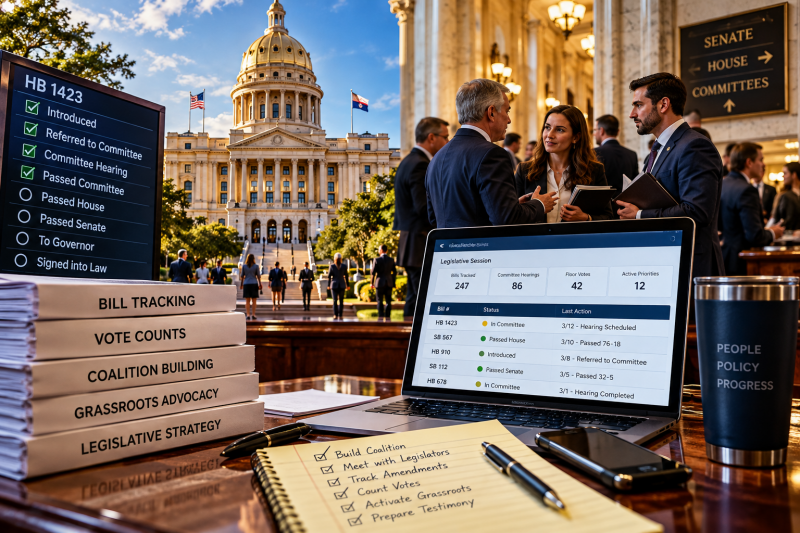
When most people hear the word lobbying, they picture a well-connected professional walking into a state capitol, sitting down with a legislator, making a persuasive argument, and somehow convincing that legislator to vote a particular way.
Sometimes, that’s part of the job.
But if you think that’s what lobbying actually looks like from beginning to end, you’re missing most of the picture.
Professional lobbying is a complicated, time-sensitive, research-intensive operation involving legislative intelligence, relationship management, bill analysis, vote counting, coalition development, strategic communications, committee monitoring, grassroots mobilization, and constant adjustments to a changing political environment.
And here’s something I think every grassroots organizer, nonprofit leader, advocacy director, and state chapter president should understand:
The meeting with the legislator is often the most visible part of lobbying, but much of the work that makes that meeting effective happens before anyone walks into the room.
I’ve spent years working in grassroots advocacy and digital organizing, including helping organize coalitions around legislative reform. One of the most important lessons I’ve taken from that experience is that having a good policy idea and building the political support necessary to advance it are two very different challenges.
You can have a well-researched proposal, thousands of people who support it, and a compelling argument for why it matters. Yet the proposal can still fail if you don’t understand the legislative calendar, the committee process, the people who control the agenda, the votes required for passage, and the competing priorities consuming lawmakers’ attention.
On the other hand, an organized group with a relatively small number of committed supporters can make a meaningful contribution to a legislative debate when it understands the process, communicates effectively, and engages the right decision-makers at the right time.
That’s why I want to break down how lobbying actually works.
We’re not going to stop at explaining how a bill becomes a law. We’re going to examine how an advocacy organization builds and executes a legislative strategy, how professional lobbyists manage their workload, how vote counts work, how coalitions are constructed, how to influence legislation without hiring an expensive lobbying firm, and how to establish a functioning lobbying operation within your own state chapter.
Because if you’re serious about changing public policy, you need more than passion.
You need a plan.
First, Understand What Lobbying Actually Is
Let’s start with a basic distinction.
Legislative education explains how government works. Advocacy communicates a position about a public issue. Lobbying involves efforts to influence government decisions through communications or other activities covered by applicable law.
These activities overlap, but they aren’t necessarily identical.
For example, publishing an article explaining your state’s property tax system is educational communication.
Publishing an article urging legislators to support a specific property tax bill is advocacy.
Contacting a legislator to request a vote for that bill may constitute lobbying, depending on the communication, the applicable legal definition, and the circumstances.
Similarly, organizing residents to contact their representatives about pending legislation can be a form of grassroots lobbying.
The precise legal definitions matter because states have different registration, reporting, disclosure, and exemption requirements.
The University of Florida’s Government and Community Relations office provides guidance on lobbying definitions and related compliance considerations. Florida also maintains official resources for legislative lobbyist registration and reporting through its Legislature.
The important lesson is that an organization shouldn’t assume every advocacy activity is legally identical or subject to the same requirements.
Before launching a lobbying program, determine which activities require registration, which communications trigger reporting obligations, and which rules apply to paid staff, volunteers, nonprofit organizations, and outside consultants.
Sources:
- University of Florida, Government and Community Relations: https://gcr.ufl.edu/state-relations/lobbying-guidance-and-faq/
- Florida Legislature, Lobbyist Information: https://www.leg.state.fl.us/lobbyist/
The three dimensions of lobbying
For practical purposes, I think it’s useful to divide lobbying into three connected categories.
1. Direct lobbying
This involves communicating with legislators, legislative staff, committee members, leadership offices, and other relevant officials to influence a legislative decision.
Examples include:
- Meeting with a bill sponsor.
- Explaining how proposed legislation would affect your members.
- Requesting that a committee hear a bill.
- Providing research to a legislative aide.
- Asking a legislator to support an amendment.
- Discussing the concerns of constituents with a committee chair.
- Requesting a specific vote.
2. Grassroots lobbying
This involves mobilizing members of the public to communicate with decision-makers about legislation.
Examples include:
- Organizing constituents to call their representatives.
- Sending members an action alert before a committee hearing.
- Coordinating district-level meetings.
- Encouraging supporters to submit relevant public testimony.
- Helping residents prepare concise, factual messages about a bill.
3. Legislative intelligence and strategy
This is the work that helps an organization determine what to do, when to do it, and where its resources will have the greatest practical value.
Examples include:
- Tracking bills.
- Monitoring committee agendas.
- Identifying bill sponsors and committee chairs.
- Reviewing amendments.
- Maintaining vote-count spreadsheets.
- Monitoring competing proposals.
- Identifying potential coalition partners.
- Assessing legislative deadlines.
- Preparing briefings for organizational leadership.
The third category often receives less public attention because much of it happens behind the scenes.
But it connects the other two.
Without reliable legislative intelligence, an organization can spend days promoting a bill that isn’t moving, overlook an amendment that fundamentally changes its effect, or discover too late that the committee considering the legislation has already scheduled its vote.
A lobbying operation must do more than communicate.
It must know what is happening, understand why it matters, and respond before the opportunity disappears.
The Real Starting Point: Define the Policy Objective
Before tracking bills, scheduling meetings, or building a coalition, your organization needs to determine exactly what it wants to accomplish.
This sounds obvious, but it’s where many advocacy campaigns begin to lose focus.
Consider an organization concerned about property taxes.
Its broad mission might be to reduce the financial burden on homeowners.
That’s a legitimate policy objective, but it doesn’t yet provide enough direction for a lobbying operation.
Does the organization want to reduce tax rates? Change assessment limitations? Increase homestead exemptions? Restrict local government spending growth? Require voter approval for certain tax increases? Change how property is assessed? Or pursue several of these objectives simultaneously?
Those are different policy approaches with different legal, fiscal, political, and administrative implications.
A professional lobbying strategy starts by translating a broad concern into a specific legislative objective.
Build a legislative position statement
Your position statement should answer five questions.
What problem are we trying to solve?
Describe the issue in concrete terms. Use reliable evidence rather than relying exclusively on anecdotes or broad claims.
What change are we asking the legislature to make?
Identify the policy mechanism. If the proposal is already contained in a bill, specify the bill number and the relevant provisions.
What outcome would count as success?
Success might mean passing a bill, preventing a harmful amendment, securing a committee hearing, obtaining a legislative study, or getting an issue included in a budget proposal.
What are our nonnegotiable priorities?
Determine which provisions are essential and which could be modified without undermining the organization’s primary objective.
What is our fallback position?
Legislation frequently changes during the process. An organization should understand whether it would support a narrower bill, an alternative amendment, a study, or a later legislative effort if its original proposal cannot advance.
This doesn’t mean abandoning principles whenever political circumstances become difficult.
It means distinguishing the policy outcome you’re trying to achieve from the particular legislative vehicle you’re using to achieve it.
Establish measurable objectives
Instead of saying, “We want legislators to support property tax reform,” an organization could establish objectives such as:
- Identify and document the committee assignments relevant to the proposal.
- Obtain meetings with the bill sponsor and relevant committee leadership.
- Recruit organizations willing to publicly support the legislation.
- Determine which committee members have stated positions.
- Secure opportunities to provide substantive testimony.
- Track whether the bill receives a hearing and advances.
- Maintain an accurate record of recorded votes.
These are activities and milestones your team can actually measure.
They also give your state chapter a way to evaluate its performance without pretending it can control every legislative outcome.
Before the Session Starts, the Lobbying Operation Is Already Working
One of the biggest misconceptions about lobbying is that the work begins when legislators arrive at the capitol.
In reality, serious legislative preparation often starts months earlier.
The National Conference of State Legislatures explains that lobbying work frequently begins well before a regular legislative session and continues throughout the process of considering legislation.
That makes sense when you consider everything that must happen before a bill receives a vote.
Someone has to identify the issue, develop a proposal, find a sponsor, prepare supporting research, anticipate opposition, identify committee assignments, and determine which organizations and constituencies might support the effort.
Waiting until a bill appears on a committee agenda can leave an organization trying to accomplish several months of preparation in a few days.
Phase one: Build the legislative calendar
Every state has its own legislative schedule.
Some legislatures meet annually. Others have biennial sessions. Session lengths, filing deadlines, committee procedures, special sessions, and interim periods differ.
Your first task is to build a calendar covering the entire legislative cycle.
At a minimum, track:
- The start and anticipated end of the session.
- Bill filing deadlines.
- Committee organizational meetings.
- Relevant committee hearing dates.
- Budget deadlines.
- Amendment deadlines, where applicable.
- Chamber deadlines and crossover dates, where applicable.
- Adjournment.
- Relevant interim committee meetings.
- Rulemaking or implementation deadlines following enactment.
Don’t assume every state follows the same procedure. Some deadlines are statutory, some are established by chamber rules, and others are determined by leadership or committee schedules.
The official legislature’s website should be your primary source.
Phase two: Review the previous session
Before looking forward, examine what happened last time.
Which bills addressing your issue were introduced?
Which advanced?
Which died in committee?
Were any proposals amended substantially?
Did a similar bill pass one chamber but fail in the other?
Did the governor veto a measure?
Were there competing proposals addressing the same subject?
Was funding provided for implementation?
These questions help distinguish a genuinely new legislative opportunity from an issue that has already been debated repeatedly.
They can also reveal where the process previously stalled.
If a proposal repeatedly receives support in one chamber but never receives a hearing in the other, that is useful intelligence. The next strategy should account for that obstacle rather than simply repeating the previous campaign.
Phase three: Identify the people and institutions that matter
Create a directory of relevant decision-makers.
Depending on your issue, that may include:
- The bill’s primary sponsor.
- The sponsor’s legislative staff.
- Members of the committee of reference.
- The committee chair.
- The committee vice chair or ranking minority member, where applicable.
- Chamber leadership.
- Relevant appropriations committee members.
- The governor’s policy staff.
- Agencies responsible for implementing the legislation.
- Legislative research or fiscal staff.
- Other legislators with demonstrated expertise in the issue.
The goal isn’t to assume that a handful of powerful people control everything.
It’s to understand how authority and responsibility are distributed throughout the process.
A committee chair may control whether a bill is placed on an agenda under the applicable rules. A fiscal committee may determine whether a proposal with significant costs can advance. An agency may have essential information about implementation. A legislative leader may influence chamber priorities.
Your map should identify the actual authority each person or institution possesses.
A contact list tells you who exists. A legislative map tells you why each person matters.
Bill Tracking: The Daily Intelligence System Behind Lobbying
If there is one operational skill every state chapter should develop, it’s bill tracking.
Bill tracking is the process of monitoring legislation from introduction through its final disposition and, when relevant, implementation.
That includes more than recording a bill number and checking whether it passed.
A useful tracking system answers:
- What does the bill do?
- Who introduced it?
- Where is it in the process?
- What happens next?
- When is the next important deadline?
- Which committees will consider it?
- What amendments have been proposed?
- What votes have occurred?
- What is our organization’s position?
- What action should we take?
Step one: Find the official bill record
Start with the official legislative website for your state.
Locate the bill’s complete record, including its text, sponsors, committee assignments, amendments, hearing notices, votes, and other available documents.
Third-party platforms can help with discovery and notifications, but the official legislative record should be used to verify critical developments.
For multistate organizations, platforms such as LegiScan can help centralize research. The National Conference of State Legislatures also maintains state policy databases covering numerous legislative subjects.
Sources:
- LegiScan: https://legiscan.com/
- NCSL: https://www.ncsl.org/
Step two: Read the bill, not just the summary
This is essential.
A bill summary can tell you what legislation generally concerns, but the operative language determines what it actually proposes to do.
Read the full text.
Identify the sections that establish requirements, create exemptions, change existing law, appropriate funding, impose penalties, or delegate authority to an agency.
Look for definitions that affect who is covered.
Check effective dates.
Identify exceptions.
Determine whether the bill amends an existing statute or creates an entirely new section.
If the legislation is technical or legally complex, consult qualified legal or policy experts rather than assuming you can interpret every provision correctly on your own.
Step three: Create a bill-tracking record
A basic tracking sheet should include the following fields:
| Tracking Field | What to Record |
|---|---|
| Bill Number | Official legislative identifier assigned to the bill. |
| Bill Title | Official title of the legislation. |
| Sponsor | Primary sponsor and relevant cosponsors. |
| Policy Area | The specific policy issue addressed by the legislation. |
| Organizational Position | Support, oppose, amend, or monitor. |
| Bill Summary | A concise explanation of what the legislation proposes to accomplish. |
| Committee Assignment | Current committee of reference and any subsequent committee assignments. |
| Current Status | Latest verified procedural status of the legislation. |
| Last Action | Most recent official legislative action taken on the bill. |
| Next Deadline | Relevant legislative deadline or upcoming procedural milestone. |
| Upcoming Hearing | Date, time, committee, and location of scheduled hearings. |
| Amendments | Links to proposed amendments and summaries of material changes. |
| Vote Record | Recorded committee and floor votes, including individual legislator positions. |
| Key Contacts | Bill sponsor, committee chair, legislative staff, and other relevant offices. |
| Organizational Action | Specific next steps, including meetings, testimony, coalition outreach, or grassroots engagement. |
| Assigned Owner | Person responsible for monitoring the bill and reporting developments. |
| Last Verified | Date and time the information was most recently checked against official legislative records. |
For a small organization, a spreadsheet may be enough.
A larger chapter may need a legislative database, automated alerts, shared dashboards, or dedicated software.
The important thing is not the sophistication of the technology.
It’s whether the information is accurate, current, accessible, and connected to an action plan.
Step four: Monitor more than the bill’s status
Imagine a bill is listed as pending in committee.
That status alone doesn’t tell you whether the committee plans to hear it tomorrow, whether a substitute bill has been filed, or whether an amendment would substantially change the proposal.
Your monitoring system should capture procedural developments that could require an immediate response.
For example:
Monday: The bill is referred to a committee.
Tuesday: The sponsor announces that a committee substitute is being prepared.
Wednesday: The substitute is published.
Thursday: A hearing is scheduled for the following week.
Friday: A coalition meeting is held to review the revised language.
The bill’s broad subject hasn’t changed, but your organization may need to revise its position, prepare new testimony, or alert its members.
This is why bill tracking should be treated as a continuous intelligence function rather than a clerical task.
Step five: Prioritize the bills you track
A state chapter may discover dozens or hundreds of bills that touch its policy interests.
Trying to give every bill the same amount of attention is usually impractical.
Develop a prioritization system based on factors such as:
- Policy importance.
- Potential impact.
- Likelihood of a meaningful legislative opportunity.
- Upcoming deadlines.
- Current procedural stage.
- Organizational capacity.
- Availability of credible coalition partners.
- Potential consequences of inaction.
You can classify bills as high, medium, or low priority, provided the categories are based on explicit criteria.
A high-priority bill might receive daily monitoring, frequent team briefings, and a designated legislative lead.
A medium-priority bill might receive regular status checks and escalation when a hearing is scheduled.
A low-priority bill might receive automated monitoring until a significant development occurs.
These are organizational choices, not universal standards. A bill that appears relatively minor can become important if it is amended into a larger legislative package or creates a precedent affecting your organization’s mission.
The objective is not to track the greatest number of bills. It’s to ensure that important bills receive the attention their consequences warrant.
How Many Bills Does a Full-Time Professional Lobbyist Handle?
This is one of the most interesting questions in the entire lobbying business, and it deserves a careful answer.
There is no universally accepted, reliable national average establishing how many bills every full-time professional state lobbyist handles during a legislative session.
That distinction matters.
A person representing a single industry association may have a very different workload from a contract lobbyist representing multiple unrelated clients. Someone working on state budget policy may spend most of the session concentrating on a few large appropriations measures, while a regulatory specialist may monitor a much broader range of proposals.
Public research documents the scale and complexity of state lobbying, but that does not mean it establishes a single standard caseload for individual lobbyists.
For example, a 2019 study by political scientist James Strickland examined lobbying across U.S. states and found that the number of hired lobbyists associated with registered interests had increased substantially over time. The study also examined how institutional arrangements and lobbying regulations affect lobbying activity.
A separate 2024 research dataset, CHORUS, compiled approximately 13 million policy-position records involving more than 300,000 interest groups and individuals across 17 state legislatures, covering more than 500,000 bills from 1997 through 2022.
Those figures illustrate the scale of the state lobbying environment. They do not tell us how many bills an individual lobbyist personally manages.
Sources:
- James Strickland, America’s Crowded Statehouses: Measuring and Explaining Lobbying in the U.S. States: https://journals.sagepub.com/doi/10.1177/1532440019829408
- CHORUS Dataset, How Do They Lobby?: https://howdotheylobby.org/about
So how should an organization think about caseload?
The most useful approach is to distinguish between bills monitored, bills actively worked, and bills receiving intensive lobbying attention.
These are three different measures.
Bills monitored
A lobbyist may monitor a broad portfolio of legislation to identify anything that could affect a client.
Monitoring might involve reviewing automated alerts, checking bill status, reading amendments, and flagging relevant developments.
A monitored bill does not necessarily receive direct lobbying attention.
Bills actively worked
An actively worked bill requires a more substantial commitment.
The lobbyist may need to analyze its provisions, consult the client, contact legislative staff, attend hearings, coordinate with other organizations, or prepare recommendations.
Bills receiving intensive attention
An intensively worked bill may require daily activity.
That can include multiple legislative meetings, amendment negotiations, vote-count updates, coalition coordination, hearing preparation, client briefings, and rapid responses to new developments.
A lobbyist could monitor a large portfolio while actively working a smaller group and devoting most of their time to only a handful of critical measures.
An illustrative workload model
The following is a planning example, not a published industry average.
Imagine a full-time contract lobbyist has responsibility for 40 bills during a legislative session.
The portfolio might be organized as follows:
Frequent legislative meetings, vote counts, amendment negotiations, coalition coordination, and rapid-response advocacy.
Regular bill analysis, stakeholder outreach, hearing preparation, and legislative follow-up.
Routine legislative status checks, automated alerts, amendment monitoring, and escalation when significant developments occur.
Again, the figure of 40 is an illustrative planning assumption, not an empirical average for professional lobbyists.
Another lobbyist might monitor far more bills. A specialist handling a few technically complicated measures might have a smaller portfolio and still face an extremely demanding workload.
The key variable is not simply the number of bill numbers in a spreadsheet.
It’s the amount of work each bill requires, the number of clients involved, the complexity of the issues, and the speed at which decisions must be made.
Why bill counts can be misleading
Consider two pieces of legislation.
The first is a short bill making a narrow administrative change.
The second is a large appropriations bill that affects multiple agencies, contains numerous amendments, and determines funding for programs relevant to several clients.
Both count as one bill.
They do not represent the same workload.
A bill may also create multiple issues for different clients. One organization may support it overall but oppose a particular provision. Another may support its funding provisions while objecting to an implementation requirement.
Consequently, counting bills alone is a poor way to evaluate a lobbyist’s productivity.
Better questions include:
- How many priority issues require active intervention?
- How frequently are deadlines approaching?
- How many legislative meetings are necessary?
- How much amendment analysis is required?
- How many clients need updates and recommendations?
- How much time is spent coordinating coalitions?
- How much work is required to prepare for hearings?
- Which issues could require an immediate response?
This is why professional lobbying depends on workload management, not merely bill counting.
Vote Counting: The Difference Between Having Support and Knowing Where You Stand
Let’s talk about vote counts.
If you’ve never worked on a legislative campaign, vote counting can sound deceptively simple.
You identify the legislators who support your bill, count them, and determine whether you have enough votes.
In practice, a credible vote count requires much more discipline.
Your organization needs to understand the number of votes required, the composition of the voting body, the positions of individual members, the procedural circumstances of the vote, and the reliability of the information available.
Step one: Determine the actual threshold
Don’t assume every legislative vote requires the same number of votes.
The threshold can depend on the chamber, the number of members voting, the procedural question, and applicable constitutional or chamber rules.
Ordinary passage, constitutional amendments, veto overrides, procedural motions, and certain budget actions can have different requirements.
For example, a hypothetical committee with 11 voting members might require six affirmative votes for a simple majority when all 11 members participate and the governing rule uses a majority of the full voting membership.
But the applicable rules must be checked. Vacancies, abstentions, absences, quorum requirements, and the specific motion can affect how a vote is determined.
Your vote-counting system should document the relevant threshold rather than relying on an assumed number.
Step two: Classify each legislator’s position
A useful system separates legislators into categories.
| Classification | Meaning | Recommended Lobbying Action |
|---|---|---|
| Confirmed Support | The legislator or authorized office has clearly communicated support for the specific bill or relevant proposal. | Maintain communication, provide updates, and verify continued support as legislation changes. |
| Leaning Support | Available information indicates a favorable position, but support has not been confirmed. | Follow up, address outstanding concerns, and seek a clear statement of support. |
| Undecided | The office has not communicated a clear position on the specific legislation. | Provide relevant research, answer questions, and request an opportunity to discuss the proposal. |
| Leaning Opposition | Available information indicates a likely negative position, but opposition has not been confirmed. | Identify the concerns, provide relevant information, and determine whether any issues can be resolved. |
| Confirmed Opposition | The legislator or authorized office has clearly communicated opposition to the specific proposal. | Document the stated objections and determine whether further engagement or an amendment is appropriate. |
| Unknown | There is insufficient reliable information to classify the legislator's position. | Conduct additional outreach and avoid making assumptions about the legislator's position. |
This prevents one of the most common errors in advocacy: treating silence as support.
A legislator who hasn’t responded to your email is not necessarily undecided.
A legislator who voted for a similar bill three years ago is not automatically committed to voting for this one.
A legislator who supports your organization’s general mission may still oppose a particular provision.
Every position should be tied to the specific bill, version, amendment, or procedural question under consideration.
Step three: Record the evidence
Your spreadsheet should include more than a color-coded box.
Record:
- The legislator’s name.
- The date of the latest contact.
- The staff member or legislator who communicated the position.
- The exact issue discussed.
- The version of the bill involved.
- Any stated conditions.
- The next follow-up action.
- The source of the information.
For example:
Position: Leaning support.
Evidence: Legislative aide stated that the office is reviewing the bill and has concerns about its implementation costs.
Next action: Provide the fiscal analysis and request a follow-up meeting.
That is useful intelligence.
Simply labeling the legislator green because someone believes the office is friendly to your organization is not.
Step four: Separate public votes from private assessments
An actual recorded vote is stronger evidence of how a legislator voted on a particular question than an informal assessment of the legislator’s likely position.
But even recorded votes require context.
Was the vote on final passage, an amendment, a procedural motion, or a committee substitute?
Was the language identical to the version your organization supports?
Did the legislator vote against a bill because of one objectionable provision while supporting its broader objective?
Record the question that was actually voted on.
If a legislator publicly states support for a bill, record that statement and its date. If the office later changes its position following an amendment, update the record.
Step five: Count votes conservatively
Imagine a 21-member committee.
Suppose your team identifies:
- 8 confirmed supporters.
- 3 legislators leaning toward support.
- 5 undecided members.
- 4 legislators opposed.
- 1 member whose position is unknown.
You do not have 11 confirmed votes simply because eight supporters and three potentially favorable members exist.
You have eight confirmed supporters, with additional opportunities to investigate and develop support.
Your next steps should reflect that reality.
Which undecided members have jurisdictional expertise?
Which have expressed concerns that can be addressed with evidence?
Which members need additional information about the bill’s effects?
Are any of the reported positions based on outdated bill language?
The purpose of a vote count isn’t to create an optimistic spreadsheet.
It’s to help your organization make better decisions about where to spend its time.
Step six: Update the count after every significant development
A vote count is not a document you prepare once and put away.
It should change when:
- A new amendment is introduced.
- A legislator publicly announces a position.
- A committee substitute changes the bill.
- A fiscal analysis identifies new costs.
- A hearing reveals previously unknown concerns.
- A procedural motion changes the question before the committee.
- The bill moves to a different chamber.
- A previously supportive legislator raises an objection.
A useful rule is to record the date and source of every meaningful change.
When the committee hearing approaches, the team should be able to produce an up-to-date assessment without having to reconstruct weeks of conversations.
A vote count is a decision-making tool, not a prediction dressed up as a spreadsheet.
Direct Lobbying: What Actually Happens Before, During, and After a Meeting
Now let’s get into the part most people imagine when they think about lobbying.
You have identified a bill. You’ve read it. You understand the legislative calendar. You have a position statement, a coalition plan, and an initial vote count.
Now you need to communicate with the people who can influence what happens next.
The quality of those interactions matters, but the meeting itself is only one part of the process.
Before the meeting: Research the office
Start by understanding the legislator’s responsibilities and the purpose of the meeting.
Review the official legislative biography, committee assignments, publicly available voting record, relevant statements, and any legislation the member has sponsored on the subject.
Identify the specific question you need answered.
Are you requesting support for the bill?
Are you asking the office to address a concern?
Do you need clarification about a proposed amendment?
Are you asking whether the bill will receive a hearing?
Are you seeking permission to provide additional technical information?
These are different conversations.
A meeting with a bill sponsor may focus on improving the proposal.
A meeting with a committee chair may focus on the bill’s readiness for consideration and the committee’s concerns.
A meeting with a legislator who is undecided may focus on evidence, implementation, costs, or constituent experiences.
The meeting should be designed around the office’s role and the decision you’re asking it to make.
Prepare a concise briefing
A useful legislative briefing should answer four questions:
- What does the bill do?
- Why does your organization support or oppose it?
- What evidence supports your position?
- What specific action are you requesting?
Include the bill number and a link to the current text.
If the bill is complicated, provide a short summary and identify the sections most relevant to the discussion.
Bring reliable data, credible examples, and responses to likely questions.
If your organization has concerns about costs, implementation, legal authority, or unintended consequences, acknowledge them honestly.
Legislators and their staff need information they can evaluate, not simply a list of reasons your organization believes its position is correct.
During the meeting: Make the request clear
A productive legislative meeting doesn’t require an elaborate presentation.
Introduce yourself and your organization.
Explain the issue.
Identify the specific provision or policy outcome you are discussing.
Present the evidence.
Ask the question you came to ask.
Then listen.
If the office raises concerns, clarify them before responding. A concern about the bill’s cost is different from a concern about its legal effect. A concern about the policy objective is different from a concern about how the bill would be implemented.
Understanding the actual objection allows your organization to provide a relevant answer.
Avoid assuming that every objection is an excuse or that every expression of interest indicates support.
A staff member who asks detailed questions may be doing exactly what responsible legislative staff should do: identifying issues that require further analysis.
After the meeting: Document what happened
Within your organization, record:
- Who attended.
- Which bill and version were discussed.
- The office’s stated position, if any.
- Questions and concerns raised.
- Information promised by either side.
- Follow-up deadlines.
- The next requested action.
Send promised research promptly.
If you agreed to provide a fiscal estimate or legal analysis, follow through.
If the office asked for clarification, respond directly to the question.
And if the legislator did not commit to a position, record that accurately.
A meeting is not a success merely because it happened.
Its value depends partly on what the organization learned, what commitments were made, and whether the conversation advances a clearly defined objective.
Legislative Staff: Why the People Behind the Scenes Matter
One of the most important lessons for new advocates is that legislators do not operate alone.
They rely on staff to help manage schedules, review information, research policy, communicate with constituents, prepare for hearings, and understand the practical implications of legislation.
The precise structure varies by state and legislative office, but staff can play an important role in how information reaches a decision-maker.
That makes legislative staff essential participants in many lobbying efforts.
Why staff meetings can be valuable
Imagine a legislator has 20 meetings scheduled during a busy week.
Each meeting concerns a different issue.
Each organization has research it wants the office to review.
The legislator cannot personally conduct a full technical review of every proposal before deciding what questions to ask.
Staff help manage that information.
A concise, well-supported briefing can therefore be useful even when the legislator cannot immediately meet with your organization.
Staff may also identify questions that need to be resolved before a bill advances.
For example, they might ask whether a proposed requirement conflicts with existing law, whether the relevant agency has estimated implementation costs, or whether the bill creates an unintended consequence for a particular group.
Those questions are not necessarily evidence of opposition.
They are opportunities to clarify the proposal.
How to communicate effectively with legislative staff
Be specific.
Identify the bill number.
Provide links to primary documents.
Explain what your organization is asking the office to do.
Keep your supporting material organized.
Respond promptly to questions.
If you don’t know an answer, say so and explain when you expect to provide it.
Don’t send a 30-page report when a two-page summary and one relevant table would answer the question.
Don’t expect staff to reconstruct your position from a series of unrelated emails.
And don’t treat staff as obstacles standing between you and the legislator.
They are part of the legislative institution you are trying to engage.
Good legislative communication makes it easier for an office to understand the issue, verify the facts, and evaluate the requested action.
Committee Strategy: Where a Great Deal of Legislative Work Happens
A bill can have a sponsor, public support, and a growing list of cosponsors and still fail to advance.
One reason is that legislative progress depends on procedural decisions, not simply on whether a proposal has supporters.
In most state legislatures, committees examine legislation before it reaches the full chamber, although the precise process differs by state.
The National Conference of State Legislatures describes the general process as involving introduction, committee consideration, floor action, consideration by the other chamber, resolution of differences where necessary, and gubernatorial action.
Source: NCSL, Learning the Game: https://www.ncsl.org/legislative-staff/civics-education/learning-the-game
Identify the committee of reference
Once a bill is introduced, determine which committee receives it.
Then review that committee’s jurisdiction, membership, leadership, hearing schedule, and relevant rules.
If the bill is referred to multiple committees, identify the order in which they will consider it and any deadlines governing the process.
Don’t assume the first committee is the only important one.
A bill may clear one committee and face significant opposition in another.
Understand the chair’s role
Committee chairs often have substantial influence over hearing schedules and the management of committee business, subject to applicable chamber rules and leadership decisions.
That makes understanding the chair’s role important.
However, an organization should never assume it can infer a chair’s intentions solely from political affiliation, public statements, or relationships with other legislators.
Find out what the official rules permit, monitor public schedules, and communicate directly with the office when appropriate.
Prepare for the hearing
A committee hearing may include:
- A presentation by the sponsor.
- Questions from committee members.
- Testimony from supporters.
- Testimony from opponents.
- Responses from relevant agencies.
- Proposed amendments.
- Committee discussion.
- A motion and vote.
The actual format varies.
Your organization should determine whether testimony must be submitted in advance, whether registration is required, whether there are time limits, and whether remote participation is available.
Prepare witnesses who understand the bill.
Make sure their testimony is accurate, concise, and relevant to the committee’s responsibilities.
If your organization is submitting written testimony, identify the bill and version, state your position, explain the relevant facts, and make the requested action clear.
Monitor amendments closely
This is where a committee hearing can change the entire lobbying strategy.
An amendment may narrow the bill, broaden its scope, add exemptions, change enforcement provisions, alter funding, or redefine who is covered.
A bill that originally addressed one policy question may evolve into something materially different.
Your organization should establish who is responsible for reviewing new language and deciding whether the existing position remains appropriate.
Do not continue advocating for a bill based on an outdated version.
Coalition Building: How Organizations Turn Individual Voices Into a Shared Legislative Effort
Most public policy issues affect more than one organization.
A proposal concerning transportation may affect local governments, businesses, commuters, environmental organizations, and public safety agencies.
A healthcare bill may affect patients, providers, employers, insurers, and administrators.
A tax proposal may affect homeowners, renters, businesses, local governments, and public service providers in different ways.
These overlapping interests create opportunities for coalition building.
A coalition is a group of organizations or individuals coordinating around a shared objective while retaining their own identities and responsibilities.
The most useful coalitions are not necessarily the largest.
They are coalitions whose members contribute relevant expertise, credible experiences, organizational capacity, public testimony, research, or connections to affected communities.
Step one: Map the stakeholders
Start by identifying who is affected by the proposal.
Ask:
- Who benefits if the bill passes?
- Who may bear costs or face new obligations?
- Who administers the policy?
- Who has relevant technical expertise?
- Which organizations have previously worked on the issue?
- Which community groups can describe its practical effects?
- Which organizations may support the general objective but disagree about the details?
The final question is particularly important.
Coalition building does not require every participant to agree on every issue.
Organizations can share a limited objective while maintaining different priorities elsewhere.
Step two: Identify genuine common ground
Suppose three organizations support changes to a state’s occupational licensing system.
One is concerned about unnecessary barriers to entering a profession.
Another is focused on small-business formation.
A third is concerned about workforce shortages.
They may have different reasons for supporting reform, but they can potentially agree on a specific legislative change.
That shared objective provides a basis for cooperation.
However, if one organization supports a broad repeal while another supports only a narrow amendment, the coalition needs to acknowledge that difference rather than pretending it doesn’t exist.
A clear, limited agreement is more useful than a broad statement that conceals disagreements.
Step three: Establish coalition rules
Before the coalition begins public activity, agree on the basics.
Who coordinates meetings?
Who maintains the contact list?
Who approves joint statements?
Can members speak publicly on behalf of the coalition?
How are disagreements resolved?
Who verifies legislative information?
What happens when an amendment changes the proposal?
Who communicates with legislative offices?
What activities require each member’s independent approval?
These questions may seem administrative, but they prevent confusion when the legislative timeline becomes demanding.
Step four: Assign responsibilities
A coalition becomes operational when its members know what they are responsible for doing.
For example:
- One organization prepares the technical policy analysis.
- Another recruits witnesses with relevant experience.
- A third coordinates constituent outreach.
- A fourth tracks committee schedules.
- The lead organization maintains the shared legislative calendar.
- Each organization communicates with its own membership.
Responsibilities should reflect actual capacity and expertise.
Don’t assign a task simply because an organization has a recognizable name.
Step five: Protect the credibility of the coalition
Coalition members should be able to explain what they support and why.
Don’t inflate membership figures.
Don’t imply that every member endorses a statement without authorization.
Don’t attribute quotations to organizations that haven’t approved them.
Don’t treat the number of logos on a letter as a substitute for understanding the proposal.
And don’t conceal material disagreements when those disagreements affect the coalition’s public position.
Credibility takes time to build and can be lost quickly.
Step six: Keep the coalition active between legislative sessions
The strongest coalitions don’t necessarily disappear when the legislature adjourns.
They can continue reviewing implementation, monitoring agency rules, evaluating outcomes, educating members, and preparing for the next session.
That continuity is particularly valuable when a proposal requires multiple legislative attempts or when the effects of a new law take time to evaluate.
Outside Lobbying: The Work That Happens Beyond the Capitol
Direct lobbying is only one component of a legislative strategy.
A state chapter may also need to communicate with constituents, educate the public, develop relationships with community organizations, organize local events, publish research, and prepare members to participate in the legislative process.
This is the broader public-facing side of lobbying and advocacy.
The important distinction is that outside activity should be connected to a defined legislative objective rather than treated as a collection of unrelated publicity opportunities.
Constituent communication
Legislators represent districts.
Communication from constituents can provide relevant information about how a policy affects the people the office serves.
A grassroots organization can help residents understand the issue and communicate their experiences accurately.
For example, it might provide:
- The official bill number.
- A concise explanation of the proposal.
- The relevant committee and hearing date.
- The legislator’s official contact information.
- A clear explanation of the requested action.
- Links to primary sources.
- Instructions for submitting testimony, where applicable.
The organization should encourage people to communicate in their own words rather than distributing fabricated personal stories or suggesting that supporters claim experiences they never had.
Authenticity matters.
District-level engagement
Legislative work doesn’t have to happen exclusively in the capitol.
Depending on the legislature’s schedule and applicable rules, organizations may engage with officials through district meetings, public forums, town halls, community events, and scheduled constituent appointments.
District-level engagement can help legislators understand how a proposal affects their communities.
It also gives organizations an opportunity to hear concerns from people who may not share their positions.
That information can improve policy analysis and help identify unintended consequences.
Public education
An organization may publish an explainer, host a webinar, distribute a fact sheet, or hold a community discussion about a pending bill.
The purpose should be to help people understand the actual proposal.
Use primary sources.
Explain technical terms.
Distinguish what the bill would legally require from what supporters believe it would accomplish.
If the fiscal effects are uncertain, say so.
If reasonable analysts disagree about the consequences, explain the competing interpretations and the evidence behind them.
Effective advocacy doesn’t require sacrificing accuracy.
Media and digital communications
Digital tools can make legislative information easier to distribute and help organizations coordinate supporters across a large state.
An advocacy chapter might use:
- Email newsletters.
- Social media.
- Online action forms.
- Webinar platforms.
- Public legislative dashboards.
- Member discussion groups.
- Website explainers.
- Volunteer coordination systems.
The goal is to make it easier for people to understand an issue and participate meaningfully.
But digital reach should not be confused with legislative influence.
A post with thousands of views may increase awareness without producing any measurable legislative action.
A smaller number of well-informed constituents who submit substantive testimony, attend a hearing, or communicate directly with their representatives may contribute more directly to a particular legislative objective.
Both forms of activity can have value, but they serve different purposes.
Measure public engagement by what it accomplishes, not merely by how many people see it.
Building a Grassroots Action Alert That People Can Actually Use
Action alerts are among the most familiar tools in advocacy, but many are less effective than they could be.
A useful alert should make participation straightforward.
It should tell supporters what is happening, why it matters, what action is requested, and when that action needs to occur.
Consider this hypothetical example.
A state senate committee is scheduled to consider a bill next Tuesday.
Your organization supports the bill and wants constituents to contact committee members before the hearing.
A well-structured action alert might contain:
The issue: A concise explanation of the bill and the policy question it addresses.
The legislative status: The committee considering it, the scheduled hearing date, and a link to the official bill record.
The requested action: Contact your senator or submit testimony before a specified deadline.
The suggested message: A short factual summary supporters can use as a starting point, with encouragement to explain their own reasons for supporting the proposal.
The source material: Links to the bill text, official hearing information, and your organization’s analysis.
The deadline: A clear date and time, verified against the official legislative schedule.
The follow-up: A promise to report the committee’s action and explain what happens next.
Why timing matters
An alert sent three weeks before a committee hearing may help educate supporters and build participation.
An alert sent after the hearing has concluded cannot influence the testimony that was already delivered.
Similarly, an alert asking people to contact a legislator about a bill that has already passed its final vote may be poorly timed unless a relevant subsequent action remains.
Your legislative calendar should therefore drive your communications calendar.
The question isn’t simply, “What should we post today?”
It’s, “What decision is approaching, and what information would help our supporters participate meaningfully before it happens?”
Avoid overwhelming your supporters
If every bill receives an urgent email, supporters may have difficulty distinguishing genuinely important developments from routine updates.
Use prioritization.
Explain why a particular action matters.
Be accurate about deadlines.
Don’t manufacture urgency.
And follow up when the requested action is complete so members understand what happened and what remains unresolved.
A credible organization treats its supporters as partners, not merely as a list of people to mobilize.
Lobbying Is Also About Timing, Agenda Control, and Procedural Awareness
Here’s an important point that often gets lost in simplified descriptions of the legislative process.
A bill can fail to advance even when the organization supporting it has presented credible arguments and identified potential supporters.
Why?
Because legislative outcomes depend partly on which proposals receive consideration, when they receive consideration, and what procedural opportunities exist.
Research published in Political Research Quarterly examined lobbying and bill advancement in Colorado, Nebraska, and Wisconsin.
The researchers found that lobbying positions were associated with bill outcomes and that lobbying was particularly predictive of whether proposals advanced through the legislative process. Their analysis did not find that lobbying bought votes from committee members; instead, the findings highlighted the importance of agenda-setting and legislative advancement.
The study is not proof that every lobbying effort succeeds or that all states operate identically. It does, however, provide evidence that legislative progress involves more than persuading individual lawmakers to cast a particular vote.
Source: Daniel M. Butler and David R. Miller, Does Lobbying Affect Bill Advancement? Evidence from Three State Legislatures: https://journals.sagepub.com/doi/10.1177/10659129211012481
What this means for a state chapter
Your organization should monitor both the content of a bill and its procedural position.
A few practical questions can help:
- Has the bill been formally introduced?
- Has it been referred to the relevant committee?
- Is a hearing scheduled?
- Is the bill eligible for consideration under the chamber’s rules?
- Are there deadlines that could prevent further action?
- Does the bill need to clear another committee?
- Has the sponsor requested an amendment?
- Is there an alternative bill addressing the same issue?
- Has the proposal been included in a larger legislative package?
These are not shortcuts around the legislative process.
They are part of understanding it.
If a bill has not received a hearing, your organization may need to focus on the reasons it hasn’t advanced and the procedures governing consideration.
If a bill has passed one chamber, the next stage may require a different set of relationships and a revised strategy.
If the bill has been amended substantially, the first task may be to reassess the proposal rather than immediately launch another public campaign.
Good lobbying pays attention to the decision that is actually available to be made next.
Budget Lobbying: A Different Kind of Legislative Challenge
Budget policy deserves special attention because appropriations and fiscal legislation can create workloads unlike those associated with many narrower policy bills.
A budget can affect numerous agencies, programs, projects, and policy priorities simultaneously.
It may also contain provisions relevant to organizations that otherwise have little reason to monitor the same legislation.
A 2024 study by John M. de Figueiredo examined state lobbying expenditures across multiple years and found that lobbying activity increases substantially during budget processes. The research identified business groups as an important driver of increased activity during these periods.
The finding helps explain why legislative workloads can intensify dramatically around budget deadlines.
Source: John M. de Figueiredo, Budgets and the Timing, Intensity, and Composition of Interest Group Lobbying in the U.S. States: https://scholarship.law.duke.edu/faculty_scholarship/4377/
Why budgets require specialized monitoring
Suppose your organization advocates for a program that receives state funding.
You may need to monitor:
- The governor’s proposed budget.
- House and Senate budget proposals.
- Agency budget requests.
- Relevant appropriations subcommittees.
- Proposed amendments.
- Conference negotiations.
- Final appropriations language.
- Implementation requirements.
A policy may receive favorable treatment in one proposal and different treatment in another.
Funding can also be affected by provisions buried within broader legislation.
For this reason, organizations should distinguish between policy authorization and actual funding.
A bill may authorize a program without providing all the resources necessary to operate it.
Conversely, budget language may provide funding subject to conditions that affect how the program functions.
Your chapter should identify whether its policy objective depends on a separate appropriation, an existing funding stream, a new revenue source, or an administrative action.
If the answer is unclear, seek qualified fiscal analysis.
Opposing a Bill Requires a Different Set of Questions
Lobbying isn’t exclusively about passing legislation.
Organizations also lobby to prevent proposals from advancing, amend bills they consider problematic, or limit provisions they believe would have undesirable effects.
The underlying disciplines remain similar, but the immediate objective changes.
Instead of asking only how to build support for a proposal, the organization must determine what specific outcome it is seeking.
Does it want the bill defeated?
Does it support the general objective but oppose a particular provision?
Would a narrower amendment address the concern?
Is the problem a cost, a legal issue, an implementation requirement, or a likely unintended consequence?
Could an alternative proposal address the stated problem differently?
These distinctions matter.
Identify the precise concern
Suppose a bill creates a new reporting requirement.
Your organization might oppose the bill because it believes the requirement is unnecessarily burdensome.
But what exactly creates the burden?
Is it the frequency of reporting?
The number of organizations covered?
The cost of compliance?
The information that must be collected?
The penalties for noncompliance?
If the problem is narrow, a targeted amendment might address it more directly than opposing the entire bill.
That doesn’t mean compromise is always appropriate. Some organizations may conclude that a proposal’s central objective is inconsistent with their mission.
The point is to understand the objection clearly enough to communicate it accurately.
Develop a documented opposition position
A credible opposition briefing should explain:
- What the bill would do.
- Which provisions create the concern.
- What evidence supports the concern.
- Who would be affected.
- What the likely consequences are.
- What alternative, if any, your organization proposes.
- What action you want the legislature to take.
Avoid overstating consequences that haven’t been established.
If the effect is uncertain, explain the uncertainty.
If a claim depends on assumptions, identify them.
Legislators need to understand the basis of your position, even when they ultimately disagree with it.
Legislative Research: Build Your Case With Verifiable Evidence
Professional lobbying requires an organization to support its claims with evidence that others can inspect.
That means going beyond searching for articles that agree with your position.
Start with the underlying policy question.
Then identify the most appropriate sources.
Depending on the issue, those sources might include:
- The current and proposed statutory language.
- Official fiscal notes.
- Legislative research reports.
- Agency data.
- Audited financial statements.
- Government accountability reports.
- Peer-reviewed research.
- Relevant court decisions.
- Public administrative records.
- Credible studies from independent research institutions.
The source should match the claim.
If you’re making a claim about the wording of a bill, cite the bill.
If you’re discussing a state’s official revenue figures, use the relevant government data.
If you’re making a causal claim about policy outcomes, look for research designed to investigate causation rather than relying on a single anecdote.
Separate facts, estimates, and projections
These categories are not interchangeable.
A recorded vote is a historical fact.
A fiscal note may contain an estimate based on assumptions.
A projection about how a proposal will affect future behavior may depend on economic conditions and implementation decisions.
A statement about what a law will accomplish may be an interpretation or prediction rather than an established result.
Make those distinctions clear in your briefing materials.
Prepare for questions from people who disagree
A good legislative briefing should anticipate reasonable questions.
What are the costs?
Who is covered?
How will the policy be enforced?
What happens if the underlying assumptions prove incorrect?
Are there unintended consequences?
What alternatives were considered?
How does the proposal compare with existing law?
What evidence supports the expected effects?
Preparing for those questions strengthens the analysis and reduces the risk that a critical issue will emerge for the first time during a hearing.
The goal of legislative research isn’t to find the most persuasive-sounding statistic. It’s to understand the policy well enough to defend your claims accurately.
What a State Chapter’s Lobbying Operation Should Look Like
Let’s bring all these pieces together.
Imagine you’re responsible for the legislative program of a statewide advocacy organization.
You have a chapter president, several regional leaders, a policy team, volunteers, and members who want to participate in legislative advocacy.
You may not have the budget to hire a full-time professional lobbyist.
You can still build a structured operation.
The key is assigning responsibility rather than expecting everyone to monitor everything.
The chapter president or executive director
This person establishes legislative priorities, approves organizational positions, allocates resources, and maintains accountability.
They should understand the overall strategy without necessarily managing every bill-tracking entry.
The legislative director
This person coordinates the day-to-day legislative operation.
Responsibilities may include maintaining the legislative calendar, supervising bill tracking, preparing legislative briefings, coordinating meetings, and communicating with chapter leadership.
In a smaller organization, the chapter president may fill this role.
The policy lead
This person analyzes the substance of legislation.
They review bill text, identify relevant research, prepare policy summaries, and coordinate technical questions with qualified experts.
The legislative monitoring coordinator
This person monitors official legislative updates, hearing schedules, amendments, and votes.
They ensure that significant developments are communicated promptly to the appropriate people.
The coalition coordinator
This person maintains relationships with partner organizations, schedules coalition meetings, coordinates shared materials, and documents agreed-upon actions.
The grassroots coordinator
This person organizes member communications, constituent outreach, public testimony, volunteer participation, and district-level engagement.
The regional or county captains
These leaders help connect statewide priorities with local communities.
They may identify relevant local organizations, recruit participants for district meetings, distribute verified legislative information, and report constituent concerns to the state team.
The communications lead
This person prepares public explainers, email updates, social media content, action alerts, and media materials.
They coordinate with the legislative team to ensure that public communications reflect the current bill language and procedural status.
One person may fill several roles in a small chapter. A larger organization may have multiple staff members dedicated to each function.
The important thing is to make ownership explicit.
If everyone is responsible for monitoring a bill, nobody may be accountable when an important amendment is missed.
A Practical 30-Day Plan for Launching a State Chapter Lobbying Program
If your organization is starting from scratch, you don’t need to build an elaborate lobbying department overnight.
You need a manageable process that can grow with your capacity.
Here is a practical 30-day framework.
Days 1–5: Establish priorities
Identify the issues your organization is prepared to work on.
Select a manageable number of initial priorities.
Write a clear position statement for each.
Determine what legislative outcomes would constitute meaningful progress.
Identify which issues require legal, technical, or fiscal expertise.
Days 6–10: Map the legislative process
Find the official legislative website.
Create a calendar of the next session and relevant deadlines.
Identify committees with jurisdiction over your priority issues.
Compile the names and official contact information of relevant legislators and staff.
Review previous legislation addressing those issues.
Days 11–15: Build the tracking system
Create a shared bill-tracking spreadsheet.
Assign a responsible person to each priority.
Set a routine for checking official updates.
Establish a process for reviewing amendments and recording votes.
Create a standard format for legislative briefings.
Days 16–20: Begin relationship development
Request appropriate introductory meetings.
Prepare concise organizational and policy briefings.
Identify potential coalition partners.
Schedule a meeting to discuss shared priorities.
Develop a contact log that records commitments and follow-up tasks.
Days 21–25: Prepare the grassroots operation
Create a basic member action-alert template.
Prepare instructions for contacting legislators and submitting testimony.
Identify volunteers who can attend relevant hearings.
Establish a system for communicating urgent legislative developments.
Make sure public-facing materials link to official bill records.
Days 26–30: Test the system
Select one priority bill or legislative issue and run it through your process.
Can your team locate the official text quickly?
Can it identify the current committee?
Can it explain the organization’s position in two minutes?
Can it identify the next relevant deadline?
Can it determine which facts still need verification?
Can it communicate an appropriate action to members?
Can it record what happened and identify the next step?
At the end of 30 days, review what worked and what didn’t.
A small operation that reliably tracks a handful of important issues is in a better position to grow than a large operation with no clear ownership or procedures.
How to Evaluate Whether Your Lobbying Program Is Working
Legislative outcomes matter, but they aren’t the only useful measures of performance.
A bill can fail for reasons outside an organization’s control. A proposal may face a deadline, a change in legislative priorities, an unexpected amendment, or opposition that the organization cannot overcome.
That doesn’t mean the organization should ignore outcomes.
It means it should distinguish between results, intermediate milestones, and operational performance.
Outcome measures
These assess what ultimately happened.
Examples include:
- Did the bill advance?
- Did the relevant provision become law?
- Was the objectionable amendment removed?
- Was funding appropriated?
- Did the final language reflect the organization’s stated objective?
Intermediate measures
These assess progress toward an outcome.
Examples include:
- Did the bill receive a hearing?
- Did the organization obtain meetings with relevant offices?
- Did coalition partners agree on a common position?
- Were substantive concerns addressed?
- Did the organization secure opportunities to provide evidence or testimony?
Operational measures
These assess whether the lobbying program is functioning reliably.
Examples include:
- Were priority bills monitored consistently?
- Were significant amendments identified promptly?
- Were briefings delivered before important deadlines?
- Were meetings documented?
- Were member action alerts accurate?
- Were coalition commitments completed?
- Were public claims supported by verifiable sources?
A balanced evaluation considers all three.
Don’t confuse activity with effectiveness
An organization might hold 50 legislative meetings and accomplish very little.
Another might hold fewer meetings but identify a critical problem in a bill, provide useful evidence, and help develop a viable amendment.
Similarly, sending thousands of emails is not automatically evidence that a campaign is effective.
The meaningful question is whether the activity advanced the organization’s objectives, improved the quality of the legislative discussion, or helped its members participate more effectively.
Keep records, review the results, and adjust the strategy based on what the evidence shows.
The Ethics and Legal Compliance Side of Lobbying
No serious lobbying guide should leave out compliance.
Lobbying rules vary by state and can depend on whether an individual is paid, who they represent, what branch of government they contact, the nature of the communication, and the amount or type of activity involved.
Some rules govern registration.
Others address reporting, gifts, conflicts of interest, compensation, public disclosures, or communications with particular officials.
Organizations may also face separate requirements under nonprofit, campaign finance, tax, or other applicable laws.
These rules should not be treated as interchangeable.
For example, Florida maintains separate resources addressing legislative and executive-branch lobbying. Its legislative rules and statutes cover matters such as registration and reporting, while executive-branch lobbying is addressed through the applicable ethics framework.
Official resources:
- Florida Legislature, Lobbyist Information: https://www.leg.state.fl.us/lobbyist/
- Florida Commission on Ethics, Lobbyist Information: https://ethics.state.fl.us/PublicInformation/LobbyistInfo.aspx
- Florida Statutes, Section 11.045: https://www.flsenate.gov/Laws/Statutes/2025/11.045
These are examples of why organizations should consult their own state’s current requirements rather than assuming the rules are identical nationwide.
Establish compliance procedures
Your organization should determine:
- Who is responsible for reviewing applicable lobbying laws?
- Which activities require registration?
- What reporting deadlines apply?
- Which records must be retained?
- What restrictions apply to gifts, compensation, or other interactions?
- Which nonprofit or tax rules may affect the organization’s activities?
- Who approves contracts with lobbying firms or consultants?
- How will potential conflicts of interest be identified and addressed?
If your organization operates in multiple states, maintain a separate compliance checklist for each jurisdiction.
A procedure that works in one state may not satisfy another state’s requirements.
When necessary, seek advice from a qualified attorney or compliance professional.
Maintain accurate records
Good records support both legal compliance and organizational accountability.
Maintain copies of relevant registrations, reports, contracts, invoices, communications, meeting notes, and other documents as required by applicable law and organizational policy.
Avoid informal arrangements that make it difficult to determine who is representing the organization, what work is being performed, or how compensation is calculated.
The objective is straightforward: ensure that your lobbying activities are conducted transparently, lawfully, and consistently with your organization’s obligations.
Common Mistakes That Undermine State Lobbying Efforts
Even organizations with strong missions and dedicated volunteers can make avoidable mistakes.
Here are several worth watching.
Mistake one: Starting too late
Waiting until a committee hearing is announced can leave little time for research, coalition coordination, and outreach.
The better approach: Prepare before the session, monitor developments continuously, and maintain relationships between sessions.
Mistake two: Tracking bills without assigning responsibility
A spreadsheet doesn’t manage itself.
If no one owns a priority bill, important developments can be missed.
The better approach: Assign a primary owner and backup for each high-priority issue.
Mistake three: Treating cosponsors as guaranteed votes
A cosponsor’s involvement can be meaningful, but a cosponsorship record and a recorded vote are different things.
The better approach: Record the exact evidence for each legislator’s position and update it when circumstances change.
Mistake four: Ignoring amendments
A bill can change substantially after introduction.
The better approach: Review new language, compare versions, and reassess your organization’s position when necessary.
Mistake five: Assuming every legislator needs the same argument
Different offices may have different questions, responsibilities, and concerns.
The better approach: Understand the decision being considered and prepare relevant, evidence-based information.
Mistake six: Building a coalition around slogans rather than specific objectives
Organizations may agree on a broad goal but disagree about the legislative mechanism.
The better approach: Identify the exact provisions or outcomes the coalition can jointly support.
Mistake seven: Overloading supporters with action alerts
Too many urgent messages can make it harder for members to identify the actions that matter most.
The better approach: Prioritize communications around meaningful deadlines and explain why each action is being requested.
Mistake eight: Measuring success only by legislative passage
A bill’s outcome may depend on factors beyond the organization’s control.
The better approach: Measure legislative outcomes alongside intermediate milestones and operational performance.
Mistake nine: Treating public relations as a substitute for legislative work
A successful social media campaign doesn’t automatically produce a legislative result.
The better approach: Connect communications activity to a defined policy objective and track what happens afterward.
Mistake ten: Forgetting implementation
Passing a bill may be the beginning of a new set of questions rather than the end of the issue.
The better approach: Monitor effective dates, implementing regulations, agency actions, funding, and the practical effects of the law.
The Final Vote Isn’t Always the End of the Work
Let’s say your organization has worked for months to advance a bill.
The legislation clears committee, passes both chambers, and receives the governor’s signature.
That’s an important milestone.
But what happens next?
Does the law take effect immediately or on a later date?
Does an agency need to adopt implementing rules?
Does the state need to appropriate money?
Are there reporting requirements?
Does the legislation require new forms, administrative procedures, or guidance?
Are there deadlines for implementation?
These questions matter because the practical effects of a law may depend on decisions and actions that occur after enactment.
Monitor implementation
Identify the agency or agencies responsible for carrying out the law.
Review any rulemaking authority granted by the legislation.
Track relevant public meetings, notices, implementation plans, and administrative guidance.
If the law requires a report or evaluation, record the deadline.
If implementation depends on appropriations, monitor the relevant budget provisions.
If the legislation establishes a future effective date, make sure your organization understands the timeline.
Evaluate the result
After implementation begins, compare what happened with the policy objective your organization originally established.
Did the law accomplish the intended purpose?
Were the expected costs or benefits realized?
Did implementation reveal unintended consequences?
Are additional statutory changes necessary?
These questions should be investigated with appropriate evidence rather than answered solely on the basis of whether the organization supported the original bill.
Legislative advocacy is most useful when it remains connected to the real-world consequences of public policy.
The Bigger Picture: Lobbying Is an Organizational Discipline
After examining bill tracking, vote counting, direct lobbying, coalition building, public engagement, research, compliance, and implementation, a broader lesson becomes clear.
Lobbying is not one activity.
It is a coordinated process.
The person monitoring amendments needs to communicate with the policy lead.
The policy lead needs to provide reliable information to the legislative director.
The legislative director needs to understand the committee calendar.
The grassroots coordinator needs to know when supporters can take meaningful action.
Coalition partners need accurate information about the bill’s current language.
Organizational leadership needs a realistic assessment of progress, obstacles, and resource requirements.
When those functions operate independently, important information can be lost.
When they are coordinated, the organization has a clearer picture of what is happening and what it needs to do next.
This is also why professional lobbying cannot be reduced to a simple number of meetings or bills.
A lobbyist may be monitoring a broad portfolio, working intensively on a smaller group of proposals, coordinating with multiple clients, and responding to rapid legislative developments simultaneously.
A grassroots chapter may have fewer resources, but it still benefits from the same basic disciplines: clear objectives, reliable information, defined responsibilities, realistic priorities, and consistent follow-through.
You don’t need a large government affairs budget to start building those capabilities.
You need to decide what matters, learn the process, establish a system, and keep improving it.
You Don’t Have to Be a Professional Lobbyist to Lobby Effectively
One of the most encouraging things about state-level advocacy is that the process is accessible to people willing to learn how it works.
You don’t have to be a registered professional lobbyist to understand legislation, research a policy issue, organize constituents, provide testimony, or communicate with your elected representatives.
But you do need to understand the rules governing your activities, and you need to recognize that serious legislative advocacy requires preparation.
Start by identifying a specific policy objective.
Learn the legislative calendar.
Read the bill.
Build a tracking system.
Understand the committee structure.
Record what legislators actually say and do.
Prepare for meetings.
Develop coalitions around genuine common ground.
Give supporters accurate information and meaningful opportunities to participate.
Evaluate your work honestly.
And don’t disappear when the legislature adjourns.
The work between sessions can be just as important as the work that takes place under the capitol dome.
Most importantly, remember that effective lobbying isn’t simply about getting someone to agree with you.
It’s about understanding a policy problem, communicating evidence, navigating a public decision-making process, and helping the people responsible for that decision evaluate the options before them.
Sometimes the outcome will be exactly what your organization hoped for.
Sometimes the bill will stall.
Sometimes an amendment will change the proposal, forcing you to reconsider your position.
And sometimes the most useful result will be a clearer understanding of the problem and a better-informed legislative debate.
The point is to approach the work with discipline, transparency, and a willingness to learn.
Because if your organization wants to influence public policy, you cannot afford to understand only the final vote.
You need to understand everything that happens before it, everything that determines whether it takes place, and everything that happens after it.
That’s the difference between simply following the legislative process and building a genuine legislative advocacy operation.
And it’s a difference every state chapter should understand.
Additional Resources for Building Your State Lobbying Program
The following resources provide starting points for further research. Always verify current procedures and requirements with the official legislature and relevant regulatory authorities in your state.
National Conference of State Legislatures (NCSL)
Legislative processes, state policy research, and information about state legislatures.
https://www.ncsl.org/
LegiScan
Legislative bill tracking and information across U.S. jurisdictions.
https://legiscan.com/
How Do They Lobby? — CHORUS Dataset
A research portal for examining lobbying and testimony positions across 17 state legislatures.
https://howdotheylobby.org/
Florida Legislature — Lobbyist Information
Official legislative lobbyist registration, reporting, and related information for Florida.
https://www.leg.state.fl.us/lobbyist/
University of Florida — Lobbying Guidance and FAQ
Guidance on lobbying definitions and compliance considerations.
https://gcr.ufl.edu/state-relations/lobbying-guidance-and-faq/
Research Study: Does Lobbying Affect Bill Advancement?
Daniel M. Butler and David R. Miller examine the relationship between lobbying and legislative advancement in Colorado, Nebraska, and Wisconsin.
https://journals.sagepub.com/doi/10.1177/10659129211012481
Research Study: America’s Crowded Statehouses
James Strickland examines the growth and institutional characteristics of lobbying across U.S. states.
https://journals.sagepub.com/doi/10.1177/1532440019829408
This article is intended for general educational purposes. Lobbying, ethics, nonprofit, and disclosure requirements vary by jurisdiction and can change. Organizations should consult current official guidance and qualified legal or compliance professionals when determining their obligations.
Add comment
Comments