

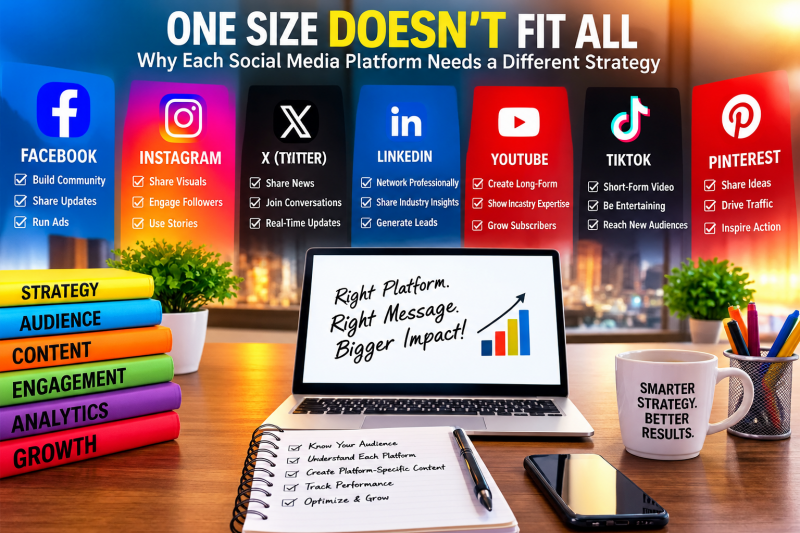
Let’s start with a question.
If you walked into a networking event, would you introduce yourself to a potential business partner the same way you would introduce yourself to a longtime friend? Would you pitch your services to a prospective client the same way you would explain them to a room full of industry experts? And would you use the same conversation to sell a product, educate a customer, recruit an employee, and build relationships with your local community?
Of course not.
You would adjust your approach to the audience, the environment, and what you were trying to accomplish.
So why do so many businesses approach social media as if every platform were exactly the same?
I see this mistake all the time. A business creates a Facebook post, copies it to Instagram, publishes the same thing on LinkedIn, pastes it into X, and uploads a version to TikTok. Then, a few weeks later, someone wonders why engagement is inconsistent, followers aren’t converting into customers, and the company’s social media presence isn’t delivering the results everyone expected.
The problem isn’t necessarily the content. It isn’t always the posting schedule. And it certainly doesn’t mean social media doesn’t work.
More often than not, the problem is that the business is treating several fundamentally different platforms as if they were interchangeable distribution channels.
They’re not.
Every social media platform has its own audience composition, culture, content formats, discovery mechanisms, user expectations, and commercial advantages. What captures someone’s attention on TikTok might fall flat on LinkedIn. What generates meaningful conversations in a Facebook community might be entirely unsuitable for Instagram. And a well-researched YouTube video can continue attracting potential customers long after a typical social media post has disappeared from someone’s feed.
Understanding these differences isn’t just a matter of becoming a better social media manager. It’s a fundamental part of building a smarter marketing strategy.
Whether you’re running a small business, managing marketing for multiple clients, leading a nonprofit, building a personal brand, or overseeing a political campaign, the principle remains the same.
You don’t maximize your impact by posting everywhere. You maximize your impact by understanding where your audience is, what they want from you on each platform, and how to give it to them.
Let’s break down exactly how to do that.
The Numbers Tell an Important Story About Social Media
Before we talk strategy, let’s look at the audience.
According to the Pew Research Center’s Americans’ Social Media Use 2025 report, based on a survey of 5,022 U.S. adults conducted between February and June 2025, platform adoption varies considerably.
The research found that:
- YouTube: 84% of U.S. adults reported using the platform.
- Facebook: 71% reported using it.
- Instagram: 50% reported using it.
- TikTok: 37% reported using it.
- WhatsApp: 32% reported using it.
- Reddit: 26% reported using it.
- Snapchat: 25% reported using it.
- X, formerly Twitter: 21% reported using it.
These figures represent reported platform usage, not the percentage of people who use each platform daily, and they don’t tell us how many users are potential customers for a particular business. But they establish an important point: Different platforms offer different opportunities to reach people.
The demographic differences are just as important.
Pew’s research found that 80% of adults ages 30–49 reported using Facebook, compared with 68% of adults ages 18–29. Instagram showed the opposite pattern: 80% of adults ages 18–29 used it, compared with 62% of those ages 30–49.
YouTube had broad reach across age groups, with reported usage ranging from 64% among adults 65 and older to 95% among adults ages 18–29.
These differences matter because your audience isn’t simply a collection of people scrolling through the internet. It’s a group of individuals with different interests, habits, needs, and reasons for spending time online.
A local home services company trying to reach established homeowners may approach social media differently from a fashion brand targeting younger consumers. A consulting firm selling services to executives has different needs from a restaurant trying to fill tables on a Friday night.
And a nonprofit trying to mobilize volunteers has a different objective from an e-commerce company trying to sell products directly through social content.
The platforms these organizations use might overlap. Their strategies shouldn’t automatically do the same.
The lesson is simple: Start with the audience and the objective, not the platform you happen to enjoy using most.
Every Platform Has a Different Job to Do
One of the biggest mistakes businesses make is expecting every social media platform to deliver the same results.
They want every channel to generate leads, increase sales, build brand awareness, improve customer relationships, attract new followers, and establish credibility.
Ideally, your overall marketing strategy should contribute to several of those outcomes. But individual platforms don’t need to perform every function equally well.
Think of your social media presence as a team.
Each platform has a different role. Some are particularly useful for discovery. Others are better suited to relationship-building, professional credibility, community engagement, or answering questions from people actively researching a purchase.
Your job is to understand those roles and organize your strategy accordingly.
Here is how I would approach the major platforms.
Facebook: Community, Relationships, Local Visibility, and Customer Engagement
Facebook remains one of the most useful platforms for businesses that depend on local customers, established communities, repeat business, and direct relationships.
Its broad adult audience makes it relevant to many industries, particularly local services, hospitality, restaurants, retail, real estate, nonprofit organizations, and community-oriented businesses.
But Facebook’s value goes beyond its overall audience size.
Businesses can use Facebook Pages, Groups, Events, Messenger, and paid advertising to support different parts of the customer journey.
A restaurant can promote specials, answer questions, share customer experiences, and advertise upcoming events.
A roofing company can publish project updates, explain seasonal maintenance needs, and share testimonials from satisfied customers.
A nonprofit can use Facebook to promote fundraisers, recruit volunteers, share community updates, and maintain relationships with supporters.
A political campaign can communicate with local voters, promote events, explain policy positions, and distribute important election information.
Notice what these examples have in common: They give people a reason to interact with the organization beyond simply looking at a product or service.
Facebook works best when you treat it as a place to build relationships, not merely a place to publish advertisements.
That means asking questions, responding to comments, participating appropriately in relevant communities, sharing useful information, and making it easy for people to contact your business.
It also means understanding that a Facebook Group and a Facebook Page serve different purposes. A Page represents your organization, while a Group can facilitate community interaction among members.
One important consideration: Facebook isn’t automatically the best platform for every business simply because it reaches a large audience. Your actual customer demographics, location, competition, and historical performance should determine how much attention and budget it receives.
Instagram: Visual Storytelling, Brand Identity, and Discovery
Instagram is particularly valuable for businesses whose products, services, experiences, or people can be communicated effectively through visual content.
Think restaurants, fashion brands, beauty businesses, fitness studios, travel companies, interior designers, real estate professionals, photographers, and lifestyle brands.
But don’t make the mistake of assuming Instagram is useful only for businesses that sell attractive products.
Professional service providers can use it to humanize their businesses, explain complicated services, introduce team members, demonstrate expertise, and show the work behind their results.
A digital marketing agency might share a short video explaining a common marketing mistake.
A contractor could publish before-and-after project photographs.
A financial professional could create a simple carousel explaining a budgeting concept.
A restaurant could use Reels to showcase food preparation, introduce its staff, or highlight a new menu item.
Instagram’s formats also serve different purposes.
- Reels: Short-form video for discovery, storytelling, demonstrations, and educational content.
- Stories: Timely updates, behind-the-scenes moments, questions, polls, and informal interaction.
- Carousels: Multi-slide educational posts, tutorials, explanations, and step-by-step guides.
- Feed posts: Brand identity, photography, announcements, and other content that supports your overall profile.
These are strategic starting points, not rigid rules. Performance depends on the quality of the content, audience preferences, competition, and the platform’s changing recommendation systems.
The key is to think visually.
Rather than asking, “How can we promote our business on Instagram?” ask, “How can we communicate our value in a way someone can immediately understand, appreciate, or remember?”
That change in perspective can transform the quality of your content.
LinkedIn: Professional Credibility, Thought Leadership, and Business Development
LinkedIn deserves a different approach because its professional context creates different opportunities.
For B2B companies, consultants, marketing agencies, recruiters, business coaches, technology providers, and professional service firms, LinkedIn can be an important channel for demonstrating expertise and building relationships with decision-makers.
It can also be valuable for nonprofit leadership, economic development, executive communications, professional networking, and recruiting.
The most effective content often helps people understand a problem, evaluate an opportunity, learn something useful, or see an industry issue from a fresh perspective.
For example, a business consultant might explain why a company’s customer acquisition strategy isn’t producing sustainable growth.
A marketing agency could break down a campaign’s performance and discuss the lessons learned.
A software company might explain how a common operational problem affects productivity and what organizations can do about it.
An executive could share a thoughtful perspective on leadership, hiring, economic conditions, or the challenges facing an industry.
LinkedIn’s own marketing research has emphasized the growing importance of video in B2B marketing. Its June 2025 guidance reported that video viewing on the platform had increased 36% over the preceding year.
That doesn’t mean every LinkedIn post should become a video. It does demonstrate why businesses should avoid assuming that a professional audience is interested only in traditional text-based content.
The opportunity is to combine expertise with accessibility.
You don’t need to sound like a corporate press release to establish credibility. In many cases, a clear explanation, a useful observation, or an honest account of a lesson learned is far more compelling than a post filled with buzzwords.
LinkedIn is an opportunity to show people how you think, not just tell them what you sell.
And remember that a professional audience is still made up of people. Personality, storytelling, humor, and genuine conversation all have a place when used appropriately.
TikTok: Discovery, Entertainment, Education, and Human Personality
TikTok has helped popularize a style of content that prioritizes short-form video, immediate interest, personality, and rapid communication.
It can be particularly useful for consumer brands, restaurants, beauty businesses, entertainment, fitness, retail, travel, and creators.
It can also work for professional services, nonprofits, and other organizations willing to explain their work in an accessible and engaging way.
The biggest misconception about TikTok is that a business needs to dance, chase every trend, or constantly produce comedy to succeed.
That’s simply not true.
A mechanic can explain why a vehicle makes a particular noise.
A lawyer can discuss a general legal concept in plain English.
A marketing consultant can identify a common advertising mistake.
A restaurant owner can show how a popular dish is prepared.
A nonprofit can introduce the people behind its mission and explain the problem it is trying to solve.
These examples work because they combine information with a format people can easily consume.
TikTok can also offer opportunities for discovery beyond an account’s existing followers. However, reach isn’t guaranteed, and a viral video doesn’t necessarily translate into meaningful business results.
A video that attracts a million views from people who will never buy your product may be less valuable than one that reaches 10,000 people who are genuinely interested in your services.
The goal isn’t to become famous.
The goal is to get the attention of the right people and give them a compelling reason to take the next step.
For many businesses, that means explaining something useful, demonstrating a result, answering a common question, or showing the human side of the organization.
YouTube: Education, Search, Demonstration, and Long-Term Content Value
YouTube occupies a distinctive position because it combines video discovery, search behavior, entertainment, education, and a substantial library of content that people can revisit over time.
According to Pew Research Center’s 2025 findings, YouTube was the most widely used platform in its survey of U.S. adults.
That broad reach makes it relevant to a wide range of industries, but its particular strengths depend on what you’re trying to accomplish.
A home services company can publish maintenance tutorials.
A marketing agency can explain digital advertising strategies.
A software provider can create product demonstrations.
A financial educator can break down complicated concepts.
A real estate professional can publish neighborhood guides and explain the buying process.
A nonprofit can document its work and explain the issues it addresses.
YouTube also offers multiple formats, including long-form videos and Shorts. These can complement one another, but they shouldn’t automatically be treated as interchangeable.
Shorts can introduce a topic, capture attention, and help people discover a creator or organization.
Long-form videos can provide deeper explanations, demonstrations, interviews, and detailed answers to questions.
The biggest advantage is that useful videos can continue attracting viewers long after publication, although their longevity varies by topic, quality, competition, and search demand.
A timely announcement might lose relevance within days. A well-produced tutorial that answers a recurring customer question could remain useful for years.
That creates an opportunity to build a library of content that supports your broader marketing efforts.
Instead of treating every video as a temporary social media post, think about whether it can become a lasting resource for potential customers.
X: Timely Commentary, News, Public Conversation, and Rapid Response
X can be useful for organizations that benefit from participating in current conversations.
That includes journalists, commentators, public figures, political campaigns, advocacy organizations, technology companies, sports-related businesses, and brands operating in industries where timely updates matter.
Its fast-moving conversational environment can make it useful for sharing commentary, responding to developments, distributing announcements, and participating in discussions around relevant topics.
For a political campaign, X may be a place to respond to breaking news, communicate a candidate’s position, or distribute a concise policy explanation.
For a technology company, it might provide a way to discuss product updates or participate in conversations among industry professionals.
For a local business, its value depends heavily on whether customers in the relevant market actually use it.
The most important consideration is timing and relevance.
A long promotional message may not fit the environment as naturally as a concise observation, a useful update, or a thoughtful response to an ongoing discussion.
However, fast-moving platforms also demand judgment. Not every trending topic is relevant to your brand, and not every conversation deserves your participation.
A good strategy balances responsiveness with purpose.
Pinterest: Visual Discovery and Purchase Planning
Pinterest is often overlooked by businesses that focus exclusively on the largest mainstream social networks.
That can be a mistake, particularly for industries where people collect ideas, compare possibilities, plan projects, and prepare for purchases.
Home design, wedding planning, fashion, food, crafts, beauty, travel, and certain retail categories can be particularly well suited to its visual discovery environment.
A kitchen remodeling company might publish design inspiration and practical renovation ideas.
A wedding photographer could share photography concepts and planning resources.
A retailer could organize product collections around specific styles or occasions.
A food brand might publish recipes that help consumers use its products.
Pinterest content should be designed to help people discover something relevant and give them a useful next step.
That might mean visiting a website, exploring a collection, reading a tutorial, or saving an idea for a future project.
As with any platform, success depends on whether your audience uses it and whether your content aligns with what they are trying to accomplish.
Don’t invest in Pinterest simply because a competitor uses it. Invest when its audience behavior and discovery model align with your business objectives.
Reddit: Community Knowledge, Niche Audiences, and Authentic Participation
Reddit operates differently from many traditional social media channels because communities often form around specific interests, experiences, industries, and questions.
That creates opportunities for businesses whose audiences actively research products, discuss technical challenges, compare solutions, or seek advice from people with relevant experience.
Technology companies, specialized retailers, hobby-related brands, and certain professional services may find relevant communities there.
But Reddit requires particular care.
People frequently visit communities to have genuine conversations, learn from others, and exchange experiences. A business that enters those spaces simply to distribute advertisements risks undermining its credibility.
Instead, organizations should understand community rules, contribute useful information, and avoid pretending to be ordinary customers when they are representing a commercial interest.
Reddit can also be useful for understanding the language people use to describe their problems, the objections they raise, and the questions they ask before making decisions.
Those insights can inform product development, customer service, advertising, and content strategy elsewhere.
The lesson is straightforward: On community-driven platforms, participation must come before promotion.
Your Industry Matters Just as Much as Your Audience
Understanding platform differences is only half the equation.
The other half is understanding your industry.
Two businesses can have similar audiences but very different marketing needs. A restaurant and a commercial accounting firm may both want to attract customers, but the way those customers discover, evaluate, and purchase their services is fundamentally different.
Let’s look at several examples.
Restaurants and Hospitality
For restaurants, hotels, bars, tourism businesses, and other hospitality brands, visual appeal and timely information can be particularly important.
Instagram and TikTok can showcase experiences, food, atmosphere, and staff personalities.
Facebook can support local awareness, events, community engagement, and customer communication.
YouTube can provide destination guides, behind-the-scenes stories, and longer-form experiences.
Pinterest may be useful for wedding venues, event spaces, travel inspiration, and certain planning-oriented services.
The best combination depends on the type of establishment, location, customer demographics, and whether the primary objective is immediate visits, reservations, events, or broader brand awareness.
A neighborhood restaurant doesn’t necessarily need the same social media strategy as a luxury resort.
Home Services and Contractors
For plumbers, electricians, roofers, landscapers, remodelers, and other home service providers, credibility and evidence of quality are essential.
Facebook can support local engagement and customer communication.
Instagram can showcase completed projects through photographs and video.
YouTube can answer recurring maintenance questions and demonstrate expertise.
TikTok can introduce common household problems, explain warning signs, and show the people behind the business.
LinkedIn may be useful for commercial contractors seeking relationships with property managers, developers, or other businesses.
The important thing is to connect the content to the customer’s actual decision-making process.
A homeowner who needs emergency plumbing services is in a different position from someone collecting ideas for a kitchen renovation six months from now.
Your content should reflect those differences.
Professional Services and Consulting
Consultants, accountants, attorneys, financial professionals, marketing agencies, and other service providers often need to establish credibility before a prospective customer is ready to buy.
LinkedIn can be particularly useful for thought leadership and professional relationships.
YouTube can help explain complicated subjects and demonstrate expertise.
Instagram and TikTok can make complex topics more approachable through short educational videos.
Facebook can support local visibility and customer relationships.
A blog on your website can provide deeper explanations, searchable resources, and useful destinations for social media traffic.
For professional services, one of the most effective strategies is to answer the questions potential clients already have.
What mistakes should they avoid? What does a process involve? How should they evaluate their options? What warning signs should they recognize?
Educational content helps demonstrate your value before a sales conversation begins.
Retail and E-Commerce
Retail businesses have opportunities to combine visual storytelling, product education, customer reviews, and direct purchasing pathways.
Instagram and TikTok can help introduce products and demonstrate how they are used.
Facebook can support customer communication, community building, and advertising.
Pinterest can help people discover products while planning projects or collecting ideas.
YouTube can provide comparisons, tutorials, demonstrations, and more detailed product information.
The right mix depends on product category, margins, purchase frequency, audience demographics, and the complexity of the buying decision.
A relatively inexpensive impulse purchase requires a different content strategy from an expensive product that customers research extensively before buying.
Nonprofits and Advocacy Organizations
Nonprofits often need to accomplish several objectives simultaneously: educate the public, recruit supporters, raise funds, build trust, mobilize volunteers, and demonstrate impact.
Facebook can support community relationships, events, and volunteer engagement.
Instagram and TikTok can communicate stories and make complex issues more accessible.
YouTube can provide educational resources, interviews, and longer-form explanations.
LinkedIn can help establish organizational credibility, engage professional networks, and support fundraising or partnership development.
X may be useful for timely commentary, advocacy, and public discussion.
The strongest approach connects content to a specific action.
Instead of simply telling people that your organization does important work, show them what that work accomplishes, explain why it matters, and make it easy to participate.
Political Campaigns and Public Affairs
Political campaigns have particularly strong reasons to avoid a one-size-fits-all approach because different audiences consume political information in different ways.
Facebook can support local community engagement, event promotion, and voter communication.
Instagram and TikTok can introduce candidates, explain policy positions, and make campaign messages more accessible through short-form video.
YouTube can host interviews, speeches, policy explanations, and longer-form conversations.
X can facilitate rapid responses, commentary, and participation in current political discussions.
LinkedIn may be relevant for candidates whose outreach includes business communities, professional networks, or economic policy discussions.
But campaigns must also consider geography, voter demographics, election calendars, applicable advertising rules, and the difference between online engagement and actual voter contact.
A post with impressive engagement numbers isn’t necessarily a successful campaign communication if it fails to reach the relevant electorate or encourage meaningful participation.
The objective isn’t simply to generate attention. It’s to communicate effectively with the people whose participation matters.
Across every industry, the principle remains the same: Choose platforms based on audience fit and business objectives, then build content around the behavior you want to encourage.
Stop Copying and Pasting. Start Repurposing Strategically.
Now let’s address one of the most common questions in social media management.
If every platform needs a different strategy, does that mean creating completely different content for every channel?
Not necessarily.
In fact, trying to produce entirely original material for every platform can become expensive, inefficient, and unnecessarily time-consuming.
The smarter approach is to distinguish between your core message and the way you communicate it.
Your core message can remain consistent. Its presentation should adapt to the platform.
Imagine that you’re a digital marketing consultant publishing an article about why small businesses struggle to generate leads online.
That single topic could support an entire content campaign.
Here’s how.
On LinkedIn: Publish a professional analysis explaining three common lead-generation mistakes, why they happen, and how businesses can address them.
On Facebook: Share a concise, accessible summary and invite local business owners to discuss which challenges they encounter most frequently.
On Instagram: Create a carousel explaining the three mistakes, with each slide presenting one problem and a practical solution.
On TikTok: Record a short video explaining one mistake, demonstrating why it matters, and offering a useful recommendation.
On YouTube: Produce a longer tutorial that walks viewers through the process of diagnosing and correcting lead-generation problems.
On X: Share a concise observation about why generating website traffic isn’t the same as generating qualified leads.
On your website: Publish the complete article, including supporting evidence, detailed explanations, and a clear next step for readers who want help.
Notice what’s happening here.
You’re not creating seven unrelated messages. You’re developing seven platform-appropriate ways to communicate one valuable idea.
This is the difference between repurposing and indiscriminate cross-posting.
Repurposing preserves the substance of your message while adapting the format, length, presentation, and call to action to the audience’s expectations.
Copying and pasting assumes that the same presentation will work equally well everywhere.
The first approach builds efficiency without sacrificing relevance. The second often sacrifices relevance in the name of convenience.
Build Content Around a Central Idea
A practical way to implement this strategy is to begin with a central piece of content.
That might be a blog article, a research report, a customer success story, a webinar, an interview, or a substantial educational video.
Then identify the smaller ideas contained within it.
One article might provide material for:
- Three short-form videos.
- Two educational carousel posts.
- A LinkedIn thought-leadership post.
- Several concise observations for X.
- A Facebook discussion prompt.
- An email newsletter.
- A longer YouTube explanation.
- A series of frequently asked questions.
You don’t need to publish every derivative piece on every platform. Select the formats that make sense for your audience and resources.
The goal is to extract more value from the work you’ve already done.
This approach is especially useful for small businesses and marketing agencies managing multiple brands, where time, staffing, and production budgets are often limited.
One well-researched idea can become the foundation of a coordinated content strategy rather than a single post that disappears from the feed.
Understand the Difference Between Reach, Engagement, Traffic, and Conversions
Another reason businesses struggle with social media is that they measure success using the wrong indicators.
They look at follower counts, likes, and views without asking whether those numbers reflect meaningful progress toward their objectives.
These metrics aren’t inherently useless. They simply measure different things.
Reach and Impressions
Reach generally refers to the number of unique accounts or people exposed to content, subject to the platform’s reporting definitions.
Impressions generally refer to the number of times content is displayed.
These metrics help evaluate exposure, but they don’t necessarily tell you whether someone paid attention, remembered your message, or became interested in your business.
Engagement
Engagement can include likes, comments, shares, saves, replies, and other interactions, depending on the platform.
These actions can help you understand whether content is prompting a response.
However, engagement should be interpreted in context.
A controversial post might attract numerous comments without contributing to your business objectives. A practical educational post might receive fewer visible interactions while helping prospective customers understand your services.
Website Traffic
Website traffic measures whether social media users are visiting your website.
You can examine referral traffic through analytics tools and use tagged campaign links to distinguish visits generated by different campaigns or channels.
But traffic quality matters.
A thousand visits from people who have no interest in your services may be less valuable than 100 visits from potential customers who are actively researching a purchase.
Leads and Conversions
For many businesses, these are among the most important indicators.
Depending on your objectives, conversions might include form submissions, consultation requests, purchases, event registrations, donations, bookings, or other meaningful actions.
A social media strategy designed to generate sales should ultimately be evaluated against its contribution to sales, not simply its ability to produce likes.
That doesn’t mean every post needs to generate an immediate conversion. Educational and awareness-focused content can play important supporting roles.
It means you should understand what each piece of content is designed to accomplish and measure it accordingly.
Customer Retention and Relationship Quality
Social media can also support existing customers.
A business might use its channels to answer questions, share product guidance, communicate updates, and reinforce relationships after a purchase.
These activities may contribute to customer satisfaction and retention even when their impact isn’t immediately visible in a standard engagement report.
The key is to measure what matters for the role the platform plays in your overall strategy.
Don’t ask every platform to produce the same numbers. Ask every platform to justify its role in your marketing objectives.
How to Manage Multiple Social Media Platforms Without Burning Out
Let’s get practical.
Managing one social media account consistently can be challenging. Managing several accounts across multiple platforms can quickly become overwhelming without a system.
The solution isn’t necessarily to hire more people or publish more frequently.
It’s to create a repeatable process that reduces unnecessary work while preserving quality.
Here’s the framework I recommend.
Step 1: Establish a Clear Purpose for Every Account
Start by identifying what each platform is supposed to accomplish.
For example:
This is a starting point, not a universal formula.
Some businesses won’t need every platform. Others may assign different responsibilities to the same channel.
The important thing is to avoid operating accounts simply because they exist.
If you can’t explain why a platform matters to your business, it’s time to reassess how you’re using it.
Step 2: Audit Your Existing Accounts
Before creating a new content calendar, evaluate what you’re already doing.
For each account, review:
- Audience demographics and relevance.
- Follower growth over time.
- Reach and impressions.
- Engagement quality.
- Website referral traffic.
- Leads, sales, or other conversions.
- Content formats that perform well.
- Time and money required to maintain the account.
- Customer questions and recurring feedback.
Look beyond isolated posts.
A single successful post doesn’t establish a reliable trend, and a single disappointing post doesn’t prove that a platform is ineffective.
Review performance across a meaningful period, compare similar content formats, and consider differences in paid promotion, seasonality, audience size, and campaign objectives.
The result should be a clearer understanding of where your resources are producing value.
Step 3: Build a Unified Content Calendar
A content calendar provides structure, improves coordination, and helps prevent the last-minute scramble that often leads to repetitive or low-quality posts.
Your calendar should identify:
- Publication date and time.
- Brand or client account.
- Platform.
- Content topic.
- Format.
- Target audience.
- Primary objective.
- Caption or script.
- Creative assets.
- Call to action.
- Approval status.
- Tracking links, where applicable.
For agencies managing multiple clients, include the client’s industry, brand voice, campaign priorities, and approval requirements.
For businesses managing several departments, coordinate the calendar with product launches, seasonal promotions, events, hiring needs, and customer communications.
A good calendar doesn’t mean every post must be planned months in advance. You should leave room for timely opportunities and unexpected developments.
The objective is to establish enough structure that routine publishing becomes manageable without making the entire strategy inflexible.
Step 4: Create Content in Batches
Batching is one of the simplest ways to improve production efficiency.
Instead of creating one post, publishing it, and then starting from scratch the next day, group similar tasks together.
For example, you might:
- Research several related topics during one session.
- Write multiple captions together.
- Record several short-form videos in one sitting.
- Design a series of related graphics using a consistent template.
- Edit video clips in batches.
- Schedule approved content for publication.
- Review performance reports at a designated time.
Batching reduces the time lost switching between tasks and makes it easier to maintain a consistent standard.
It also helps smaller teams produce content without allowing social media to consume every working hour.
However, batching shouldn’t eliminate spontaneity. Reserve some capacity for timely conversations, customer questions, and opportunities that arise between scheduled posts.
Step 5: Separate Creation, Publishing, and Engagement
These are three different responsibilities.
Creation involves developing ideas, writing copy, recording videos, producing graphics, and preparing other assets.
Publishing involves scheduling content, checking formatting, adding links, selecting appropriate settings, and confirming that posts appear correctly.
Engagement involves responding to comments, answering messages, participating in relevant conversations, and identifying opportunities to strengthen customer relationships.
When one person attempts to perform all three simultaneously across several platforms, important tasks can easily fall through the cracks.
Even a small team can benefit from assigning designated blocks of time to each activity.
For example, a business might dedicate certain mornings to content production, use a publishing calendar to organize scheduled posts, and establish daily periods for checking messages and responding to customers.
The exact schedule matters less than having a reliable process.
And remember: Scheduling tools can help distribute content, but they cannot replace the human judgment required to respond appropriately to customers.
Step 6: Use the Right Tools for the Right Tasks
Social media management software can simplify scheduling, approvals, reporting, and account coordination.
Depending on your needs and budget, tools such as Meta Business Suite, Buffer, and Hootsuite may help organize publishing and reporting workflows.
Official resources include:
The right choice depends on the platforms you manage, the number of accounts, team size, approval requirements, reporting needs, and available budget.
You don’t need an expensive platform simply because your business has several social media accounts.
Start by identifying the tasks that consume the most time, then choose tools that solve those specific problems.
Automation should reduce administrative work, not encourage you to publish more irrelevant content.
Step 7: Establish Clear Brand Voice Guidelines
If you manage multiple brands, consistency becomes especially important.
Each brand should have a documented voice that explains how it communicates, what it stands for, and how it speaks to its audience.
A useful brand voice guide includes:
- Core values and positioning.
- Target audiences.
- Preferred tone and vocabulary.
- Topics the brand should address.
- Topics requiring additional review.
- Writing and formatting conventions.
- Visual identity guidelines.
- Calls to action.
- Customer service expectations.
For example, a professional consulting firm might emphasize clarity, expertise, and practical recommendations.
A neighborhood restaurant might use a warmer, more informal voice centered on hospitality and community.
A nonprofit might prioritize empathy, transparency, and mission-driven storytelling.
These voices can be different while remaining authentic to their respective organizations.
The objective isn’t to make every brand sound identical. It’s to make each brand recognizable and consistent wherever it appears.
Step 8: Establish an Approval and Quality-Control Process
Publishing errors can damage credibility, particularly when managing several accounts.
Before content goes live, verify that the copy, visual assets, links, and calls to action are correct.
Check that the content matches the intended platform and audience.
Confirm that any factual claims are supported and that appropriate permissions have been obtained for photographs, testimonials, and other materials.
For regulated industries, political advertising, health-related content, financial services, or other sensitive subjects, incorporate the necessary compliance reviews.
Agencies should also establish clear approval deadlines with clients so that publishing schedules don’t depend on last-minute responses.
A simple approval workflow can prevent unnecessary revisions, missed opportunities, and avoidable mistakes.
Build a Content Strategy That Connects Every Platform
Although each platform needs its own approach, that doesn’t mean your marketing channels should operate independently.
In fact, the strongest strategies often connect them.
Imagine a small business publishing an in-depth article on its website.
That article can support an educational LinkedIn post, a short Instagram carousel, a TikTok video, a YouTube tutorial, and a Facebook discussion.
Each channel introduces the topic in a way that fits its audience.
Someone who discovers the business through a short video might later visit its website, read the complete article, subscribe to an email newsletter, and eventually request a consultation.
Another person might discover the business through a Google search, watch a YouTube demonstration, and contact the company directly.
These are different paths toward the same destination.
This is why it’s important to view social media as part of a broader marketing system rather than a collection of isolated accounts.
Your website provides a destination you control.
Your email list creates a direct communication channel with subscribers who have agreed to receive your messages.
Your social media accounts help you distribute information, discover audiences, participate in conversations, and build relationships.
Your analytics help you understand which activities contribute to your objectives.
Together, these channels can create a more effective customer journey.
Give Every Piece of Content a Next Step
Not every post needs to sell something.
But most content should have a clear purpose.
An educational post might encourage someone to read a complete guide.
A customer success story might direct interested readers to a case study.
A product demonstration might invite viewers to explore a product page.
A nonprofit’s video might encourage people to volunteer or donate.
A consulting post might invite business owners to request an assessment.
The call to action should match the content and the audience’s level of interest.
Someone encountering your brand for the first time may not be ready to schedule a consultation. They may simply need more information.
Someone who has already researched your services might appreciate a direct invitation to discuss their needs.
Effective marketing recognizes these differences and provides appropriate next steps.
How to Use Data to Improve Your Strategy
Publishing content is only the beginning.
The next step is learning from the results.
This is where many businesses leave opportunities on the table. They create content, look at a few engagement numbers, and move on without systematically evaluating what worked and why.
A better approach is to establish a regular review process.
Review Performance Weekly
A weekly review can focus on execution and immediate opportunities.
Ask:
- Did scheduled content publish correctly?
- Are customer questions receiving timely responses?
- Which posts generated meaningful conversations?
- Did any content attract unusual attention?
- Are there relevant developments worth addressing?
- Are there issues that require immediate attention?
This review doesn’t need to involve a lengthy report. Its purpose is to keep the operation organized and responsive.
Review Performance Monthly
Monthly reporting should look for patterns.
Compare performance across platforms, content types, topics, and objectives.
Identify which posts attracted relevant audiences, generated website visits, prompted inquiries, or encouraged other meaningful actions.
Evaluate results against the amount of time and money invested.
Where possible, compare similar campaigns and use consistent measurement definitions.
For example, comparing a paid campaign’s reach with an organic post’s reach without acknowledging the difference can lead to misleading conclusions.
Similarly, a platform with a smaller audience might produce more qualified leads per dollar than one with substantially greater reach.
Review Strategy Quarterly
Quarterly reviews provide an opportunity to reconsider the overall approach.
Ask whether the target audience has changed, whether your objectives remain relevant, and whether each platform still deserves its current level of investment.
Look at customer feedback, industry developments, content production costs, and the quality of leads generated.
Consider whether new formats or channels are worth testing.
And don’t be afraid to discontinue activities that consistently fail to justify their cost.
The purpose of measurement isn’t to prove that every decision was correct. It’s to identify what should change.
Use Experiments Instead of Guesswork
If you’re uncertain whether a different format, topic, or posting approach will work, test it.
For example, you might compare two versions of an educational video, experiment with different opening lines, or evaluate whether a particular topic generates more qualified website traffic.
Whenever possible, change one major variable at a time and give the experiment enough time to produce useful evidence.
Be careful not to draw sweeping conclusions from small samples. Social media performance can fluctuate for reasons unrelated to the content itself.
The goal is to make progressively better decisions based on evidence rather than assumptions.
Avoid the Biggest Mistakes in Multi-Platform Social Media Management
Let’s bring several common problems together.
Mistake No. 1: Publishing Identical Content Everywhere
Cross-posting can be useful when the content genuinely fits multiple platforms. The problem is assuming that identical formatting, messaging, and calls to action are always appropriate.
Repurpose the idea. Adapt the execution.
Mistake No. 2: Chasing Every Trend
A trend is not a strategy.
Before participating, ask whether the topic is relevant to your audience, appropriate for your brand, and capable of supporting a meaningful objective.
Sometimes the best decision is to ignore the trend and focus on content that provides lasting value.
Mistake No. 3: Measuring Success by Follower Count Alone
Followers can contribute to distribution and community-building, but they aren’t the ultimate measure of business success.
A smaller, relevant audience may be more valuable than a large audience with little interest in your products or services.
Evaluate the quality of your audience and the outcomes your content produces.
Mistake No. 4: Ignoring Comments and Messages
Social media is a communication channel, not just a publishing platform.
If customers ask questions and never receive a response, your content may be creating expectations that your business isn’t meeting.
Establish clear responsibilities for monitoring and responding to messages.
Mistake No. 5: Treating Every Platform as Equally Important
Not every business needs to maintain an active presence on every major network.
Your audience, industry, objectives, budget, and available staff should determine your priorities.
It’s better to manage three relevant platforms well than eight platforms poorly.
Mistake No. 6: Publishing Without a Clear Objective
Before publishing, ask what the content is supposed to accomplish.
Does it educate, build awareness, encourage discussion, demonstrate expertise, generate leads, or support existing customers?
If the answer is unclear, reconsider the content before investing time and money in its production.
Mistake No. 7: Automating the Human Element Away
Automation can make publishing more efficient, but it cannot replace thoughtful communication.
Customers can recognize when a business treats every interaction as a transaction.
Use technology to improve consistency and reduce administrative work. Preserve the human judgment that makes communication meaningful.
A Practical 30-Day Plan for Improving Your Social Media Strategy
If your current approach involves posting the same content everywhere without a clearly defined strategy, you don’t need to overhaul everything overnight.
Start with a structured 30-day plan.
Week One: Audit and Prioritize
Review your existing accounts, audiences, performance, and content.
Identify your primary business objectives.
Determine which platforms appear most relevant to your target audience.
Choose two or three priority platforms for focused improvement rather than attempting to optimize everything simultaneously.
Week Two: Build Your Content System
Define the purpose of each priority platform.
Develop a content calendar and establish brand voice guidelines.
Identify a handful of central topics that support your business objectives.
Create templates for recurring formats, such as educational posts, customer stories, short-form videos, and frequently asked questions.
Establish a realistic production and approval process.
Week Three: Publish and Engage
Begin publishing platform-specific content.
Adapt your central ideas to each channel rather than distributing identical posts everywhere.
Respond to comments and messages.
Observe how people interact with different formats and topics.
Record any meaningful website visits, inquiries, bookings, or other outcomes you can attribute to your activity.
Week Four: Evaluate and Refine
Review the month’s results.
Identify which content generated the strongest audience response and which activities contributed to your objectives.
Look for production bottlenecks and opportunities to simplify the process.
Decide what to continue, what to change, and what to test next.
At the end of 30 days, you won’t necessarily have definitive answers about every platform. You will, however, have a stronger foundation for making informed decisions.
Continue the process, build on the evidence, and refine your approach over time.
Consistency matters, but consistency without evaluation can simply make an ineffective strategy more efficient at repeating its mistakes.
The Future of Social Media Management Is Strategic, Not Just Automated
Social media management continues to evolve as platforms introduce new formats, recommendation systems change, and audiences develop different expectations.
Artificial intelligence and automation can help marketers research topics, organize workflows, analyze performance, and accelerate parts of content production.
Those capabilities can be valuable, particularly for teams managing multiple accounts.
But efficiency alone isn’t a competitive advantage if everyone is publishing more of the same generic content.
The more content businesses can produce, the more important it becomes to offer something genuinely useful, distinctive, credible, or entertaining.
That means understanding your audience.
It means developing a recognizable point of view.
It means knowing when a short video is more effective than a long explanation, when a professional analysis is more appropriate than a promotional graphic, and when a direct conversation matters more than another scheduled post.
It also means recognizing that algorithms are distribution systems, not substitutes for marketing strategy.
You cannot control every recommendation, every impression, or every change in platform behavior. You can control the relevance of your message, the quality of your content, the clarity of your objectives, and the care you bring to your audience relationships.
Those are the foundations of a resilient social media strategy.
Final Thoughts: Stop Managing Platforms. Start Managing Outcomes.
Social media has created extraordinary opportunities for businesses, nonprofits, campaigns, and individuals to reach audiences, communicate ideas, establish credibility, and build relationships.
But those opportunities are not distributed equally across every platform, and they don’t produce the same results for every organization.
Facebook, Instagram, LinkedIn, TikTok, YouTube, X, Pinterest, and Reddit each offer different possibilities. Their value depends on how people use them, what your audience needs, and what you’re trying to accomplish.
The businesses that understand this distinction can make smarter decisions about where to invest their time, how to create content, and which results deserve their attention.
They don’t simply ask how often they should post.
They ask what their audience needs to know.
They don’t measure success by follower count alone.
They examine whether their marketing contributes to meaningful outcomes.
And they don’t assume that one successful post can be copied everywhere without adjustment.
They build systems that allow a strong idea to reach different audiences in different ways.
That’s the real opportunity in multi-platform social media management.
You don’t have to be everywhere. You don’t have to publish constantly. And you don’t have to reinvent your entire content strategy every time you open another app.
You need to understand your audience, establish a purpose for every channel, create content that fits the environment, and measure whether your efforts are making a difference.
Stop treating social media as a checklist of platforms you need to maintain. Start treating it as a strategic marketing system designed to reach the right people, deliver the right message, and produce meaningful results.
Because the goal isn’t to post more.
It’s to make every post, every platform, and every marketing dollar work harder for the people and organizations you’re trying to serve.
Add comment
Comments