

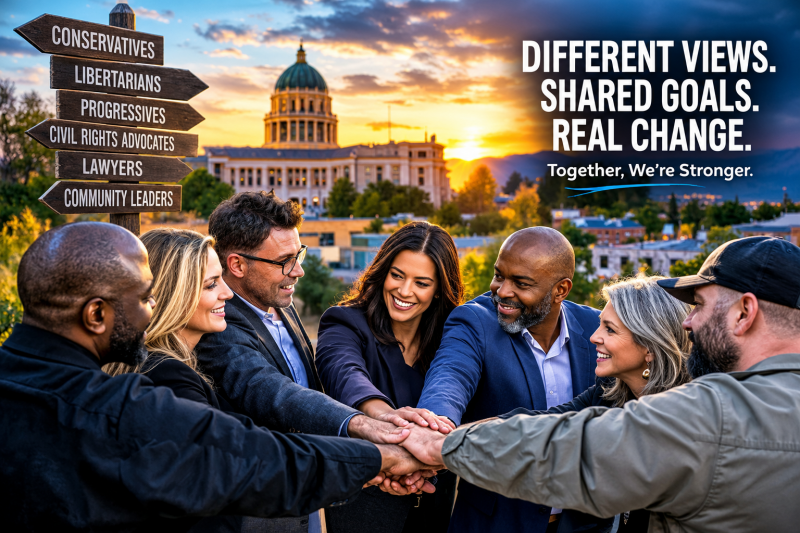
The most powerful coalitions aren’t built by people who agree on everything. They’re built by people who decide one thing matters enough to work together anyway.
If there is one lesson I took away from my years working in advocacy, grassroots organizing and public policy, it is this:
You don’t have to agree with someone to work with them.
In fact, some of the most effective partnerships I’ve ever been part of were built between people who probably would not have chosen each other if the only question on the table had been, “What do you believe?”
The better question is:
“What can we accomplish together?”
I learned that lesson particularly well during my time with Americans for Prosperity and, more specifically, during the fight to end qualified immunity in New Mexico in 2021.
It was one of the most unusual political coalitions I had ever seen.
Conservatives.
Libertarians.
Progressives.
Civil-rights advocates.
Criminal-justice reform organizations.
Former professional athletes.
Lawyers.
Grassroots activists.
People who disagreed with each other on an enormous number of political and policy questions.
And somehow, we worked together.
Not because we suddenly agreed on everything.
We didn’t.
We came together because we found one issue where our principles overlapped: government officials should not be above the law when they violate someone’s constitutional rights.
That experience taught me more about coalition building than any textbook, training or strategy memo ever could.
And those lessons have stuck with me long after that particular campaign ended.
What Is Coalition Building, Really?
Coalition building sounds simple.
Get organizations together.
Agree on an issue.
Coordinate.
Win.
Except anyone who has actually built a coalition knows that the word “simple” doesn’t belong anywhere in that description.
A coalition is essentially an agreement among separate people or organizations to work together toward a shared objective while maintaining their own identities, priorities and independence.
That distinction matters.
A coalition is not a merger.
You’re not asking everyone to become the same organization.
You’re not asking everyone to adopt the same worldview.
You’re not asking everyone to suddenly support every position held by every other member.
You’re asking them to identify a specific objective important enough to justify cooperation.
Research on social-movement coalitions consistently finds that coalitions can provide organizations with something they cannot easily create alone: broader networks, additional resources, specialized expertise, information, credibility and the ability to demonstrate widespread support. Researchers also identify relationships, organizational structures, ideology and identity, institutional conditions and resources as important factors in coalition formation. Trust and commitment become particularly important for keeping coalitions together. (Compass Hub)
That’s the theory.
The practice is much messier.
Because people are messy.
Organizations are messy.
Politics is messy.
And when you put all three together, things get really interesting.
My Biggest Lesson: Start With the Agreement, Not the Disagreement
This sounds obvious.
It isn’t.
When people from different ideological backgrounds enter the same room, the instinct is often to figure out where everyone stands.
That’s usually the wrong place to start.
If I had walked into that 2021 qualified-immunity fight and started asking everyone what they thought about taxes, abortion, guns, criminal justice, policing, economic policy, government spending or dozens of other contentious issues, the coalition probably wouldn’t have lasted five minutes.
Instead, we focused on the issue in front of us.
Do we agree that there should be a meaningful mechanism for holding government accountable when constitutional rights are violated?
Yes.
Great.
Let’s work.
The broader coalition supporting New Mexico’s HB 4 included organizations that represented dramatically different political and philosophical traditions. The Institute for Justice described the coalition as bipartisan and included the ACLU, Americans for Prosperity, the Innocence Project and National Police Accountability Project. The Innocence Project later described the broader coalition as including those organizations alongside Ben Cohen and Jerry Greenfield, the founders of Ben & Jerry’s. (Institute for Justice)
That’s the magic of coalition building.
You don’t need 100 percent agreement.
You need enough agreement on one clearly defined objective to make cooperation worthwhile.
The 80/20 Rule of Coalition Building
One of the most useful ways I’ve come to think about coalition building is this:
You don’t need to agree on 100 percent of the issues. You need to agree on the 20 percent that matters for the campaign.
Maybe your coalition partners agree with you on 20 percent of public policy.
That’s okay.
Maybe it’s 10 percent.
That’s okay too.
If that 10 percent is the specific issue you’re trying to solve, you have something to build on.
The mistake is believing that coalition partners have to become ideological allies.
They don’t.
They simply need to become strategic allies on the issue at hand.
That distinction can completely change the way you organize.
The 2021 New Mexico Example
In 2021, New Mexico passed the New Mexico Civil Rights Act through House Bill 4.
The law created a state cause of action allowing individuals to seek relief when their rights under the New Mexico Constitution’s Bill of Rights were violated by public bodies or people acting under their authority. Critically, the law prohibited qualified immunity as a defense in those claims. (New Mexico Legislature)
The legislation had a complicated history.
The New Mexico Civil Rights Commission had recommended legislation addressing the problem, and the Institute for Justice had developed model legislation addressing government accountability and qualified immunity. The New Mexico Legislature introduced HB 4 in January 2021, and the final bill passed the House and Senate before being signed by Gov. Michelle Lujan Grisham on April 7, 2021. (New Mexico Legislature)
But the policy itself was only part of the story.
The coalition was what made the campaign extraordinary.
The organizations involved brought very different perspectives to the table.
The ACLU approached the issue from a civil-rights and civil-liberties perspective.
The Innocence Project brought decades of experience dealing with wrongful convictions and government misconduct.
The Institute for Justice approached the issue through a libertarian individual-liberty and government-accountability framework.
National Police Accountability Project brought the perspective of attorneys litigating police misconduct cases.
Americans for Prosperity brought a conservative, free-market and grassroots organizing perspective.
And the Players Coalition, founded by former NFL players including Anquan Boldin, brought another powerful voice to the conversation.
The politics were unusual.
The objective was clear.
And that was enough.
Don’t Try to Make Everyone Sound the Same
This is one of the biggest mistakes I’ve seen organizations make.
They build a coalition and then try to force everyone into the same message.
Don’t.
Let people explain the same issue through their own values.
A libertarian might say:
Government officials aren’t above the law.
A civil-rights advocate might say:
Constitutional rights mean little if people have no meaningful remedy when those rights are violated.
A wrongful-conviction advocate might say:
Victims need a way to seek justice when government misconduct destroys someone’s life.
A police-accountability advocate might say:
Accountability strengthens public trust and protects communities.
Those are different messages.
But they can all lead people toward the same policy.
That’s a strength, not a weakness.
Research on diverse social-movement coalitions specifically identifies the ability to bridge different movements and organizational cultures as an important component of coalition building. (Compass Hub)
Don’t erase the differences.
Use them.
The Power of Parallel Messaging
This is something I learned over and over again in grassroots work:
Your coalition doesn’t need one voice. It needs a common destination.
Give everyone the freedom to explain the issue to their own audience.
The conservative organization should be allowed to speak to conservatives.
The civil-rights organization should be allowed to speak to civil-rights advocates.
The criminal-justice organization should speak to its supporters.
The athlete should speak to athletes and sports fans.
The grassroots organizer should speak to grassroots activists.
The attorney should explain the legal consequences.
Everybody doesn’t have to use the same words.
They just have to be pointing toward the same outcome.
That’s how you take a coalition and turn it into a multiplier.
Rule No. 1: Define the Win
Before you build the coalition, define what winning actually means.
Not:
“We want criminal justice reform.”
That’s enormous.
Not:
“We want accountability.”
Still too broad.
Instead:
“We want the Legislature to pass HB 4 and establish a state-law mechanism for holding government entities accountable for violations of constitutional rights while eliminating qualified immunity as a defense under that law.”
Now everybody knows what they’re working toward.
The actual New Mexico law was specific. It created a cause of action, addressed qualified immunity and established other parameters around liability, damages and litigation. (New Mexico Legislature)
A coalition without a clearly defined win becomes a discussion group.
And discussion groups don’t pass legislation.
Rule No. 2: Establish the Non-Negotiables
Every coalition needs boundaries.
Before you start working together, figure out:
- What are we absolutely committed to?
- What can be negotiated?
- What is outside the scope of the coalition?
- What will we publicly support?
- What won’t we publicly support?
- Who speaks for the coalition?
- Who speaks only for their own organization?
- How are disagreements resolved?
You don’t need a 47-page coalition constitution.
But you need clarity.
Because ambiguity becomes conflict later.
Rule No. 3: Never Assume Your Partner Thinks Like You
This one is huge.
If you’re working with someone from another ideological organization, don’t assume they’re secretly becoming one of you.
They’re not.
And they shouldn’t have to.
If I’m working with an organization that has completely different views on ten other issues, I don’t need to convince them to change their position on those ten issues.
That’s not the assignment.
The assignment is the issue we’re working on.
Stay on the assignment.
Rule No. 4: Separate the Person From the Position
Coalitions inevitably disagree.
Sometimes strongly.
The worst thing you can do is turn a policy disagreement into a personal conflict.
Instead of:
“You guys are impossible.”
Try:
“I understand why your organization sees it that way. Here’s why our organization has a concern with that provision.”
There’s a huge difference.
One attacks the relationship.
The other challenges the idea.
You can disagree without creating an enemy.
And that becomes incredibly important when you’re going to need that person sitting across the table from you again tomorrow.
Rule No. 5: Fight Privately. Unite Publicly.
This may be the single most important operational rule in coalition building.
If you have a disagreement with a coalition partner, handle it internally.
Don’t embarrass them publicly.
Don’t subtweet them.
Don’t criticize them to reporters.
Don’t make your disagreement part of the campaign.
You can have difficult conversations behind closed doors and still stand next to each other at the press conference.
That’s not hypocrisy.
That’s professionalism.
The public doesn’t need to see every argument that happened in the conference room.
They need to see whether the coalition can accomplish the mission.
Rule No. 6: Give People Something They Can Own
Coalition members are more invested when they have meaningful ownership.
Don’t simply say:
“We need you to sign this letter.”
Ask:
“What can your organization uniquely contribute?”
Maybe they have:
- Grassroots activists.
- Lawyers.
- Research.
- Media relationships.
- Influencers.
- Donors.
- Volunteers.
- Legislative relationships.
- Digital infrastructure.
- Storytelling expertise.
- Credibility with a particular constituency.
The coalition becomes stronger when each organization contributes something different.
In the New Mexico campaign, that diversity was part of the point. The coalition’s strength wasn’t that everyone possessed the same capabilities. It was that the organizations brought different constituencies, expertise and credibility to the same campaign. (Institute for Justice)
Rule No. 7: Don’t Let the Loudest Organization Become the Coalition
This happens constantly.
One organization has more money.
Another has more staff.
Another has more name recognition.
Another has the biggest email list.
Suddenly, the coalition becomes an extension of the largest organization.
That’s dangerous.
A successful coalition needs leadership, but leadership isn’t ownership.
The coalition belongs to everyone participating in it.
That means listening.
It means making room for smaller organizations.
And it means recognizing that the organization with the biggest budget isn’t necessarily the organization with the most important perspective.
Rule No. 8: Build Trust Before You Need It
Don’t wait until there is a crisis to establish relationships.
Talk.
Meet.
Call people.
Learn how they operate.
Understand their internal constraints.
Learn what they can and cannot publicly support.
Ask what keeps their leadership awake at night.
And, importantly, do what you say you’re going to do.
Trust is built through hundreds of small interactions.
You send the document when you said you would.
You give credit when someone contributed.
You don’t leak private conversations.
You don’t surprise a partner with a press statement.
You don’t take credit for someone else’s work.
Those little things compound.
So do the opposite.
The Difference Between Coordination and Collaboration
There is a difference.
Coordination means:
“We’re all doing our own thing, but we’re trying not to get in each other’s way.”
Collaboration means:
“We’re actually building something together.”
The best coalitions do both.
You want independent organizations maintaining their own strengths while also coordinating enough that the campaign feels like something bigger than any single member.
That’s why shared strategy matters.
Shared calendars matter.
Shared talking points matter.
Shared legislative intelligence matters.
And communication matters.
A lot.
The Coalition Meeting Nobody Wants to Have
Eventually, someone will propose something that everyone doesn’t like.
It happens.
The instinct is to immediately ask:
“Who is right?”
I think a better question is:
“Does this disagreement threaten the shared objective?”
If the answer is no, keep moving.
Not every disagreement needs resolution.
That’s another lesson that took me years to fully appreciate.
Sometimes the best coalition decision is:
“We disagree on this. Let’s not make it part of the campaign.”
You don’t have to solve every disagreement.
You only have to prevent the disagreement from destroying the work you’re doing together.
What To Do When a Partner Crosses a Line
Not every disagreement is harmless.
Sometimes a coalition partner will say something publicly that creates a genuine problem.
That’s when you need a process.
First, call them.
Don’t send an angry tweet.
Don’t immediately go public.
Ask what happened.
Maybe there was a misunderstanding.
Maybe someone spoke outside their authority.
Maybe the organization genuinely changed its position.
Find out.
Then determine whether the issue can be resolved without damaging the coalition.
If it can’t, you may have to separate on that particular issue.
But even then, professionalism matters.
Today’s disagreement doesn’t have to become tomorrow’s war.
Politics has enough permanent enemies.
You don’t need to manufacture another one.
Don’t Make the Coalition Bigger Just for the Sake of Being Bigger
More organizations aren’t automatically better.
Every new member adds potential:
- Reach.
- Expertise.
- Credibility.
- Resources.
But every new member can also add:
- More meetings.
- More opinions.
- More approval processes.
- More potential conflicts.
- More opportunities for mixed messaging.
Build the coalition around strategic value, not vanity metrics.
Ask:
“Does this organization make the campaign meaningfully stronger?”
If yes, bring them in.
If not, you may be better off having them as an informal supporter.
The Importance of a Shared Message
Coalition members should be able to answer three questions:
What are we trying to accomplish?
Why does it matter?
What do we want people to do?
That’s it.
You should be able to explain the campaign in a hallway conversation.
If your coalition’s message requires a 25-minute PowerPoint presentation, you have a messaging problem.
During the New Mexico campaign, the underlying message could be distilled to a powerful principle:
Constitutional rights need meaningful enforcement.
That principle could be understood by people across ideological lines.
And that’s exactly what you want.
Don’t Underestimate the Power of Strange Bedfellows
One of the most powerful things about an unlikely coalition is that it changes the political conversation.
If only one side supports an issue, opponents can dismiss it as partisan.
But when people from competing political traditions stand together, that argument becomes much harder to make.
That’s what happened in New Mexico.
The campaign’s coalition was unusual enough to attract national attention. Forbes described HB 4 as being supported by an ideologically diverse coalition that included the Institute for Justice, Innocence Project, National Police Accountability Project, ACLU, Americans for Prosperity and the founders of Ben & Jerry’s. (Forbes)
And AFP itself highlighted the striking partnership between its chairman Mark Holden and Ben Cohen and Jerry Greenfield, noting that the three approached public policy from very different perspectives but found common ground on ending qualified immunity. (Americans for Prosperity)
That’s the power of an unlikely alliance.
The disagreement makes the agreement more powerful.
But Don’t Manufacture “Bipartisanship”
There’s another lesson here.
Don’t build coalitions simply so you can put “bipartisan” in a press release.
People can smell fake alliances.
If organizations are genuinely committed to the same outcome, great.
If they’re simply participating for optics, it usually shows.
Authenticity matters.
The best coalitions aren’t:
“Look! Democrats and Republicans are standing together!”
They’re:
“We disagree about a lot. But on this issue, we genuinely believe the same thing.”
That’s much more compelling.
Coalition Building Is About Translation
One of the most underrated skills in coalition work is translation.
You have to be able to take the same policy and explain why it matters to different audiences.
For one person, the issue may be about constitutional rights.
For another, individual liberty.
For another, police accountability.
For another, wrongful convictions.
For another, government efficiency.
For another, public trust.
None of those explanations has to invalidate the others.
Your job isn’t to decide which constituency has the “correct” reason.
Your job is to understand the reasons well enough to help everyone see where their interests overlap.
Researchers studying coalition building have specifically emphasized the role of “bridge-builders” who can translate between movements with different cultures, priorities and political identities. (DOI)
That is an incredibly valuable skill.
And it is transferable far beyond politics.
Coalition Building Works in Business, Too
This isn’t just a political lesson.
I’ve used the same principles throughout my entrepreneurial life.
Businesses form strategic partnerships all the time.
Two companies might compete in one area while collaborating in another.
A marketing company might partner with a web-development company.
A nonprofit might partner with a corporation.
A local business might partner with another business that serves the same customers.
You don’t need identical interests.
You need aligned interests.
The question becomes:
“Where do our interests overlap enough that working together creates more value than working separately?”
That’s coalition building.
The Biggest “Don’t”: Don’t Make It About You
This one is particularly important for leaders.
If you’re building a coalition, don’t obsess over who gets credit.
You will be tempted.
Someone will publish a press release without mentioning your organization.
Someone else will get quoted in the newspaper.
Another organization will get the photo.
A politician will thank someone else from the podium.
Let it go.
Seriously.
If the objective is important enough, winning matters more than recognition.
Coalitions fall apart when everyone is keeping score.
They become powerful when everyone is focused on the scoreboard.
Give Credit Generously
The flip side is equally important.
When somebody does something valuable, say so.
Publicly.
Privately.
Consistently.
If a partner gets the meeting that moves the campaign forward, thank them.
If another organization writes the policy language, recognize them.
If another group mobilizes hundreds of people, celebrate it.
People want to work with people who make them feel respected.
And recognition costs you almost nothing.
Know When to Compromise
Coalition building requires compromise.
But there is a difference between compromise and abandoning your principles.
Compromise on:
- Process.
- Timing.
- Messaging.
- Tactics.
- Sequencing.
- Who speaks.
- Where an event happens.
- Which organization leads a particular piece of work.
Be much more careful about compromising on:
- The core objective.
- Fundamental principles.
- Accuracy.
- Integrity.
- Trust.
The New Mexico legislation itself went through changes as it moved through the legislative process. The final law included provisions addressing liability, damages and other concerns, illustrating an important reality of policymaking: successful legislation often requires negotiation without losing the central purpose of the reform. (Forbes)
That’s not failure.
That’s legislating.
The Coalition Is Not the Campaign
Another important distinction:
A coalition is an asset. It isn’t the entire strategy.
You still need:
- Grassroots organizing.
- Legislative strategy.
- Communications.
- Digital engagement.
- Storytelling.
- Research.
- Opposition research.
- Relationship building.
- Earned media.
- Paid media when appropriate.
- Volunteer activation.
- Direct constituent contact.
A coalition amplifies these things.
It doesn’t replace them.
In New Mexico, AFP-NM reported reaching thousands of residents and nearly 2,000 people contacting lawmakers through its digital tool in support of HB 4 before the legislation became law. (Americans for Prosperity)
That’s an important lesson.
A coalition gives you more voices. Organizing turns those voices into pressure.
Measure the Coalition by Outcomes, Not Membership
Here’s another mistake organizations make:
“We have 40 groups supporting this!”
Okay.
What are they doing?
How many people did they mobilize?
How many legislators did they contact?
How many meetings happened?
How much earned media resulted?
How many volunteers became active?
How many constituents were moved?
How did public opinion change?
How did legislative support change?
The number of logos on a letter is less important than what those logos can actually accomplish.
A coalition is valuable because of what its members do, not simply because of who they are.
The Five Things Every Successful Coalition Needs
If I had to reduce everything I’ve learned about coalition building to five things, I’d choose these:
1. A Clearly Defined Common Goal
Everyone needs to know what they’re trying to accomplish.
2. Mutual Respect
You don’t have to agree with your partners to respect them.
3. Strategic Independence
Every organization should be able to maintain its own identity and message.
4. Reliable Communication
People should know what’s happening, what’s changing and what is expected of them.
5. Trust
Without trust, every disagreement becomes a potential coalition-ending crisis.
Research backs up that last point. Trust and commitment aren’t simply nice additions to coalition work; scholars identify them as important factors in sustaining coalitions over time. (Compass Hub)
My Coalition-Building Checklist
When I’m thinking about building a coalition today, these are the questions I’d ask:
The Issue
- What exactly are we trying to change?
- Is the objective specific?
- Is there a clear definition of victory?
The Partners
- Who already agrees?
- Who might agree unexpectedly?
- Who has credibility with a constituency we don’t reach?
- Who has expertise we don’t possess?
The Boundaries
- What do we agree on?
- What do we disagree on?
- Which disagreements are irrelevant to the campaign?
- What are our non-negotiables?
The Strategy
- What can each partner contribute?
- Who is responsible for what?
- How will decisions be made?
- How will disagreements be resolved?
The Message
- What is the simplest explanation of the problem?
- What is the simplest explanation of the solution?
- What action do we want people to take?
The Relationship
- Are we treating partners with respect?
- Are we giving credit?
- Are we communicating?
- Are we building trust?
If you can answer those questions before the campaign gets difficult, you’re dramatically better positioned when it inevitably does.
The Real Secret: Find the Shared “Why”
Ultimately, successful coalition building isn’t about getting everyone to think alike.
It’s about helping different people recognize that their reasons for acting can lead them toward the same destination.
That’s what happened in New Mexico.
We didn’t suddenly become one organization.
We didn’t suddenly agree on every political issue.
We didn’t suddenly share identical philosophies about government.
We found one place where our principles intersected.
And then we built from there.
The New Mexico Civil Rights Act ultimately became law on April 7, 2021, creating a new state-law mechanism for enforcing rights protected by the New Mexico Constitution and expressly barring qualified immunity as a defense under the Act. (Americans for Prosperity)
That result wasn’t the accomplishment of one person or one organization.
It was the product of legislators, lawyers, advocates, grassroots organizers, affected communities and organizations that were willing to put their differences aside long enough to accomplish something they believed mattered.
And that’s the part of coalition building I think we sometimes forget.
You don’t build a coalition because everyone agrees.
You build one because the goal is important enough to overcome the disagreement.
The Art of the Possible
I’ve spent a lot of my career working with people who don’t necessarily agree with me.
I’ve sat across tables from people with completely different political philosophies.
I’ve worked with organizations whose priorities were dramatically different from my own.
And I’ve learned that disagreement doesn’t have to be an obstacle.
Sometimes it’s an asset.
Because when people with fundamentally different perspectives find common ground, they bring something powerful with them:
different audiences, different relationships, different expertise, different credibility and different ways of telling the story.
That’s how a small idea can become a movement.
That’s how a policy proposal can become legislation.
And that’s how people who seemingly have nothing in common can discover that they have enough in common to change something.
If there’s one lesson I would leave anyone with who is trying to build a coalition, whether in politics, business, advocacy or their own community, it’s this:
Stop asking, “Where do we disagree?”
Start asking:
“Where do we agree—and what can we accomplish together?”
You might be surprised by what happens next.
Because sometimes the most powerful partnerships aren’t the ones that make the most sense on paper.
They’re the ones that make the most sense when there’s something important enough to fight for.
Add comment
Comments