

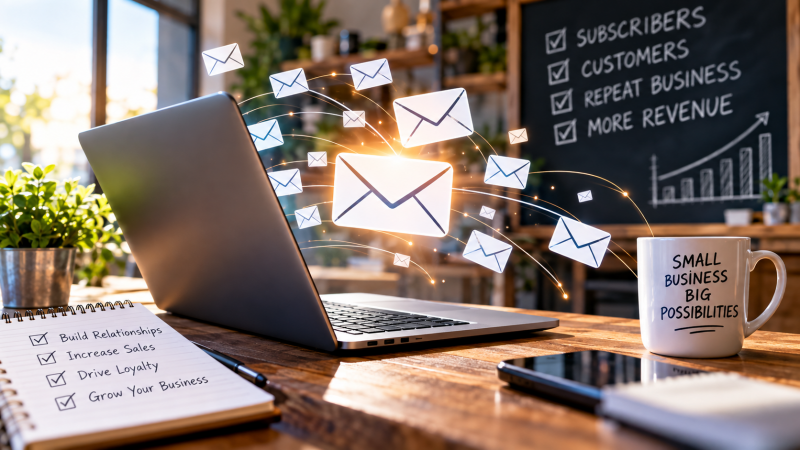
Social media may get more attention, but email gives small businesses something far more valuable: direct access to an audience they can actually build, nurture, and convert.
When most small-business owners start talking about digital marketing, the conversation usually goes to the same places.
Social media.
Google.
SEO.
Paid ads.
Maybe content marketing.
And those are all important. I spend a lot of time talking about them myself.
But there is another piece of the digital marketing puzzle that I think gets pushed further down the priority list than it deserves: email marketing.
Email isn’t new. It isn’t flashy. Nobody is going to announce email as the next revolutionary marketing platform.
And maybe that’s part of the reason businesses overlook it.
We’ve become so conditioned to chase the newest platform, algorithm, content format, or advertising tool that one of the oldest digital marketing channels sitting right in front of us can start to feel almost boring.
That’s a mistake.
Because when email marketing is done correctly, it can accomplish something incredibly valuable for a small business: it can turn a person who interacted with your business once into someone you can continue building a relationship with for months or even years.
Even better, that relationship isn’t entirely dependent on a social media algorithm deciding whether you’re allowed to reach them today.
That’s a pretty big deal.
Social Media Gives You Followers. Email Helps You Build an Asset.
I love social media as a marketing tool. Used correctly, it can build awareness, establish credibility, create conversations, generate leads, and introduce your business to people who otherwise may never have discovered you.
But there’s an important distinction every business owner needs to understand.
Your social media following isn’t completely yours.
You may have spent years building it. You may have produced hundreds of posts, invested thousands of dollars in advertising, responded to countless comments, and accumulated tens of thousands of followers.
But ultimately, the platform controls access to those people.
An algorithm changes.
Organic reach declines.
Advertising prices increase.
A feature disappears.
Your account gets restricted.
A platform loses popularity.
Suddenly, reaching the audience you spent years building becomes harder.
Email works differently.
When someone voluntarily gives you their email address and agrees to hear from your business, you’re developing what marketers commonly call an owned audience.
You still rely on email infrastructure and inbox providers for delivery, of course, so “owned” doesn’t mean completely free of third parties. But you control the customer relationship, your subscriber data, your messaging strategy, and your list in a way you simply don’t control a Facebook, Instagram, TikTok, or LinkedIn following.
That distinction matters.
Current email marketing research continues to show why. Email programs commonly generate somewhere between $10 and $36 in return for every $1 invested, while higher-performing programs can exceed those figures. (Litmus)
That doesn’t mean every business can throw together a newsletter and magically make $36 tomorrow.
Marketing doesn’t work that way.
It means that when email is built strategically—around permission, relevance, segmentation, automation, testing, and measurable customer behavior—it can be an extraordinarily efficient channel.
And for small businesses operating with limited marketing budgets, efficiency matters.
The Real Power of Email Isn’t the First Sale
This is where I think some businesses approach email backward.
They view their email list primarily as another place to advertise.
New product?
Send an email.
Twenty-percent-off sale?
Send an email.
Need to make this month’s revenue target?
Send another email.
And then another.
Eventually, every message basically says:
BUY SOMETHING.
That’s not really a relationship.
That’s a digital salesperson showing up at someone’s front door three times a week.
The real power of email marketing is its ability to keep your business connected to people throughout the customer relationship.
Think about a local business for a minute.
Someone discovers you through Google.
They visit your website.
Maybe they aren’t ready to buy today.
But they subscribe to your newsletter, download a guide, request information, enter a promotion, join a loyalty program, or make their first purchase.
Without email, that interaction can easily end there.
With email, it can become the beginning.
Now you have an opportunity to educate that person.
Answer questions.
Show them something useful.
Introduce another service.
Tell your story.
Send a reminder.
Share customer success stories.
Offer a loyalty incentive.
Ask for feedback.
Bring them back to your website.
Encourage another purchase.
Reconnect six months later.
That is where email becomes more than advertising.
It becomes customer relationship infrastructure.
Email Marketing Works Best When It Matches the Customer Journey
Effective email marketing isn’t simply sending one giant message to everyone on your list every Tuesday morning.
The best programs become more relevant as businesses learn more about their subscribers.
Imagine two people on an email list.
One subscribed yesterday but has never purchased anything.
The other has purchased from the business six times.
Should they receive exactly the same message?
Probably not.
The first person might benefit from a welcome series explaining who you are, what makes your business different, your most popular products or services, and what they should do next.
The repeat customer might be much more interested in a loyalty offer, an early product release, complementary services, a referral incentive, or a personalized recommendation.
That’s segmentation.
And then there is automation.
Automation allows specific customer behaviors to trigger specific messages without the business owner manually sending every email.
Someone joins your list?
Start a welcome sequence.
Someone buys a product?
Send helpful post-purchase information.
Someone hasn’t purchased in six months?
Trigger a win-back campaign.
Someone leaves an ecommerce shopping cart without completing checkout?
Send a reminder.
That last example is especially powerful.
In October 2026, Klaviyo reported benchmark data covering more than 110,000 customers showing abandoned-cart email flows averaging $6.77 in revenue per recipient, with the top-performing 10% reaching $13.70 per recipient. Welcome flows also performed strongly, averaging $5.75 in revenue per recipient. (Klaviyo)
That’s the difference between randomly sending emails and building an actual email marketing system.
One is broadcasting.
The other responds to customer behavior.
Don’t Become the Business Everyone Wants Out of Their Inbox
There’s a flip side to all of this.
Email marketing gives businesses incredible access to customers.
That makes respecting that access even more important.
Think about your own inbox.
There are probably companies whose emails you actually enjoy receiving.
Then there are companies that make you wonder:
How did I get on this list, and why are these people emailing me again?
Don’t become the second company.
One of the fastest ways to destroy the value of an email list is to treat subscribers as email addresses instead of people.
Sending too frequently can be a problem.
Sending irrelevant offers can be a problem.
Using misleading subject lines is a problem.
Hiding the unsubscribe button is a problem.
Purchasing questionable lists is a problem.
Sending nothing but sales pitches is a problem.
The goal shouldn’t be to squeeze as many emails as possible out of your database.
The goal should be to make your subscribers believe that remaining subscribed is worth it.
Google explicitly recommends setting expectations about email frequency because repeatedly sending messages subscribers don’t find useful increases the likelihood of unsubscribes and spam complaints. (Google Help)
And spam complaints aren’t merely annoying.
They can affect deliverability.
Google recommends keeping user-reported spam rates below 0.1% and avoiding rates of 0.3% or higher. Gmail also requires stronger authentication and one-click unsubscribe capabilities for high-volume senders, while Yahoo maintains similar authentication, unsubscribe, and spam-rate requirements. (Google Help)
In other words, respecting your audience isn’t merely good customer service.
It can directly affect whether future emails reach the inbox at all.
Stop Obsessing Over Open Rates
For years, one of the first questions businesses asked about email marketing was:
What’s my open rate?
It’s still worth monitoring, but it shouldn’t be treated as the ultimate measure of success.
Privacy features and automated activity can distort email opens. Mailchimp notes that Apple’s Mail Privacy Protection and bot activity can inflate engagement metrics, while Google says it doesn’t track opens itself and cannot verify the accuracy of third-party open-rate reporting. (Mailchimp)
That means businesses need to look deeper.
Did people click?
Did they visit the website?
Did they request a quote?
Did they book an appointment?
Did they use the offer?
Did they make another purchase?
How much revenue did the campaign generate?
How many customers came back?
What’s the revenue per recipient?
What’s happening to customer lifetime value?
Those questions get much closer to what actually matters.
Because I’d rather have an email opened by 500 people that produces 25 customers than an email opened by 5,000 people that produces nothing.
Marketing isn’t ultimately about collecting impressive-looking numbers.
It’s about producing meaningful business outcomes.
Five Ways Small Businesses Can Improve Their Email Marketing Today
You don’t need a massive marketing department or some incredibly complicated email funnel to improve your results.
Start with the fundamentals.
1. Start Building Your List Everywhere You Interact With Customers
The first step sounds obvious, but businesses routinely miss it.
Give people a reason to join your list.
Put signup opportunities on your website.
Include them in your checkout process where appropriate.
Promote the newsletter on social media.
Add a QR code in your physical location.
Include signup opportunities at events.
Use lead magnets such as guides, checklists, resources, discounts, loyalty benefits, early access, educational content, or genuinely useful newsletters.
But here’s the key:
Don’t just say “Join our email list.”
Why should they?
Tell people what they’re getting.
“Get weekly home-maintenance tips.”
“Get subscriber-only specials.”
“Get early access to new products.”
“Get our monthly small-business growth guide.”
That’s a value proposition.
And I strongly recommend building a permission-based list rather than buying a giant database of strangers.
A smaller list containing 1,000 people who actually want to hear from you can be far more valuable than 50,000 addresses belonging to people who couldn’t care less about your business.
2. Build a Welcome Series Instead of Sending One Generic Welcome Email
Someone subscribing to your list is raising their hand.
They’re essentially saying:
I’m interested. Tell me more.
Don’t waste that moment.
Build a short automated welcome sequence.
Your first email might welcome them and deliver whatever you promised.
The next can explain your business and what makes you different.
Another can answer a common customer question.
Another can showcase your most popular service or product.
Another might introduce an offer.
You aren’t trying to overwhelm someone during their first 48 hours on your list.
You’re trying to move them from “I’ve heard of this business” to “I understand this business, trust this business, and know what I should do next.”
Current automated-flow benchmarks demonstrate just how valuable those moments can become. Email automation allows a business to respond to customer behavior at the point when the message is most relevant rather than hoping a mass email happens to arrive at the right time. (Klaviyo)
3. Segment Your Audience and Send More Relevant Emails
This is one of the biggest opportunities for small businesses.
Stop treating your email database like one giant group.
Segment it.
Depending on your business, that could mean:
Prospects versus customers.
New customers versus repeat customers.
Residential versus commercial customers.
Customers interested in different services.
Local customers versus customers elsewhere.
Recent buyers versus customers who haven’t purchased in a year.
High-value customers.
Newsletter readers.
Event attendees.
Past leads who never converted.
Once you begin segmenting, your emails can become dramatically more relevant.
Instead of:
“Check out everything we’re selling this month!”
You can send:
“It’s been six months since your last service. Here are three things worth checking before winter.”
That’s useful.
That’s timely.
That’s personal without being creepy.
And that is much closer to how email should work.
4. Follow the Value-First Rule
Before sending an email, ask yourself one simple question:
Why would the person receiving this care?
If you can’t answer that question, don’t hit send yet.
Your emails shouldn’t always be about you.
Teach something.
Solve something.
Answer a question.
Share useful information.
Provide an update.
Tell a story.
Highlight a customer.
Offer a useful resource.
Then make offers when they’re relevant.
You absolutely should sell through email. That’s part of the point.
But earning attention makes selling easier.
This is particularly important because inboxes are incredibly personal spaces. People aren’t logging into an algorithmic feed and happening to encounter your advertisement.
You are arriving directly in their inbox.
Act like you’ve been invited into someone’s home rather than buying a billboard beside the highway.
5. Measure Revenue, Test Constantly, and Improve
Finally, stop guessing.
Email gives small businesses an enormous amount of information.
Use it.
Test subject lines.
Test calls to action.
Test shorter emails against longer ones.
Test offers.
Test sending frequency.
Test different segments.
Test educational content against promotional content.
Then follow the customer beyond the email.
Mailchimp currently reports an average click rate of about 2.62% across users, although performance varies significantly by industry. Its benchmarks, for example, put nonprofits around 3.27% and business and finance around 2.78%. (Mailchimp)
Benchmarks are useful.
But your most important benchmark is eventually your own historical performance.
If last quarter’s emails generated $2,000 in attributable sales and this quarter generated $3,500 with a similar list size and investment, something improved.
Figure out what.
Then do more of it.
There’s Also a Legal Side Small Businesses Should Understand
Email marketing isn’t the Wild West.
In the United States, commercial email is governed by the CAN-SPAM Act.
The Federal Trade Commission’s CAN-SPAM compliance guidance makes clear that businesses must use accurate header information, avoid deceptive subject lines, provide a valid physical postal address, give recipients a way to opt out, and honor qualifying opt-out requests within 10 business days. The law applies to commercial messages generally—not merely giant bulk-email campaigns. (Federal Trade Commission)
Email providers increasingly impose additional technical standards as well.
At a minimum, businesses should work toward properly configuring email authentication—including SPF, DKIM, and where appropriate DMARC—while using a reputable email marketing platform rather than blasting marketing messages from an ordinary personal inbox. Gmail’s current sender requirements specifically incorporate authentication, spam-rate, and unsubscribe standards, with additional requirements applying to higher-volume senders. (Google Help)
This sounds technical, but the principle behind it is simple:
Send legitimate email to people who actually want it, make it obvious who you are, protect your domain, provide value, and make leaving easy.
That’s good marketing anyway.
Your Email List Should Become More Valuable Every Year
This is the part I really want small-business owners to think about.
Imagine you spend the next five years consistently growing your business.
During those five years, thousands of people visit your website.
Hundreds or thousands buy from you.
Others request estimates.
People attend events.
Customers interact with your social pages.
People download resources.
Prospects ask questions.
Some buy immediately.
Some don’t.
What happens to all those relationships?
Without a strategy for capturing and nurturing them, many simply disappear.
But imagine building an email audience throughout those same five years.
Now every successful advertising campaign isn’t just generating today’s sale.
It can also generate tomorrow’s audience.
Your SEO can grow the list.
Your social media can grow the list.
Your events can grow the list.
Your website can grow the list.
Your customers can grow the list.
Your content can grow the list.
Then email helps you continue the conversation.
That’s why I don’t view email marketing as something separate from digital marketing.
It’s connective tissue between the pieces.
Don’t Build Your Entire Business on Rented Attention
Social media isn’t going anywhere.
Neither is search.
Neither are paid ads.
And businesses should absolutely use them.
But there’s a fundamental difference between using platforms to discover an audience and building infrastructure that lets you maintain a relationship with that audience.
Smart digital strategy should do both.
Use social media to get discovered.
Use search to get found.
Use content to establish authority.
Use advertising to accelerate reach.
Use your website to convert attention.
And use email to continue the relationship.
Because algorithms will change.
Advertising costs will change.
Platforms will rise and fall.
Organic reach will fluctuate.
But the relationships you’ve intentionally built with customers are one of the most durable marketing assets your business can develop.
So if email marketing has been sitting somewhere near the bottom of your marketing to-do list, it may be time to move it up.
You don’t need to send more email just for the sake of sending email.
You need to send better email to the right people at the right time for the right reason.
Do that consistently, and your email list stops being a database.
It becomes an audience.
Build enough trust with that audience, and it becomes a community of customers.
Take care of those customers, and many of them come back.
And that’s ultimately where the real value of email marketing lives—not in how many messages you send, but in how many relationships you keep.
Need help turning your digital marketing into a strategy that actually drives growth?
Stephen Despin Consulting helps businesses develop practical digital strategies designed to turn online attention into measurable action—from content and search strategy to audience growth, reputation, and customer engagement.
Visit StephenDespin.net to learn more or schedule a consultation.
Add comment
Comments