

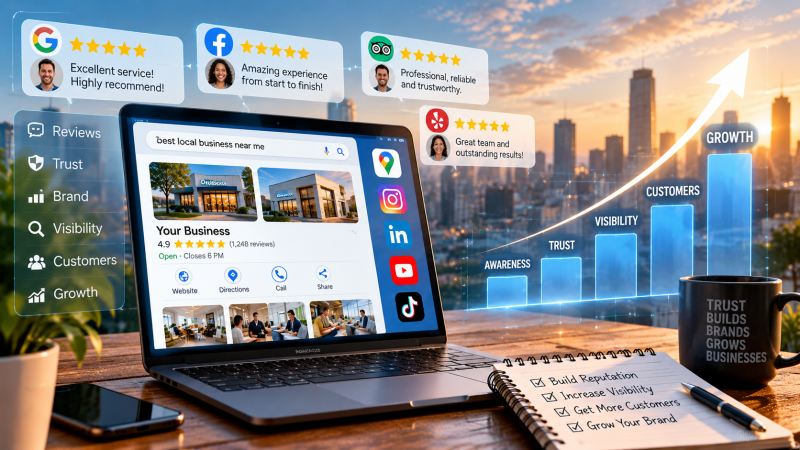
There was a time when a business could control most of its reputation.
You bought an ad in the newspaper. You put up a billboard. You sponsored the local Little League team. You made sure your storefront looked good, your employees treated people well, and hopefully your customers told their friends.
Your reputation was built largely through word of mouth.
That still matters.
But today, word of mouth has gone digital.
Before someone calls your business, walks through your door, schedules an appointment, requests an estimate, or spends a single dollar with you, there is a very good chance they have already looked you up.
They searched your name.
They checked Google.
They looked at your reviews.
They visited your website.
They scanned your social media.
Maybe they searched for you on Facebook.
Increasingly, they may even ask ChatGPT or another AI platform which company they should consider.
And within a surprisingly short period of time, they start forming an opinion about your business.
That opinion is your online reputation.
And whether you intentionally built it or not, you already have one.
Your Reputation Exists Whether You Manage It or Not
I think this is one of the biggest misconceptions businesses have about reputation management.
People hear “online reputation” and immediately think about damage control.
Bad reviews.
Negative Facebook posts.
Someone complaining about the company online.
Those things certainly matter, but reputation management is much bigger than trying to make negative information disappear.
Your online reputation is essentially the collection of signals someone encounters when researching your business.
That includes:
- Google reviews
- Google Business Profile information
- your website
- Facebook, LinkedIn, Instagram, TikTok, YouTube, and other social profiles
- news coverage
- directory listings
- customer testimonials
- photos and videos
- mentions on other websites
- comments and discussions about your company
- the way your company responds to customers
- the consistency of your branding and information across the internet
Increasingly, we should add another category to that list:
What artificial intelligence knows and can verify about your business.
That changes the conversation considerably.
Because your reputation is no longer simply about what people see when they Google you.
It is becoming part of the information ecosystem that search engines, recommendation systems, and AI assistants use when trying to understand who you are.
Customers Are Researching You
The numbers here are difficult for businesses to ignore.
BrightLocal’s 2026 Local Consumer Review Survey, based on a representative panel of 1,002 U.S. adults, found that 97% of consumers read online reviews for local businesses. Even more interesting, 41% said they always read reviews when browsing for businesses. (BrightLocal)
Think about that for a second.
Online reviews aren’t something used by a small group of especially cautious shoppers anymore.
They are part of normal consumer behavior.
BrightLocal separately found in 2026 that 84% of consumers had searched for a local business within the previous three months, and that most consumers chose a business in less than 30 minutes. (BrightLocal)
That means you frequently don’t have days to convince someone.
You may have minutes.
And you probably don’t know the customer is evaluating you while it is happening.
That’s what makes digital reputation so fascinating.
A potential customer can quietly compare three businesses from their couch at 9:30 at night.
Business A has 4.8 stars, dozens of recent reviews, thoughtful responses from the owner, a professional website, current photos, and consistent information everywhere.
Business B has a decent website but hasn’t received a review in nine months.
Business C has incorrect hours, an outdated Facebook page, three unanswered negative reviews, and a website that looks like it hasn’t been touched since 2017.
Nobody from those businesses gets an opportunity to explain themselves.
The customer simply chooses.
Your Reputation Is Part of Your Sales Funnel
This is where I think businesses need to change the way they view reputation management.
Reputation isn’t just a public-relations function. It is part of sales.
Marketing gets someone’s attention.
Reputation helps determine whether they trust you.
Your website helps explain what you offer.
Your reviews provide social proof.
Your content demonstrates expertise.
Your digital presence reduces uncertainty.
Your call to action gives them somewhere to go.
Then, hopefully, they become a customer.
Every one of those pieces interacts with the others.
BrightLocal’s 2026 research found that 85% of consumers said positive reviews made them more likely to use a business, while 77% said negative reviews made them less likely to use one. (BrightLocal)
But here’s the part I find even more important.
Positive reviews don’t necessarily close the sale by themselves.
After reading positive reviews, 54% of consumers visited the company’s website. Overall, 66% continued researching the business, while 34% were ready to move toward purchasing or booking. (BrightLocal)
That’s incredibly important.
A review isn’t the end of the customer journey.
It is often the doorway into the next stage.
Someone sees strong reviews.
Then they visit your website.
Then they check your services.
Then they look at your social media.
Then they look at your photos.
Then they compare pricing.
Then they decide whether you seem legitimate.
Then they call.
This is why I constantly come back to one word when discussing digital strategy:
Trust.
Trust Is Becoming a Competitive Advantage
We talk constantly about price, advertising, SEO, social media, content, and branding.
But underneath all of them is trust.
The 2026 Edelman Trust Barometer Special Report on brands surveyed 17,688 respondents across 15 countries and found that 88% considered trust in a brand an important or critical purchasing criterion—essentially level with value at 88% and quality at 89%. (Edelman)
That’s remarkable.
Trust isn’t some soft, feel-good branding metric.
Consumers are effectively placing it beside quality and price when deciding what to buy.
And that makes sense.
People are trying to reduce risk.
If I’m hiring someone to repair my roof, manage my money, represent me legally, market my business, sell me a home, work on my car, or provide a service to my family, I’m asking myself some variation of the same question:
Can I trust these people?
Your digital presence is helping answer that question long before you ever speak with me.
Google Reviews Affect More Than Perception
Reviews can also influence visibility.
Google says its local search results are primarily determined by relevance, distance, and prominence.
Prominence includes how well known a business is, and Google specifically notes that more reviews and positive ratings can help a business’s local ranking. (Google Help)
So reputation and discoverability aren’t entirely separate strategies.
They overlap.
A healthy review profile can help people feel more confident choosing your business while also contributing to the signals Google uses when determining local visibility.
That creates a powerful cycle:
Better customer experiences → more authentic reviews → stronger reputation → better visibility → more opportunities → more customers → more reviews.
That’s brand growth.
Not a gimmick.
Not a shortcut.
A compounding system.
And Now AI Is Entering the Conversation
This is where things get even more interesting.
For years, the digital customer journey largely looked like this:
Search → website → reviews → decision.
Now we increasingly have:
Question → AI recommendation → verification → website/reviews → decision.
BrightLocal’s 2026 review survey reported rapid growth in the use of generative AI tools for local recommendations. Its broader consumer-search research also found that consumers who used AI frequently went back to Google or another channel to verify what they found before making their decision. (BrightLocal)
That second part matters.
AI doesn’t eliminate reputation.
It makes a consistent reputation across the internet even more important.
Google itself explains that local business information can be assembled from multiple sources, including a business’s official website, licensed third-party data, user contributions, photos, videos, reviews, and information derived from Google’s interactions with a business. (Google Help)
The internet is becoming increasingly interconnected.
Your website cannot say one thing while Google says another.
Your Facebook page shouldn’t have different hours from your website.
Your company description shouldn’t change dramatically from platform to platform.
Your services should be clearly explained.
Your location information should be accurate.
Your branding should be recognizable.
Your expertise should be demonstrated.
Your reviews should reinforce the experience you claim to provide.
That consistency makes your business easier for humans—and machines—to understand.
Reputation Is Bigger Than Your Star Rating
This is another important distinction.
A 4.9-star rating is fantastic.
But reputation isn’t simply:
“How many stars do I have?”
Imagine two companies.
Both have 4.8 stars.
Company A has 137 reviews, including 19 from the last three months. Customers repeatedly mention specific employees, services, professionalism, communication, and results. The owner regularly responds.
Company B has 11 reviews. The newest is 18 months old.
Same rating.
Completely different trust profile.
Consumers increasingly care about recency, volume, substance, authenticity, and responsiveness, not merely the average number displayed beside the stars. BrightLocal’s 2026 survey specifically found rising expectations around both ratings and recent reviews. (BrightLocal)
That’s why reputation growth needs to be continuous.
You don’t “finish” building your reputation.
Your Responses Matter Too
Business owners sometimes become so focused on reviews that they forget potential customers are also reading the company’s responses.
Especially the responses to criticism.
Google explicitly recommends responding professionally, keeping responses relevant and conversational, protecting customer privacy, acknowledging mistakes when appropriate, and responding to negative feedback constructively. Google also notes that public replies can help businesses build relationships with customers. (Google Help)
This is something I wish more businesses understood.
A negative review does not automatically destroy your reputation.
Sometimes the response matters more.
Imagine reading:
“Had an issue with my order and couldn’t get anyone to answer.”
Then underneath it the owner replies professionally, apologizes, explains that they reached out, fixes the problem, and thanks the customer for bringing it to their attention.
As a potential customer, I don’t necessarily walk away thinking:
“This company makes mistakes.”
Every company makes mistakes.
I might instead think:
“When something goes wrong, these people actually respond.”
That’s valuable.
The worst strategy is usually becoming defensive, attacking the customer, writing an emotional essay, or ignoring every complaint entirely.
You’re rarely writing your response solely for the person who left the review.
You’re writing it for the hundreds of potential customers who may read the exchange later.
Don’t Try to Fake Your Way to a Great Reputation
There is another side of reputation management that needs to be addressed because shortcuts are tempting.
Don’t buy fake reviews.
Don’t manufacture testimonials.
Don’t have employees pretend to be customers.
Don’t condition rewards on someone leaving a positive review.
Don’t try to bully legitimate negative reviewers into silence.
Aside from the obvious ethical problems, some of these practices can create legal problems.
The Federal Trade Commission’s Consumer Reviews and Testimonials Rule went into effect on October 21, 2024. Among other things, it addresses fake or false reviews, purchasing reviews conditioned on positive or negative sentiment, undisclosed insider reviews, deceptive review suppression, and fake social-media indicators. (Federal Trade Commission)
The goal shouldn’t be to look trustworthy.
The goal should be to be trustworthy and build a digital presence that accurately demonstrates it.
There is a massive difference.
So How Do You Actually Build a Strong Online Reputation?
This is where we move from theory into execution.
You don’t need some enormous corporate reputation department.
You need a system.
Step One: Audit What Already Exists
Search your business exactly the way a customer would.
Search:
[Business Name]
Then:
[Business Name] + reviews
Then:
[Service] + [City]
Look at what appears.
Check Google.
Check Facebook.
Check your website.
Check major directories.
Check industry-specific platforms.
Search the owner’s name if the business is closely tied to an individual.
Ask an AI assistant about businesses in your category and see whether your company appears and whether the information is accurate.
You can’t improve what you haven’t measured.
Step Two: Fix Your Digital Foundation
Before worrying about sophisticated marketing tactics, make sure the basics are correct.
Your business name should be consistent.
Your address should be correct.
Your phone number should work.
Your hours should be accurate.
Your services should be clearly described.
Your website should load properly on mobile devices.
Your contact information should be obvious.
Your Google Business Profile should be complete.
Your branding should look like the same company everywhere someone encounters it.
Google specifically advises businesses to keep Business Profile information complete and accurate because businesses with complete and accurate information are more likely to appear in relevant local search results. (Google Help)
Basic doesn’t mean unimportant.
The basics are the foundation.
Step Three: Build a Repeatable Review Process
One of the biggest mistakes businesses make is waiting for reviews to happen organically.
Some will.
Many won’t.
Even extremely happy customers frequently go home, get distracted, make dinner, answer emails, put the kids to bed, and completely forget about leaving the review they genuinely intended to write.
Make it easy.
Build review requests into the normal customer experience.
Send a direct review link.
Use a QR code.
Follow up after the service.
Train employees to ask.
Automate reminders where appropriate.
Google provides businesses with the ability to create a review link or QR code specifically for requesting reviews. (Google Help)
The important part is that you’re requesting honest feedback, not manufacturing praise.
Step Four: Respond Like a Human
This is where automation can sometimes go too far.
If every response says:
“Thank you for your five-star review! We value your business!”
people notice.
Instead, respond naturally.
Mention something from the review.
Thank them genuinely.
Address concerns.
Answer questions.
Be professional.
You don’t need a 400-word response.
You need evidence that an actual person is paying attention.
Step Five: Turn Great Customer Experiences Into Content
Your reputation shouldn’t live exclusively on Google.
When customers voluntarily provide strong testimonials or success stories and you have the appropriate permission to use them, those experiences can become powerful trust assets.
Testimonials.
Case studies.
Short videos.
Before-and-after examples.
Customer stories.
Project highlights.
Social posts.
Website content.
Frequently asked questions derived from real customer concerns.
Now you’re connecting reputation management with content marketing.
And that content can continue working long after the original customer interaction.
Step Six: Demonstrate Expertise
A strong reputation isn’t only about people saying you’re good.
It’s also about demonstrating that you know what you’re doing.
This is one of the reasons I believe educational content is so valuable for businesses.
Answer the questions your customers are already asking.
Explain your industry.
Break down complicated concepts.
Address common misconceptions.
Publish useful guides.
Talk about mistakes customers should avoid.
Explain how your process works.
Don’t hide every ounce of knowledge behind a sales call.
Teach people something.
When someone spends ten minutes learning from you before ever becoming a customer, the relationship has already changed.
You are no longer a random business asking for their money.
You’ve begun establishing credibility.
Step Seven: Make the Next Step Ridiculously Easy
This gets overlooked constantly.
You can have phenomenal reviews, excellent content, beautiful branding, and a professional website—and still lose customers because nobody knows what they’re supposed to do next.
Call.
Schedule.
Book.
Request an estimate.
Send a message.
Visit the store.
Start a consultation.
Whatever your desired action is, make it obvious.
Remember that BrightLocal found 54% of consumers visited a company’s website after reading positive reviews. (BrightLocal)
When they arrive, don’t make them hunt for the next step.
Reputation Management Isn’t About Looking Perfect
This might be the most important thing I can tell a business owner about online reputation.
Stop chasing perfection.
Customers know businesses aren’t perfect.
Employees have bad days.
Orders get delayed.
Phones get missed.
Technology breaks.
Miscommunication happens.
Sometimes customers are unhappy.
The objective isn’t to create some artificial internet persona where every customer supposedly had the greatest experience of their life.
In fact, Google itself notes that a mixture of positive and negative feedback can feel more trustworthy. (Google Help)
What matters is the overall pattern.
Do customers generally have positive experiences?
Does the business respond when something goes wrong?
Are complaints taken seriously?
Does the company communicate?
Does the online presence match reality?
Does the business appear active?
Can customers easily verify who you are?
That’s reputation.
The Businesses That Win Will Be the Businesses People Trust
We’re entering a fascinating period in digital marketing.
Traditional search isn’t disappearing.
Social media isn’t disappearing.
Reviews aren’t disappearing.
Websites aren’t disappearing.
AI isn’t replacing all of them.
They’re converging.
Consumers are moving between Google, websites, social platforms, reviews, videos, directories, maps, and AI tools while trying to answer one basic question:
Who should I trust with my money?
The businesses that understand this will stop treating SEO, reviews, branding, content, social media, reputation management, and AI visibility as completely separate projects.
They’re pieces of the same ecosystem.
And when you build that ecosystem correctly, something powerful begins happening.
Your marketing generates awareness.
Your visibility gets you considered.
Your reputation creates confidence.
Your content demonstrates expertise.
Your reviews provide validation.
Your website reinforces credibility.
Your calls to action remove friction.
And trust turns attention into customers.
That’s how reputation becomes growth.
How Stephen Despin Consulting Can Help
This is exactly the kind of problem I built Stephen Despin Consulting to help businesses solve.
A lot of small and growing businesses are excellent at what they actually do.
They’re great contractors.
Great restaurants.
Great real estate professionals.
Great service providers.
Great nonprofits.
Great entrepreneurs.
But running the business already consumes nearly every available hour.
Then we’re telling the owner they also need to understand Google Business Profile optimization, online reviews, reputation management, SEO, social media, content strategy, AI search, AISO, GEO, brand consistency, customer acquisition, and whatever new platform appeared last Tuesday.
That’s a lot.
My approach is to step back and look at the entire digital ecosystem.
How are people finding you?
What do they see when they find you?
Does it build trust?
Can search engines and AI systems clearly understand what you do?
Are your reviews helping or hurting conversion?
Is your website reinforcing your reputation?
Are you giving potential customers a clear reason to choose you?
And once they’re interested, are you making it easy for them to become customers?
That’s where digital marketing stops being a collection of disconnected tactics and starts becoming a strategy.
Through Stephen Despin Consulting, I help businesses and organizations strengthen their digital presence, online reputation, search visibility, SEO/GEO/AISO strategy, digital marketing, and overall customer acquisition ecosystem.
Because ultimately, this isn’t about collecting stars on Google.
It’s about building something far more valuable:
Trust.
Trust creates confidence.
Confidence creates action.
Action creates customers.
Customers create growth.
And in an increasingly crowded digital marketplace, your reputation may be one of the strongest competitive advantages your business can build.
If you’re ready to take your online reputation and branding to the next level, strengthen the way people find and trust your business, and turn that visibility into real growth, let’s talk. Use the buttons below to reach out to Stephen Despin Consulting, and let’s start building a digital presence that works as hard as you do.
Add comment
Comments