

For most of the last two decades, the formula for getting discovered online was fairly straightforward.
Build a website.
Get it indexed by Google.
Figure out what your customers are searching for.
Create useful content around those searches.
Build some authority.
Improve your local presence.
Collect reviews.
Work your way up the search results.
That entire system still matters.
But there is now another layer sitting on top of it, and I think a lot of businesses are dramatically underestimating how quickly it is becoming important.
People aren’t just searching anymore.
They’re asking.
“Who is the best realtor for first-time homebuyers near me?”
“What’s a good digital marketing consultant for a small business?”
“Who can repair my roof this week?”
“What’s the best family-owned restaurant near me?”
“Which accountant works with small businesses?”
“Who should I hire to manage a political campaign?”
“What company can build me a website and handle the marketing?”
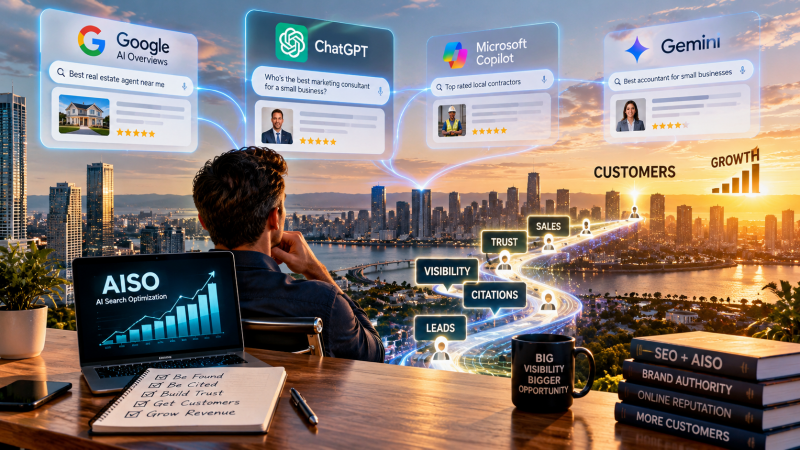
Those questions may still begin with Google. But increasingly, they are being asked through AI-powered search experiences, Google AI Overviews and AI Mode, ChatGPT, Microsoft Copilot, Gemini, and other conversational tools.
That changes the game.
Because the objective is no longer simply:
Can somebody find your website?
The emerging question is:
Does the internet contain enough clear, credible, consistent information about you for an AI system to understand who you are, what you do, where you do it, why you’re credible, and when it should recommend you?
Welcome to AISO.
What Exactly Is AISO?
I use AISO — AI Search Optimization — to describe the process of improving the ability of AI-powered search and discovery systems to understand, retrieve, cite, surface, and potentially recommend a person, business, organization, product, service, or piece of content when answering a relevant question.
You’ll see related terms throughout the marketing industry: GEO, or Generative Engine Optimization; AEO, or Answer Engine Optimization; AI SEO; LLM optimization; AI visibility.
The terminology is still evolving.
The underlying objective is much easier to understand.
You want machines to understand your business well enough to confidently connect it with the right human being.
And here’s something important:
AISO is not replacing SEO.
At least not in the foreseeable future.
Google explicitly says traditional SEO best practices remain relevant to its generative AI features because those experiences are rooted in Google’s existing search ranking and quality systems. Google says AI features use techniques including retrieval-augmented generation, or RAG, to retrieve relevant and current pages from its search index. (Google for Developers)
Microsoft makes essentially the same point. Bing’s webmaster guidelines say traditional SEO fundamentals also support eligibility for AI-powered grounding and citations in Bing and Copilot. (Search - Microsoft Bing)
OpenAI provides another piece of the puzzle. Public websites can appear in ChatGPT search, and OpenAI tells publishers that allowing OAI-SearchBot to access their sites helps their content become discoverable, surfaced, cited, and linked in ChatGPT search. (OpenAI Help Center)
So I don’t think businesses should be asking:
SEO or AISO?
The better model is:
SEO + AISO + reputation + authority + entity clarity.
They increasingly work together.
Why AISO Suddenly Matters So Much
This isn’t some hypothetical marketing trend that might matter five years from now.
Consumer behavior is already changing.
Google reported in 2026 that AI Overviews had more than 2.5 billion monthly active users, while AI Mode had surpassed one billion monthly users. Google also reported that AI Mode queries had been more than doubling every quarter since launch. (blog.google)
Pew Research Center found that 60% of U.S. adults said they read AI summaries appearing at the top of search results. (Pew Research Center)
And there’s an even bigger change hiding underneath those numbers.
People are asking search engines more complicated questions.
Traditional search trained us to speak like machines:
plumber Panama City FL
AI lets people search like humans:
Who is a reliable plumber near me who can handle an emergency leak and has good customer reviews?
That distinction matters enormously.
Google has said AI-powered search is leading people toward longer, more complex questions and follow-up conversations. Its AI Mode can even use a technique Google calls “query fan-out,” running multiple related searches across subtopics and data sources before synthesizing the information. (blog.google)
Your business isn’t competing for one keyword anymore.
It can potentially be evaluated against an entire context.
And This Isn’t Just About Big Companies
This may actually be more consequential for small businesses.
Think about how many businesses depend upon discovery.
Realtors.
Consultants.
Attorneys.
Accountants.
Contractors.
Restaurants.
Marketing agencies.
Insurance agents.
Home-service companies.
Financial professionals.
Photographers.
Nonprofits.
Medical practices.
Tourism businesses.
Retailers.
Coaches.
Professional service providers.
Independent creators.
Even individual professionals building personal brands.
If some portion of your revenue begins with somebody asking:
“Who should I hire?”
AISO should be on your radar.
Recent local-search research illustrates why.
BrightLocal reported in March 2026 that 45% of surveyed consumers had used AI tools for local business recommendations during the previous year, up from 6% the year before. Among the surveyed consumers, ChatGPT was used by 31% for business recommendations, while Google’s AI Mode was used by 23%. (BrightLocal)
Their broader 2026 consumer research found 84% of consumers had searched for a local business online during the previous three months, while three-quarters used multiple channels during their most recent local search. (BrightLocal)
That last part is incredibly important.
AI isn’t replacing Google, social media, websites, reviews, or traditional search. It’s becoming another layer connecting all of them.
The Search Funnel Is Changing
The traditional digital funnel might have looked something like this:
Search → Website → Research → Contact → Customer
Now it can look more like:
Question → AI Answer → Shortlist → Verification → Website/Reviews/Social → Contact → Customer
That means your first interaction with a potential customer may happen without the customer ever seeing your homepage.
An AI system may introduce you.
That’s a fundamentally different relationship.
And it makes what the broader internet says about you much more important.
Think of AISO as Building a Digital Evidence Trail
Here’s the easiest way I know to explain this.
Imagine I tell you:
Stephen’s Plumbing is the best plumbing company in town.
You’d probably ask:
According to whom?
Now imagine the internet contains:
A clearly written website explaining its services.
A complete business profile.
Consistent address and contact information.
Detailed service pages.
Dozens of legitimate customer reviews.
Local directory listings.
Articles demonstrating expertise.
Mentions from community organizations.
Local news coverage.
Professional profiles.
Photos of completed projects.
Clear information about the areas served.
Answers to common plumbing questions.
Other reputable websites mentioning the company.
Suddenly the statement has evidence surrounding it.
That’s the mindset I want businesses to adopt.
Don’t try to trick AI into recommending you. Build enough legitimate evidence that recommending you makes sense.
The Five Layers of AISO
I like to think of a strong AISO strategy as five interconnected layers:
Discoverability → Understanding → Relevance → Authority → Verification
If any one of those layers is weak, your overall visibility can suffer.
1. Discoverability
Before an AI-powered search system can do anything useful with your information, that information needs to be accessible.
That means your website should be crawlable and indexable.
Your important information shouldn’t exist exclusively inside images, videos, PDFs, JavaScript interfaces, or social posts.
Google specifically recommends making important content available in textual form, maintaining crawl access, using internal links, providing a good page experience, and keeping relevant Business Profile information current. (Google for Developers)
For ChatGPT search, OpenAI similarly recommends allowing OAI-SearchBot to crawl your public site if you want its content eligible for inclusion in search results. (OpenAI Help Center)
You cannot be retrieved if you cannot be discovered.
2. Understanding
Once discovered, machines need to understand what you actually are.
This sounds obvious.
It isn’t.
I’ve looked at plenty of business websites where, after reading the homepage, I still couldn’t clearly tell:
What exactly does this company do?
Where does it operate?
Who does it serve?
What makes it different?
Who owns it?
How do I contact it?
AI systems face variations of the same problem.
Your website should make those answers ridiculously easy to identify.
A consultant shouldn’t simply say:
Helping businesses achieve tomorrow’s potential through transformative solutions.
That sounds impressive while communicating almost nothing.
Compare that with:
Digital marketing and strategy consultant helping small businesses improve online visibility, search performance, reputation, and customer acquisition.
Now we have an entity.
We have services.
We have an audience.
We have context.
Clarity beats cleverness.
3. Relevance
Understanding what you do isn’t enough.
Search systems also need to determine when you are relevant.
Suppose you’re a realtor.
“I’m a realtor” provides one piece of information.
But customers might actually ask:
“Who specializes in first-time homebuyers?”
“Who knows waterfront properties?”
“Who works with military families relocating to the area?”
“Who sells luxury homes?”
“Who knows this neighborhood?”
“Who can help me sell an inherited property?”
Those are completely different intents.
Your website needs content that connects your expertise to the actual problems customers bring to the internet.
This is where traditional keyword research evolves into something more conversational.
Stop thinking exclusively about keywords.
Start building around questions, problems, situations, comparisons, and decisions.
4. Authority
Then comes the harder question:
Why should anyone trust you?
Google’s guidance continues emphasizing helpful, reliable, people-first content. Its quality guidance specifically discusses effort, originality, skill, and factual accuracy. (Google for Developers)
This is where genuine expertise becomes extraordinarily valuable.
Publish original insights.
Show your experience.
Explain your methodology.
Use original data when possible.
Publish case studies.
Document results.
Answer difficult questions.
Include author information.
Cite authoritative sources.
Update outdated information.
Add original photos and videos.
Explain what you’ve actually learned from doing the work.
AI can generate a generic 1,500-word article in seconds.
That makes generic information less valuable—not more.
Your competitive advantage is increasingly the information that only you could credibly produce.
5. Verification
Finally, your claims need corroboration.
This is where reputation, reviews, citations, directories, media mentions, associations, third-party profiles, and links become powerful.
Google says local ranking is primarily influenced by relevance, distance, and prominence, and notes that links, reviews, and positive ratings can contribute to prominence. (Google Help)
This is also why consistent information matters.
If your website says one thing, your Google Business Profile says another, an old directory has a third phone number, your LinkedIn page describes completely different services, and your Facebook page hasn’t been updated in four years, you’re creating unnecessary ambiguity.
Think of every legitimate digital property as another witness verifying:
Yes. This organization exists. This is what it does. This is where it operates. And these are the subjects for which it has demonstrated relevance.
Your Website Is Still Hugely Important
There’s a weird narrative floating around that AI means websites don’t matter anymore.
I wouldn’t bet my business on that.
A September 2026 BrightLocal study analyzed more than 200,000 localized AI searches and 1.9 million citations across ChatGPT, Google AI Mode, and Google AI Overviews.
Among its findings: 93% of the unique domains used as sources were business websites, and business websites accounted for 42% of citations. (BrightLocal)
That’s a pretty compelling reason to take your website seriously.
Your website is one of the few digital properties you completely control.
Treat it like the authoritative database for your business.
Structured Data Helps Machines Understand What They’re Looking At
This gets slightly technical, but don’t tune me out.
Structured data gives search engines standardized information about what exists on a page.
Google recommends Organization structured data to help it understand and disambiguate organizations. For local businesses, Google supports LocalBusiness structured data that can communicate details such as business name, address, telephone number, URL, hours, and other applicable information. (Google for Developers)
Bing also supports Schema.org structured data, including JSON-LD. (Search - Microsoft Bing)
But here’s an important myth to kill:
There isn’t some magical “AI schema” that instantly gets you into AI answers.
Google explicitly says you don’t need special AI files or special Schema.org markup to appear in its AI features. Your structured data should accurately represent the visible content of your website. (Google for Developers)
Schema helps machines understand information.
It does not manufacture authority.
Reviews Are Becoming Part of Your Information Infrastructure
Businesses often think about reviews strictly as reputation management.
Think bigger.
Reviews describe your business using the language of actual customers.
Customers mention services.
Locations.
Employees.
Experiences.
Problems.
Results.
Specialties.
Products.
AI-driven discovery makes that broader reputation footprint increasingly valuable.
And consumers are still checking.
BrightLocal’s 2026 research found that most AI users did not simply accept recommendations without verification; 97% said they sometimes double-checked AI recommendations against real reviews. (BrightLocal)
So don’t build an “AI strategy” while ignoring your reputation.
The two increasingly intersect.
Here’s How I’d Start From ZERO Today
Now let’s assume the worst-case scenario.
You have basically no AISO strategy.
Maybe you have a website.
Maybe it’s outdated.
Maybe you’ve never thought about AI visibility.
That’s okay.
Don’t spend the next six months building some enormous strategy document.
Start today.
Day 1: Establish Your Baseline
Open several AI search tools and ask the questions your customers would realistically ask.
Not your business name.
That defeats the purpose.
Ask:
“Who are the best [service] providers in [location]?”
“Who can help me with [specific problem]?”
“What’s a good [profession] for [specific customer type]?”
“What companies provide [service] near me?”
“Who specializes in [your specialty]?”
Run 10–20 realistic prompts.
Record:
Do you appear?
Who does?
Which sources are cited?
How are competitors described?
What characteristics appear repeatedly?
Don’t panic if you’re invisible.
You just established your baseline.
Days 2–5: Fix Your Foundation
Make sure your website clearly answers:
Who are you?
What do you do?
Who do you serve?
Where do you operate?
Why should someone trust you?
How can someone contact you?
Then audit:
Page titles.
Meta descriptions.
Headings.
Internal links.
Mobile usability.
Indexability.
Contact information.
Business name consistency.
Google Business Profile.
Bing presence.
Social profiles.
Directory listings.
Structured data.
Sitemap.
Robots.txt.
Crawler accessibility.
For Bing, consider implementing IndexNow, which Bing recommends as a way to notify participating search engines when URLs are added, updated, or deleted. (Search - Microsoft Bing)
For ChatGPT visibility, verify that you aren’t unintentionally blocking OAI-SearchBot. (OpenAI Help Center)
This isn’t glamorous work.
It is foundational work.
Days 6–10: Build Your Entity
Now make the internet’s description of your business consistent.
Your name.
Logo.
Biography.
Address, where applicable.
Phone number.
Website.
Service area.
Business category.
Core services.
Founder or leadership information.
Professional credentials.
Social accounts.
Everything should tell roughly the same story.
You are essentially creating a clean digital identity.
Days 11–15: Build Your Question Map
Write down the 25 questions potential customers ask before hiring you.
Not questions marketers think they should ask.
Questions real people actually ask.
For a realtor:
“How much house can I afford?”
“What should I fix before selling?”
“How long does closing take?”
“Should I buy before selling my current home?”
For a contractor:
“How much does a roof replacement cost?”
“How long should a roof last?”
“Does insurance cover storm damage?”
For a consultant:
“When should a small business hire a marketing consultant?”
“How much should a business spend on marketing?”
“SEO vs. Google Ads: which should I use?”
These questions become your content roadmap.
Days 16–20: Publish Answer-First Content
Start answering those questions.
And don’t bury the answer underneath 900 words of filler because somebody told you that’s how SEO works.
Give the answer.
Then explain it.
A strong format is:
Question
Direct answer
Explanation
Evidence/data
Example
Exceptions
Practical recommendation
Related questions
This makes content useful to humans while also creating clearly structured information machines can parse.
Days 21–25: Build External Validation
Now work outside your website.
Claim relevant profiles.
Correct outdated listings.
Ask satisfied customers for honest reviews.
Join legitimate industry directories.
Build relationships with local organizations.
Seek earned media.
Contribute expert commentary.
Publish useful content on reputable platforms.
Participate in your professional community.
Build links because you’re doing things worth referencing—not because somebody sold you 5,000 backlinks for $99.
The objective is not artificial popularity.
It’s credible corroboration.
Days 26–30: Measure, Test, Adjust
Return to the exact questions from Day 1.
Run them again.
Don’t obsess over a single answer.
AI recommendations can vary substantially between repeated queries, platforms, locations, and wording. BrightLocal’s 2026 local AI study found considerable variation between repeated searches, reinforcing why visibility should be measured across multiple prompts and over time rather than through one screenshot. (BrightLocal)
Track:
Mentions.
Citations.
Descriptions.
Competitors.
Source domains.
Referral traffic.
Branded searches.
Organic visibility.
Leads.
Calls.
Form submissions.
Revenue.
OpenAI says ChatGPT search referral URLs include utm_source=chatgpt.com, which gives businesses one straightforward way to identify some ChatGPT-generated referral traffic in analytics. (OpenAI Help Center)
Google has also rolled out dedicated generative-AI visibility reporting within Search Console for AI features including AI Overviews and AI Mode. (Google for Developers)
Bing Webmaster Tools now provides AI Performance reporting showing how pages are cited across supported AI-generated experiences including Microsoft Copilot and Bing’s AI-generated summaries. (Search - Microsoft Bing)
Use the data.
AISO should eventually become measurable business infrastructure, not another marketing buzzword.
Your 30-Day AISO Model
If all of that feels overwhelming, simplify it into four weekly objectives:
Week One: Become Understandable
Fix your website, profiles, contact information, services, locations, crawlability, and technical foundation.
Week Two: Become Relevant
Map customer questions, problems, services, locations, specialties, and buying situations.
Week Three: Become Authoritative
Publish original, genuinely helpful answers supported by experience, expertise, evidence, and strong sources.
Week Four: Become Verifiable
Strengthen reviews, citations, external mentions, profiles, relationships, and third-party validation—then measure everything again.
Then repeat.
That’s the model.
Understandable. Relevant. Authoritative. Verifiable.
What You Should NOT Do
Please don’t respond to AI search by pumping out 500 garbage articles generated entirely by AI.
Google specifically warns that using generative AI to produce large quantities of pages without adding value can violate its scaled-content-abuse policies. (Google for Developers)
AI should make good marketers faster.
It shouldn’t turn businesses into content factories producing information nobody needed.
Don’t invent credentials.
Don’t manufacture reviews.
Don’t create fake experts.
Don’t copy competitors.
Don’t stuff pages with awkward keywords.
Don’t create hundreds of near-identical city pages.
Don’t buy junk backlinks.
Don’t publish “research” that never happened.
Don’t chase some secret prompt hack that supposedly guarantees ChatGPT recommendations.
Build something much harder to fake:
actual authority.
AISO Is Really About Digital Trust
That’s ultimately where I think this entire conversation leads.
People hear “AI Search Optimization” and immediately start looking for tricks.
I think that’s backwards.
The companies that win this transition probably won’t be the companies that discover the cleverest AI hack.
They’ll be the companies that make themselves extraordinarily easy to understand and extraordinarily easy to trust.
Clear website.
Clear services.
Clear expertise.
Consistent identity.
Useful information.
Real reviews.
Original content.
Strong reputation.
Credible third-party references.
Accurate data.
Accessible pages.
Demonstrated experience.
Those are good SEO signals.
They’re good AISO signals.
But more importantly, they’re good business signals.
The Businesses That Start Now Have an Opportunity
There’s another reason I’m encouraging businesses to start immediately.
Most businesses are nowhere near mature AISO.
Many still haven’t mastered traditional SEO.
Plenty have incomplete business profiles.
Outdated websites.
Weak service pages.
Almost no original educational content.
Inconsistent directory information.
Very few reviews.
No structured data.
No meaningful authority-building strategy.
No idea what AI systems say about them.
That sounds like a problem.
I see opportunity.
Because you don’t need to dominate AI search tomorrow.
You need to start building the information ecosystem today that gives search engines, AI systems, and—most importantly—customers reasons to understand and trust you tomorrow.
The internet has gone through these transitions before.
First businesses needed websites.
Then they needed search visibility.
Then mobile optimization.
Then social presence.
Then local search.
Then online reputation.
Now we’re entering the next phase:
machine-mediated discovery.
A customer may never type your URL.
They may never search your exact business name.
They may simply explain their problem to an AI system and ask:
“Who should I call?”
Your job is to make sure the digital evidence exists for your business to become part of that answer.
And if you’re starting from zero?
Perfect.
Start with one question today:
If an AI system had to explain exactly who we are, what we do, who we help, where we operate, and why someone should trust us—does the internet currently give it enough evidence to get the answer right?
If the answer is no, you’ve just found your first AISO project.
And you’ve got 30 days to start changing it.
Add comment
Comments