

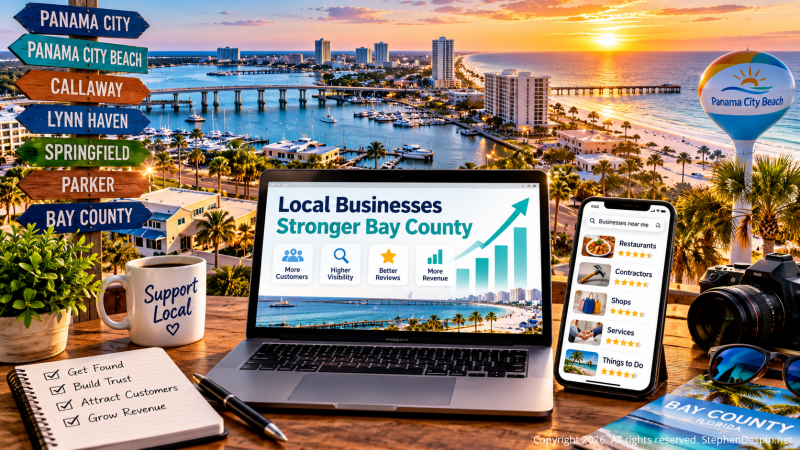
Something pretty remarkable is happening in Bay County.
We’re growing.
Not in the vague, “Florida sure seems crowded lately” kind of way, either. The numbers are pretty hard to ignore.
The U.S. Census Bureau estimated Bay County’s population at 204,479 people in 2025. The county’s 2020 population base was 175,226.
That means Bay County grew roughly 16.7% in only five years. (Census.gov)
Think about that for a second.
That’s tens of thousands of additional people living here, buying groceries here, repairing their homes here, eating at restaurants here, getting haircuts here, hiring contractors here, putting their kids into activities here and generally spending money throughout our local economy.
Then add tourism.
According to the Bay County Chamber of Commerce, tourism generates approximately $3.1 billion in direct visitor spending annually, supports more than 35,000 local jobs and produces roughly 19.2 million visitor nights per year. (Bay County Chamber of Commerce)
And those visitors aren’t only showing up during summer anymore.
Panama City Beach tourism officials reported that Tourist Development Tax collections for November 2025 increased 7% year over year, followed by a 10.7% increase in December. Through December, fiscal-year collections were running 7.8% ahead of the previous year. (Visit Panama City Beach)
So here’s the question I think every local business owner should be asking:
How much of that growth are you actually capturing?
Because economic growth happening around your business does not automatically mean economic growth happening inside your business.
And that’s what I really want to talk about.
There Is an Enormous Amount of Money Moving Through Bay County
Sometimes we talk about economic development as though it were this abstract thing happening somewhere above our heads.
It’s not.
It’s somebody buying lunch.
It’s a homeowner replacing an air conditioner.
It’s a family looking for a dentist.
It’s a tourist deciding where to eat tonight.
It’s somebody needing an electrician.
It’s parents looking for activities for their kids.
It’s a business hiring an accountant.
It’s a couple deciding where to spend their anniversary.
It’s somebody moving here who suddenly needs everything from pest control to insurance.
Put enough of those transactions together and you have an economy.
The latest Census business figures help put the scale into perspective.
Bay County had 5,306 employer establishments in 2023, employing 62,282 people and generating nearly $3 billion in annual payroll.
Then there is another part of the local economy that can easily get overlooked: entrepreneurs operating without paid employees.
The Census Bureau’s newly released 2024 Nonemployer Statistics count 21,441 nonemployer establishments in Bay County. These are generally businesses without paid employees, including many self-employed entrepreneurs. (Census.gov)
Retail sales alone totaled approximately $4.57 billion in 2022, while accommodation and food-service sales exceeded $1.06 billion. (Census.gov)
And the labor market continues moving.
Preliminary Bureau of Labor Statistics data for August 2026 show total nonfarm employment in the Panama City-Panama City Beach metropolitan area at about 95,200 jobs, up 1.8% from a year earlier. Leisure and hospitality employment was up 9.4% year over year, while professional and business services were up 2.6% and education and health services were up 3.4%. (Bureau of Labor Statistics)
That’s the market we’re talking about.
And I think there is a really important distinction here:
Bay County businesses aren’t necessarily suffering from a lack of potential customers. A lot of businesses are suffering from an inability to consistently capture the customers already around them.
Those are two completely different problems.
The second one is much more fixable.
The Customer Has Changed
Here’s where things get interesting.
Imagine your air conditioner quits working tomorrow.
What do you do?
Maybe you ask a friend.
But there’s a pretty good chance you grab your phone.
You search Google.
You open Maps.
You compare businesses.
You look at reviews.
You visit a website.
You might check Facebook.
Increasingly, you might even ask an AI assistant something like:
“Who are the best HVAC companies near Panama City?”
Then you narrow down your choices.
All of this can happen before you speak with a single business.
That’s incredibly important.
Because the competition for that customer didn’t begin when the phone rang.
The competition happened before the phone ever rang.
Google itself says local search results are primarily determined by relevance, distance and prominence. Complete business information helps Google understand relevance, while reviews and positive ratings can contribute to prominence. (Google Help)
Google also pulls business information from more places than many owners probably realize, including official websites, publicly available web content, third-party data, user contributions, photographs and reviews. (Google Help)
And we’re entering another stage of that evolution.
Google’s local listings can now include AI-generated summaries based on sources including place information and customer reviews. (Google Help)
That means your digital presence isn’t simply advertising anymore.
It’s infrastructure.
Problem #1: You’re Great at What You Do, but Nobody Can Find You
This might be the most frustrating problem in small business.
You can be the best plumber in Bay County.
The best mechanic.
The best roofer.
The best restaurant.
The best photographer.
The best landscaper.
But if somebody searches for what you do and finds five competitors before they find you, being great doesn’t necessarily help.
I wish it did.
The internet doesn’t automatically rank businesses by craftsmanship.
Search engines don’t know that you’ve spent 25 years mastering your trade unless the digital information surrounding your business gives them enough information to understand who you are, what you do, where you operate and whether people trust you.
Start with the basics.
Search Google for the service you provide.
Not your business name.
Search the way a customer would.
“Plumber near me.”
“Panama City electrician.”
“Best seafood Panama City Beach.”
“Callaway AC repair.”
“Lynn Haven roofing company.”
“Panama City family photographer.”
Now look at what appears.
Are you there?
If you aren’t, your first marketing problem probably isn’t advertising.
It’s discoverability.
Problem #2: You’re Renting Your Entire Audience
I love social media.
I’ve spent a pretty substantial part of my career working in digital engagement, and social platforms can be incredibly powerful.
But there is one mistake I see businesses make constantly.
They build their entire digital operation on Facebook or another social network.
That’s dangerous.
Your Facebook followers aren’t really your audience.
Facebook controls your access to them.
The same applies to Instagram, TikTok, X, LinkedIn and practically every other platform.
Algorithms change.
Reach changes.
Platforms change.
Accounts get suspended.
Consumer behavior changes.
You should absolutely use social media.
But social media should be a bridge, not the destination.
The goal should be moving people from platforms you don’t control toward assets you do:
Your website. Your email list. Your customer database. Your phone list. Your referral network.
If 10,000 people follow your business on Facebook but you have no reliable way of contacting them outside Facebook, you’ve built an impressive audience on somebody else’s property.
Build your own property too.
Problem #3: You’re Measuring Attention Instead of Customers
This one drives me crazy.
A post gets 20,000 views.
Great.
What happened next?
A video gets 400 likes.
Awesome.
What happened next?
Your Facebook page gains 500 followers.
Fantastic.
What happened next?
Marketing isn’t supposed to generate applause.
Marketing is supposed to generate action.
Depending on your business, that action might be:
Search → Website → Phone Call → Appointment → Customer
Or:
Facebook Post → Menu → Directions → Restaurant Visit
Or:
Google Maps → Reviews → Website → Estimate Request → Sale
Or:
Video → Email Signup → Follow-Up → Purchase
That’s the journey you should be measuring.
I learned this lesson long before I began focusing heavily on businesses.
A huge part of my background has been digital engagement and grassroots organizing, where getting thousands of people to see something was essentially meaningless if nobody took action afterward.
A million impressions don’t matter much if the goal was getting 100 people into a room and nobody showed up.
Business marketing works the same way.
Reach is not the finish line. Action is.
Problem #4: Your Reputation Is Marketing Whether You Manage It or Not
Go search for your business right now.
Seriously.
Pretend you’ve never heard of it.
What would you think?
Look at the rating.
Look at the number of reviews.
Read the newest reviews.
Look at the photographs.
Check whether the hours are correct.
Visit the website.
Try calling.
Try filling out the contact form.
Then do exactly the same thing with your three biggest competitors.
That exercise can be uncomfortable.
It can also be incredibly valuable.
Google says reviews and positive ratings can help local ranking, while responses to reviews can help a business stand out. (Google Help)
Google Maps published 1.14 billion local reviews during 2025 alone across categories including restaurants, shopping, services, entertainment, lodging and health and wellness. (Google Transparency Report)
Consumers are building an enormous public database of business reputation.
Whether you participate in managing yours is optional.
Whether it exists isn’t.
And here’s the good news.
You don’t need some elaborate system to start improving it.
Ask happy customers for honest reviews.
Google allows businesses to generate direct review links and QR codes that can be placed on receipts, included in thank-you emails, sent after customer interactions or displayed inside a business. Google does prohibit incentivizing reviews, so don’t offer discounts or freebies in exchange for positive feedback. (Google Help)
Then respond to the reviews you receive.
Good ones and bad ones.
You’re not only responding to the person who wrote the review.
You’re responding to every future customer who reads it.
Problem #5: You’re Marketing to “Bay County” Instead of Actual People
This one is especially important here.
Bay County isn’t one customer.
The tourist staying on Front Beach Road for five days is not the same customer as the family that’s lived in Callaway for twenty years.
The military family newly stationed here isn’t the same customer as the retiree who moved down from Ohio.
The homeowner in Lynn Haven isn’t necessarily searching the same way as somebody staying in a condo on Panama City Beach.
The person visiting for a youth sporting event has completely different needs from someone who works at Tyndall Air Force Base.
Different people.
Different motivations.
Different timelines.
Different search behavior.
Different relationships with your business.
A tourist might search:
“Best breakfast near me.”
A resident might search:
“Best HVAC company Panama City.”
The tourist needs an answer in ten minutes.
The homeowner might be choosing someone they’ll call for the next decade.
Those customers shouldn’t necessarily receive identical marketing.
And with approximately 19.2 million visitor nights annually alongside a resident population now exceeding 200,000, Bay County businesses have an unusually interesting opportunity to serve both markets. (Bay County Chamber of Commerce)
The key is understanding which customer you’re trying to reach at any given moment.
So What Should a Bay County Business Actually Do?
This is where I want to make this practical.
You don’t need a $100,000 marketing budget.
You don’t need to become an influencer.
You don’t need to post twelve TikToks every day.
You don’t even need to do everything I’m about to suggest immediately.
But you should know where you stand.
So here’s the exercise I’d give practically any local business.
The Bay County Small Business Growth Checklist
1. Search for yourself like a customer.
Don’t search your company name.
Search for what you sell.
See whether you appear.
Then repeat the search using Panama City, Panama City Beach, Callaway, Lynn Haven, Springfield, Parker or whichever communities you actually serve.
2. Completely audit your Google Business Profile.
Check your business category, services, hours, phone number, website, address, service area and photographs.
Google specifically recommends maintaining complete and accurate information because it helps the platform match businesses with relevant local searches. (Google Help)
3. Compare your reviews against your competitors.
Don’t obsess over the star rating alone.
Look at volume.
Recency.
Responses.
Photographs.
What customers repeatedly praise.
What customers repeatedly criticize.
That information isn’t just reputation management.
It’s market research.
4. Build a consistent review process.
Don’t randomly remember to ask for reviews every six months.
Make it part of the customer journey.
Job completed?
Send the link.
Meal finished?
QR code.
Follow-up email?
Include it.
Happy customer tells you how wonderful you are?
Thank them—and ask if they’d mind sharing that experience publicly.
Make the process easy.
5. Look at your website on your phone.
Not your computer.
Your phone.
Can someone immediately understand:
Who are you?
What do you do?
Where do you operate?
Why should they trust you?
And most importantly:
What should they do next?
Call?
Book?
Request an estimate?
Order?
Visit?
If you can’t answer those questions in a few seconds, neither can your customer.
6. Start collecting first-party customer information.
Email addresses.
Phone numbers, with appropriate permission.
Customer records.
Past purchases.
Service dates.
Whatever makes sense for your industry.
Build relationships you can maintain without asking a social-media algorithm for permission.
7. Track where customers actually come from.
Ask.
Google?
Facebook?
Referral?
Instagram?
Saw your truck?
Repeat customer?
Tourist recommendation?
Hotel?
Friend?
You’d be amazed how many businesses spend thousands of dollars marketing without actually knowing which marketing generates customers.
8. Build a referral system.
Bay County is still a relationship-driven community.
Use that.
A plumber should know a restoration company.
A Realtor should know a photographer.
A restaurant should know nearby hospitality businesses.
A wedding venue should know florists, DJs, photographers and caterers.
A business serving tourists should know other businesses serving tourists.
Stop viewing every other business as competition.
Some of your best customer-acquisition channels might be sitting at the Chamber luncheon with you.
9. Create content that answers real customer questions.
Don’t just post:
“Happy Monday!”
Teach people something.
If you’re a roofer, explain what homeowners should inspect after a storm.
If you’re a restaurant, show the dish people keep asking about.
If you’re an HVAC contractor, explain why an AC system struggles during August.
If you’re a Realtor, explain what’s happening in a particular Bay County neighborhood.
If you’re an accountant, answer a common small-business tax question.
Useful content builds authority.
Authority builds trust.
Trust makes buying easier.
10. Start thinking about AI discovery now.
This is the newest piece of the puzzle.
People are increasingly using AI systems alongside traditional search to research businesses, products and services.
You don’t need to panic about “AI optimization.”
Start with something much simpler:
Make your business easy for machines to understand.
Clearly state what you do.
Clearly state where you operate.
Clearly describe your services.
Maintain consistent business information across the web.
Publish useful information.
Build genuine reviews.
Earn legitimate mentions from other websites and community organizations.
Maintain a technically sound website.
Those are good practices whether the customer discovers you through Google, Maps, an AI-generated answer or something that hasn’t been invented yet.
The Goal Isn’t More Marketing. It’s Less Waste.
This is probably the biggest point I want local businesses to take away from this.
You don’t necessarily need to spend more money.
You need to stop losing opportunities you’re already paying to create.
If 1,000 people visit your website but nobody calls, buying another 1,000 visitors probably isn’t the first problem to solve.
If customers love you but nobody leaves reviews, fix the review process.
If you have 8,000 Facebook followers but no email database, start building one.
If people search for exactly what you sell but your competitors dominate the results, improve your discoverability.
If your ads generate leads but nobody follows up quickly, fix the follow-up process.
Sometimes the highest-return marketing investment isn’t another advertisement.
It’s fixing the leak in the bucket.
Bay County’s Growth Creates Opportunity—But Opportunity Isn’t Automatic
I am incredibly optimistic about the potential for businesses in this community.
We have more than 204,000 residents.
We have billions of dollars in annual retail activity.
We have billions more associated with visitor spending.
We have tens of thousands of entrepreneurs and business establishments.
We have a tourism economy increasingly stretching beyond the traditional summer season.
We have military installations, families, retirees, entrepreneurs, hospitality workers, professionals, tradespeople and millions of visitor nights feeding an incredibly diverse local economy. (Census.gov)
The opportunity is here.
But opportunity doesn’t automatically deposit itself into your business checking account.
Somebody still has to capture it.
And increasingly, that battle is being fought before the customer ever walks through your door.
It’s happening on Google.
It’s happening on Maps.
It’s happening in reviews.
It’s happening on websites.
It’s happening on social media.
It’s beginning to happen inside AI-generated answers.
And, thankfully, it’s still happening the old-fashioned way too:
One person telling another person, “You should call these guys. They took care of me.”
Technology hasn’t eliminated relationships.
If anything, it has amplified them.
A recommendation that once traveled across a backyard fence can now be read by thousands of people.
A great customer experience can become a review.
A review can become visibility.
Visibility can become a phone call.
A phone call can become a customer.
A customer can become a repeat customer.
And a repeat customer can become another referral.
That’s the system.
One Last Challenge
If you own a business anywhere in Bay County, I want you to try something today.
Open your phone.
Pretend you’re a customer.
Search for exactly what your business sells.
Don’t use your company name.
Look at the businesses that appear before yours.
Look at their reviews.
Look at their websites.
Look at their photographs.
Look at what they’re doing well.
Then ask yourself one simple question:
If I knew absolutely nothing about these companies, would I choose mine?
If the answer is yes, fantastic.
Keep building.
If the answer is no?
That’s not failure.
That’s information.
And information gives you something incredibly valuable:
A place to start.
Bay County is growing.
The customers are here.
The money is moving.
The opportunity is real.
Now the question is whether our local businesses are positioned to capture it.
Add comment
Comments