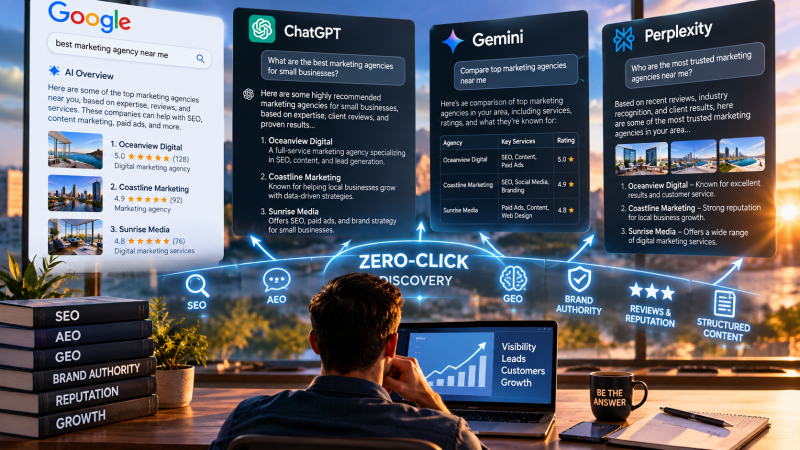
For most of the internet’s history, getting found online followed a fairly predictable formula.
Someone had a question.
They opened Google.
They typed a few words into the search bar.
Google gave them a list of websites.
They clicked one.
For businesses, the objective was obvious: get as close to the top of that list as possible.
That basic idea gave birth to an entire industry around search engine optimization. Businesses researched keywords, built backlinks, optimized title tags, published blog posts, improved page speed, and fought relentlessly for those coveted first few positions on Google.
And to be clear, SEO still matters.
A lot.
But there is one increasingly important problem with building your entire digital discovery strategy around traditional search rankings:
People don’t always need to click anymore.
The search engine itself can answer the question.
AI can summarize the options.
ChatGPT can research a purchase.
Google can generate an AI Overview before someone ever reaches the traditional organic results.
Google AI Mode can turn what once required five, ten, or twenty individual searches into a conversation.
And suddenly, being ranked does not automatically mean being seen.
Welcome to the zero-click, AI-driven discovery economy.
And businesses need to start adapting to it now.
The Search Box Isn’t Disappearing. It’s Becoming an Answer Box.
Think about how you searched for something five years ago.
Maybe you needed an accountant.
You might have searched:
“small business accountant near me”
Then you opened several websites, read their service pages, looked at Google reviews, compared prices, went back to Google, searched a few more questions, and eventually made a decision.
Now imagine asking:
“Who are some good accountants near me for a small business with five employees, and what should I look for before hiring one?”
That’s fundamentally different.
The consumer isn’t simply asking a search engine to locate webpages.
They’re asking technology to research the decision for them.
Google’s AI Overviews increasingly synthesize information directly within search results. Google AI Mode takes that concept further by creating a conversational search experience. ChatGPT Search similarly provides timely answers alongside links to relevant web sources. OpenAI has also been expanding ChatGPT’s role in product discovery, allowing consumers to explore, compare, and research purchases conversationally. (OpenAI)
HubSpot describes the shift well. Its September 2026 analysis says search behavior has moved from a largely linear Google experience toward multi-platform discovery involving tools such as ChatGPT, AI Overviews, and AI Mode. In HubSpot’s survey of U.S. SEO professionals, 73% agreed to some degree that AI tools or features were becoming an important component of their company’s SEO strategy. (HubSpot Blog)
This isn’t some theoretical change coming five years from now.
It’s happening while you’re reading this.
And the numbers surrounding zero-click behavior are difficult to ignore.
Here’s Where Things Get Really Interesting
Pew Research Center analyzed the browsing behavior of 900 U.S. adults during March 2025.
Among those participants, 58% encountered at least one Google search containing an AI-generated summary.
But the fascinating part was what happened next.
When an AI summary appeared, users clicked a traditional search result during just 8% of visits.
When there wasn’t an AI summary?
That number was nearly twice as high at 15%.
Even more striking, users clicked links contained directly inside Google’s AI summaries during only about 1% of visits. People were also more likely to end their browsing session after receiving an AI summary: 26% did so, compared with 16% after traditional search pages without one. (Pew Research Center)
Think about what that means from the perspective of a business owner.
You could theoretically rank well.
Your content could help generate the answer.
And the customer might still never visit your website.
Ahrefs has found an even more dramatic effect. Its 2026 update analyzed 300,000 keywords and found that the presence of an AI Overview correlated with a roughly 58% lower average click-through rate for the top-ranking page compared with what its model estimated absent AI Overviews. That’s an observational correlation rather than proof that every site will lose 58% of its clicks, but the direction of the change is hard to dismiss. (Ahrefs)
This changes the question businesses need to ask.
For years, we asked:
“Does my website rank?”
Now we also need to ask:
“Does the internet understand who my business is well enough to recommend it?”
Those are not the same question.
Ranking on Google ≠ Being Visible Everywhere Decisions Are Made
This is probably the biggest mental shift businesses need to make.
Traditional SEO generally attempts to increase a website’s visibility within search engines.
That’s still important.
But modern discovery is becoming fragmented across multiple environments.
Someone might discover you through Google Search.
Someone else might ask ChatGPT.
Another customer might encounter an AI Overview.
Someone could research businesses through Google Maps.
Another might look at Reddit.
Another might watch YouTube reviews.
Another might ask an AI system to compare three businesses they’ve already discovered.
And those systems increasingly synthesize information from multiple sources rather than simply returning ten blue links.
That means visibility is becoming less about winning one ranking and more about establishing a sufficiently strong digital footprint that search engines, AI systems, platforms, and consumers repeatedly encounter consistent evidence about your business.
That’s a very different game.
And it requires a broader strategy.
SEO Isn’t Dead. It Just Isn’t the Whole Strategy Anymore.
Every few years someone declares SEO dead.
It isn’t.
In fact, abandoning traditional SEO right now would probably be one of the worst reactions a business could have.
AI systems still need information.
Search engines still crawl websites.
Consumers still click search results.
High-quality websites still establish authority.
Technical performance still matters.
Internal linking still matters.
Keywords still matter.
Backlinks still matter.
Useful content definitely still matters.
The difference is that businesses increasingly need to think beyond SEO alone.
The modern visibility formula looks more like this:
SEO + AEO/GEO + Brand Authority + Reputation + Structured Content
Each piece strengthens the others.
SEO helps search engines discover and rank you.
Answer Engine Optimization, commonly called AEO, focuses on making information easy for answer-oriented systems to understand and surface.
Generative Engine Optimization, or GEO, focuses more broadly on improving the likelihood that generative AI systems understand, cite, reference, or mention your brand and information.
Brand authority creates broader signals that your company actually exists, has expertise, and is recognized outside its own website.
Reputation gives consumers—and increasingly the broader information ecosystem—independent evidence about your business.
Structured content makes information easier for machines to interpret.
None of these should exist in isolation.
That’s the key.
Your Website Is Becoming a Knowledge Source, Not Just a Sales Brochure
This is where a lot of business websites are falling behind.
Open the average small-business website and you’ll probably see something like:
HOME | ABOUT | SERVICES | CONTACT
The homepage says:
“We’re committed to providing exceptional customer service and quality solutions tailored to your unique needs.”
Great.
But what does that actually tell a search engine or AI system?
Not much.
Who do you serve?
Where do you serve them?
What specifically do you do?
What problems do you solve?
How does your service work?
How much does it generally cost?
What separates one service from another?
What questions do customers repeatedly ask?
What expertise does your company actually have?
These are the things businesses need to answer clearly.
Your website shouldn’t merely say:
“We provide professional roofing services.”
It should build an entire information architecture around roofing.
How long does a roof typically last in your climate?
What does roof replacement cost?
What are the warning signs of storm damage?
Can a roof be repaired instead of replaced?
What roofing materials work best locally?
How does insurance affect storm repairs?
How long does installation take?
What should homeowners ask before hiring a contractor?
Now your website isn’t simply advertising a service.
It’s becoming a knowledge base surrounding that service.
That distinction is increasingly valuable.
Write for Questions, Not Just Keywords
Traditional keyword research isn’t disappearing, but conversational AI is changing the kinds of queries businesses should consider.
People don’t necessarily talk to AI the way they search Google.
Traditional search:
“best digital marketing Panama City FL”
Conversational query:
“I’m a small business owner in Panama City and need help generating more local leads without wasting thousands on Facebook ads. What should I look for in a digital marketing consultant?”
That’s an entirely different information request.
Businesses should therefore map the actual questions customers ask throughout the buying process.
Before purchasing.
While comparing.
Immediately before making a decision.
After purchasing.
Build content around those questions.
Create FAQ sections.
Write comparison pages.
Publish detailed guides.
Explain complicated terminology.
Answer objections.
Explain pricing where possible.
Create “how it works” content.
Publish original research.
Build location-specific resources.
Answer the weird questions customers actually ask your employees.
The objective isn’t stuffing more keywords into paragraphs.
It’s becoming the clearest, most useful source of information within your area of expertise.
Structure Matters More Than Most Businesses Realize
Machines need context.
That’s why structured content matters.
Google explicitly says structured data provides clues about the meaning and classification of webpage content. Properly implemented structured data can also make pages eligible for richer appearances in Google Search. (Google for Developers)
That doesn’t mean adding schema markup magically guarantees an AI citation.
It doesn’t.
There is no magic “rank me in ChatGPT” button.
But making information technically clear and semantically organized gives machines fewer ambiguities to resolve.
Businesses should therefore pay attention to things like:
clear headings,
descriptive page titles,
logical website architecture,
schema markup where appropriate,
author information,
publication and update dates,
service descriptions,
business information,
FAQ-style content,
consistent names and terminology,
and easily identifiable facts.
Think of it this way.
Your website should be understandable at three levels simultaneously:
Human → Search Engine → AI System
If humans understand it but machines can’t properly interpret it, you have a problem.
If machines understand it but humans hate reading it, you also have a problem.
The best content works for both.
Reputation Is Becoming Part of Search Infrastructure
This may be one of the most overlooked pieces of the entire AI visibility conversation.
Your reputation is no longer sitting in one place.
It’s distributed across the internet.
Google reviews.
Facebook.
Reddit.
Industry directories.
News coverage.
Podcasts.
YouTube.
Professional organizations.
Articles.
Customer testimonials.
Local business directories.
Social media.
Third-party websites.
And increasingly, businesses need to think about all of those signals as pieces of the same digital identity.
For local businesses specifically, Google says local rankings are primarily determined by relevance, distance, and prominence. Google also says prominence incorporates signals such as links and reviews and that more reviews and positive ratings can help local rankings. (Google Help)
That makes reputation management much bigger than simply trying to maintain five stars.
Every legitimate review adds another piece of evidence about what your company does and what customers experience.
A detailed review saying:
“Stephen helped us improve our local Google visibility and generate more qualified leads”
contains far more meaningful context than:
“Great service!”
Both are valuable.
But one actually describes the business.
Businesses should never script fake reviews or manipulate customers into posting predetermined language. Instead, make it easy for genuine customers to describe what they hired you for, what problem was solved, and what their experience was.
Authenticity matters.
Brand Mentions Matter, Too
Here’s another fascinating development.
AI visibility and website citations aren’t necessarily the same thing.
A 2026 Semrush analysis examined 3,981 domain appearances across 115 prompts in 14 countries and four AI search environments: ChatGPT, Google AI Overviews, Gemini, and Google AI Mode.
It found that about 61.7% of appearances were what researchers called “ghost citations”—the source was cited, but the brand itself wasn’t mentioned in the generated answer.
Only 13.2% of appearances included both a citation and a brand mention, while another 25.1% contained a brand mention without a citation. (Semrush)
That’s an incredibly important distinction.
You don’t merely want AI to use information from your website.
Ideally, you want the system to understand the relationship between the information and your brand.
That means businesses should stop treating branding as something separate from search optimization.
Your company name should be associated consistently with your expertise.
Your founder or subject-matter experts should be identifiable.
Your services should be clearly described.
Your business information should be consistent.
Your expertise should exist beyond your own website.
You want corroboration.
If your website says you’re an expert but virtually nothing else on the internet associates your name with that expertise, that’s a relatively weak digital footprint.
If your website says it, industry publications say it, customers describe it in reviews, podcasts discuss it, organizations reference it, directories confirm it, and authoritative websites cite it?
Now you’ve created an ecosystem of evidence.
The New Goal Is Digital Consensus
I think this is the easiest way to understand what is happening.
Businesses used to optimize primarily for position.
Increasingly, businesses need to optimize for consensus.
Imagine an AI system trying to determine whether your company should be included when someone asks:
“Who are reputable companies in my area that provide this service?”
Ideally, it encounters the same basic story everywhere.
Your website clearly explains the service.
Your Google Business Profile confirms your location and business category.
Your reviews discuss that service.
Directories contain accurate business information.
Articles demonstrate expertise.
Other websites mention the company.
Your social profiles reinforce the brand.
Your leadership has identifiable expertise.
Your content answers the exact questions customers ask.
All those signals point in the same direction.
That’s digital consensus.
And it is becoming incredibly valuable.
So What Can a Business Actually Do About This Today?
This is the part I care about most.
Because talking about AI disruption is easy.
Giving a business owner something useful they can do before lunch is much more valuable.
So if your company hasn’t thought seriously about AI search visibility yet, start here.
1. Search Your Own Business Like a Customer
Don’t just Google your company name.
Search the problems you solve.
Then ask ChatGPT.
Try Google AI Mode.
Look at AI Overviews when they appear.
Search things like:
“best [service] in [city]”
“who can help with [problem] near me”
“what company should I hire for [service]”
“[your company] reviews”
“[your company] vs [competitor]”
“What should I look for when hiring a [service provider]?”
Document what appears.
You’re conducting a basic AI visibility audit.
The question isn’t merely whether your website ranks.
The question is whether your business exists in the answers.
2. Build a Customer Question Library
Sit down with your employees and write down the 25 questions customers ask most frequently.
Not keywords.
Actual questions.
Then answer every one of them online.
Some answers may require full articles.
Others need only an FAQ.
Some belong on service pages.
Some could become videos.
Some could become social posts.
This gives search engines and answer engines significantly more context surrounding your expertise.
3. Rewrite Weak Service Pages
Look at every major service page on your website.
Ask:
Does this explain exactly what we do?
Who is it for?
Where is it available?
What problem does it solve?
How does the process work?
What does it generally cost?
How long does it take?
What questions would a customer naturally have next?
If your page contains 200 words of generic marketing language, rebuild it.
Your service pages should actually teach people something.
4. Strengthen Your Entity Information
Make sure the fundamental facts about your business are consistent everywhere.
Business name.
Address where applicable.
Phone number.
Website.
Service area.
Business category.
Leadership.
Social profiles.
Hours.
Services.
Descriptions.
Conflicting information creates unnecessary ambiguity.
Consistency creates clarity.
5. Build a Real Review System
Don’t occasionally remember to ask customers for reviews.
Create a process.
Ask consistently.
Make the link easy to access.
Follow up appropriately.
Respond to reviews.
And encourage customers to describe their genuine experience rather than simply clicking five stars.
For many local businesses, this alone can dramatically strengthen their digital footprint.
6. Add Structured Data
Work with your web developer or SEO professional to implement appropriate schema markup.
Depending on the business and content, that could include information relating to organizations, local businesses, articles, products, events, breadcrumbs, or other Google-supported structured-data types.
Again, schema isn’t magic.
It is communication.
You’re helping machines understand what they’re looking at.
7. Publish Something Worth Citing
This is where businesses can separate themselves quickly.
Stop publishing another generic article called:
“5 Reasons You Need Our Service.”
Create something original.
Analyze local market data.
Survey your customers.
Publish pricing trends.
Create an annual industry report.
Build a local guide.
Compile statistics.
Conduct an experiment.
Interview experts.
Create a calculator.
Publish a case study.
Document an actual process.
Original information gives other people—and potentially AI systems—a reason to reference you.
8. Build Authority Outside Your Website
Your website cannot be your entire digital reputation.
Contribute to publications.
Appear on podcasts.
Join legitimate professional organizations.
Participate in your community.
Speak at events.
Provide expert commentary.
Build partnerships.
Earn media coverage.
Publish on platforms where your audience already spends time.
The internet should contain independent evidence that your company matters.
9. Measure Visibility, Not Just Traffic
This may require businesses to rethink their dashboards.
Website traffic still matters.
Rankings still matter.
Conversions definitely matter.
But businesses should increasingly monitor additional questions:
Are we appearing in AI-generated answers?
Are we being cited?
Is our brand being mentioned?
What sources are being cited instead?
Which competitors appear repeatedly?
Which questions trigger our brand?
Are branded searches increasing?
Are direct visits increasing?
Are leads saying they “found us through ChatGPT”?
That’s a different measurement framework.
And businesses that start collecting that information now will have a major head start in understanding how discovery is evolving.
Don’t Chase the Algorithm. Build the Evidence.
This is probably the most important takeaway.
Businesses have spent years chasing algorithms.
Google changes something.
Everyone reacts.
Facebook changes something.
Everyone reacts.
Instagram changes something.
Everyone reacts.
Now AI search arrives, and inevitably there will be businesses looking for the newest trick to “hack ChatGPT rankings.”
That’s the wrong lesson.
Instead of trying to manipulate every new discovery system, build such a strong digital presence that those systems have overwhelming evidence about who you are.
Create genuinely useful content.
Answer real questions.
Build a recognizable brand.
Earn legitimate reviews.
Establish expertise.
Keep your information accurate.
Structure your website properly.
Earn credible mentions elsewhere.
Publish original information.
Make your company easy for machines to understand and easy for humans to trust.
Those fundamentals survive algorithm changes.
The Website Visit Is No Longer the Beginning of the Customer Journey
This may ultimately be the biggest transformation of all.
For years, marketers designed funnels assuming the website was where research happened.
Search → Website → Research → Decision.
Increasingly, research can happen before the website visit ever occurs.
Search → AI Answer → Comparison → Reputation Check → Decision → Website.
Sometimes the website visit may happen near the end.
Sometimes it may never happen at all.
A customer could research your company, compare it against competitors, read summarized reviews, determine whether you provide the service they need, and potentially develop substantial purchase intent before ever seeing your homepage.
That’s why obsessing exclusively over website traffic can become misleading.
You could conceivably receive fewer informational clicks while still building meaningful visibility earlier in the decision process.
The challenge becomes figuring out whether your brand is actually present during those invisible moments.
This Is Bigger Than SEO
HubSpot’s 2026 State of Marketing report says 61% of marketers believe AI is creating the biggest disruption marketing has experienced in 20 years. It also emphasizes something that matters enormously in this conversation: as AI makes content easier to produce, distinctiveness and trust become more important rather than less. (HubSpot)
That’s exactly where I think businesses should focus.
AI isn’t eliminating marketing fundamentals.
It’s exposing weak ones.
Generic content becomes easier to replace.
Weak brands become easier to overlook.
Businesses with no reputation become harder to confidently recommend.
Thin websites provide little useful context.
But organizations with genuine expertise, strong reputations, useful information, clear positioning, original insight, and recognizable brands have something algorithms cannot manufacture overnight:
evidence.
And that brings us back to the fundamental question businesses need to start asking.
Not:
“How do I rank #1?”
But:
“When someone asks the internet who can solve this problem, is there enough evidence for the internet to confidently say my name?”
That is the discovery challenge of 2026.
Traditional SEO remains part of the answer.
But it isn’t the entire answer anymore.
The businesses that understand that shift early won’t simply optimize for Google.
They’ll build digital ecosystems designed to be understood by search engines, discovered by AI systems, validated by third parties, trusted by humans, and remembered by customers.
Because in an AI-driven, zero-click world, getting the click is no longer the only victory.
Sometimes the bigger victory is becoming the answer.
Add comment
Comments